You might not peg the artist when you hear it, but if you lived through the '80s, you'll recognize the song "I Beg Your Pardon," a techno banger that incorporates the "smile for a while and let's be jolly" hook from Lynn Anderson's 1970 country classic "(I Never Promised You A) Rose Garden." It's by Kon Kan, the creation of Barry Harris, a Canadian producer who found the cutting edge of electronic music in the late '80s with an array of samplers and synths. (The name Kon Kan is a play on "Can Con," the Canadian content regulations that stipulate at least 35% of radio play come from Canadian artists.)
Kon Kan's debut album, Move To Move, was released in 1989 and features vocals by Kevin Wynne on "I Beg Your Pardon" and several other tracks. It's one of those sample-crazy (or at least interpolation-crazy) late '80s albums from a time when the legalities were really squishy - the Beastie Boys released Paul's Boutique, with over 100 samples, that same year. Thanks to all those samples, the songs on Move To Move bounce from one hook to the next, so there's never a dull moment. "Puss N' Boots / These Boots (Are Made For Walking)," the follow-up to "I Beg Your Pardon," is built around Nancy Sinatra's classic song but also weaves in some Led Zeppelin riffs and the chorus from "Tequila." Props to the lawyers at Kon Kan's label, Atlantic, which got everything cleared.
Kon Kan put out two more albums: Syntonic in 1990 and Vida!... in 1993. Later in the decade, Harris teamed with Chris Cox to form Thunderpuss, which did hundreds of remixes for name-brand artists like Madonna, Jennifer Lopez and Whitney Houston.
In this interview, Harris takes us behind the scenes for a fascinating look at how he put together Kon Kan's most famous songs and how the remix process worked with Thunderpuss.
Carl Wiser (Songfacts): How did "I Beg Your Pardon" come together?Kon Kan's debut album, Move To Move, was released in 1989 and features vocals by Kevin Wynne on "I Beg Your Pardon" and several other tracks. It's one of those sample-crazy (or at least interpolation-crazy) late '80s albums from a time when the legalities were really squishy - the Beastie Boys released Paul's Boutique, with over 100 samples, that same year. Thanks to all those samples, the songs on Move To Move bounce from one hook to the next, so there's never a dull moment. "Puss N' Boots / These Boots (Are Made For Walking)," the follow-up to "I Beg Your Pardon," is built around Nancy Sinatra's classic song but also weaves in some Led Zeppelin riffs and the chorus from "Tequila." Props to the lawyers at Kon Kan's label, Atlantic, which got everything cleared.
Kon Kan put out two more albums: Syntonic in 1990 and Vida!... in 1993. Later in the decade, Harris teamed with Chris Cox to form Thunderpuss, which did hundreds of remixes for name-brand artists like Madonna, Jennifer Lopez and Whitney Houston.
In this interview, Harris takes us behind the scenes for a fascinating look at how he put together Kon Kan's most famous songs and how the remix process worked with Thunderpuss.
Barry Harris: I had wanted to make my own record since I was a kid. I learned piano at 7 and guitar at 11. I played in a few high school garage bands in the late '70s playing bass and singing at 14-16 that never went anywhere. By the time the mid-'80s arrived it was now the midi era and one could make their own song by playing all the instruments themselves. I had a ton of ideas when I went in to make "I Beg Your Pardon."
I lived in Toronto and in October of 1987 I met Tom Gerenscer who owned a midi studio with drums and keyboards synced up with a reel-to-reel via SMPTE. I had previously dabbled with another DJ friend of mine Paul Grace in Toronto with drum machines and a sampler in 1985 and 1986, with my Yamaha DX7 and midi syncing, but we never took it all that seriously and were more exploring and experimenting.
I had the (now famous) hook in mind from the beginning and we went through different keyboard sounds he had until we came across the one I liked. I knew I wanted to sample "Rose Garden" and early in the making of my song I realized I had to make it fit somehow within it at 122bpm. Not only did it have to be chopped up to fit tempo wise, it would also dictate what key my song around it would have to be. The only reason the "Smile for a while and let's be jolly... L, L, L, love shouldn't be so melancholy" and the stuttering happens is because it was the only way I could get that section sample-wise to actually fit at 122bpm. The original song was recorded in 1970 and the tempo was all over the place. Little did I realize I was also creating an additional catchy gimmick or hook.
I hadn't even written the lyrics yet, but I knew how the melody in the verses would be within my head. After about a month of "I Beg Your Pardon" programming and experimenting with different sounds, I finally sat down at home one week and decided to write the verses. I didn't even have the title to the song itself yet. I hadn't even come up with the project name Kon Kan yet!
I'd never written a song before, so I thought, hmmm... once upon a time, which is why it starts with, "There once was a time and there once was a way."
So each weekend I would focus on getting my new song (which had no title yet) finished. I brought in a lot of family members and friends where we all huddled up in to Tom's vocal booth to yell out the intro "awwwwwwwww... ya!" A few weeks later, I brought in two roommates of mine who were both from São Paulo, Brazil. I had them both do the talking back and forth on the 12" version: "Hey, vamos dancar..." I wanted my song to be international!
I had not only been a club DJ since 1983, but I also worked at Starsound Records who were one of Toronto's main import record stores for club DJs: dance, UK imports, US imports, Euro, hip-hop, house etc. I really had my finger on the pulse, and Starsound owners agreed to put my record out on their own indie label, Revolving Records. It really helped when "I Beg Your Pardon" first came out being on that indie club level.
Songfacts: What equipment did you use to create the song?
Harris: I used every keyboard and sampler Tom had! I'm not much of a gear hound and don't remember all his keyboards and rack mounts, but I do recall us using the SP-12 for the drums and percussion, Yamaha FB-01, Ensoniq, Korg DVP-1 (vocoder), Korg MS-20, Korg EX8000, Prophet VS, Prophet-5. I believe I had his entire studio keyboards and rack mounts running on most of the songs I created there.
Songfacts: I was talking to Alex Forbes, who wrote dance hits for Taylor Dayne and Alicia, about how artists like Pet Shop Boys would pair meaningful lyrics to their beats, and "I Beg Your Pardon" seems to do that. What inspired that lyric?
Harris: The lyrics I wrote were about my first big relationship when I was 21. I was 28 when I wrote and produced "I Beg Your Pardon." Writing the lyrics wasn't all that hard as I just wrote about how I felt at the time.
I know the "smile for a while" "Rose Garden" lyrics don't necessarily match my verses, but obviously it didn't matter. I still like to this day the sentiment of "come along and share the good times while we can." Life is short, try not to take it all too seriously (if possible).
Songfacts: How did you promote the song? Wondering if you performed it live or on TV appearances.
Harris: Because it was an indie record that was pressed by the owners of Starsound, everyone that worked at the store (including me) pushed the hell out of my record when it first came out. We had every club in Toronto and more playing that record. That also led to mix shows like Saturday nights on Toronto's alternative station CFNY playing it on weekends then eventually adding it in to regular rotation.
Meantime, the record was getting shipped out to distributors in the US and just like us in Toronto, import record stores like The Record Rack in Houston recognized it having "import" hit potential and got it on mix shows in Houston. WDRE in Long Island also discovered it very early as an import and starting playing it. The record really took on a life of its own very quickly in the US thanks to Houston and WDRE being on it very early and getting positive feedback from their audiences!
Songfacts: Sampling was still new in 1989 and rights issues were unclear. De La Soul's uncleared samples kept their music off digital platforms for decades. How did you manage this with the samples you used for Kon Kan?
Harris: Ha! Yes, sampling was even newer in 1988. I approached Sony, who held the rights to "Rose Garden," immediately, AND I approached Bill Lowery, who owned the publishing of "Rose Garden," immediately as well. Bill Lowery was somewhat easy to deal with and we worked out an agreement. He also recognized that I approached him almost immediately in the early days. Sony was much more difficult and wouldn't return my calls throughout that summer of 1988. I can kind of understand that the Sony lawyer I was trying to reach in New York City had more important things to deal with than some unknown guy with a Canadian indie record.
Once the record started to blow up and Atlantic showed interest and I agreed to sign the record with them, it was Atlantic that worked out a deal with Sony. I think everyone was aware I was at least trying to explain and work things out, so there was no one ever freaking out over my sampling the original "Rose Garden." I think they all recognized I attempted to be honest and work with them from the beginning.
Songfacts: You even dared sample Led Zeppelin, using "Immigrant Song" on "Puss N' Boots." That's the only one sample that is credited on the original album. Why is that?
Songfacts: "Puss N' Boots" was the next single, and it also charted in America. Please tell us about that song, including what inspired the lyric.
Harris: That song was a throwaway song to me. It was the DJ in me and songwriter in me that came up with that idea. I knew I had to come up with another "I Beg Your Pardon" type of novelty concept, so that is what I came up with. The lyrics were basically, Hmmm, what would be the other side of the story for her to sing "These Boots Are Made For Walkin'"? So I came up with having to create verses that would kind of be a prequel to the original "These Boots Are Made For Walkin'." Kind of a "no brainer" of a song and more of a medley and mash of different songs and ideas all thrown in together.
Funny side note. Later on in the Thunderpuss years I met Nancy Sinatra backstage at The Whisky around '99 or 2000. I didn't bother to bring up Kon Kan though. Her manager was hoping we'd remix something new she was working on at the time.
Songfacts: Please tell us about the song "Arts In D Minor/Harry Houdini," including what inspired the lyric and what "Arts In D Minor" refers to.
Harris: Wow, your questions are unusual and deep! I don't know why I came up with Harry Houdini. I remember going for a walk in the summer of '88 and I heard the musical hook in my head and instantly came up with the melody and lyrics, "I wanna be like Harry Houdini, and be the one to make the great escape."
Then I asked myself what does that actually mean and where would the lyrics go from there, so I kind of figured "escapism" of course, perhaps from a bad relationship, perhaps from life's anxiety or angst. Once again, I liked the idea of sad or depressing lyrics on top of happy music. After all, it was the '80s!
As for "Arts In D Minor," I came up with that on the fly as I was writing "Harry Houdini." I was busting with lots of ideas and creativity.
Basically "Arts In D Minor" was me putting that bass line on loop and coming up with as many hooks on top of it that came to mind at the time. As for naming it, my father's name was Arthur - aka Art - who died at 46 when I was just a kid. I also had a friend of mine who had recently died who was also named Art. When it came time to name this instrumental I just figured it would be a private tribute to them both. I just added the "D Minor" to it to be a little creative, like my own mini Beethoven "Symphony No. 5" type of title.
Songfacts: That music video is an early example of a lyric video. Please let us know how it came about and how you feel about it. I believe Julia Waters, who sings on the track, makes an appearance.
As for Julia Waters singing on that song, it was my co-producer Jon Lind that brought in both Waters sisters, who also sang background on a few other Kon Kan songs. We were producing this in LA so great session singers were obtainable!
When I demoed "Harry Houdini" earlier in the summer of 1988 I had a few different session singers come in to the Hamilton studio and sing that gospel-like wailing outro, and none of them could nail it, as it's a difficult part to sing. You really need a GREAT singer to nail it, which of course Julia did like a simple walk in the park!
Songfacts: The second Kon Kan album, Syntonic, you made without Kevin Wynne. What was that transition like?
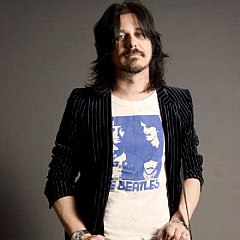
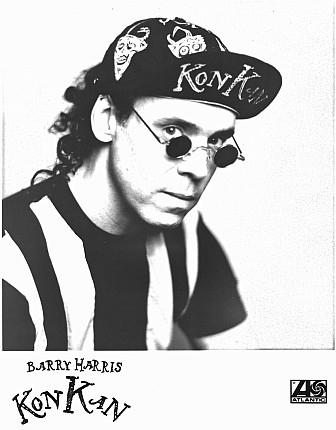 Barry with his signature look from back in the day
While making the Move To Move LP it became clear my voice suited certain songs better. Plus it was Tom Gerenscer in Hamilton back in 1988 who suggested Kevin sing on "I Beg Your Pardon." I never really knew Kevin personally and we were put together only at Atlantic's suggestion. It was Atlantic that wanted to market us as a duo. I wanted to do more of a UK approach like KLF, S'Express, "Pump Up The Volume," etc. Kon Kan was my project and still is to this day.
I've always been the driving force and maintained ownership of the Kon Kan name from day one, which was and is still perfectly clear by EVERYONE involved. There was no actual transition to do, I just carried on what I was doing on the first album writing and producing and continuing on as Kon Kan myself how I had always envisioned it from the day I first walked in to Tom's basement studio back in the spring of '88!
So to be perfectly clear, Kon Kan was NEVER an actual duo. I hired Kevin with contract by myself. I have always been and continue to be at the Kon Kan "helm."
Later on in years, when I partnered with Chris Cox as Thunderpuss for a few years, he and I WERE an actual creative duo with an actual previous friendship bond and musical working relationship for about seven years before we created Thunderpuss! Chris also did solo remixes for myself as Kon Kan pre-Thunderpuss.
Songfacts: "Liberty!" was the first single from that album. Please tell us about that song.
When I went to NYC to make Syntonic in the summer of 1990, it was my Atlantic A&R man Marc Nathan who suggested I work with Debbie Cole. I knew her voice from Malcolm McLaren's "Madame Butterfly" and agreed she'd be a great voice to duet with on "Liberty." I loved her! She's awesome!
Marc also hooked me up with John Luongo, who was a red-hot producer/remixer from the '70s and '80s. Google him - his resumé is crazy. He was also such a fun guy to work with! I learned a lot from working with him in various NYC studios in the summer of 1990!
Songfacts: Please tell us about a Kon Kan song we didn't discuss that means a lot to you.
Harris: "Sinful Wishes" means a lot to me. It's a song that I know in my heart should have been a big global hit, but I guess the stars didn't align for it. I witnessed it being a local club hit in the Toronto area back in '93/'94 and when I re-recorded it as a Eurodance track in 1996, it was a legit hit in Latin America under the dance act I named Outta Control with Kimberley Wetmore on vocals.
It has just always felt like "Sinful Wishes" was "the one that got away." Also I simply REALLY like the song and am very proud of it!
Songfacts: As Thunderpuss, you've done lots of remixes. What are your Top 5?
Harris: My fave Thunderpuss remix is Mary J Blige, "No More Drama." Of course, Whitney Houston's "It's Not Right, But It's Okay" will always be our big signature Thunderpuss song. A few other Thunderpuss faves of mine are Tamia's "Stranger In My House," Britney Spears' "I'm A Slave 4 U," and of course working with the Madonna camp was awesome with "Don't Tell Me," which she just put out on all digital platforms this week - November 2023!
Songfacts: What's the process for these remixes? Wondering who commissions them and how you get the split tracks.
Harris: The times have certainly changed the past 20 years. Back in the late '90s and early '00s Chris and I were both on a creative roll. We were both very driven, excited, and had a chemistry that we knew was simply working. We had a great relationship and we both worked our asses off for more than seven years solid. It was a great time indeed!
The record companies often would send us the multi-tracks on CD at the time (1997-2003) or at least the a cappella. We'd pretty much rewrite and reproduce it from scratch for a club environment or dance mix show type of format.
Songfacts: What are the challenges in making remixes for other artists?
Harris: The biggest challenge for making a remix (during the peak Thunderpuss era) was "crossover." Making sure it had a current cool vibe, yet making it palatable for the masses. That was always the hardest thing to do. It was very easy to make something too pop. It was and still is always important to make them fresh, current and have an edge.
Songfacts: What are you up to these days, Barry?
Harris: Music has always been a part of my DNA since I was about 7. Since 1988 I've not stopped creating, playing, writing, performing, producing or remixing music. Sure I've taken a few breaks and of course the COVID era 2020-2022 shut the world down. I wasn't interested in going out to the public and crowds even in 2022 until COVID was well behind us and the airports as well got their act back together.
Kon Kan has never been out of my life over the years. It has always been a source of income for me and I had a lot of DJ friends remix "I Beg Your Pardon" back in 2013. In 2016 I claimed my Kon Kan Artist Spotify page and then admin of the Kon Kan Apple Music page. In 2020 I released the 1993 Kon Kan LP Vida! out to the world digitally on my own label and included a bunch of remixes that were never previously available commercially. Vida!, by the way, had ONLY come out in Canada on CD back in 1993.
I've written new Kon Kan songs throughout the years, but have decided to record and release them lately. First up came "Stars," which I wrote with Bob Mitchell back in 2014 and finally finished it, produced it and released it to the world digitally in the summer of 2023. I've got a new band I put together throughout 2022 and 2023. We're looking forward to getting out and about in the world come 2024 with more new Kon Kan songs after all!
December 1, 2023
Find Barry on X (Twitter) and Facebook.
More interviews:
Crystal Waters
Exposé Creator-Songwriter-Producer Lewis Martineé
Kristine W
More Songwriter Interviews