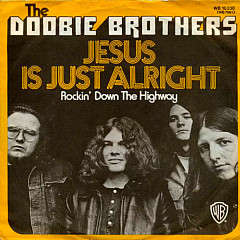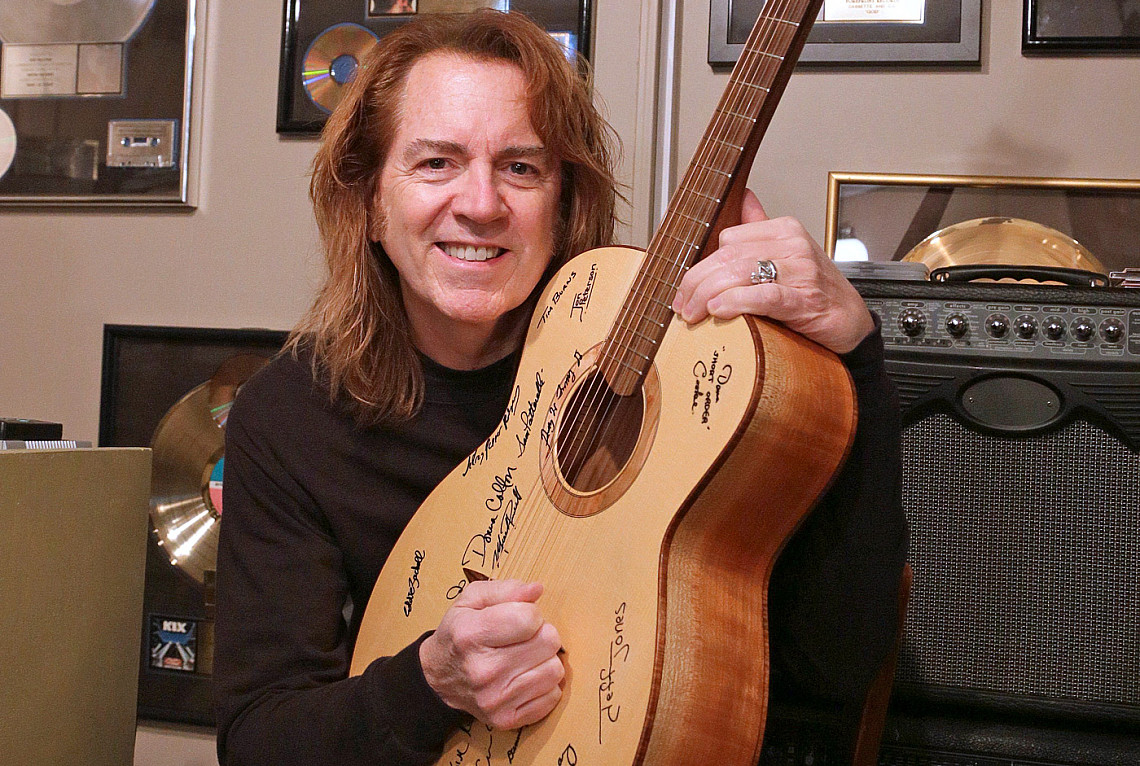
On Judas Priest's 1982 album, Screaming For Vengeance - the one with "You've Got Another Thing Comin'" - every track was written by their creative triumvirate of Rob Halford, Glenn Tipton and K.K. Downing, except one. "(Take These) Chains" came courtesy of Bob Halligan Jr., an American songwriter who was just getting his start. It happened again on Priest's next album when they recorded Halligan's "Some Heads Are Gonna Roll" as the only track by an outsider.
Writing two songs recorded by Judas Priest gave Bob big-time metal bona fides, so other bands sought his services. He wrote for Kix, Blue Öyster Cult, even Kiss. Then he took a pivot to pop (Cher, Michael Bolton) and CCM (Bob Carlisle, Rebecca St. James) before landing on Celtic rock with his own band, the fabulous Ceili Rain (pronounced Kay-Lee). How did Bob get from Judas Priest to Ceili Rain by way of Michael Bolton? To find out, we had him take us through some key songs in chronological order.
After an upbringing in Central New York, Bob lived in New York City and Nashville before returning to Syracuse in 2003, where he taught songwriting at Syracuse University for 12 years. He's quite good at explaining how to write a successful song in a range of genres (the trick with CCM: make the narrator flawed) and revealing the layers of meaning beneath his lyrics. Turns out one of those Judas Priest songs is a Cold War analogy.
Bob Halligan Jr.: I was signed as a member of a group called Pictures to United Artists music publishing. In 1981, we were in New York City and not getting a lot of action. I wanted to see if I could explore my songwriting for other people, so I phoned up May Pang, who was the song plugger at United Artists. May is well known as the girlfriend of John Lennon during the Lost Weekend.1
She told me what she was looking for, and I said, "Let me see what I can do." This was noon on a Wednesday, and by 3:30 p.m. I was in her office playing her "(Take These) Chains," note for note and word for word as it appears on the Judas Priest album.
So the fact that I could come up with a good song that quickly made a good impression on her, and was something I always felt I could do, set the tone for how I went forward in many ways. First of all, it gave me confidence that there was a gift, plus some acquired skills. Secondly, it set the very loud tone of heavy-metal music, which is not anything I knew about or understood. But my wife Linda said, "Write them another one, they'll at least listen to it," and that led to "Some Heads Are Gonna Roll," which was on their next album, and was in fact the hit track from that album.
Songfacts: "(Take These) Chains" sounds like it could be a soul song with a different arrangement. It doesn't sound like it has to be heavy metal.
Halligan: I wrote it as a as a Foreigner-type song. What I talked through with May Pang led me to think that a Foreigner-esque song would be of use to her. But yeah, a more soul kind of artist could do the song and it would be terrific.
Songfacts: This is a song that sounds like it could be about your life, moving 3,000 miles away. Is it at all about your life?
Halligan: All the stuff is fact in there somewhere, but it's fiction based in fact. If there's any real life I can't remember what it is. But you find inspiration in whatever delights you or upsets you in a given moment, and you just expand on it and go with it and write whatever song is available to you that day.
Songfacts: So you wrote that specifically on an assignment thinking it was going to be Foreigner-esque, but it ends up going to Judas Priest, who I understand you had never even heard of.
Halligan: That's right.
Songfacts: That's bananas how you could not have heard of Judas Priest.
Halligan: Yeah. It's just a fate kind of thing, as is so much in life. And of course, the music business is luck and timing.
Songfacts: So then you write a very different song for Judas Priest. Go ahead and talk about what's going on in your mind when you're writing "Some Heads Are Gonna Roll."
It sounds like an aggressive, angry, vengeful persona there, but it's really more "watch out" rather than "I want to hurt people." People can easily get hurt when man's greed for power and money wins the day.
I carried on and wrote a bunch of songs that were like that. There was one called "Beat 'Em Up" that was a pushback against the establishment, but it was more beat' em up with volume than with fists. And that one was recorded by Blue Öyster Cult.
On a lot of stuff like that I realized you could use the heavy-metal lexicon, but not to ill purpose.
Songfacts: The other thing with Judas Priest is, they're a musically unique band with the two lead guitarists and that ridiculous voice of Rob Halford. Did you have to take that into consideration when you were writing the song?
Halligan: Yeah. The first one was accidental, then when I wrote them "Some Heads Are Gonna Roll," just hoping that they'd at least listen to it, I wrote it on the guitar instead of the piano, which I had used for "(Take These) Chains." And I specifically put in guitar riffs that I felt would work for them. As far as the vocal, I knew it had to be high, but I also knew that I couldn't do a demo where I could imitate what Rob might do, so I pitched it in a tenor range and hoped for the best. I let Rob do his improv, which he definitely did, certainly live. All those incredibly high screeches and stuff toward the end of the song are amazing and way beyond anything I could do myself.
Songfacts: What percentage do you get from the royalties when you're on an album like that?
Halligan: There's what they call a statutory rate, which changes. It's regulated, I think by the government, but it's negotiated. At that time it might have been four cents per song, and the publisher and the writer split that amount, so in the case of "(Take These) Chains" it would be two cents to United Artists music and two cents to me.
That's for mechanical royalties, meaning anything that's physical - a CD, a cassette, a vinyl record - for the sale of those, and then the performance royalties come in through ASCAP or BMI, whichever one you're affiliated with. They collect it based on the percentage of overall airplay that you get and they affix, depending on how much money they have at hand on a given pay period, a certain monetary value to each play, or what they imagine to be the plays based on samples that they take.
Songfacts: Did those two cents an album add up to anything?
Halligan: Yeah. The great thing about the Priest records is that they keep selling. And also when they perform the songs at big venues there's a nice amount of money that comes in on that. Over the life of either of those songs it's definitely tens of thousands of dollars. It beats working.
Songfacts: Let's move on to "Rock You" by Helix.
Songfacts: So you could substitute F-U-C instead of R-O-C?
Halligan: That was the idea I was playing off of. Like, if you can't get with our program, then rock you baby. Sort of the guitarists' middle finger.
You write these things and you don't know how they'll be taken or interpreted. The very tricky thing I've found for some songwriters is, they find it very hard to let go. They want to be in the studio with the artist while they're recording and make sure they sing it the "right way." And you can't. You just have to let go and allow it to happen, and it's going to happen however it happens. That's a lesson I learned over the years. Just to be thrilled, to be grateful.
Songfacts: "Midnight Dynamite" from Kix.
Halligan: I'm trying to remember if I had that title or Donnie [Kix bass player/songwriter Donnie Purnell] did. I think it was me.
I love the song and I love my now 30-plus-year relationship with Donnie Purnell. You know, I've just produced a new album for him that's called Hooray. It's going to soon be on Spotify and everywhere else. It's 25 years worth of songs that he has written and trusted me to help get across the finish line.
Songfacts: Who sings them?
Halligan: He does. And he was not the singer in Kix. He's the more acquired-taste, quirky singer as opposed to blast-a-hole-through-the-wall high tenor guy. He's closer to Bob Dylan and Tom Petty than to Steve Whiteman [Kix lead singer].
Songfacts: So now we get into 1987, and here's a big turning point for you. "Gina" by Michael Bolton.
Songfacts: Why would he say that?
Halligan: Because he knows the difference between a song that's just kind of a screechy blues, musically unsophisticated thing and something that has the tradition of Beatles, Bacharach and David, Motown musicality. So he heard that right away and said, "Do you want to write?" And I said, "Yeah."
This was before he had the big hits. It was late 1985 we met.
Songfacts: He was a metal singer at that time, wasn't he?
Halligan: Yeah, to some degree. There was a lot of hard rock in what he was doing, so he could relate on all fronts. Plus, he was writing straight-ahead pop stuff like "How Am I Supposed to Live Without You" for Laura Branigan.
We wrote nine songs together over a period of four years and seven of the nine were recorded, six of those seven on major records. So it was a really great connection and was the pivot from me being an exclusively rock guy to the broader elements of music, including more mainstream pop.
Songfacts: Specifically the song "Gina," what's going on there?
Halligan: So, it's fairly late on a Sunday night. It's Michael Bolton, Keith Diamond and myself. I've got my non-reverse Firebird electric guitar through a Rockman, and I keep playing this riff.
When you're collaborating with other people and you have an idea, you just kind of insinuate it and keep repeating it with the hope that somebody's going to look up from what they're doing and say, "Hey, that's kind of cool." And that's what happened.
So they got excited about the riff, and that's kind of why I was there - Bob can give us some electric guitar riffage. We all worked off of that for the A part of the intro and then the A part of the verse, just the three of us back and forth.
Who came up with the name Gina? I don't know if that was Michael, but I know it wasn't me. I might have had the chords for it. But we just kept hacking away till God knows what time in the morning, and it was a pretty satisfying experience.
Songfacts: So you have no idea if there's any significance to the name Gina?
Halligan: It was three guys trying to write a hit song. There was no Gina on the premises to my knowledge, as far as any reference to an actual person.
Songfacts: Moving on to 1989, now we get into another Kix song, which becomes their big hit. "Don't Close Your Eyes."
Halligan: Yep. Donnie came to New York City with a few songs he had started, one of which was "Don't Close Your Eyes," which he had started with John Palumbo from Crack The Sky. They had it pretty well along, and he played it for me. I thought it was great. They had the chorus going already, and he knew it was, "Don't close your eyes..." Then I came up with, "Don't sing your last lullaby," the lyrics and the melody and the chords for that part to finish the chorus.
And then a lot of the guitar stuff, the intro and the guitar solo, was stuff that I came up with, but other than my line there, Donnie really did the rest of the lyrics, and I couldn't tell you what John Palumbo did because I wasn't there for it, but he's a very creative guy who Donnie still holds in very high regard, so I'm sure he did significant elements of it.
Songfacts: That song has a very intense theme, which you don't hear very often.
Halligan: It sure does, and I love that it's ultimately an anti-suicide song. He's trying to keep this person awake who has hit the panic button and done that emergency error of taking pills. It's something you can feel proud of contributing to. At the end of the day, that's what I hope I will have done: give the world some stuff that it wants or needs.
Songfacts: "Rise To It" by Kiss. A very different song from "Don't Close Your Eyes."
A lot of times with songwriting, you create a punchline and then you create the story that leads up to it that makes it funny or makes it land. Sometimes the punchline arrives as you're creating the story that's leading up to it. Other times, you work backwards. More commonly we work backwards, particularly in the Nashville world where you start with a title or an idea and then think, how do we set that up?
I have a feeling that I had the "rise to it" line. A lot of times, the vocal is a duet with the instrument you're writing the song on, so "rise to it," then the guitar... "you know I really can do it."
So there's a back and forth. You like to have them sort of answer each other and complement each other. Once I had the first verse and chorus and the intro, I said, "Geez, these guys are grownups." You know, some of the hard-rock guys, especially when they're very young, you can hand them what essentially is a great song or the beginnings of a hit, and they're not into it because they don't feel ownership of it and they just want to play fast guitar riffs, whereas I knew Gene and Paul were bringing me in because they wanted to have hit records, and if they heard something they felt was that or could become that, they would jump on it, and that's exactly what happened with "Rise To It." Paul came to my apartment, I played him the intro, first verse and the chorus, and then back to the intro and repeated the verse and the chorus. He said, "Man, that's great. Let's finish it."
Songfacts: In 1991 you become a solo artist and you have a song called "Could've Been You," which Cher ends up recording, and it's an unabashed pop song. So here's another big transition point in your career.
Halligan: I give a lot of credit on that song to Arnie Roman, who was the co-writer. He was more the birth mother of it than I. But it was a great song for me to sing, and then good news, bad news, it was a great song for Cher to sing also. The whole issue was that her record was coming out when mine was going to be the first single from my solo album. The really good news is that Cher did the song and had a minor hit with it in Europe and the album did really well, and I made the down payment on my house. So we can't complain about that.
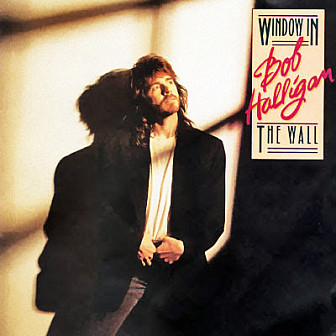 Bob's solo album, Window In The Wall, with his own version of "Could've Been You"
Halligan: It sure is, and it was the second one I had with her. The first one was "Still In Love With You" that I wrote with Michael Bolton.
Songfacts: Now we get to 1996 and we get into a Christian artist, Rebecca St. James, with the terrific song called "You Then Me," and this one also seems to have some of the Celtic influences that would show up later on.
Halligan: Yeah, that was written as a Ceili Rain song. A bunch of the Ceili Rain songs in the early days ended up being recorded by other artists. In fact, from our first album I think we had nine different cover recordings, but that was the only one that went Gold, and I think they did a fantastic job reinterpreting the song. It's also on our first album, Say Kay-lee.
That's another one involving my friend Graham Shaw up in Canada. I finished writing the song and I said, "Hang on, this reminds me of Graham's song 'Keep Your Face On Straight.'" So I phoned him up and I said, "I made your verse my chorus and your chorus my verse. It's not identical but it's got some of your song's stuff in it. Can we do a split? I'll give you a third of it." He said, "Yeah, great."
You never know how stuff is gonna come rolling out, but honesty is always the best policy. He's a dear friend to this day, due in no small part to the fact that we always were good to each other.
Songfacts: Talk about what you're getting across in the lyrics to that song.
Halligan: I wrote the song the night before I was going to do a morning-drive radio show. Before I went to bed that night, I thought it would be fun to try to write something that would work well on morning- drive radio. What's happening then? Alright, morning drives, people are driving to work, they're in their cars. What's an issue there? Well, people don't let each other merge onto the highway. So I thought, let's have the speaker in the song be kind of a jerk, which is the thing that I learned writing Christian music: The person singing the song should be the one who has the fault or the sin, rather than pointing a finger at someone else. Because nobody wants to be preached at, but we're interested in what's wrong with you and how you're going to fix it. So he says:
It's my turn, it's not your turn
It's my turn, get out of my way
It's my turn, go on complain
I'm coming through anyway
Don't ask me why I'm like this
But lately I'm wondering if it will come to pass
And then he quotes the Bible:
The last shall be first and the first shall be last
The idea of pride goes before the fall. And then I go, "Here's the way it ought to be..."
A military march is what I was imagining. The guys are going, "Here's the way it ought to be. You then me, then you then me." In other words, let's take turns. One from this column goes onto Route 81,3 now it's my turn. Share the wealth, share the Earth, but getting it across by not being too preachy. You present the problem, which is that the guy is kind of a schmuck, and he realizes, maybe I'm being a little selfish and aggressive here. Maybe he remembers his Bible verse from when he was a kid.
 Ceili Rain (L-R): Kevin de Souza (bass, vocals), Joe Davoli (fiddle, mandolin), Bob Halligan Jr. (vocals, guitar), Raymond Arias (guitar, vocals), Burt Mitchell (tin whistle, flute, Highland bagpipes), Bill Bleistine (drums)
Songfacts: This leads into the Ceili Rain song "That's All The Lumber You Sent."
Halligan: That was a pulpit joke that my father-in-law heard in church one day. The story is that the guy dies, he goes to heaven, Saint Peter meets him at the gate and says to him, "Would you like to see what we built out of all the lumber you sent up to us from the good works that you did? And the guy says, "Great." They go down the road and there's this great big house. "Is that mine?" "No, that's not yours." The houses keep getting smaller and smaller and smaller until they come to this little tiny shack. Saint Peter pulls into the driveway, "Here you are." The guy says, "Saint Peter, why is it so small?" And Saint Peter says, "Well, that's all the lumber you sent."
I thought, That's got to be a song, so I sat down and made it happen. Rick Cua worked on it with me a little bit, my wife Linda worked on it with me a little bit, and it became one of the signature songs for Ceili Rain over the years.
Songfacts: Then we get to your latest album, Crash This Gate, and the title track jumped out at me. I'd like you to talk about that one.
So "Crash This Gate" is really the letter that I sent to him just before he was going into that Crucible:
I've cleared a path the best I can
Now you must work with your own hands
To see this business through
Get where you're going to
It's at that point when the parent says, "Yeah, I rescued you on this one and that one and the next one, but it's out of my hands now. You've got to do it for yourself."
It was a sort of a prayer, Carl, an exhortation. You can do it buddy. And if there was any way I could be there and do it with you, I would crash this gate for you. It's a parent's love for his kid, but it translates to anybody who has an intense desire to protect and help and encourage and be with somebody they love.
Songfacts: How did Liam's Marine Corps career shake out?
Halligan: Very well. He did eight and a half years active duty in the Marine Corps and he got out three or four years ago. Now he's in heating and air conditioning and plumbing and all manner of tradesman stuff that he's really good at and really loves.
Songfacts: For a parent, that has to be so nerve-racking having a child in the Marines.
Halligan: Golly yeah, we were beside ourselves. But praise God he got through it and did a great job with the the eight-and-a-half-year career.
Songfacts: Let's talk about your song "I Can Believe" on the album.
Halligan: People always say, if there's a God, why does He allow Columbine? Why does he allow Putin to destroy a dam and flood a big chunk of Ukraine? It's that faith thing of, "Lord I believe, help thou my unbelief." It's that part of us that can't help but doubt sometimes.
Much like how John Lennon said a lot of the stuff he wrote was kind of therapy or medicine for his psyche, this is an encouragement and exhortation to oneself to be at that place where you believe in spite of all outward appearances being that you shouldn't believe. The song says, "I can believe in my legs when they're not walking." There they are - they might be on the couch but I have prima facie evidence that these things work because I walked over here. So it's trying to buttress one's faith with images.
It's like how Doubting Thomas had to put his hand into Jesus' side to feel the wound. There are so many occasions in our lives where our hand was put into a place to show us. Faith is a tricky business and one has to keep at it. That song is an exhortation to oneself and to anyone listening. Believe the best you can.
 Ceili Rain in concert
Songfacts: One more track on the album, "My Specialty."
Halligan: That's for the missus. That song is really fiction based in fact, and by that I mean there's stuff in there like, those guys at the reunions were sure successful - lawyers, doctors, bankers, whatever - and I feel like a schmuck. Well, in fact, I've had a nice career and been to reunions where people look up to me, but the idea is that in any humbling circumstances, which is what I placed myself in in the song, I have ownership of a relationship with somebody who is incredibly special, and the cosmic feather in my cap is you, baby doll.
So it's the latest love letter to the missus.
Songfacts: What is a song that we haven't discussed so far that's very important to you?
Halligan: "Love Travels." That's a song that Ceili Rain did. It's one that Linda and I wrote together and Kathy Mattea, the country artist, recorded it and it was the title track of her album back in 1997. It's the song that Ceili Rain always finishes a show with - we never don't do that song. It's the whole idea that people can be separated geographically but it doesn't affect their connectedness emotionally.
Songfacts: When you were teaching at Syracuse, what's a song that you would use to demonstrate great songwriting?
Halligan: Most often I would use "Yesterday." There are many songs that I used to point out different things, but "Yesterday," for its melodic shape, is just a great song to try to teach people melody. And it can be taught.
But many young people nowadays don't even know what you mean when you say melody. If I hear a crappy song and I think the melody is crappy, I would say, "There's no melody." They would push back, and I would say, "It doesn't go anywhere. There's no development, no sense of home and then journey and back to home. And I can't remember it because it has no shape to it, no arithmetic, no rhythm."
But "Yesterday" has what we call "motivic control," where a three-note thing - "bam ba dom" - repeats in a different part of the scale and weaves the story musically such that you can follow it but it feels exciting and fresh. It's hard to teach all that stuff, but it can be taught because there's a reason that "Yesterday" and other songs I've used are classic and great. I love to explore those reasons with people.
Songfacts: Sounds like hip-hop drives you crazy.
Halligan: It doesn't drive me crazy, I just leave it aside. Some of it I hear and enjoy, but they say that every new generation's music sounds like noise to the generation before, so that principle is in effect there. I enjoy what I can and appreciate when something is good, and some of it is really good.
June 15, 2023
Check out our interviews with Paul Stanley, Kathy Mattea, and Michael Bolton
Tour dates and more on Ceili Rain at ceilirain.com
Photos: Jack Bocchino (1), Bill Bleistine (2), Ceili Rain (3)
Footnotes:
- 1] The Lost Weekend was a lot longer than a weekend. It took place when John Lennon had an affair with his assistant, May Pang, starting in 1973 and ending in 1975 when he rededicated himself to his wife, Yoko Ono, who suggested the arrangement. Pang narrates a documentary about it that was released in 2023. (back)
- 2] "Rise To It" landed on the 1989 Kiss album Hot In The Shade, which includes another Stanley/Halligan composition: "Read My Body." The big hit from the album is "Forever," which Stanley wrote with... Michael Bolton. (back)
- 3] Route 81 runs through Syracuse, so Bob knows it well. Drivers there are actually really good about letting you merge, unlike, say, Phoenix, where every on-ramp is a challenge. (back)
More Songwriter Interviews