It's understandable to have passed off Mudvayne as a "gimmick band" when they first appeared on the scene with their 2000 release, L.D. 50. After all, their nu metal sonics and make-up wearing visuals sounded/looked like quite a few other bands enjoying popularity at the time. But to their credit, they eventually ditched the make-up so they could solely let the music do the talking, and continued to enjoy chart success after "unmasking" (their 2005 album, Lost and Found, peaked at #2 on the Billboard 200).
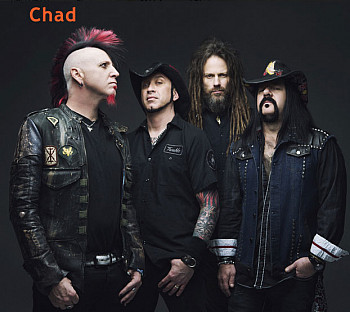
And former Pantera drummer Vinnie Paul certainly saw something in the band, as he enlisted two Mudvayne members (singer Chad Gray and guitarist Greg Tribbett) to unite with him in the band Hellyeah, which has issued four albums since 2007. However, by their fourth release, 2014's Blood for Blood, Tribbett was gone, and in his place was former Nothingface six-string plucker Tom Maxwell.
Gray spoke with Songfacts a few months after the release of B4B. He chatted about the importance of heavy metal in his life, the stories behind several Hellyeah and Mudvayne compositions, and the possibility of a Mudvayne reunion in the future.
And former Pantera drummer Vinnie Paul certainly saw something in the band, as he enlisted two Mudvayne members (singer Chad Gray and guitarist Greg Tribbett) to unite with him in the band Hellyeah, which has issued four albums since 2007. However, by their fourth release, 2014's Blood for Blood, Tribbett was gone, and in his place was former Nothingface six-string plucker Tom Maxwell.
Gray spoke with Songfacts a few months after the release of B4B. He chatted about the importance of heavy metal in his life, the stories behind several Hellyeah and Mudvayne compositions, and the possibility of a Mudvayne reunion in the future.
 Greg Prato (Songfacts): If you want to start off by talking about the new album, Blood for Blood.
Chad Gray: I think it's definitely more realized. We've been doing it since '07, and in '07 it was just like a bunch of dudes jamming out, putting the fun back in music, taking the business out of it. Business can continue - we just wanted to play, and that's definitely what that first record feels like.
That second record [Stampede (2010)], well, now looking back on it, I don't know that we had a full understanding of what we were doing or what we wanted it to be. Because, with Greg [Tribbett] and I, we were really trying to keep Hellyeah and Mudvayne separate, because we were doing them both. We put on the Hellyeah hat and then we'd take that off and put on the Mudvayne hat and it was back and forth. So we really wanted to go a little further with keeping them separated, and it turned into that rock record. Not really metal.
I listened to the second record, and I was like, This isn't me. Lyrically this isn't me. Vocally, no. I didn't aspire to be a rock singer. I'm a metal singer. That's my heart, my trade, everything about metal is what I bleed. It saved my life - that's why I have such a dedication to it.
I wanted to get back to that, but you can't really go too far away from that too fast or it just confuses people. We talked about getting heavier on Band of Brothers, and everything about it was heavier: the lyrics were deeper, the harmonies, the clear parts. Not so bam! bam!, like formulated songs, mixing it up a little bit more, getting back to what I'm used to doing.
We got done with that cycle and we were really under the gun. We only took two weeks off, and we went right back in and started writing. Ended up hooking up with [producer] Kevin Churko in Vegas, and I really went in with nothing. I mean, I had some ideas for "Moth" and a couple of little ideas just peppered through 11 completed musical songs that Tom [Maxwell] and Vinnie [Paul] had put together. It was really kind of back-against-the-wall the whole time.
The first song I started with was "Moth," which Kevin thought was just bizarre. I figured he would come in here wanting to crank out some really heavy shit first, and I'm like, This is just the emotion of that record, the beginning of it with the departure of Greg. I felt like that's more where my head was at and I needed to get that out of me. Not exactly pertaining to the Greg situation, but just that helpless feeling. And still very heavy - not a ballad. I don't consider that song a ballad at all, but just from a lyrical standpoint, I think a lot of people can relate to it.
And the next song was "Blood for Blood" [aka "Sangre por Sangre"], and then "DMF" and on down the line. It really started coming together. It's like when you're taking a picture and you've got your subject matter and you're trying to zone in on it; you're trying to get it right in focus and it's not quite there. That's kind of how Band of Brothers was, and that's how Blood for Blood was for me when we started writing it: It was like that same subject and then slightly out of focus. Then that little tweak, and everything came into focus, everything became really clear for me as to what we were doing.
So as much pressure as I was under deadline-wise, the definition of Hellyeah became more clear: There was light in one side and staying very heavy on the other side. Me, Tom, and Vinnie wrote that thing and we're really proud of it. And I think it's setting up for even better stuff to come, which is really great.
Songfacts: Before you said that you liked to think of yourself as primarily a heavy metal singer, and that heavy metal means a lot to you. Why would you say that heavy metal means that much to you? You even said it saved your life.
Chad: I went through very dark times in my youth. I'm not all there. I have an honest mind. Certain things are very important, certain things aren't as important. Growing up was hard. I was kind of cast out because I was the middle kid, and I went to small schools or uppity kind of schools. I moved around a lot. I had a pretty bad upbringing.
Heavy metal was the one thing that I could really relate to. It was like I grew up with music my whole life. There was my grandparents, who I was really, really close to, probably more so than my mom and my dad. My grandma was like my angel, she was everything to me. And my grandpa could play fiddle and banjo and mandolin and guitar and all that stuff. They were farmers in tear-in-my-beer country, so it was like barn dance stuff where a bunch of friends would get together and just play.
My mom had me when she was 17 years old, so she wasn't done being a kid yet. So when I was with my mom, the stuff on the radio was Peter Frampton, Bob Seger, Aerosmith, and Zeppelin. That was the era my mom came from, and I was always around her music.
But then I went through pretty hard times in middle school when family life and everything got bad. I got Mötley Crüe's Too Fast For Love tape and I had this little one-speaker player that kind of looked like a dictation device, like something you'd put your thoughts in and hand to your secretary and she'd put your schedule together. It was just mono, not stereo. This was literally all I had.
I had that tape, and I remember putting that on, and probably within the first minute-and-a-half of "Live Wire," I was like, "Oh shit, I can relate to this!" This was back in the Mötley Crüe dark leather days. I don't know what I would have done without that tape. I don't know what I would have done without the bands: the Metallicas, the Megadeths, the Slayers. One of my favorite bands of all time is Slayer. Every hard time I've ever gone through still to this day I always go to metal, I always go back to it. It never leaves me.
That day when I put that Too Fast For Love record on, I married the most truthful partner I could ever be with, and that was heavy metal music. And it's never let me down. It's always there.
Since Metallica has been at the top of the metal heap for so long, it may come as a surprise to some new fans that there was a time when the band was still searching for their breakthrough hit. 1986's Master of Puppets was it. While The Black Album is Metallica's best-selling album, MoP is their best album. Spawning such all-time headbanging classics as "Battery," the title track, "Welcome Home (Sanitarium)," and "Disposable Heroes," it just may be Metallica's strongest album from front to back (some may say Ride the Lightning is just as strong... I wouldn't argue), and peaked at #29 on the Billboard 200 in an era when hair metal ruled the charts and airwaves. Within a few years, Metallica would make the leap to "worldwide arena/stadium headliner and chart-topper" - a title they still enjoy today.
If I'm pissed off, in a bad mood or something, and I need to get some aggression out, dude, Master of Puppets, "Battery," I've got to hear it. I've got to hear that record back to fuckin' back. And it gets me through. I'm not saying I've got a gun to my head or anything, but when you feel like the chips are down and everything sucks, that's always the one thing that burns me out of it. If you feel bad, chances are something's got you down and it's broken your confidence on some level. It brings my self-confidence back and makes me feel strong as a human being. Makes me feel like I can take on the world, because I have that relationship with it, and I have a long, long relationship with it. It's never let me down.Songfacts: How would you say the songwriting works primarily in Hellyeah?
Chad: Usually, Tom comes in with a riff and he'll get with Vinnie and they'll pound it out and get some sort of arrangement. We record everything we do. I guess that's one of the beauties of Pro Tools: you don't have to work it out. Because when you're working it out, you're kind of riffing. Like, transitioning parts and following each other. It's very organic the way that we do stuff.
And then after they get the nuts and bolts of it together to where there is some sort of framework, then I'll get with them. I'll sit for an hour or more before a lyric ever comes or before an idea ever comes. I want to get inside the song. I want to let it speak to me. Let the song dictate what I want it to be about. Obviously, you're not going to write some mellow melody over something that's like [makes sounds like a machine gun]. The song kind of tells you what it wants to be.
And then after I determine that - and usually there's a million ideas that are flying through my head - I go to my computer or notebook and just vomit lyrics. Then I go back through and just start picking out ideas that I like. Then it just goes from there.
The really fast, staccato kind of stuff that I do, I'll blow the rhythms of those words, syllabation, like syllabated rhythms like a bass player, kind of hook it up with a drum. You give it that rhythmic aspect and it'll really support what Vinnie's doing and Vinnie is supporting what I'm doing. More of me supporting him. I'm building really fast staccato, rhythmic melodies.
Vinnie has that gift of knowing he just plays for the song. There's one cool thing that's always been awesome about how everybody just checks their ego at the door. All criticism is given constructively. Nobody's like, "That sucks!" Vinnie has a real natural knack for guiding the initial arrangement. It can be something really heavy and he'll just lay back and choose a chorus... it's kind of a signature move. It's really powerful, but it also gives him a break.
But with Greg being gone, it was awesome and magical to watch Tom come back to his own. It's weird, because all three of us come from Nothingface, Mudvayne, Pantera, and Damageplan, and all were one-guitar-player bands. We started this band, and there were two guitar players. That's just a little bit of music trivia. But everybody worked really well together with that whole check-the-ego-at-the-door thing and everything being constructive. But this time Tom got a second coming where he got his time to shine as that single guitar player, and he really did. He really rose to the occasion, just really wrote from his heart. It's that "While My Guitar Gently Weeps" kind of vibe. I think that there's a level of emotion that he needed to exorcise, so to speak, and he really embraced it.
Songfacts: Let's discuss a few specific songs, starting with "Cross To Bier."
Chad: I thought that that was a different word. I love the word, "bier." The way that we use it, "bier" is something that you put a casket on, and I like that. As an artist in this day and age where everybody's got something to say, because of the anonymity, they aren't the nicest things that people can say. And everybody wants a little something from you and everybody's got their hand in your wallet. It's like, Do I get anything? You want to hang me up and crucify me and judge me. In the end, it's like, "Fuck it. Tear me off my cross to bier. Put me in my coffin so cold."
It's got that judgment factor in it. While people are judging you they're also rolling you.
On some level I would like to think that my work has validity and means something to people, and I'd like to hope that maybe I'm saving their life, too. Maybe I'm helping them get through hard times. Yet, there's a lot of judgment and a lot of throwing under the bus. You say the wrong thing on social media or you say the wrong thing on stage and it's recorded. I mean, it's not even really the wrong thing. You can say anything and there's going to be 15 different groups of people, six of them are going to be on your side and eight of them are going to be completely against you. Sorry about the math there.
Everybody has a platform, there's so many groups, and it's just like nobody can be right anymore. There's always going to be somebody that's going to talk shit and there's always going to be somebody that praises you. I just want to live a humble life and say what I've got to say, and if you don't have something nice to say, you shouldn't say it.
But that song goes to that feeling like you're hanging on a cross and you're being judged, and you're tired of it. "Put me in my coffin, it's on the bier."
And then the idea of just carrying the weight of the world on your shoulders. It ain't my cross to bear, and it's not your cross to bear. It definitely plays into that, too. B-E-A-R.
Songfacts: And then going back a few years, what about the track "Alcohaulin' Ass"?
So I felt like there was a lot of magic in that room. Greg had been on me all day: "Let's write a country song." Because we were trying to separate so much from what we did with Mudvayne, and we were also trying to do things on that first record that couldn't fly in our next record, or in our other respective bands. We were trying to do stuff.
That was on me all night: Let's write a country song. And I was working on something with Sterling [Winfield, producer], and he was hungover and sitting behind me on the couch on an acoustic guitar, and he's just playing it. I had cans [headphones] on and Sterling had cans on and we were tracking some stuff. I was working on lyrics for something, and it just came to a point where Sterling was like, "Man, I got to go get a pickle." He'd always go get those big pickles, just to get away.
And Greg was sitting there, he's like, "Man, let's write a country song." And I'm like, "Then play something." He started playing that riff, and it just came out like, "A little bit of me and a little bit of you." And he's like, "You'd better write that shit down." So I turned around and I wrote it down. And literally by the time Sterling got back from going to get a pickle, we were like, "Dude, you need to set up a drum line, we got something." We'd written the whole song in probably under 20 minutes - the first incarnation of it, which was just vocal and acoustic. And then we added the electric part where everybody comes in. Made it a "Hellyeah, wanted dead or alive" kind of vibe.
Songfacts: Going to back to the Mudvayne days, what do you remember about the song "Forget to Remember"?
Chad: That was inspired by a graphic novel. I'm not going to say the name - some people can't dissect it because it's not that hardcore. I got some ideas for lyrics out of that. Not stealing them directly from it, but just kind of loose ideas.
I got the idea that somebody had grown so far in life that they couldn't remember where they came from. It's about becoming that fucking arrogant tycoon. People don't remember that whole everything I ever needed to know about life I learned in kindergarten thing, that humility. When you forget where you came from, that's a problem.
And I imagine I just liked the play on words.
Songfacts: What about the song "Dig"?
Songfacts: As far as Mudvayne, do you have any updates on the status of the band? Would you say that you'd like to return, do you think the band will ever work together again?
Chad: I don't know if the full band will. Who knows - they might be putting something else together. We were talking for a while and that whole Greg thing went down [Greg left Hellyeah in 2014] and everything kind of fell apart. Our relationship, which was the only truly solid relationship in the whole group, although Matt [McDonough] and I are still great, Ryan [Martinie] and I still briefly talk. I mean, the only way I personally would want to do Mudvayne is if everybody licked their wounds and got over it.
There's a lot of things in that band that tore us apart. Maybe Mudvayne was the martyr for people that stopped supporting music. You sell 159,000 records the first week, and then the next record is like, "Whatever, fuck it." Maybe it's a subliminal message if you don't support things. Mudvayne's probably bigger now than it ever was. So, people want what they can't have.
I'm a strong believer in supporting these guys. I still support these guys. I still buy records. I still buy things that touch me, and I know the game. I think it's an important part of the economy, it's an important part of life, and I think the more people just let it go and forget about it, it's bad. I married myself to heavy metal music because it saved me and I almost feel like sometimes it's like, "Wow, thanks for pulling me out of a burning building. Go fuck yourself." You save me or you helped me through a hard time, but I guess it feels like some people - I'm not saying everybody, because I know a lot of people still do support us very much, and we're very grateful to those people - but it's not a lighthearted thing. It's an industry.
March 3, 2015
More Songwriter Interviews