Chris Hill has writing credits on nine of the 17 songs from Raye's 2026 album, This Music May Contain Hope, a musical feast of orchestral arrangements and positive vibes. It's exciting, nuanced, and very human. The album is divided into four seasons representing the emotional shifts in the songs. On vinyl, it's a 2-disc set with a different season on each album side. There's also a theatrical theme, with Hill and Raye's other contributors (including Hans Zimmer and Al Green) listed as her crew, complete with headshots.
Hill, who is on the top row on the credits, is also the arranger and bass player on many of the tracks. Based in South London, he's worked on many movies, TV shows and commercials, and he's contributed bass to tracks by the Pretenders, Robbie Williams and Paul McCartney. Here, he gives us an inside look at the making of the album and explains how the seasons concept came about.
Hill, who is on the top row on the credits, is also the arranger and bass player on many of the tracks. Based in South London, he's worked on many movies, TV shows and commercials, and he's contributed bass to tracks by the Pretenders, Robbie Williams and Paul McCartney. Here, he gives us an inside look at the making of the album and explains how the seasons concept came about.
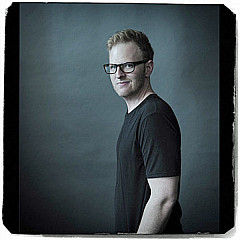
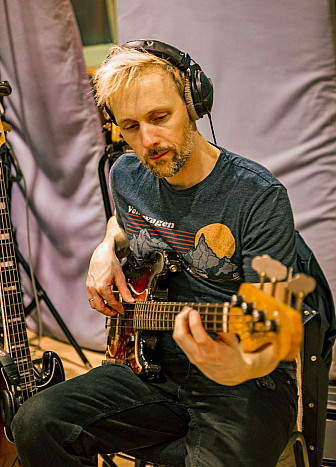 Chris Hill
photo: Simon Whiteside
What was the process for working on this album?
It began with a trip to Madeira with some of Raye's band. Her bassist Liv [Thompson] couldn't make it I think, and as I had recently played double bass on the single "Genesis" (and assisted Tom [Richards] with some of the pre and post production), I was suggested as a useful addition to the team and asked to go. In that trip we wrote several songs that made the record. We jammed, hung out, etc.Then the next year was a mix of writing things in my studio with Tom ("I Will Overcome" and "Nightingale Lane" began like this) and working/writing with Raye in other studios in London, Northamptonshire, and in Provence (France). Raye also did a lot of the finishing process at her home studio, and she spent time America with the other writers and producers (mainly Mike [Sabath]).
How did Raye's lyrics dictate the music you and the team composed?
To be honest the lyrics often came after the music, and they would heavily develop and change over time. Sometimes she would suggest a vibe, or a few chords, or perhaps a musical idea or a title and then we would respond, but mostly it was the other way round, as far as I remember it.Raye also had notebooks which she would use to draw on ideas and phrases that came to her, so she could quickly pluck things out and put them into songs. The only song I remember where the main lyric kind of appeared with the music was "I Know You're Hurting"... the jam on that lasted about 23 minutes!
"I Will Overcome" sounds like a grand finale, but it's only track 2! Please tell us about that song.
Yeah, that track was so fun to do. It started in my studio in London with me and Tom around February 2025 - she gave us a bit of a cue and we were trying to write something for her that felt like French film music from the '60s. Immediately when she heard it she was in Paris and went straight to a studio to put down some melodies, and we all knew it was going to be a massive track.Over the year it developed and developed. Tom did more orchestration, we dug deep on the drums, we wrote the intro ("Girl Under The Grey Cloud") in France, which also gave us the final section of the song. Mike also came in on it and kind of turned it all up to 11. We went to Abbey Road and recorded the orchestra. Jon did an insane mix, and it all evolved into the beast it is now.

Raye's vocals on many of these songs are very dynamic, going from softly spoken to full-throated roar. How did you accommodate that with the music?
Compression. Scale. Genre-hopping to convey different feels and emotions (like the way we brought Vivaldi into "Winter Woman," and '50s big band into "I Hate The Way"). Real, live performances. A complete and utter rejection of AI.Hans Zimmer also worked on this album. How do your styles compare?
Well he's a world-renowned Hollywood composer and I'm a humble little bassist from South London, so I'm not sure we are comparable! But if anything I'd say we have a similar kind of respect for the laws of music, the fundamental building blocks of harmony and counterpoint that weave emotions into music, which in turn allow the singer to thrive and to express themselves. And we also share that love of pushing boundaries to create drama and musical power.How did you evoke the different seasons for the songs you worked on?
The seasons idea came quite late, in October 2025 in France, after Tom and I had put Vivaldi into "Winter Woman." After that Raye started to arrange the album according to these seasons, and it all fit rather well!How did you get that modern retro sound on "I Hate The Way I Look Today"?
OK, so the modern is definitely Raye (although she has the classic timeless vibe as well when she sings jazz) - crisp, clean, multi-tracked vocals, the lyrics, her energy, and also Tony's mix. The retro is literally old tech and live playing. We recorded the big band and Raye onto a 24-track, 2-inch tape machine, which meant we had to be economical with our mic choices, sparing with the edits, and basically think as if we were recording 30 or 40 years ago. It's a tribute to the musicians and engineers in London in 2026 that this is still possible... I fear that some of the "old" techniques will die out unless we keep striving to do things properly!Another song you worked on is "I Know You're Hurting." Please tell us about that one.
I think I mentioned this one earlier. It came out of a 23-minute jam session on an emotional day in Madeira. I think Raye asked the whole room, "how is everybody feeling?" and we all kind of reflected for a moment. I suddenly felt deeply moved, very connected to each other and grateful to be there, but also I suppose we were missing our families and homes, so all these emotions somehow channelled themselves into this song. After that, it was tirelessly worked on by Raye, several producers, and a full orchestration for the Abbey Road live version which Tom, Callum Au, and I put together (which also made the record), and various other production elements, and another stunning mix by Jon.Track 16 is the rather ambitious "Happier Times Ahead." What can you tell us about that song?
So that one I think we wrote in another band jam session in London at the end of 2024. We had a brilliant jazz pianist named Joe Webb with us, and we just had a really fun time playing and jamming ideas which evolved into songs (there are all sorts of tracks that never made it!).I completely forgot about it until Raye revisited it at the end of 2025 and we were all like, "Awesome, this is such a cool vibe." She worked on it in France, her band then worked on it in December in Metropolis, recorded it to tape, and that's it.
I was initially a bit sad not to get to play bass on that one, but Liv did an awesome job and I have more than enough moments on this record, so I was glad to pass that one over to her!
What's a project you worked on before This Music May Contain Hope that you're quite proud of?
I expect not many people will have heard it, but my old friend Tim Dickinson made a beautiful album which I produced/played on called How To Prepare. It was made on my favorite tape machine, an old 3M M79, in my first studio in my garden, and it's a very deep exploration of grief, loss, depression, and other emotions.I also arranged and produced the classic song "One Day I'll Fly Away" with the band Vaults back in 2016 for a TV advert, and I still love that record. It was also done live in Abbey Road, and I even got my Dad's choir (The Bach Choir) to come and sing, with him conducting them, so it will remain a special memory.
Oh, and last of all, I have always loved playing double bass on Wes Anderson's film scores (composed by Alexander Desplat). I've done his last four feature films and every time it has been such fun.
April 1, 2026
Learn more about Hill at Audio Network
Further Reading:
Raye Songfacts Entries
Interview with Samara Joy
Interview with Carol Kaye
Interview with Scott Edwards
More Songwriter Interviews