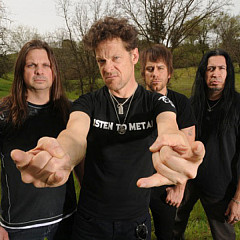
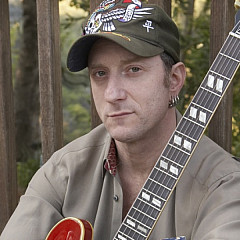
Toronto seems to have a thing for hard rockin' trios. Case in point, Rush, Anvil, and most recently, Danko Jones, have all hailed from this Canadian city. Comprised of singer/guitarist Danko Jones, bassist John "JC" Calabrese, and drummer Atom Willard, the group has been steadily issuing releases since 1998, and over the years, has built a solid fan base throughout the world - having made admirers of Lemmy Kilmister and Elijah Wood (who you will read about below).
Danko Jones issued their sixth full-length studio effort last year, Rock and Roll is Black and Blue, and rather unsurprisingly, have toured heavily behind it - and will continue to do so this summer - as one of the bands included on this year's edition of the Rock Star Energy Drink UPROAR Festival (alongside the likes of Alice in Chains, Jane's Addiction, and Coheed and Cambria).
Mr. Jones took some time to chat with us about a variety of subjects, including his love of the Bad Brains, filming star-studded videos, and the stories behind some of his best-known songs.
Danko Jones issued their sixth full-length studio effort last year, Rock and Roll is Black and Blue, and rather unsurprisingly, have toured heavily behind it - and will continue to do so this summer - as one of the bands included on this year's edition of the Rock Star Energy Drink UPROAR Festival (alongside the likes of Alice in Chains, Jane's Addiction, and Coheed and Cambria).
Mr. Jones took some time to chat with us about a variety of subjects, including his love of the Bad Brains, filming star-studded videos, and the stories behind some of his best-known songs.
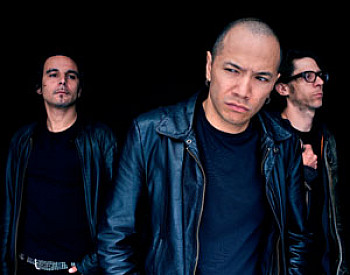 Greg Prato (Songfacts): Let's discuss the latest Danko Jones album, Rock and Roll is Black and Blue.
Danko Jones: Well, the album has been out since I believe September of last year, so we've had a lot of time to live with it and play the songs off of it. It was April and May of last year that we recorded it in Noble Street Studios in Toronto. We did it with Matt DeMatteo, who's done our previous albums. This was our sixth studio album and we took a month in the studio. We spent the better part of winter and fall 2011 writing it. We had a lot of good ideas and we chose the best 16. I think twelve made it onto the record [the album features fourteen tracks].
And now that we've had a year to live with it and play it out, I really like playing a lot of those songs live. They really stand up live, I think. "I Believed in God," "Legs" is a big one for us. And "Conceited," I think those are the three. The single was "Just A Beautiful Day," but the first three songs I mentioned get the best response.
Songfacts: Does the album title have any special significance or meaning?
Danko: It was actually a title that we came up with year one of our band. We've been around 17 years, so that title has been around for at least 16. There's even a song that we wrote that I just found a few months ago digging through our old rehearsal tapes called "Rock and Roll is Black and Blue," but we never recorded it and we only played it live maybe once ever and forgot about it. But we always remembered the title, we just never used it, because at the time in Toronto there was a band called the Deadly Snakes and they had just released a seven inch called Real Rock and Roll Tonight, so we thought it sounded a little too similar within the same theme. We never used it, but we'd bring it up every now and then.
So we were struggling for a title for this one, and with past records we've often chosen a song title, and if we couldn't come up with a song title, there was always an album title that we'd quickly come up with that would summarize the record. I've always thought we were pretty lucky with album titles. I've always liked our album titles. But for this one we just didn't have anything. And then JT, our bass player, remembered "Rock and Roll is Black and Blue," and we all really liked it. So it stuck.
When we did press in Europe and we toured Europe, we realized that "black and blue" is not a term that they're familiar with. They always thought it was some sort of ode to The Rolling Stones [whose 1976 album was titled Black and Blue]. But it's not. Now we realize it's more of a North American term.
Songfacts: As far as the songwriting for the band, how does it work?
Danko: What's ended up happening is I come up with a bunch of riffs and I just lob it over at the guys, and if it sticks with them, then we move forward. If it doesn't, I just put it away. If I really like it, maybe I'll push for it. Like, "Guys, let's not be so dismissive. Let's work on this." Or "Let's just save this for the next record." I'll lob it over the next round.
It's really just a foundation riff and then it's me and JC in the studio going back and forth. But for this album we also incorporated Adam, our drummer. The three of us would get into the rehearsal room and just work on these songs.
I have a backlog of, I don't know, 30, 50, 60 riffs. Sometimes the riffs are two months old and I've been dying to show them. Sometimes they're riffs because I'm just in the zone; some are riffs that I came up with the night before. And so a song like "Legs" off the new album was a riff with a melody line that we couldn't finish for the last record, Below the Belt. So I just stored it away. I knew it was really good, I really liked it. It just wouldn't leave me. So I brought it in again for Rock and Roll is Black and Blue and it made the record. We finished it and that was that.
But a song like "Always Away," I came up with it the night before we jammed. So it could happen any time, anywhere. It's all dependent on the reaction I get from the other guys. And then from there we all write and finish the song together and then I'll write the lyrics later.
Songfacts: Who are some of your favorite songwriters?
Danko: I listen to a wide range of music, as I guess every musician does or is supposed to, although it's not a prerequisite, as I've since encountered. In terms of songwriters, I really like Elvis Costello and Malcolm Young.
I try to incorporate the genre we do. I understand who we are and what we do and our place in it, and never think of our band as anything more than that. But I also try to look at how someone like Elvis Costello would take a phrase or a riff and turn it on its head the way he does, in a way that you weren't expecting. Because, especially in the genre that we do, which is pretty much meat and potatoes rock & roll, it's not the newest form of music. It's been done to death over and over again. I find a lot of new rock & roll bands are very derivative.
So I like to cobble together all kinds of influences that some people won't recognize, but for us, songwriting, it will add that kind of flavor or spice that will distinguish it from the twelve bar rock & roll git 'er done rock song that everybody's almost tired of. It's become quite challenging. People consider this music generic and done to death, but I find it's more challenging than ever before because of that.
Songfacts: I know in the past you've been vocal about admiring the Bad Brains. Would you say that the Bad Brains are a band that you admire as far as songwriting goes, as well?
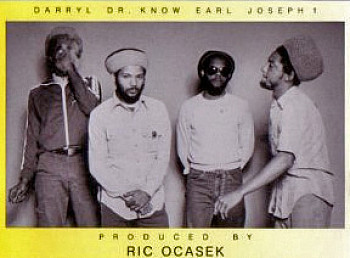 Danko: Oh, definitely. You'd have to jog my memory - when it comes to a big question like that you asked me, the first person that would come to mind is Elvis Costello. But if we talk further, I'm sure that Elvis Costello would slowly, slowly make his way down the list. A band like the Bad Brains, I listen to them the way I listened to them when I first discovered them when I was 15 or 16, listening to Rock for Light and just going, "What is this?" They were definitely very influential on how I approached songwriting. "I Against I" is one of the greatest songs ever written as far as I'm concerned.
Songfacts: I agree. I was just listening to their Quickness album the other day, and the guitar riffs that Dr. Know came up with are just totally crazy. They're very heavy and huge sounding.
Danko: With the Bad Brains, they took kind of a leap in terms of songwriting that even to this day I don't think a band can come close. And it was funny, because I was actually hanging out with a couple of friends of mine and they were listening to the Deftones. And I respect the Deftones. I think they're good, I think they put out good records. And they go, "Don't you see the Bad Brains influence on this?" And I'm like, "No, I never really heard it." They played it for me and they said, "It sounds like this." And then it just all clicked in and I go, "Wow." Here's a band that's done that. They're the band who've come closest to the Bad Brains in terms of the way they write songs. It didn't hit me over the head at first.
But the Bad Brains, the way that Chino [Moreno, Deftones vocalist] sings the songs is kind of like HR. People give the Deftones a lot of credit for being original, but after that little tutorial that I was given when they compared it to the Bad Brains, I think once again the Bad Brains are still leaps and bounds ahead of everyone today.
Beyond the music, as well, the Bad Brains politically and socially represented something else. Especially for someone like me who never saw a visible minority vaunted as much as the Bad Brains, respected as much as the Bad Brains in such an esteemed position doing the music that they did. It's a huge impact on someone who growing up, being into punk rock and heavy metal was a white experience. Just having the Bad Brains there and a few other bands that I cite - Death Angel, Soundgarden - these are bands that were doing it in a way that was respected and they were in the scene. It meant a lot for kids who were a visible minority but couldn't see a representation back to them. So, on a political level, the Bad Brains represented even more.
And then, musically, they took punk rock and they threw it in another direction, but also they incorporated full on hardcore reggae, which just fucked with me more than anything. Turning to the back cover of Rock for Light, listening to what was coming out of my vinyl speakers and looking at the photo that was supposed to represent the sounds, I thought there was a misprint in the jacket for a second. I'm like, "Maybe they did a misprint on a reggae album?" If I didn't know what I was buying, I would have thought that. Here are these Rastafarian guys and the picture, like HR smoking a blunt, and it just fucked with my head.
And then to top it all off, the album was produced by the guy from the Cars [Ric Ocasek]. It just was the most fucked up thing for someone like me. I remember that as a pivotal moment when I just said, "Man, there's really no rules here." Growing up as a metal kid, it was so conservative, especially back when punk stayed on one side of the fence and metal on the other. There were so many rules and you had to adopt the uniform and stuff. And here were these guys that were just giving it the finger.
Songfacts: Let's discuss the writing of some of your songs. Let's start with "Just A Beautiful Day."
Songfacts: And what about the song "First Date"?
Danko: Oh, "First Date," that's a few years back. Coming up with that song, it was mainly like an AC/DC kind of riff that started it. And then the "Whoa, whoa, whoa," I just wanted to juxtapose that with a kind of rousing melodic chorus. At the time I was really uncomfortable with singing melodies, which sounds weird, but it's true. I really bumped heads with a lot of people on the way to this album over the years, people wanting me to sing more. I'd sing in the dressing room, I'd sing here, and people would say, "Why don't you sing more on the records? You can sing." And I'd go, "Well, no." It was more of a macho stance.
So that was juxtaposing a melody singalong part with the AC/DC part. It was the beginning of me kind of melding the two worlds together - now it's seamless for us on Rock and Roll is Black and Blue and Below the Belt. I sing a lot more now.
Songfacts: And going back a ways, what about "Code of the Road"?
Musically, Seattle will always be known first and foremost as the location that provided "the grunge revolution" of the early '90s. But that's not to say that other notable non-grunge rock acts have emerged from the region - case in point, hardcore punkers Zeke. Since 1993, the group has been issuing seven-inches and full-lengths, and offering fans high-energy, kick ass live shows. And the band is never ashamed to get filthy and goofy, as evidenced by the name of band member Blind Marky Felchtone, and such album titles as Dirty Sanchez. For more info on Zeke, check out their official site.
Danko: I'm a huge fan of Zeke, and Zeke is known for writing these über ultra fast fast punk rock songs, done in ten seconds flat. But when they slow down, they can give Motörhead a run for their money, when Motörhead slows down. I think Motörhead are the heaviest band in the world. Same with Zeke. Same riffage, but slowed down a bit, which is other bands' versions of being real fast. So I wanted to write that kind of mid tempo Motörhead/Zeke kind of song. So that's what that main riff is, just the chugging part.It was a pretty easy song to write. There was really nothing except the pre-chorus that took a while to get together. I think we fixed the song in the studio because the pre-chorus wasn't happening. That was about it. Other than that, it pretty much wrote itself. Lyrically it's about touring.
Songfacts: And what are some memories of filming the "Full of Regret" video, which features appearances by Elijah Wood, Selma Blair, Lemmy Kilmister, and Mike Watt?
But finally they got on board on the project and we were on tour, so we just said, "You figure it out. This is the date, we've got to go on tour." So we'd get these updates. And the first one was Elijah - who is a friend of theirs - was on board to do the video. We had heard years before that they'd given Elijah our music and he's a fan and he liked the band. So throwing his name out wasn't really out of the blue. We were not half expecting it, but we weren't totally surprised. But we were surprised that he was going to be in our video. So that just got everybody more excited about it, and we were able to get Selma Blair, because now we had Elijah Wood. And once we had those two guys, we approached Motörhead for Lemmy, who has always helped out the band in the past - he's been very kind to us. He agreed to do it because they were in LA making their record at the time, so it was a nice coincidence. And Mike Watt was in San Pedro and he was able to do it. Even though he tours constantly, he drove down and he laid down the bartender character, and he knocked it out of the park. I remember not knowing what Mike could do, and then he just got behind the bar, they started recording, and as he was laying down his speech, we were just all looking at each other, going, "Oh, my God, this is going to be amazing." And so it was really cool.
And then when Mike wrapped up for the day, he was leaving, we were walking him back to his van, because that's how he traveled then. And as he was walking to the van, Lemmy drove up and the two bass players had a little convention with our bass player JC, so three bass players had a little convention there on the street.
It was a great day. It was a great two days, actually. We shot a lot of cool stuff and everybody was very nice. And then after that we were able to use that video to get other people involved, so it got even better and better. Like Ralph Macchio and Jena Malone and Don Jamieson.
Songfacts: And then also last year, a book came out about the band, called Too Much Trouble.
Danko: Well, it's a book written by Stuart Berman. Stuart Berman writes for Pitchfork, he's written for Spin, he's a music editor here in Toronto for a weekly called The Grid, and he worked on it for about a year and a half before he handed in the copy to ECW Press, who's the publisher. Yeah, it was just a long time coming. The band had been around when we started the project. We asked Stuart to take it on, it was I think 15 years the band had been around. And we'd watched other bands who'd been around for less than half of our history put out books. I think it's the new thing to do these days with bands, especially with rock & roll getting over middle age, I think it's past middle age now, so people are starting to look back more. And the oral history Legs McNeil [who along with Gillian McCain, co-penned Please Kill Me: The Uncensored Oral History of Punk] approach has become in fashion now, so we did that. It was just rounding up people and trying to get them to talk to Stuart. I had basically no say in what people said, and I didn't want to know what they said. I would just say, "Hey, here's this guy, talk to him. I don't need to know what you're going to say, good or bad." Some people said flattering things, some people have said not-so-flattering things, it was fine. And that's just how it came out. It came out in October of last year, same time as Rock and Roll is Black and Blue.
Songfacts: Very cool. Yeah, I actually put out a couple of books through that same publisher, one of which is Grunge Is Dead: The Oral History of Seattle Rock Music. That came out in 2009.
Danko: Oh, excellent. I just met up and did a podcast episode with Tad Doyle [singer/guitarist of the grunge band Tad].
Songfacts: Cool. And then just the last question I have is if you want to talk a bit about the Rock Star Energy Drink UPROAR Festival that's coming up.
Danko: Well, yeah, definitely. We play the second stage. And to be honest with you, I'm more excited to see the second stage bands, like Middle Class Rut, Walking Papers with Duff. I'm looking forward to seeing Alice in Chains and Jane's Addiction and Coheed and Cambria. I think it's going to be a fun festival tour. It's funny that it's with Jane's Addiction, because Perry Farrell started this thing going in North America with the Lollapalooza Festival like what, 22 years ago [1991 was the first Lollapalooza]. So it's kind of cool. I saw that tour, too, so it's nice to go on tour with him now, in an off way. I mean, he's on the main stage, I'm on the second stage. I don't know if our worlds will meet, but I'll say that to my friends, at least.
July 3, 2013. Get more at dankojones.com
More Songwriter Interviews