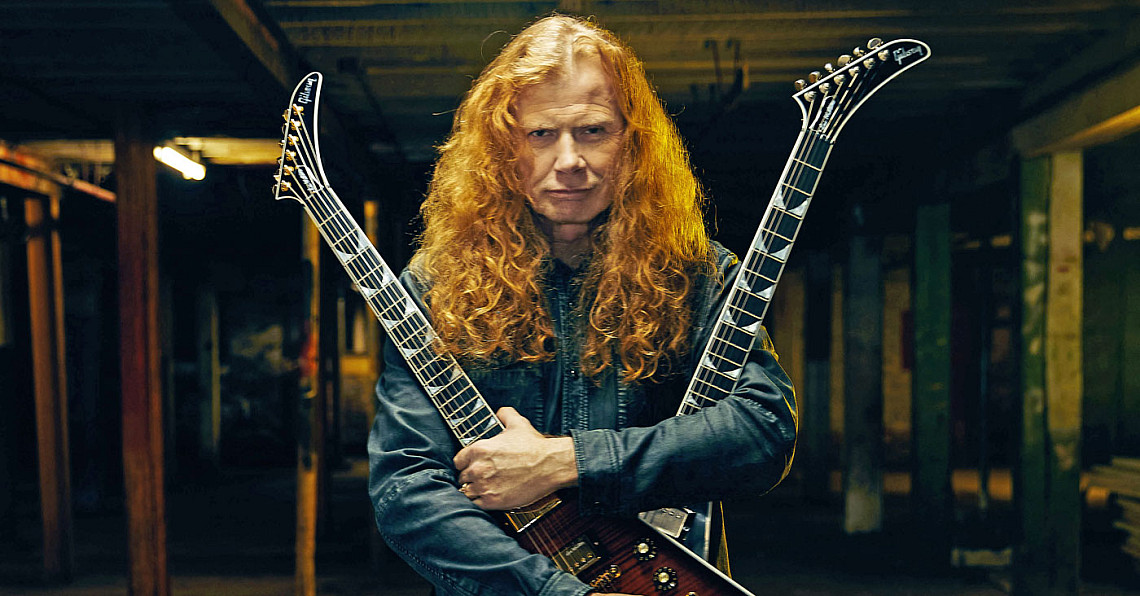
In addition to being one of the architects of thrash metal, it seems like no matter what obstacle is put in the way of Dave Mustaine, he will find a way to overcome it.
Case in point, almost immediately after his dismissal from Metallica in 1983, launching one of metal's all-time great - and most successful - bands, Megadeth, in which he has supplied lead vocals and guitar, and penned the majority of the songs since their inception.
Or, overcoming drug addiction and promptly issuing two of Megadeth's greatest - and best-selling - albums: Rust In Peace and Countdown To Extinction.
Or, keeping Megadeth afloat in the mid-late '90s when popular taste in rock music changed and metal entered a very uncertain era.
Or, recovering from a potentially career-ending injury after suffering nerve damage to his left arm.
Or, most recently, battling throat cancer. He is now cancer free.
2022 proved to be one of Mustaine's best-yet career-wise, with Megadeth issuing their 16th studio effort, The Sick, The Dying... And The Dead! The band also earned their 13th Grammy nomination, and Mustaine announced new additions to his signature line of guitars for Gibson: the Dave Mustaine Flying V EXP Limited Editions.
Megadeth's long-time leader spoke with Songfacts shortly after the Grammy nomination announcement to discuss guitars, songwriting, and his interest in collaborating once again with an old friend.
Greg Prato (Songfacts): Let's discuss the recently announced Dave Mustaine Flying V EXP Limited Edition guitars. You posted a photo online recently that looked like there will be Explorer shapes forthcoming, as well.Case in point, almost immediately after his dismissal from Metallica in 1983, launching one of metal's all-time great - and most successful - bands, Megadeth, in which he has supplied lead vocals and guitar, and penned the majority of the songs since their inception.
Or, overcoming drug addiction and promptly issuing two of Megadeth's greatest - and best-selling - albums: Rust In Peace and Countdown To Extinction.
Or, keeping Megadeth afloat in the mid-late '90s when popular taste in rock music changed and metal entered a very uncertain era.
Or, recovering from a potentially career-ending injury after suffering nerve damage to his left arm.
Or, most recently, battling throat cancer. He is now cancer free.
2022 proved to be one of Mustaine's best-yet career-wise, with Megadeth issuing their 16th studio effort, The Sick, The Dying... And The Dead! The band also earned their 13th Grammy nomination, and Mustaine announced new additions to his signature line of guitars for Gibson: the Dave Mustaine Flying V EXP Limited Editions.
Megadeth's long-time leader spoke with Songfacts shortly after the Grammy nomination announcement to discuss guitars, songwriting, and his interest in collaborating once again with an old friend.
Dave Mustaine: I do play both models. If you go back to my beginning as a guitarist, one of the first guitars I ever had was an SG. The next one I had was a Les Paul copy. After that, a friend of mine loaned me his Destroyer, which is an Explorer copy, and I eventually got a King V because I loved the Gibson Flying V but it didn't have 24 frets.
I had gone to Gibson once before, and it was under different management - that almost was the end of the company. So, I passed. Going back to them now with this new company [Gibson is now owned by KKR & Co., Inc.], they're just fantastic.
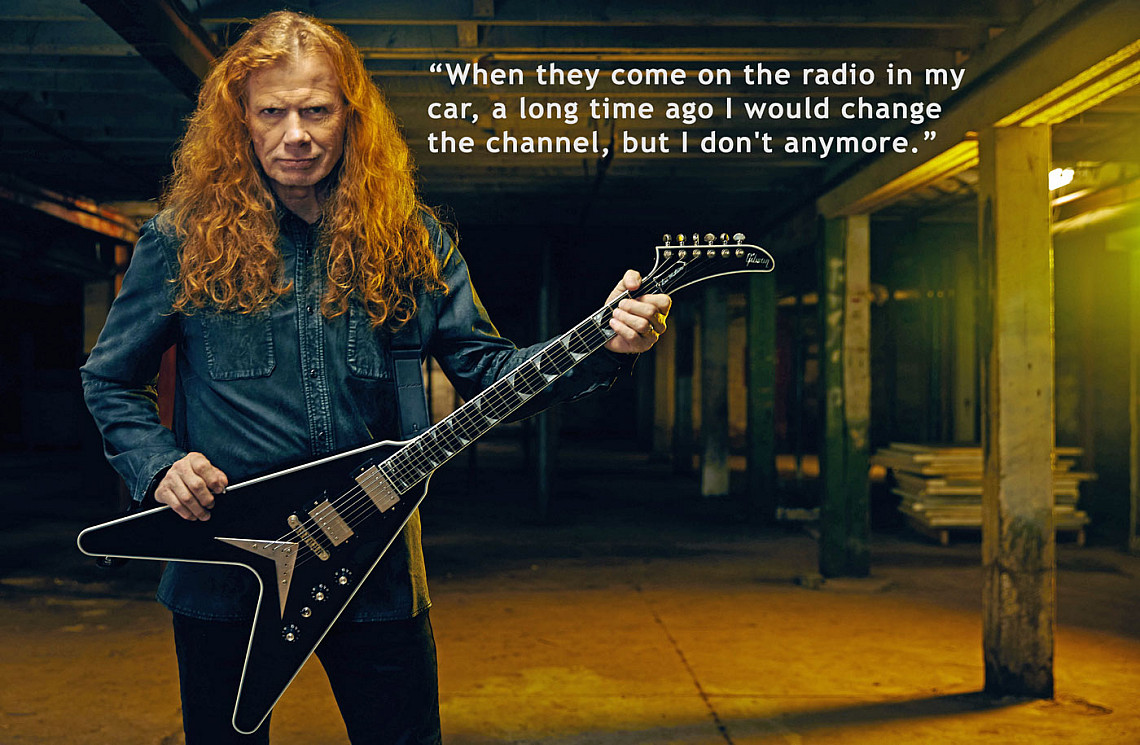
The model that I play, my Flying V, is 24-fret with my neck configuration on it, which is a different shape than the original Flying V's neck. It has more access where the heel is on the back of the neck joint and the body. The electronics are different. The pick-up switch and electronic knob placement, that configuration is different - it's my own. I have certain things that I like interior-wise with guitars: fret-wire, inlays, and the nut up at the top, the bridge at the opposite end. They're all important things.
The original Gibson Flying V had the input jack on the front, and a lot of guitar players back in the day only had straight guitar cord plugs, and they would stick right up off of the guitar. I can't even tell you how many people I know have broken cords off when the input jack is sticking out. I use an angular input jack, because for me, it has to be flush with the body.
I also use the Jim Dunlop strap locks, and they sink into the body. Because of the demand on the guitars I use live, I can't use the Schaller strap locks. I was using those before, and I don't know if they've fixed it, but back when I was using them, the strap would fall off of the guitar. So, I discovered the ones from Dunlop and they were great.
So, that's the story about the different body shapes. Right now with Gibson I have the Flying V, we're working on the Explorer, and we have a 24-fret Les Paul I finished creating, but this is something for next year, maybe the year after. [All of Dave's Gibson models are available at gibson.com.]
Songfacts: Megadeth recently received their 13th Grammy nomination, in the Best Metal Performance category for the song "We'll Be Back."
Mustaine: First off, that pesky little number has been haunting me for a long time. I started playing guitar at 13, I was born on the 13th, there are 13 steps on the front of my property, our address added up to 13. This being the 13th nomination, I'm hoping we continue our good run.
The last time we got nominated we won. It was a long time coming. I have to tell you, I felt like it wasn't going to happen for us. For some reason, I listened to my management and was told, "You probably should go this year." It was when Dystopia came out, and it won for Best Metal Performance [at the 2017 ceremony]. It was great to do that.
Songfacts: How do you find you write your best songs?
Mustaine: They're all so different when I start off with something. I think I've got something really good going and then it ends up being bad. The song could really stop the creative process where I don't even want to fuck with it anymore.
But I've been really fortunate. I stick with the plan, and if I have a riff that I write, I either save it or I throw it away. I don't have any bad riffs that I don't like. If I'm playing something and it doesn't feel good, I'll stop playing it.
And I hardly play at all. I very rarely pick up the guitar because I'm not ready to record all the time, and I sometimes will come up with the riff while I'm playing and I'm not ready to record, so it's gone forever, and that just makes me angry. Not in a bad way angry that I'm going to go out and kick a cat or something, but it's gone forever. I've had moments like that where it's just a really cool riff and I think, "Oh shit, those were some genius little nuances and they're gone!"
My playing is so meticulous with the importance of the hand shape. If I slide into a note, or if I wait a little bit, or if I land right before the downbeat, or after the downbeat if I'm pushing or pulling.
The funniest thing that happens with us is, almost more than half of the times we start a new riff, I'll start playing and the drummer will start playing, and he'll be upside down. I'll say, "Stop, stop, stop. You start playing." Then I'll listen to him playing and I'll start playing to them playing normally to what my mentality is, and they didn't get where the "one" was.
So a lot of times we'll write riffs and I'll have a drum machine going in the background. It's Slate drums, and Slate drums are pretty consistent and realistic.
Songfacts: What's the hidden gem in the Megadeth catalog?
Mustaine: I think one of the best songs I've ever written - as far as drama is concerned, like a picture within a song - is "Wanderlust." I always thought "Wanderlust" was one of the best songs that we had recorded, with the lyrics, the singing, the climax to the song. It just came out at a time when the music populous were liking a different kind of music.
But when that record came out after Cryptic Writings, we were still continuing to make concessions to Marty's desire to be more melodic and more alternative sounding. Therefore, the tempos went down and a lot of the right-hand action became subdued. It was stuff I never intended doing on a guitar in the beginning, laying back and holding chords and stuff. I was always thinking, "Stand back motherfucker! You're going to eat this guitar!"
I know that's a terrible mentality to have, but that's how I rolled when I was younger. I don't do that very much anymore - somebody's really got to get me mad for me to want to clock them with my guitar. I did throw a guitar recently, in probably the last decade or so. I was in Toronto. I can't remember exactly when it was, but some guy went over to our monitor console and started messing with it. I have in-ear speakers, so in my in-ears, that's what I hear.
We don't have wedges on the ground, so if it goes squeeeeee onto the speakers, I can't walk away from the speakers because it's in my ears. I have to claw at my face and try and get that thing out of my ear, and it's like a corkscrew. You have to put them in your ears because they go into your ear canal, and your ear canals are not just straight holes. They have to match up, and sometimes it takes corkscrewing them into your ears. So they fit snuggly on me, and if I have something like that happen, I'm pissed.
So, this guy did this, and I grabbed my V. I thought, Fortunately for me and fucked for you, this Flying V is just like a dart, and I threw it across the stage. I almost made it all the way to the console, but didn't make it. You can probably see it online somewhere. It's a famous incident in Toronto.
Songfacts: What song by another artist had the biggest impact on you as a songwriter?
Mustaine: I don't know that there's any one song that had the biggest impact as far as a songwriter is concerned. I did learn the majority of my guitar playing from the New Wave of British Heavy Metal, and I learned the majority of my songwriting from the British Invasion. So a lot of it was music from the UK, which copied American rock and roll from Robert Johnson, and it all goes back to Satan. [Laughs]
Songfacts: Who are some guitarists you admire?
Mustaine: Eric Johnson is one. I just think he's magic on the guitar. And I was really surprised by Dweezil Zappa. I think a lot of the household names in metal can go without saying: Michael [Amott] from Arch Enemy, and some of the guys like Jeff Loomis. And the guys from Lamb of God and the guys from Trivium. They're all really good guitar players in their right.
And I really think it's time for the guys in Metallica to step up, and us do one last round, see if we can get Slayer to come out of retirement and do a "Big 4 passing of the torch" to the new Big 4. It would remain to be seen who they are, but I have a feeling it would include some of the players we already mentioned.
I think it would be really cool symbolically if we did something at like, the LA Coliseum, even if it's one show and that's it. Slayer is from Los Angeles, so it would probably make it more convenient for them to go home at night. I personally have been hoping for this for a while, and I keep asking and asking and asking. They're just not into it. But that's up to them.
Songfacts: Recently, there was talk that you'd like to collaborate again with James Hetfield. Have you actually discussed that with him?
Mustaine: The last time we talked it didn't end very well because we have some memory of a couple of things that took place when I was in the band. I remember it one way and he is saying that it happened another. But it's about somebody else - it's not even him. He's talking to me on behalf of "you know who" [Lars Ulrich].
They wanted to release No Life 'Til Leather [the early Metallica demo Mustaine was on] - 27 songs, posters, flyers, pictures, everything. I said I would love to do this thing, and James said, "Look, we fucked up. The last three things we've done failed abysmally."
He said it was Lulu [Metallica's collaboration with Lou Reed, released in 2011], something called Orion [a festival called Orion Music + More that took place in 2012 and 2013], and there was one other thing... I think it was a film about a fan or something [the 2013 film Metallica: Through The Never]. I don't know. I don't see them as a failure.
But, I had said, "Yeah, I'd be interested." And he said, "We'd like to get everything right with all the history, the publishing and stuff." And I said, "Good." Because part of the reason why we haven't been able to really reconcile is because I had songs that when I left I didn't want them to record, and they went ahead and recorded them but they didn't pay me what my share of the songs were.
James and I wrote "Metal Militia" and "Phantom Lord" - every note. And somehow, on the record [Kill 'Em All] it says Lars gets 10%. And on "Metal Militia" that Kirk gets some of it, and he wasn't even in the band!
So I've come to terms with it, and when he said, "We'd like to get this right," I said, "Great. Let's do it. I have no problem." And when I said, "This is what it is," he said, "No. It's kind of what it was, and that's how it is."
And I thought to myself, you know what? When you guys did that to me before, it was not cool. I said, "Don't use my stuff," and you did it, and then didn't give me my fair share. So why would I want to willingly enter into something like that? I wouldn't. So that's where we stand right now.
I would love to work with James. I'd like to work with Lars again, too, but I think the real talent in Metallica has always been around the guitar - everybody makes fun of the drums.
Lars is a really great song arranger. And believe it or not, I watched him on a piece-of-shit acoustic guitar write the opening riff to "Ride The Lightning." [Sings riff, which turns out to be "Master Of Puppets"... keep reading. We've included the audio below so you can hear it.]
You know what that was? It was a guy with a guitar that doesn't know how to play, and he's going [mimics playing a chromatic run] on the neck. It wasn't anything really mind-blowing by any means. The way James played it made it mind-blowing.
Songfacts: The melody of the riff you just hummed, it sounded more like the song "Master Of Puppets." Was that the song you meant?
Mustaine: Yeah, whatever that is. I don't fuckin' know their song names. I don't listen to them. I totally respect them, I just don't listen to them. It's not out of me not liking them. When they come on the radio in my car, a long time ago I would change the channel, but I don't anymore. It's just music, and I've been able to put all that stuff behind.
That's why when I saw James talking bad about himself, I was thinking, "Fuck that, man. Don't buy into that." I don't know if he's back in the bottle or not, but I love that guy. I fought somebody because of James. Somebody was going to beat his ass in San Francisco, and I got in between them - and got knocked around a bit myself. But I would never let anything happen to those guys.
Somebody picked on Lars and I snapped his leg - you remember that, right? And I'm not a violent person, I'm just very protective of the people I love. And when I see James saying stuff like that, I don't like it. I want to help him. He probably wouldn't want my help, but maybe if a couple of guys with guitars and a bag full of chips can get through a conversation and become friends again, who knows?
Songfacts: What's an example of a song that means something different to you now from when you first wrote it?
Mustaine: Well, I'd have to say the song that has been the most misunderstood is "The Conjuring." "Mary Jane" is way more dark than "The Conjuring" is. "Mary Jane" was off the So Far, So Good... So What! record, and "The Conjuring" was on Peace Sells... But Who's Buying?
One is about black magic and conjuring a spirit ["The Conjuring"], and the other is about a witch who gets buried alive by her dad ["Mary Jane"] - this is supposedly true, because the gravestone is at a place we went and visited. It's not in the place that I was told it was - it's in Iowa. I heard it was in Minnesota, but it's in Iowa. I think it's right on the border. But we drove up there and someone said, "You've crossed into Iowa."
Mary Jane Terwillegar is the name of the witch, so that's why I called it "Mary Jane." It wasn't about pot. I wasn't writing about drugs back then. I don't think I've ever written a song like that.
You know, Eric Clapton did a great song with "Cocaine," but back then in the '70s that kind of stuff was "bohemian." You were an outlaw if you were smoking hookah pipes and slamming heroin.
Songfacts: That's all the questions I have. It was great getting the opportunity to speak with you, and I'm happy to see that you're doing very well health-wise.
Mustaine: Thank you. Yeah, I am actually. I've been doing a pretty rigorous exercise activity/routine and just trying to take care of myself. I've lost a lot of weight from the cancer - I've lost about 30 pounds - but it's coming back up, slowly. Because not only did I lose fat, I lost muscle mass, too. So, it's coming back and I feel good about it. It's just that I look like a dead general sometimes.
November 21, 2022
For more Megadeth, visit megadeth.com
You can find Dave on Twitter and Instagram
Further reading:
Megadeth Songfacts
Interview with Charlie Benante of Anthrax
Interview with Steve "Zetro" Souza
Interview with Chuck Billy of Testament
Interview with Andy Larocque of King Diamond
Photos courtesy of Gibson
More Songwriter Interviews