On the definitive Byrds and CSN songs, the day he met Joni Mitchell, and the song he wrote after a conversation with George Harrison.
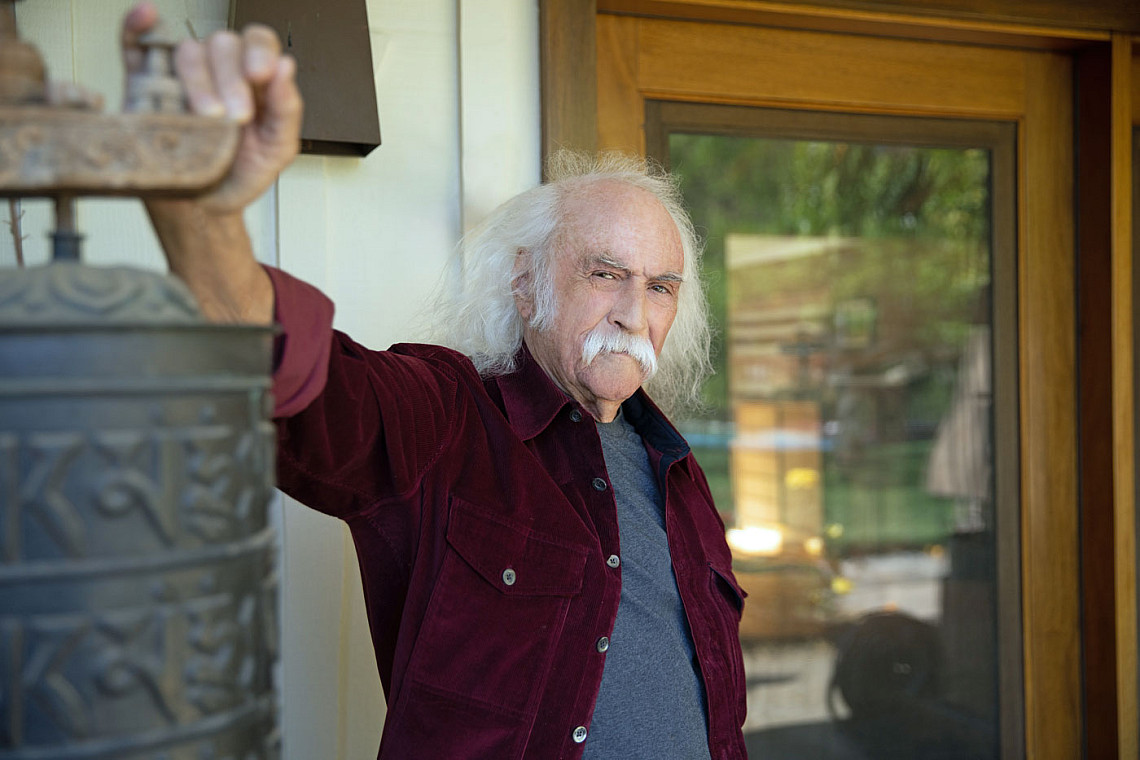
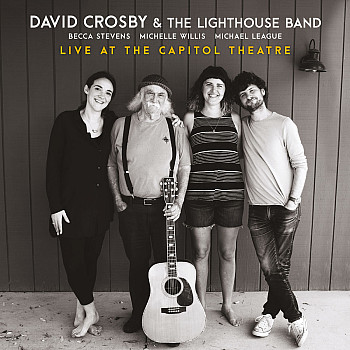
At 81, David Crosby considers himself retired from the concert stage. Yet, he continues to make inspired and memorable music with at least two bands, the Sky Trails Band and the Lighthouse Band, the latter of which will issue their first live release, the CD/DVD set Live At The Capitol Theatre, on December 9, 2022.
Best known for his classic work with The Byrds and in various configurations with Stephen Stills, Graham Nash and Neil Young, Crosby's life has seen many peaks and valleys, as recounted in the exceptional 2019 documentary directed by Cameron Crowe, Remember My Name.
So, what's left to ask a man who's been so thoroughly documented? About the music, of course. There are a few deeper cuts we've never heard him discuss, so we got those stories and also found out what songs from throughout his career stand tallest today. And then there's Joni Mitchell, the woman who wrote "Woodstock" but also broke his heart. When we asked Crosby to name her greatest song, he told quite a story.
Greg Prato (Songfacts): How's it going?Best known for his classic work with The Byrds and in various configurations with Stephen Stills, Graham Nash and Neil Young, Crosby's life has seen many peaks and valleys, as recounted in the exceptional 2019 documentary directed by Cameron Crowe, Remember My Name.
So, what's left to ask a man who's been so thoroughly documented? About the music, of course. There are a few deeper cuts we've never heard him discuss, so we got those stories and also found out what songs from throughout his career stand tallest today. And then there's Joni Mitchell, the woman who wrote "Woodstock" but also broke his heart. When we asked Crosby to name her greatest song, he told quite a story.
David Crosby: That's a complex question right up front! It's going pretty well. It's different on a lot of different levels. I don't like being retired - we can start there. I fucking hate it. I miss playing, man.
Songfacts: I was going to ask, are you planning on playing live again?
Crosby: The reality of it is that I have tendinitis in both hands. So no, I don't think so. My playing is down by 20 to 30 percent, to the point where I would not feel comfortable going on stage and playing.
Songfacts: What do you consider your greatest strength as a songwriter and musician?
Crosby: Maybe my ability to work with other people. The successes at co-writing - "Wooden Ships" is a good example.
I've been so lucky in the people that I've gotten to write with, starting with my son James [Raymond], who's just a really good writer and is a better musician than I am. Without any question at all, definitely a better musician than I am. So, what a writing partner to have - your son, who you love and want to be close to, and it turns out you can write songs together? Wow. So, that's one.
And then, a wonderful thing happened to me. I met a guy named Michael League. Michael League is the bass player and composer and band leader for a jazz band called Snarky Puppy. They're a very, very good jazz band. Big jazz band. And he writes all the stuff and he's a really good writer and a really fantastic musician.
I met him and liked him a lot, and he introduced me to Becca Stevens and Michelle Willis at a benefit gig that we did together. I like them both a lot - they're really good writers and both really good singers, and they are really nice human beings. So we wound up singing together and we wound up putting a group together called Lighthouse. I think my ability to write with those people, to work with other people and not be territorial about it, to be able to co-write with others, that's probably my strength.
Songfacts: The song "1974" off the new Live At The Capitol Theatre CD/DVD has an interesting back story.
Crosby: It was a song without words that I was fooling around with. I used to do that a lot: I'd have a set of changes but I didn't have a set of words, so I would stack vocals like horn parts. I'm basically doing a horn record with voices. I had a bunch of those.
Well, that one was laying around on my computer someplace and Mike heard it and said, "Wait a minute... this isn't finished." And I said, "OK. Go ahead!" And they finished it.
It turned into a perfect example of what I just said. If you are open to it, you can have chemistry with other people if it's there. That kind of creative chemistry doesn't happen very often - that's why I'm excited when I talk about it.
 The Lighthouse Band (L-R): Michael League, Becca Stevens, David Crosby, Michelle Willis
Songfacts: Your song "Laughing" is on the CD/DVD. What inspired the lyric to that one?
Crosby: I was very taken with George [Harrison]. I liked him a lot. He was very friendly to me. He invited me over to his house, we had dinner together, we talked a lot. Paul was very friendly to me, John was very friendly to me, Ringo was very friendly to me, but the one that I had the relationship with was George.
So, George gets a hold of me one day and he says, "I met this fellow in India. A teacher, a guru1 that I like a lot." And I said, "Really? No shit?" And he said, "Yeah. I think he's got something." And I said, "Well, that's wonderful."
And what I wanted to say - the exact words I wanted to say - were, "Take it with a grain of salt." Because I am a skeptical person about religious teaching. I don't believe in God and I'm not really a big fan of religion... any of them. Buddhism isn't exactly a religion, it's a philosophy, and I did not want to come off like a snot to my new friend who I really respected hugely, so I didn't say anything.
But I had it in my head: "Take it with a grain of salt. Don't just accept it at face value." So I wrote that song to tell him that. That the person I thought was the wisest I had met was a child laughing at the sun. And that I thought I could learn more from that child laughing at the sun than I could from anybody teaching.
Songfacts: You also do the Crosby & Nash song "Carry Me." What's that one about?
Crosby: "Carry Me" is a love song. And that's all it is. It's a really, really good love song.
Songfacts: Which of the songs that you wrote a long time ago remains most relevant today?
Songfacts: What do you consider the definitive Crosby, Stills & Nash song?
Crosby: Probably "Suite: Judy Blue Eyes." Maybe "Wooden Ships," but for that acoustic tilt we had, I think "Suite: Judy Blue Eyes."
Songfacts: How about the definitive song from The Byrds?
Crosby: "Eight Miles High." "Turn! Turn! Turn!"
Songfacts: I asked Graham Nash to pick the best Joni Mitchell song and he chose "A Case Of You." What's your pick?
Crosby: Can't do it. There's just too many. Joni Mitchell is, as far as I'm concerned, the best singer-songwriter of our times. Without any question to me. She's way better than I am, she's way better than everybody I know. She's as good a poet as Bob - if not better - and 10 times the musician he is, and singer. I think she's unquestionably the best singer-songwriter alive. Pick a song? The whole record of Blue. Everything on it.
Songfacts: If you listen to Joni Mitchell's albums from the late '60s and then forward ahead a few years when she was working with Jaco Pastorius, it's so impressive how much she changed stylistically.
Crosby: Well, she grew. She grew from the day that I met her. Man, when I met her, she was singing little folkie things in a coffeehouse and nobody had heard of her. Ever. Not one person.
She was in a coffeehouse in Florida singing "Both Sides Now," and I listened to it, I looked at her, and
A) I wanted her really badly, and
B) I thought I might be falling for her, and
C) She was obviously a fuckin' brilliant songwriter and singer. She bowled me over completely.
Songfacts: It's hard to believe that both CSN's debut and CSNY's Déjà Vu celebrated 50-year anniversaries a few years back. How do you think those albums hold up today?2
Crosby: Match them. Show me a record put out in the last year that's anywhere near as good.
Songfacts: How is your relationship currently with the other members of CSNY?
Crosby: I don't have a relationship with Neil or Graham at all. I haven't spoken to either one of them in two years. I still really love Stephen Stills. I just can't help it. There's something about his music, something about the way he plays that just thrills me. It always has. But I don't get along well with Neil or Graham, either one. So that's that.
Songfacts: Future plans or upcoming projects?
 Crosby: Oh boy, do I. One is my son James, who is my producer for one of my two bands, Sky Trails, which is really just me and James and anybody we decide we want to work with. We write well together, and he's a much better musician than I am. He's my son and I'm really proud of him, and we do really good work together. That's one.
Then there's this guy Michael League, who is the band leader, composer, and bass player for Snarky Puppy. If you haven't heard them, go listen to them, you won't be able to hold still. They're just fantastic. Michael and I have a chemistry with these two girls, Becca Stevens and Michelle Willis, and the four of us have a group called Lighthouse.
I think you'll see one more Lighthouse record and one more Sky Trails record before I go. I'm working on them. I do have another Lighthouse record finished in the can, a studio record ready to come out. I think it's going to be called Hello Moon. And then there's the live record of the Lighthouse band coming out.
Songfacts: Yes, let's discuss the Live At The Capitol Theatre release by Lighthouse.
Crosby: The Capitol Theatre is a magical place, man. For some reason, music happens there really well. Maybe it's the audience, maybe it's the room, maybe it's a combination of factors. I don't know. But it does seem to happen repeatedly, which you can't ignore. And it happened to us. It was the last night of the tour [December 8, 2018], we were very confident, and I think it really holds up. I think you will plainly hear the chemistry that thrills us about the four of us, and I think you'll love it.
Songfacts: I always enjoy when you're interviewed on The Howard Stern Show. Why do you think he's able to get such great stories out of you during those interviews?
Crosby: He's not bad at it. He's actually better at it than most people give him credit for.
November 28, 2022
Here's where you can order David Crosby & the Lighthouse Band's Live at the Capitol Theatre
Also check out our interview with Becca Stevens and the Songfacts Podcast episode with Michelle Willis.
Further reading:
Crosby, Stills & Nash Songfacts
Joni Mitchell Songfacts
Interview with Roger McGuinn of The Byrds
Remembering John Lennon
Interview with Donovan
Photos: Anna Webber (1), Scott Harris (2), Maxine Evans (3)
Footnotes:
- 1] The guru is Maharishi Mahesh Yogi. In 1968, The Beatles studied with him in India, but Harrison's bandmates weren't impressed; John Lennon wrote "Sexy Sadie" as a takedown. Crosby recorded "Laughing" in 1969 but it wasn't released until 1971 when it appeared on his debut solo album, If I Could Only Remember My Name. (back)
- 2] The self-titled Crosby, Stills & Nash album was their debut, released in 1969. All three wrote songs, so they had a lot to choose from. Highlights include Crosby's "Guinnevere," Stills' "Suite: Judy Blue Eyes," and Nash's "Marrakesh Express." For their next album, Déjà Vu, released the following year, they added Neil Young. With four uber-talented songwriters, you'd think there wouldn't be room for a cut by an outside writer, but Joni Mitchell was no ordinary songwriter. They included "Woodstock" on the tracklist, a song she had waiting for them when they returned from the famous festival. (back)
More Songwriter Interviews