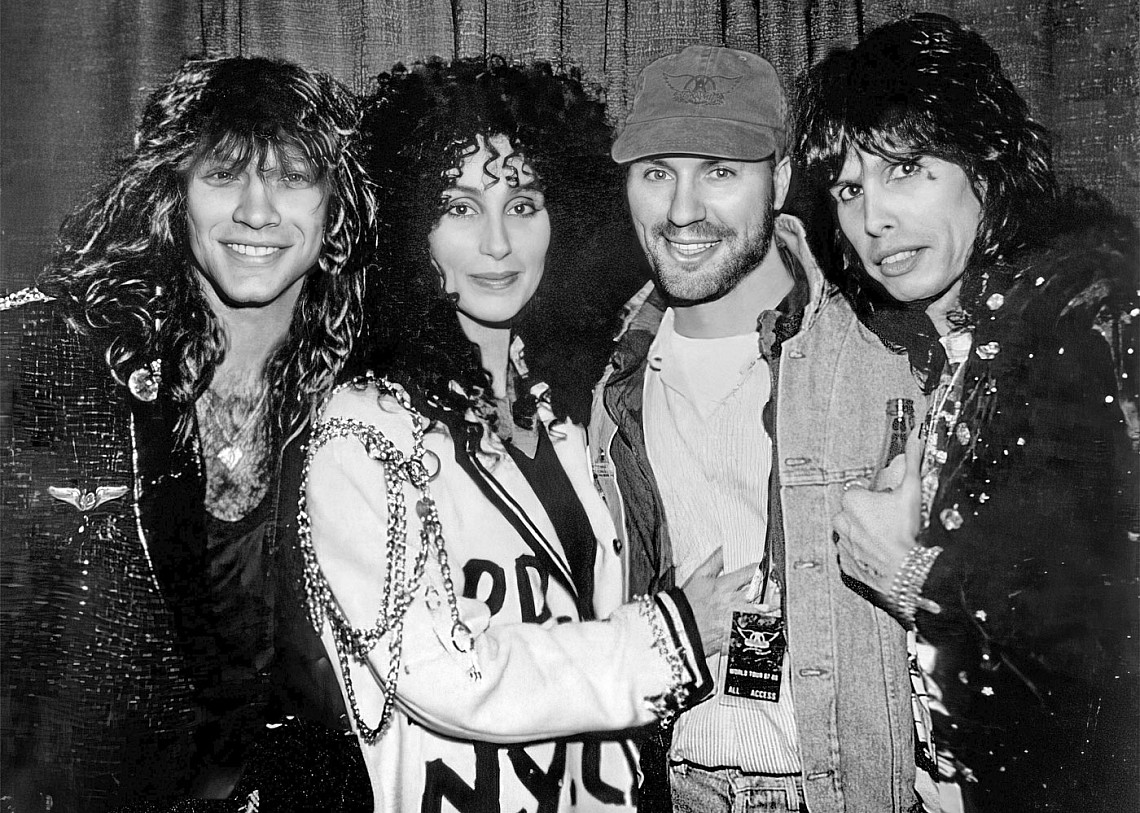
 Desmond Child with Jon Bon Jovi, Cher and Steven Tyler, whose "big blubber lips" led to the Aerosmith hit "Angel." Photo from Desmond's archives.
Judging from the number of hit singles he had a hand in writing, there have been few songwriters-for-hire as successful as Desmond Child. Case in point, co-writing such hits as Bon Jovi's "You Give Love A Bad Name," "Livin' On A Prayer," and "Bad Medicine," plus Aerosmith's "Dude (Looks Like A Lady)," Joan Jett's "I Hate Myself For Loving You," Alice Cooper's "Poison," and Ricky Martin's "Livin' La Vida Loca," among many others.
Child got his start as the leader of the group Desmond Child & Rouge back in 1975, when, determined to escape poverty, he believed his destiny was "to be the biggest star in the world." Fate had other plans. The band charted in 1979 with "Our Love Is Insane," but that same year Kiss had a much bigger hit with "I Was Made For Lovin' You," which Desmond wrote with Paul Stanley. Soaking up the lessons he learned from Stanley's "Kiss way" of songwriting and production, Desmond shifted his focus to working with other artists and went on a run of hits that can be measured in generations.
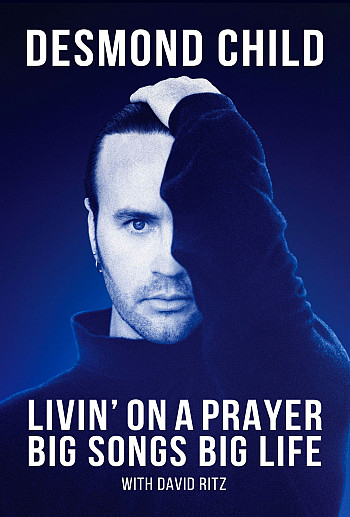
In 2023, Child released his fascinating autobiography, Livin' On A Prayer: Big Songs Big Life. Speaking to Songfacts for the second time (the first was back in 2012) shortly after the book's release, he engaged us in a truly insightful discussion on how and why his hits have made such a connection, and the one by another writer that had the biggest impact on him.
Greg Prato (Songfacts): Let's discuss your new book, Livin' On A Prayer: Big Songs Big Life. What made you decide to write an autobiography now?Child got his start as the leader of the group Desmond Child & Rouge back in 1975, when, determined to escape poverty, he believed his destiny was "to be the biggest star in the world." Fate had other plans. The band charted in 1979 with "Our Love Is Insane," but that same year Kiss had a much bigger hit with "I Was Made For Lovin' You," which Desmond wrote with Paul Stanley. Soaking up the lessons he learned from Stanley's "Kiss way" of songwriting and production, Desmond shifted his focus to working with other artists and went on a run of hits that can be measured in generations.
In 2023, Child released his fascinating autobiography, Livin' On A Prayer: Big Songs Big Life. Speaking to Songfacts for the second time (the first was back in 2012) shortly after the book's release, he engaged us in a truly insightful discussion on how and why his hits have made such a connection, and the one by another writer that had the biggest impact on him.
Desmond Child: I didn't decide to write it now. I started it seven years ago!
I didn't realize that it would take me that long to write it. And during those seven years, other things started to happen so I had to keep writing to continue the story. Finally, I had to draw the line in the sand after my big show in Greece.1
But my original motivation was because my kids were starting to grow up and I had been sort of a studio rat most of their lives. I'd be working really late, so by the time I got home they were asleep, and by the time I woke up they'd be gone to school. So, I would see them, if lucky, on the weekend.
I didn't want to be just "daddy with the big checkbook." I wanted to be a real, fleshed-out human being - they could read the book and then know who I was. I don't expect them to even read it until I'm way gone, but it was sentimental. I had sentimental reasons for doing it.
Plus, I wanted to get it all out of me because it's a burden to keep all of those memories in your mind, and then you don't remember them accurately. You start to think about what really did happen, and then you clarify your motivations and what happened and what your reactions were and what caused you to take the next step because of what happened. It's like a puzzle that fits together.
Songfacts: What's the song by another writer that had the biggest impact on you?
Child: It depends on what era. But originally, hearing the music of Laura Nyro and hearing a song like "Eli's Coming." It just seems so cinematic and epic. It would speed up, it would slow down – it was very dramatic. It stirred something inside of me that felt very personal.
At that time, when I was 15 years old hearing her music, I felt like I knew her, and I felt like I wanted to have that effect on the world. That motivated me to write songs seriously and to find my own path in music.
Songfacts: About five years ago I heard the album New York Tendaberry by Laura Nyro for the first time and I was blown away.
Child: I know, it's so deep. She just went into such a deep subconscious plain to explore all of those feelings. And she was not shackled by the idea of having to write a hit song because she was already doing well with other people recording her music, like The 5th Dimension, Three Dog Night, and Barbra Streisand.
Songfacts: Was Laura Nyro also an inspiration for you to write songs for other artists?
Child: Honestly, I have to say I wanted to be the biggest star in the world. I just felt that was my destiny. I felt like if I could do that, then I could control the circumstances of my life and also of my mother's life, because we were living in poverty in the projects of Liberty City in Miami.
My mom just couldn't hold down a job. She worked at Burger King for a long time. That's how we ate – she'd come home with soggy Whoppers and then we'd put two bun tops together to make a dry one. That was a big motivation for me: to try to be successful financially.
So when it didn't work out for me, I switched gears. I had the opportunity that was given to me by Paul Stanley, who has become one of the most important figures in my career. I always say there would be no Desmond Child without Paul Stanley. That's for sure.
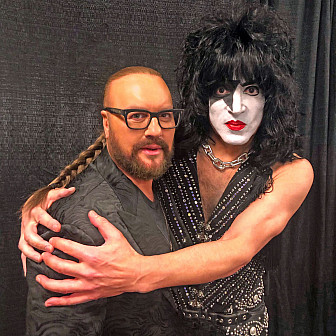 Desmond with Paul Stanley
Photo by Curtis Shaw Child
I then had another wave of success in Latin music with Ricky Martin, and then after that I started working with the American Idol stars, so I was one of the first producers for Kelly Clarkson, Carrie Underwood, Clay Aiken – that became the next phase. I managed to have a #1 song in six decades2 so far, so I'm good until 2030!
Songfacts: What's the most unusual song you've written?
Child: I would say "Dude (Looks Like A Lady)." Because that one is very cinematic, and also the tongue-twisting title is very provocative. It has the tension of opposites – dude, lady – and it sends your mind spinning. Like, "What do they mean by that?"
I think that really helped ignite people's interest again in Aerosmith. It was their big first single for Permanent Vacation.
Songfacts: What's a piece of songwriting advice you learned from one of your co-writers?
Child: The biggest piece of advice was from Paul Stanley, who taught me how to write stadium anthems the Kiss way, in which the protagonist is always the winner. There's always victory. And the music is also lifting constantly upwards.
I used those kinds of ideas or feelings in my collaborations with Jon Bon Jovi and Richie Sambora for the band Bon Jovi. The most perfect example of that is "Livin' On A Prayer," which is also the title of my book. It is the most significant song I've ever worked on.
Songfacts: What's the best song you wrote that didn't become a hit?
I can't say it wasn't a success because it went to #1 on the AOR charts, but that song is one of my favorite songs, and when I do my shows with my music, I always end with that song.
Songfacts: One album that tends to get overlooked in your songwriting career was Ratt's 1990 album, Detonator, which not only did you co-write most of the songs for, but you were also credited as co-producer.
Child: During that time, I was working on and promoting my own album called Discipline on Elektra Records. I didn't really want to be the sole producer, so I think I was the executive producer. My engineer, Sir Arthur Payson, I kind of threw it to him to produce, but I collaborated on most of the songs on the record with the band.
It was a very troubled time for the band because Robbin – who they called King – was having a lot of struggles with his substance abuse problems. And in the end, it did kill him.3
At the same time, that kind of music was overshadowed by Nirvana, "Smells Like Teen Spirit," and the whole Seattle sound, which brought in grunge. It was the complete opposite of the extroverted presentations: chest out, reaching out, looking up. The new generation were what we'd call "shoegazers" – they just looked down because they had to, because they weren't really guitarists and couldn't really play. They could play three or four chords and had trouble with that. They were not virtuosos like Joe Perry, Richie Sambora, Eddie Van Halen, Steve Vai, who could light up the stage with their extraordinary playing.
The shoegazers were more conceptual. Some of them were art students that took up guitar. Their hair was in their face, they looked down, their chests were sunken in, their clothes were baggy instead of tight – everything was completely the opposite. That's how it is: things swing one way and then suddenly it swings the other way. You can't have styles change like that unless you have a star, and Nirvana had a star that captivated everyone's imagination.
The same could be said about Jon Bon Jovi, who was a real, true star. A real entertainer, a real magnetic personality. When we had the success with "You Give Love A Bad Name" and "Livin' On A Prayer," it changed the course of popular music. Every band started to get off of the "she's hot" kind of songs to storytelling songs like "Janie's Got A Gun." Songs that had a deeper meaning, which is what Bon Jovi brought to hard rock.
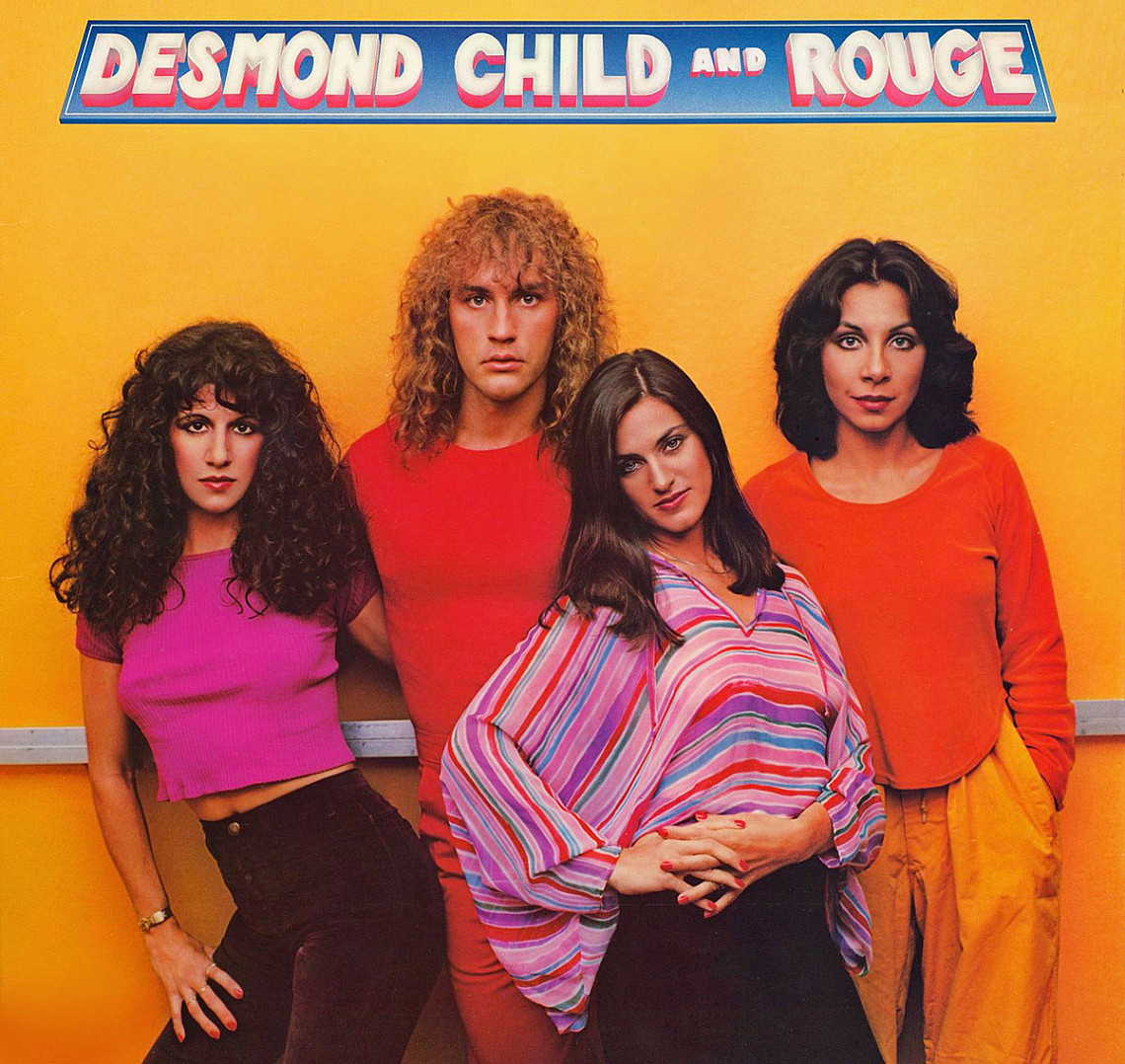 The real-life inspirations for Tommy and Gina in "Livin' On A Prayer": Maria Vidal (left) and Desmond Child. Along with Myriam Valle and Diana Grasselli, they were the band Desmond Child & Rouge. Maria was a singing waitress at a diner who used the name Gina Velvet; Desmond didn't work on the docks but drew from his struggles as an aspiring singer and songwriter for the character Tommy. It's one of many great stories Desmond tells in his book.
Songfacts: How did the fake ending in Bon Jovi's "Bad Medicine" come about?
Child: I think that was the band and their producer, Bruce Fairbairn, just having fun. Like, "Ah, it's not over!" I don't think it was like a profound trick or anything like that. It was more humor, done in jest.
Songfacts: What can Bon Jovi bring to a song that other artists can't?
Child: Star power. A singular vision of being working-class heroes. The message is, you work hard, you build your life, and you achieve the American Dream. You can make it. In "Livin' On A Prayer," it says:
It doesn't make a difference if we make it or not
We've got each other and that's a lot for love
We'll give it a shot
This whole aspiring thing. We're not going to give up. Even in the face of failure, we keep trying. And that's the American way.
And remember, the '80s was the "me generation" and it was Reagan time – the whole idea of pull yourself up by your bootstraps and all of those ideas were there. That kind of stuff really works for white people, especially. There are a lot of people who don't have advantages who can't catch a break, but in the world of Bon Jovi, all things are possible.
Songfacts: How did you get Steven Tyler to write and record the sincere ballad "Angel," which was new territory for Aerosmith?
Child: The very first day that I got there to write, we wrote "Dude (Looks Like A Lady)," which I coaxed out of them because their title was originally "Cruisin' For The Ladies." That's a whole other story.4 But I don't think Joe Perry really liked me, so the next day he didn't show up. Steven just showed up by himself. It was just him and me in this big, cavernous space that looked like an airplane hangar where they set up their stage set. There was a keyboard on the floor facing the stage. I look up and I can see the microphone with all the scarves on it.
He and I sat together, and he's a very candid person. He's an over-sharer, you could call it. I asked him, "What's going on with you? What's going on with your life?" And he told me he had struggled with drugs and alcohol, and that he had overcome that. He was in rigorous meetings. I think the band had meetings and therapy individually and together as a band. The wives had their own meetings, the roadies had their own meetings. Tim Collins, their manager at the time, was orchestrating this whole recovery thing with Aerosmith, and it's what brought them back.
Steven said at that time he met a very beautiful woman named Teresa, who he married, and he said, "She's my angel." And when he said "angel," I looked at him, and he has those big blubber lips like Mick Jagger, right? When he said "angel," it reminded me of Mick Jagger singing "Angie." I thought, I want him to say the word "angel" over and over again so I can see those big lips flap in the wind, saying "angel."
The song was autobiographical for him. I think that song has become a classic unto itself. For many years, they didn't want to perform it in the show because I think he wanted to rock harder than that. He saw it as pop. It was the next single and it was very successful. It opened the door for them to do other ballads, like "Cryin'," "Crazy," and "What It Takes."
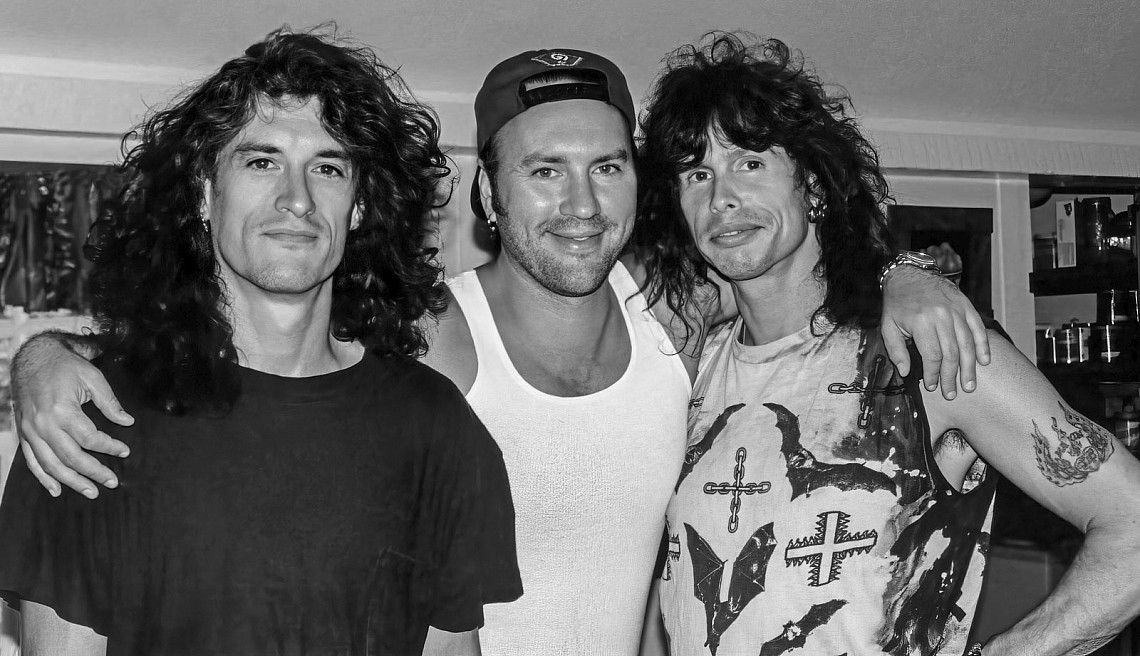 With Joe Perry and Steven Tyler of Aerosmith. Photo by Curtis Shaw Child.
Songfacts: Was there a real-life inspiration for "Little Liar," which you wrote with Joan Jett?
That's one of the things that I think I do well: To size up the artists I'm working with and to understand at the core what their archetype is. All of these people are stars because they come close to a universal archetype that we've seen in the Greek and Roman gods or the Indian gods. In Shakespeare there's King Lear and then there's Hamlet. And then later on, movie stars became our idols and they were following the same thing - Venus is Jean Harlow or Marilyn Monroe or Gwen Stefani. Then there's always Medusa who pops up, and that's Bette Davis, Joan Crawford, Madonna, Lady Gaga... the latter two could literally wear snakes on their head. [Laughs]
When you understand how to connect an artist with the universal archetype and know what they would sing, the closer you get to people's hardwired expectations. People are hardwired to run away from something that looks like a snake slithering on the ground. They can just see it in the corner of their eye and they're flying out of there. It's the same kind of hardwired survival instinct that lets us understand archetypes. The stronger somebody's archetype is, the more people will relate to it. Thus, the more people will listen and buy.
Songfacts: What are Joan Jett's talents as a songwriter?
Child: She is an amazing rhythm guitar player and she has her persona which she brings to the table. And her exquisite taste. She's someone who does not sell out in any way. I've never even seen her endorse a product. God knows, through the years she might have used the money, right? But she won't do it because she's pure about her calling, which is rock n' roll. And that's what I love about her.
As one explores a song with her, she'll say, "I can't sing that. I would sing this." And then you go down that road because it's comfortable for her and it feels true. And truth is what Joan Jett is all about.
Songfacts: Which song have you written with Paul Stanley that you think is the most underrated?
Child: There were two. "Reason To Live," I think that song is very profound. And "Who Wants To Be Lonely." Those two songs. They're not Kiss-like. They're more introspective. Who wants to be lonely? Nobody. Everybody's got a reason to live. Those kinds of feelings bring out a whole other dimension of what Kiss is about.
I went to see their final show at Madison Square Garden on December 2 [2023], and I was just blown away by the variety in their arrangements. The guitar work, the showmanship combined with their artistry, I think they are very underrated.
Songfacts: A while back, I interviewed ex-Kiss guitarist Bruce Kulick for the book Take It Off: Kiss Truly Unmasked, and he mentioned a song he co-wrote with you and Paul, "Sword And Stone," that never made it to a Kiss album but he felt very strongly about.
That's why Gene never liked "I Was Made For Lovin' You." He thought it was off brand for Kiss to do a song that had that much yearning in the verses. It's almost like Romeo and Juliet, and then it bursts out with these hard-rock guitars over a dance beat, which had never been done before in a hit song.
That definitely opened the door to the next decade, which was dance beats with hard-rock guitars. Think of Prince, think of Michael Jackson, think of so many things that combined. I wouldn't call it disco, I'd call it Motown. Motown meets hard rock, that's what "I Was Made For Lovin' You" is.
I read an article written by a professor at the New School that said songs that had been the most successful throughout the history of recorded music - which isn't that long, about 100 years - are the ones that had some quotient of soul music. So if you listen to "You Give Love A Bad Name" and "Livin' On A Prayer," the bassline is pure Motown, and that makes it so much easier for people to feel good when they hear it, because soul music is all about the gut and the heart, not just the mind.
Songfacts: Who is an artist you haven't worked with but would like to?
 Child: Can I make a list? Adele, Sam Smith, Troye Sivan, Dua Lipa. Of my heroes, it's anyone having to do with Britpop of the '80s: Duran Duran, Pet Shop Boys. I so envied that sound because I was in a diametrically different kind of music. Their music was cool, like way before Nirvana. Their angular melodies and the stuff they would sing about was very sophisticated in a kind of existential way.
I just love that song "Human." The lyrics were written by Terry Lewis of Jimmy Jam and Terry Lewis. Human League came to work with them, or maybe they went to work with Human League in London. That song has such a profound lyric, but the music is just... Wow. It's so linear and cool.
Oh, I'll tell you right now of all time: Sade. I would love to work with Sade. I still listen to Love Deluxe. Almost every other night we have Sade playing, the same album. You never get sick of it - it's timeless.
I would have loved to work with George Michael. I met him and the story's in my book. I had his phone number, I tried many times, but his life got complicated and I wasn't able to write with him, which is a big regret of mine.
There are so many other bands. I love The 1975 because they really sound like Britpop from the '80s. I would love to work with them. I know they're from Northern England from the Newcastle area or something, and I went up there last year to get this huge Viking tattoo to celebrate my 70th birthday. In the tattoo studio, The 1975 was playing all the time.
I'd love to work with Ariana Grande again. I worked with her when she was 16 and she was in the workshop of my musical Cuba Libre. She originated one of the most important roles. I would love to be back in her world musically. And of course, Lady Gaga. Are you kidding me? I feel like that's what I was made for, to write with Lady Gaga.
I would love to work on anything that Mark Ronson produces. I just love what he did with Amy Winehouse. I followed his career and he did all those great songs for the Barbie soundtrack and so many other things. But I'd just covet working with him.
January 16, 2024
For more Desmond, visit desmondchild.com
Further reading:
Legends of Songwriting: Laura Nyro
Interview with Paul Stanley
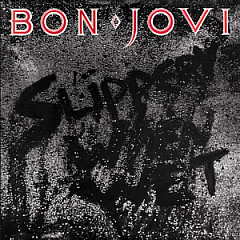
Cover Story: Slippery When Wet
Interview with Steven Tyler
Interview with Holly Knight
Footnotes:
- 1] Child is referring to a concert that took place on June 27, 2022 at the Odeon of Herodes Atticus, and featured artists he worked with over the years, including Alice Cooper, Kip Winger, and Bonnie Tyler. (back)
- 2] Desmond's 2020s chart-topper is "Kings & Queens" by Ava Max, a global hit that went to #1 on Billboard's Adult Pop Airplay chart. (back)
- 3] Robbin Crosby was one of the two lead guitarists in Ratt, along with Warren DeMartini. He got hooked on heroin and was diagnosed with HIV in 1994. He died in 2002 at 42. (back)
- 4] Desmond told this story in his previous Songfacts interview. The dude who looks like a lady was Vince Neil of Mötley Crüe. Check out the Songfacts entry to read all about it. (back)
More Songwriter Interviews