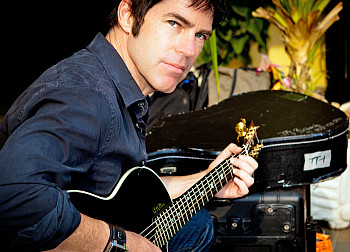
 "I never thought I'd ever have a song I'd get death threats for writing."
That was because in Dishwalla's "Counting Blue Cars," God is a woman. "I'd really like to meet her," the child in the song asks.
Lead singer JR Richards wrote it when he was 21. In the summer of 1996, it became Dishwalla's breakout hit, reaching the top spot on the Alternative Songs chart and helping their debut album, Pet Your Friends, sell over 500,000 copies. But besides the death threats, the song posed another problem: expectations. JR went into a funk bearing the burden of creating another hit for their next album. The result was "Until I Wake Up," which didn't storm the charts but remains one of the most important songs he's written, and one that many with depression have connected with. It's one of the songs Dishwalla performed on a rather memorable episode of Charmed.
JR's curse is that he can't bang out a fun, meaningless song, something his sister learned when she asked him to play at her wedding. A good chunk of his soul goes into every one, and they can be quite painful. His 2009 solo track "A Beautiful End" he wrote for a friend's daughter who died at 15. In 2016, he released "Come To Tears," a song about his son, who suffers from schizophrenia and autism.
Dishwalla split in 2005 after releasing their fourth album. The band re-formed in 2008, but without JR, who moved to England, where there is better treatment for his son. He's had a lot of success with PledgeMusic, and is using his fan community to fund his next album. He spoke with us about making the transition from band to solo, and shared the stories behind many of his songs, including the one where he counts only blue cars.
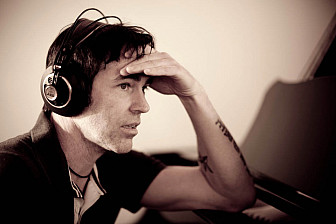 Recording cello
JR Richards: I don't ever specifically sit down to write a song. I'm constantly collecting is how I like to describe it. I'm collecting ideas, whether they're lyrical ideas or experiences, or little riffs or melodies. I'm constantly collecting those, and I'll either write them down or I'll record those pieces, or they'll just be bouncing around in my head. Then I'll notice that maybe this lyric might fit with that melody and I'll start connecting some of those things and they'll eventually grow into a song.
Songfacts: How is it different now than it was when you were in Dishwalla?
Richards: With Dishwalla, in most cases the song would be written and it was just a matter of presenting it to the guys in a way that they could do their thing - give them some space to add whatever they are gonna do to make it a Dishwalla song. Often we would write together as well, so I would take those ideas home and work on them and then bring them back. And sometimes other guys in the band would bring in an idea that was basically done, but you'd generally try to leave space for those people to change things around or add their mark to it.
Being a solo artist, I don't have all that. Often you're writing to try to please other people in a band, and sometimes that can be great, and sometimes that can hinder with fully realizing the song you might be working on. So, working on stuff solo gives me that opportunity to try things that I hear in my own head and not have to concede to somebody else. I don't feel like I'm conceding something creative that I want to do in order to make them happy.
Songfacts: When you left Dishwalla, was that the first time you were a solo artist?
Richards: Well, when I did my first solo record I hadn't left Dishwalla. We were kind of on hiatus because at that point three guys had quit the band and our label had folded. There was only three out of five of us, so we just never seemed very motivated, and a bit disillusioned. But I didn't want to stop writing songs, so I thought it was a good opportunity to go do something on my own. [JR's first album, A Beautiful End, appeared in 2009.]
Songfacts: It almost sounds like you have to write songs for your mental health.
 At a diabedes clinic in Rwanda
Songfacts: Now that's interesting. You hear about musical families, but you don't often hear about songwriting families. Can you talk about how you learned the craft and how that developed?
Richards: Sure. When my grandfather was writing songs, they would break it into two pieces, with one guy doing the lyrics, and one guy doing the chords and the melodies. It was always like a 50-50 songwriting team. If you have a song, for every dollar you make, 50 cents goes to the person who wrote the words, 50 cents goes to the person who wrote the chords and the melody.
So, that's where he came from, and then my dad bridged that gap for me. I spoke to my father more about music, writing and songwriting itself because he would stop in the middle of a song and explain to me why this bridge really works well, or what's interesting about about this particular lyric. We would discuss those kind of details, even from when I was 5 or 6 years old.
Songfacts: So you learned the technical aspects of it at a very young age, which allowed you to add your artistry to it.
Richards: I really didn't think of it as anything too technical, although it is, I guess. He spent more time discussing emotionally why going here instead of going there makes the song have more impact. It was much more from an emotional perspective.
Songfacts: So this is not like what you get today, where you can throw everything into an algorithm and a song will come out?
Richards: Exactly. There is more of a formulaic way of looking at things, which can work, but you listen to a lot of modern music and it feels like there's not a lot of emotion into it. It's been kind of squeezed out by a lot of the algorithms we use in order to get played on Spotify or YouTube a gazillion times, and sometimes you lose the emotional aspect.
But when you see songs that come out like "Take me to Church" by Hozier that are truly emotionally driven and not like other things you hear, they really stand out and it hits people in a way they may not have felt before.
Songfacts: Is there one song of yours that you can single out as having that complete emotional connection in the way it was written?
Richards: Yeah. I could probably point out a few that I felt really represented where I was, but "Until I Wake Up" is my favorite song that I've written that really captures that emotion that was going on in my head and represents it in a good, powerful way.
"Until I Wake Up" was part of Dishwalla's second album, And You Think You Know What Life's About, released in 1998. It deals with his depression in the aftermath of the band's initial success:
Nothing in motion, and I'm satisfied
No disappointment until I wake up
Don't want to wake up
Songfacts: That was a very important song for you because it came after your successful first album and you had all that pressure. It sounds like the way you dealt with it was by writing a song about it. Is that accurate?Nothing in motion, and I'm satisfied
No disappointment until I wake up
Don't want to wake up
Richards: Yeah, you're absolutely right. Often the songwriting process becomes a part of you - it's very cathartic in that way. My way of dealing with that pressure was to write about it.
Songfacts: In that song, you talk about how there's no disappointment until you wake up. Some people when they're depressed, they fall asleep right away, and it's solace. Other people, they can't sleep. What was it like for you?
Richards: For me, it was definitely the falling asleep - that was really the only time I could relax. At some point during the day you have to sleep, so whatever you're struggling with, at some point you have to give in to that for a moment in order to be able to sleep.
But a part of it too is, for me, being stressed and going through depression at that point too, was exhausting. So, I remember being in that recording studio, working on songs, just staring at the floor thinking, God, all I wanna do right now is just crawl up on that carpet and go to sleep. In the middle of this band that's blasting away and running through songs.
Songfacts: After you wrote that, how did things shake out for you?
 With Dishwalla on one of their military tours
But it's also coming from within. OK, I've set this bar. How do we continue staying at this level or beyond?
You're getting that reinforced from every direction.
Songfacts: The next Dishwalla album, Opaline, sounded like a leap forward. You have a lot of songs on there that cover some pretty heavy topics. Could you talk about what was going on in your life that led you to write some of those songs?
Richards: It was the very similar thing of just trying to write and come up with material that was strong enough to keep things going. At that point it was really up to me to write songs that were going to do well on radio.
The label sent me off to Atlanta, Georgia, by myself because as a band we were having a hard time coming up with stuff, and I was having a hard time coming up with things. So I went to Atlanta and really broke things down to the very simple way of writing where it's just an acoustic guitar or a piano. The first song I wrote was "Home," and I wrote it about not necessarily a physical place, but about finding a place of peace, because I wasn't in a peaceful spot, so I was desperately trying to find that. And writing songs, certainly in my mind, I thought would help in finding that peace.
But yeah, it's a very cathartic thing to just write, and somehow I managed to open the gates and the songs just started coming out.
Songfacts: Can you talk about "Angels Or Devils"?
Richards: Yeah, absolutely. What would you like to know?
Songfacts: I would like to know what was going on that led you to write that song.
Richards: Well, from a musical perspective, Jim the keyboard player [Jim Wood], who is a fantastic songwriter himself, had shown me a few chords that he thought were really cool. It seemed a bit odd at first, and he said, "I think these are great, perhaps you can use them to write a song." So when I took them home and started working with them I was already in a slightly different place just because he had given me an interesting set of chords - it ended up becoming a big part of the chorus.
From a lyrical perspective, I was at a point where I was really trying to be conscious about doing the right thing. I think that all of us at multiple times in our lives will have a bit of that battle between right and wrong, and you can deal with your own demons. So, the song is really about that battle inside and overcoming. Focusing on love, positive things, and winning that battle. I guess that would be the best way to explain it.
Songfacts: You have an angel in another song on that album, "Somewhere In The Middle." What is that angel?
Richards: Well, that was more of an angel in disguise. I'd been in so many relationships at that point and there were a lot of people around me that would pretend to be not who they were - pretend to be an angel when they weren't. So that was that particular angel.
I don't know why, but I tend to use a lot of Christian symbolism and sayings, a lot of gothic imagery. And the word "angel" feels really cool to sing, strangely enough.
Songfacts: Well, your most famous song where you get into God and gothic imagery is "Counting Blue Cars." Can you talk about how that went down?
The other thought in my mind was how we are generally taught to think a certain way. From that younger perspective, I think we take things in a much more honest way because we are not being biased by how we're supposed to all think the same. So this idea of God, being an omnipotent being, could be a male or female. We always refer to God as a male, so why not make it a female?
I started creating imagery to describe this journey, trying to think about what it was like to be a kid and the things that you would do. It quickly came together - I didn't think too much about it. But it did end up being one of the songs that really affected people both positively and negatively. I never thought I'd ever have a song I'd get death threats for writing.
Songfacts: Really?
Richards: I know it's crazy, but it made people think. It had more impact than I ever thought it would have had. I'd never thought of that song as being a big single or anything, I just sort of wrote it and moved on.
Songfacts: Was there a real child?
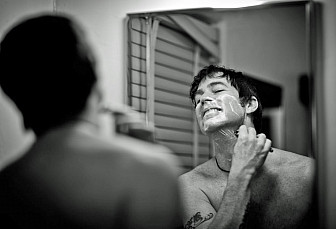 Getting a shave in before live show with
Plain White T's and Tim Lopez
Songfacts: Why did you decide to count the blue cars?
Richards: Um, that's a good question. Blue is not my favorite color - green is - but I don't think "counting green cars" would have sung very well. When you're writing songs, there is always that battle of what writes the best and what sings the best. It could have been red cars or anything, but I went to blue just because that word sung better in that phrase. Often that can be what drives you to choose specific words over others: just simply how it sounds when it's sung.
Songfacts: How did you arrive at the title?
Richards: Originally it was "Tell Me All Your Thoughts." I have the original lyrics, and you can see where I scratched that out and put "Counting Blue Cars."
As a songwriter, you typically pick the most repeated line or something that encapsulates what the subject matter is about, but I picked the line that I felt sounded the most poetic. And that upset our label because it appears just once in the song and they were concerned from a marketing perspective that people would come to the store and they wouldn't be able to find the song, because they wouldn't see "Tell Me All Your Thoughts On God" on the album. So they ended up packaging it in a way where it says "Counting Blue Cars" and in parentheses it would say "Tell Me All Your Thoughts On God." That was their way of handling that.
Songfacts: But your title is perfect.
Richards: Yeah, I thought so.
Songfacts: So these are hand-written lyrics because it was the '90s. Is that the way you still write?
Richards: Yeah, I usually start by hand, and even in the '90s I would go to a computer. I had an old Mac SE with a matrix dot printer. I'm ambidextrous, but I write with my left hand and it's almost impossible to read it. So, I'll work on it that way and eventually once I've got so much that I'm kind of lost, I'll translate it into a basic text program so that it's easier to move things around and easier to read, and usually when I go through that process of re-writing, I refine it a bit more. I was even doing that back then because it was easy for me to then print something out and take it with me. It would be easier for me to read in rehearsal at that point because my writing was so difficult.
But I carry journals with me all the time, and often I do just go straight through. I've written things on napkins on airplanes before. So, it's whatever is around, but often, especially now, I will translate it into a text program at some point once I've got most of my ideas down.
Songfacts: Along the lines of your songs that have the gothic imagery, in "Charlie Brown's Parents" you don't want to talk about Jesus or "go on converting." What's going on there?
Songfacts: What was your religious upbringing?
Richards: I was brought up as a Christian kid and kind of middle of the road. My mother was much more into it. My father wasn't very religious - he was a mathematician. I ended up somewhere in the middle of that.
Songfacts: That can lead to a curiosity that probably led to a lot of these references in the songs, because it wasn't concrete. It wasn't, you must believe this, so you had to figure out your own way.
Was "Haze" about a real person?
Richards: Yeah, I guess you could say that. I grew up in a family that has a lot of alcoholism, unfortunately. So, that was me writing from personal experience.
Songfacts: You've had a lot of placements in TV shows and movies. Which is the one that brings you the most joy?
Richards: Oh gosh, that's interesting. I thought being on Charmed was awesome. I don't know if that's because we also got in on the music use, but we also got to be on the actual show itself, which is probably why. So, that was quite a cool experience.
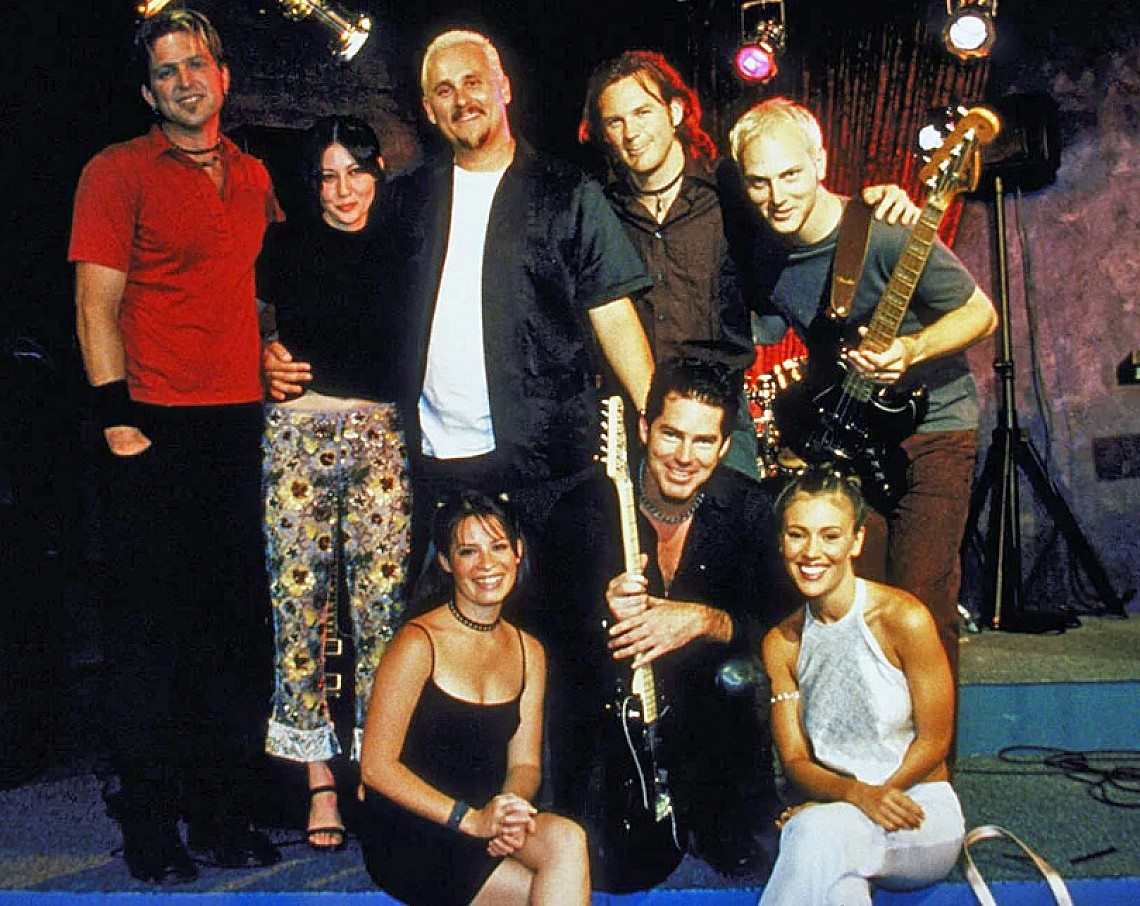
Dishwalla appeared in the Season 2 Charmed episode "The Devil's Music," which aired in 1999. The series was on the upstart WB network, which also had 7th Heaven, Buffy The Vampire Slayer and Dawson's Creek. At that point, the original cast of Shannen Doherty, Alyssa Milano and Holly Marie Combs was intact, giving it serious star power and cultural cachet.
The three leads played sisters who learn they are imbued with the power of witchcraft following the death of their mother. It was edgy and fun, with lots of music (the Love Spit Love version of "How Soon Is Now" was the theme song). In Dishwalla's episode, they play themselves, but with a manager who has made a Faustian bargain. Milano, posing as a groupie, saves the day when she vanquishes the demon.
Songfacts: Tell me about that. The three leads played sisters who learn they are imbued with the power of witchcraft following the death of their mother. It was edgy and fun, with lots of music (the Love Spit Love version of "How Soon Is Now" was the theme song). In Dishwalla's episode, they play themselves, but with a manager who has made a Faustian bargain. Milano, posing as a groupie, saves the day when she vanquishes the demon.
Richards: Well, it's not like I was watching a lot of Charmed at that point, but I'd certainly seen enough episodes to where I was familiar with these actors, and they were constantly in the tabloids. It was interesting to meet them one on one and to be working with them on something all of a sudden.
I hadn't had a lot of experience in that so it was kind of interesting to be down in Burbank, California, on a massive soundstage. It was cool because the script was sent to us and we were counting how many times they said the word "Dishwalla," and it was like 36 times. We were so flattered to be a part of that and to be so significantly included. I think our manager [on the show] had been aligned with the Devil, so he was getting people to say, "I'll get you backstage to meet the band," and they would say, "I would do anything if you could do that," and then of course that gives them the idea to sell their soul to some demon.
So that was all going on behind the scenes unbeknownst to the band. The whole thing was just crazy and cool. But I did get violently ill from eating a bad banana at craft services. I was completely ruined for a week after that.
Songfacts: I would think a banana would be the safest thing you could eat.
Richards: Yeah, you'd think. But it was Burbank, and it was like 120 degrees out. They had all these bananas just sitting in the sun.
Songfacts: You wrote "Come to Tears" about your son, and it sounds like it's even written from his perspective.
It's one of the reasons why we live in the UK right now, because we had brought him to a hospital here in Oxford which is very forward-thinking, probably literally saved his life. But my wife, Min, is just an incredibly huge advocate for our children, and we were able to get into it. It's a huge part of our lives so that's why it's going to show up in songs.
Music was something that was keeping him grounded. He's quite an amazing lyricist, and he was writing songs at 9 years old. So, one of the things that we did in order to help him keep grounded was to work on music all the way to the point where we did an EP and actually recorded it properly and it went on iTunes. I even stole a few of his lines from some of his songs in "Come to Tears."
Things that affect me emotionally one way or the other are the pieces that get kept and find their way into songs, and that's exactly what happened with "Come to Tears."
Songfacts: On your latest album, Honore et Amore, a lot of those songs sound fairly intense. Can you talk about what was going on and how much of you was in those songs?
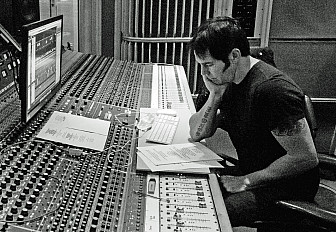 Recording at AIR Studios, London
When my sister got married, she was like, "JR, it would be awesome to have you play." She was looking through my songs for me to play at her wedding, and she was like, "You know, your songs aren't very uplifting. Perhaps you can sing a song by Elvis or something like that." That's what she wanted me to sing, because I don't have anything that would be appropriate for a wedding. I'm appropriate for funerals, but not weddings.
So that record, we had been going through a lot. We moved in the middle of recording that album so I started it in California and had to finish it in London. I went through a lot making that record.
Songfacts: What is coming out of you on the latest one you're working on?
Richards: I have quite a few songs. I tend to write about more of the challenging things that go on. I don't really write party songs. They're brilliant, I wish I could write one, but I just can't. And, I don't write booty call songs. So in terms of what I'm writing about from a lyrical perspective, I'm certainly happier than I've ever been, so there might be dark moments or melancholic moments, but for the most part it will be pretty even-keeled feeling and up in places as well.
Songfacts: What's it like being a solo artist in England when your former band is active with a different lead singer in America?
Richards: Honestly, it's weird. But it's just one of those things that happens with a lot of bands that are around for a long time: You go through quite a few personnel changes. I wish those guys the best and hope they do well. They've put out a great-sounding album [Juniper Road, 2017].
But it is a bit odd because it doesn't sound like Dishwalla to me, because I always think of my own songwriting and my own voice being in that. But I'm proud that they're still playing.
Songfacts: It's probably good that they didn't replace you with somebody that sounds just like you. They didn't do a Journey, so it's clear right away that this is not JR.
Richards: Well, people are funny because when they go to a live concert, they're hearing the album in their heads. If they're more musically inclined they'll notice a lot of the differences, but I think for a normal music lover who doesn't play or doesn't sing, they hear what they heard on the radio in their head 20 years ago even when they see it live in that moment and it's a different person playing and a different person singing.
It's interesting because in 2005, on the last album that we made, and the album before that, when we were touring it was a completely different band. If you'd go see us live it was only me, Jim and Rodney [guitarist Rodney Browning Cravens], who are two of the five-piece now. That was in 2005, so it's amazing how bands can evolve through different personnel. It doesn't really matter I guess.
Songfacts: It's familiar in your brain because the songs are the same.
Richards: Yeah. I think that's bigger than any one person or any group of people, it's just more about the songs.
June 12, 2018
Tour dates, music and many more photos at jrrichardsmusic.com
More Songwriter Interviews