 Listening to the new Everclear album is like watching a Darren Aronofsky film: The characters have a mix of ambition and obsession that is both compelling and tragic.
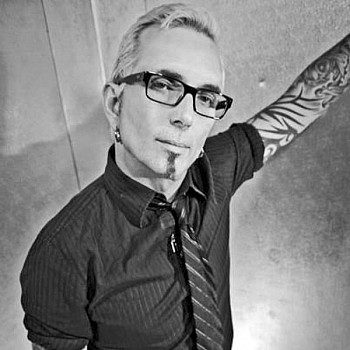
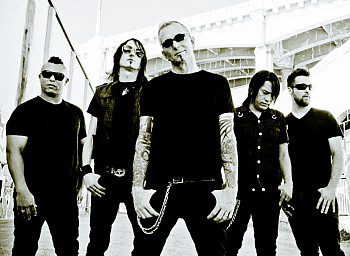
 This mix of blessing with burden is classic Art Alexakis, who has been the frontman and songwriter in Everclear since he formed the band in 1992. Their first major-label album, Sparkle and Fade, was released in 1995 (when Art was 33). The Everclear sound - big drums and bigger guitars - powered the hits "Santa Monica" and "Heartspark Dollarsign." Over the next 20 years, the group remained stalwart bastions of modern rock, growing from a trio to a five-piece in the process.
Black Is The New Black, to be released April 28, is distinctly Everclear but with songs that are sometimes shocking in their confession. Track 5 is called "You." Art sings:
I was raped when I was eight years old on a sunny afternoon.
It continues:
All the scars on my body and soul, all the trouble I have ever known... all bring me closer to you.
The song and the story behind it help explain how this fire started, and what he does to control it.
 Carl Wiser (Songfacts): I really enjoyed listening to your album. It kicked me in the head when I got four or five tracks in with the song called "You." That's one of the most intense songs I've ever heard. Can you talk about that a little bit?
Art Alexakis: Yeah. I like to sing from the first person, which is storytelling – I like to tell stories. And I think a lot people think all my songs are autobiographical, or a large number of them are. And really, the opposite is true. About two or three songs on every album is hardcore, autobiographical. And "You" is one of those songs.
"You" is a pretty intense song of me dealing with some demons, just like "Father of Mine" was, and a couple other songs that I've put out there. Yeah. It's rough. There was a rough incident that happened in my life, and all the shame comes back to that.
Songfacts: When you're singing about how it "all brings me closer to you," who are you talking about?
Alexakis: The child. The child within me, the child that's still there. I firmly believe that. And I know that sounds like "therapy-speak" a lot of times, but I firmly believe that all those different people inside of us that went through some sort of stress or some hard situations, I think we carry them around for our whole life. Until we deal with those situations, we can't really move on. And even though we move on, we still take that baggage with us.
And there's a way to do it and make it good. That incident opened up a large part of me that is my addictive behavior. But at the same time, that's what I think has driven me hard in life to do a lot of the good things I've done, as well. But it's also left its damage on me: I'm fucked up and angry. Even though I'm doing really well. But most of the time I'm doing great, but that person is still inside of me.
Songfacts: Who was it that raped you when you were a little kid?
Alexakis: Do you have kids?
Songfacts: Yeah. I have a stepson and a six-year-old daughter.
Alexakis: All right. Imagine that happening to your six-year-old daughter. Doesn't that fill you with rage?
Songfacts: Yeah. I would think I'd become homicidal.
Alexakis: Absolutely. And I think that is the exact right emotion. And that's how I felt. And I never told my mother. Ever. Until the day she died. Because I know it would've killed her.
Songfacts: Who was it that did it to you?
Alexakis: This crazy family that lived in the projects near me. My mom always told me to stay away from those people. They just weren't supervised, and there were teenagers over there - maybe even older. And they were all doing drugs.
This was back in 1970, and I never told anyone in my family about it. I just showed up beat up. I mean, they beat the fuck out of me. I was eight years old.
I'm at a place now where if anyone looks at my kid twice, I'd just rip your fucking throat out, you know? I'm not that different from most dads. It's really weird. I'm like that about any kid.
One of Everclear's biggest hits is "Father of Mine," the true story of Art's absentee dad who really did send him a birthday card with a five-dollar bill. Poor fatherhood tends to get handed down, so Art made it his mission to break the cycle. He's a devoted dad to his two daughters and an outspoken advocate of responsible fatherhood. There is both a social and political component to his efforts, as he has worked with organizations to support single mothers and has lobbied politicians to be tougher on deadbeat dads.
One thing in China, which is really weird, is that people there would come up and touch people with blonde hair, like my wife and my daughter - touch their faces for luck. Most of them didn't mean it in a bad way, but there was this one creepy cop, an older man, that touched the face of this nine-year-old boy that was with us. I pulled the boy away from him. I was in "fight or flight" syndrome. I was ready to just go after him because he seemed weird and creepy. Sometimes that overprotectiveness is bad, and I don't know what to do about it, because I don't want to let that happen to any other kids, ever - or myself. I think that's one reason I've been so aggressive in life. Which again, has been both good and bad.Songfacts: Yeah. And when you talk about this yin/yang kind of thing – kicking it back to China there – there are certainly the down sides to this. But then, in some of your other songs, you talk about how there are certain things that you wouldn't ever change – "Simple and Plain" as an example. Can you talk about how some of the other tracks on the album relate to that sentiment?
Alexakis: Well "Simple and Plain" takes that to a different place: "Pain was my brother from the age of eight." We moved to the projects when I was seven years old, right before I turned eight, and that was just a culture shock. We were living in suburbia in a nice house in Redondo Beach, and then my mom and dad split up. My dad beat up my mom, and gave me a concussion. Then he split and wouldn't sign over the house, so we had to give up the house and move to a housing project – just all this stuff. I was six when that all went down. I was like your daughter's age, and my daughter's age. I have a seven-year-old. It was a lot to process. I think most of it was impossible to process.
But I learned how to process it. I remember when I was eight, I had been picked on in school by a lot of the project kids, because I was just a little white boy. They would take my lunch money and make me cry, because I was a pretty sweet kid still. And then after that I remember beating up six kids out in front of the school after school. That was the turning point for me. That's when I learned to say, "Fuck you." That's when I actually learned how to say the words "fuck you." In other words, I learned to say no. I started saying no. I started getting into trouble.
But at the same time I think that those statements have helped propel me through life when I was put into situations I didn't want to be in. When the label would say, "Can you write a song like this?" "No. Fuck you. This is what you get. This is what I'm going to do." I never made music for anyone but me, which is admirable in some ways and kind of pathetic in some ways. I work within the confines of whatever band I've got around me, but at the same time, I do what I want to do.
Songfacts: Some of your most personal stuff – songs like "Father of Mine" and "Santa Monica" – end up being the songs that connect most with your fans.
Alexakis: Yeah. "Santa Monica" wasn't really autobiographical, but that was talking about getting to a comfort zone, and I just named it "Santa Monica" which is where I grew up. But that's a very personal song, and I think that's why it resonates with our fans. There are plenty of musical acts out there doing superficial stuff - fun, party stuff, whatever. And I don't judge it, because I like music like that. But I do particularly like music where people will pull back their skin a little bit and let you see inside. That's what interests me. That's the singer-songwriter aspect of what I like, and at the same time, I like huge guitars and drums. So all I ever really wanted to do was to combine the intimacy of those songs with rock and roll – hard, heavy, punkish rock and roll.
Songfacts: Tell me about "The Man Who Broke His Own Heart."
Alexakis: What do you want to know?
Songfacts: It seems to be about the idea that you can't hurt me because I'm already broken. And I'm interested in where you were, mentally, when you wrote that.
Alexakis: That is a statement within the song, but I don't think that's what the song is about. I wrote the song in 2004 for a more acoustic-driven record called Welcome to the Drama Club. I recorded it and didn't really like the way it came out. It sounded more Oasis-like: acoustic guitars and then the big guitars come in. It didn't work. But we played it at a couple of shows, and people really liked it. And people started calling it "Almost Instant Karma," which is in the first line. I had never named the song - it was just "that song."
It's a song about coming out of the divorce, and a new relationship. I felt like making reparations, but reparations on my terms. I've talked to a lot of people who've felt that way. I've seen men and women do that to themselves: be their own worst enemy. I was just exploring that a little bit from a personal point of view, but it's not autobiographical - there's a lot of things I've taken from other relationships I've seen.
But yeah, I was broken. I've been broken since I was born, but especially since I was six or eight when shit started going crazy in my life. And a lot of people I know felt like that. They come into relationships and do the same things they did in their last relationship and expect a different outcome. And it doesn't work like that. You have to grow and change. You have to have some sort of seed to change in your life, to actually bring that into another relationship and not make the same mistakes, and make better choices as you go along.
So that song has sat around for years, but I've always loved the idea of that song. When we started working on this record, I just turned it onto a heavier riff, and then it just came together. I wrote a couple different parts, rearranged it differently, and it just came together really quick.
Songfacts: You have a song called "Anything is Better Than This," and there's a line in there where I'm pretty sure you mention "the drug uglies."
Alexakis: Yeah.
Songfacts: What are the drug uglies?
Alexakis: You ever do drugs?
Songfacts: Nothing besides pot.
Alexakis: Let me try to describe the drug uglies to you. You got two guys sitting around. They've been shooting dope all night, coke, whatever, speed. And all you can think is, "I want those last drugs. Okay. He's going to cut it." "No way dude."
That's one aspect of the drug uglies – the way you treat people around you. The way you start treating yourself, and looking at yourself as a different entity. I've been clean and sober, 100 percent, for almost 26 years, but I remember that feeling. I remember that feeling of my skin crawling from detox, and trying to kick. That's where this character in the album comes from. He looks like me, but he isn't me. But he is a little like me – he has a better hairline. But this person goes through hitting rock bottom, and it can be the drug analogy, it could be money, it could be anything.
I actually think there are some really funny lines in that song, but people aren't going to pick up on them because I'm screaming. "I'd rather be on fire, anything is better than this."
Songfacts: Yeah, I though it was a pretty funny song. But I also thought it was kind of interesting, because it's very much a reaction to boredom.
Alexakis: I see what you're saying – kind of. Like, life is better when it gets difficult. I see what you're saying, but let me try and explain this from my perspective. Growing up, everything was hard for me. Nothing good ever came easy for me, and I was used to people saying, "No you can't do that. You can't sing." Blah. Blah. Blah. And then finally, when I was successful, a lot of those same people turned around and said, "I always knew you had it dude. You can do anything you want. You don't need those guys." Blah. Blah. Blah.
I had an easier time in my life dealing with negativity as opposed to people liking me. So when things are hard, I understand that. I understand what I have to do. I have no problem buckling down and making shit happen. But when things are too easy for me, I don't trust it and it feels alien, like it's not real. It scares me.
Songfacts: What was it that filled the void for you 25 years ago so you could get sober and stay that way?
Alexakis: I started turning into an ugly drunk. An angry, ugly drunk. Instead of making me feel better, it made me feel worse, but I couldn't stop doing it, and couldn't stop acting out my addictive, uneven behavior everywhere in my life. I finally had this epiphany: I'm not that guy. I just can't come home and have a cold beer on a hot day. Or have a shot, or a drink, or smoke a joint. I can't do it. I want more. It just makes the whole inside of me get bigger and makes me want to fill it in. I want more.
Songfacts: But was there something that took its place? It seems like there has to be something to fill it.
 Alexakis: Absolutely. Yeah. You're not going to like the answer. Love. Positivity. Work.
 For a while, good things were made negative by addictive behavior. Sex, people, relationships, anger - I've gone through the whole gamut of it. And then when success happened, that was like putting gasoline on fire, it made all the hard things even harder. Addicts and success, I don't know if that's a good combination. I'm still an addict, I just don't practice it. I don't use. I go to meetings.
Songfacts: Something you've got to work on constantly.
Alexakis: Constantly. For the rest of my life.
Songfacts: When we spoke a long time ago, you mentioned that a song that's important to you is "Learning How to Smile." I was never able to ask you what was going on with that song or why it's important to you. Can you talk about that song?
Alexakis: That song was another example of coming to grips with being fucked up and celebrating life. It was influenced by one of my favorite songs, a Bob Dylan song called "Tangled Up in Blue." Just that panoramic view of traveling all over and bringing yourself wherever you go. You can't run away from yourself.
In my first marriage, we moved to San Francisco thinking things were going to get better between us. They didn't get better, we just took it to San Francisco.
It's one of my favorite songs because I think I kind of nailed it in that time. As a writer, you know when you nail things and when you don't, and I think I really hooked into what I was trying to say pretty well. Even after the song was done, it resonated with me personally, just listening to it, which is hard to do sometimes.
Songfacts: Is "Heroin Girl" a real story?
She went down there and was just wandering. My sister and brother-in-law found her wandering out in the parking lot out of her mind. Took her to the station, and there were some cops over in the corner, just going on and on: "Just another fucking overdose. Another stupid kid." And my mom goes up to these people and goes, "This isn't another overdose. This is my baby." And that's where that line comes from ["I heard the policeman say, 'just another overdose'"], but other than that, no.
I like the name Esther. There was a girl in fifth grade I had a crush on – a chola girl named Esther. It's a biblical name, and I created that character.
But a funny thing about that song, I had this woman came up to me once, just viciously angry. She goes, "You know what? You should be ashamed of that song." I go, "What song?" "Heroin Girl. I know Esther's family and they're upset. And they're thinking about a lawsuit." Wow! Okay. I go, "That would be really fascinating considering I hadn't met a girl named Esther since I was 10, so good luck with that. And I have no idea who that is."
But you know, I had a girlfriend overdose. I had friends overdose and die. My brother overdosed and died. I had a friend of mine that got really addicted and lived with this Mexican girl who cooked for him and stuff. So I'm sure part of it comes from that. Most of my songs are from experience and things that I read or think about, or things that I hear about, and things that are going in my life. I just try to create characters from all those things.
Art plays a tattoo artist in the 2014 Reese Witherspoon movie Wild. His other film credits include playing a car thief in the 2000 movie Committed and a cop in the 2006 film Dishdogz.
He has also worked behind the camera, directing the Everclear videos for "Wonderful" and "Everything To Everyone."
Songfacts: I was thinking about how many people must have been going out for that role that you got in the movie Wild.He has also worked behind the camera, directing the Everclear videos for "Wonderful" and "Everything To Everyone."
Alexakis: Quite a few, actually.
Songfacts: Yeah. And as you're talking here about how you can put yourself into a song, I'm wondering how you approach something like that, when you go in for this role and try to convince a casting director that you can do it?
Alexakis: Well I've been acting since I was 10. I did commercials as a kid. I was a kid actor, but never that crazy because my mom couldn't afford to be that creepy Hollywood mom. Nor did I really want to do that, because from the time I was four, all I really wanted to do was play in a rock and roll band. But I got the offer to audition for the role, and I turned in a video audition. Then they asked me to come in and read for it.
I know Cheryl Strayed's husband, the woman who wrote the book Wild, and he suggested me for it because we've worked together before. But he's like, "Dude. I can't do anything but get you an audition. That's about it, because this is Reece's thing and Fox Searchlight has all this money. They're not going to let us pick anybody. I'm like, Thanks. It's a cool part. I'll do the audition.
At the audition, there were about four people with names you would know from movies. Not huge stars, but people you would recognize that went for the role. And I got the role.
I love acting. It was never what I wanted to do, because I wanted to do music. And now I'm really enjoying doing that. I love putting myself in that position, taking all the oxygen. I'm dong a short for this guy where it's going to be me doing a ten-minute movie of just a guy lost in the woods with an epiphany at the end of it, a kind of apocalyptic ending to the story. It's going to be a challenge, but I'm really looking forward to it.
I study. I work people. I've done that for a while. Sometimes it's just therapy. Sometimes it's working towards a goal.
Songfacts: When you're acting, is there any correlation to your music and songwriting? I'm wondering if it's the same skill set.
Alexakis: I don't think so. In a sense it is, because it's coming from a creative place that's just kind of opening up the id. You know, open up that part of me that's where all the good stuff and the bad stuff lives. Where the rage lives, the happiness and the euphoria, the shame and all that stuff that lives in there. To really emote it, you have to learn how to control that and put that out.
It goes back to using your instrument. I think as a singer-songwriter it's the same way, it's just a different skill. You're using a different instrument.
Songfacts: How do you feel about making music videos?
Alexakis: Who makes music videos anymore? I always thought it was fun. It was what it was. Sometimes it was stupid. Sometimes it was cool. I liked writing them, and I liked doing what I liked to do, but I never took it that seriously to be honest with you.
Songfacts: Which is your favorites of the ones you directed?
Alexakis: "Wonderful."
Songfacts: That's a good clip. Can you tell me about coming up with the idea for that one and the whole treatment?
Songfacts: Who produced the Black Is The New Black album?
Alexakis: Me, Carson Slovak and Grant McFarland – the guys that recorded and mixed it – we produced it together.
Songfacts: There are a lot of nice little breaks in there. It's very Everclear. What are some of the production techniques you guys used to make this thing work?
Alexakis: I produced all our records before. I've never co-produced before. These are young guys who do a lot of metal bands, and I really wanted to get that aggressiveness. I didn't want it to sound metal, but I wanted to have it sound like more contemporary rock: big drums, big guitars, vocals clear, and sounding like everything sounds now. I wanted to walk that line of it sounding classic. Not like classic rock, but just like a classic, rock record.
I wanted to keep the bells and whistles to a minimum. There's reverses here, there's delays here, but it's very, very minimal - we kept it down to a few iconic things. That is what I basically said I wanted to do, and we worked within that structure. But they came up with some really good ideas, and the band played well. And it's not rocket science - it's a rock record.
Songfacts: What's the hardest part for you about writing a song?
Alexakis: Sounds like a simple question but I don't think anyone's ever asked me that before. I think the hardest thing about writing a song is having it say what I want it to say. Taking it from an idea in my head to a finished, recorded song, and coming out with it and going, "Yeah. That's better than what I envisioned." That's what you want to end up with.
That whole process of writing and recording is one in the same to me, because it's not just writing a song. I don't just write songs for other people to record. "Father of Mine" wouldn't be the same coming from anybody else, even a better singer. That song was written in my voice.
I'm working on a book right now, and the thing I work on with my editor is bringing out my voice in my narrative, because that's what connects everything together. When I read books and listen to music, I want to hear that voice. Not just in the singing, not just the vocals, but the voice in the whole music. I want to hear that unique thing that ties that all together.
Songfacts: What's the best part of your job?
Alexakis: I get to play guitar in a rock band for a living. I'm 53, and I'm a grown man that gets to play guitar for a living and support my family. I'm not rich, but we have a good life, and that gives me great pleasure. I just enjoy what I do. I get to play rock and roll, and that's a fun job.
April 14, 2015. For Everclear tour dates and more info, check out everclearmusic.com.
More Songwriter Interviews