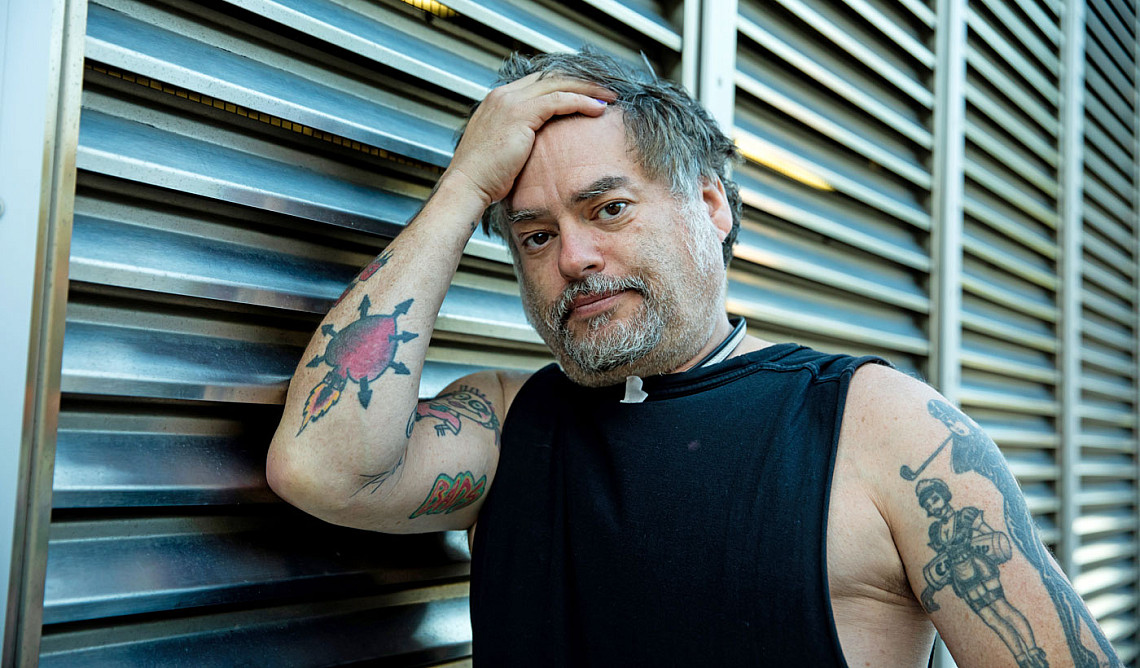
The third NOFX album, Ribbed, sold about 8,000 copies after it was released in 1991, which Fat Mike said was "a lot." The band had spent much of the '80s sleeping on floors, touring in death-trap vans to clubs in California that would be condemned had anyone bothered to inspect them. Later in 1991, Nirvana released Nevermind, triggering a pulse of punk rock popularity. After Green Day released Dookie in 1994, punk and pop merged into an unholy union, and NOFX got courted by major labels. They made the crucial decision to stay independent, per one of Mike's earliest lyrics: play for punks, not for cash.1
You couldn't find NOFX on MTV or any corporate-owned radio stations, but they still sold millions of albums (Punk In Drublic, released in 1994, was certified Gold) and became a big festival draw, especially on the Warped Tour. Their remarkable run will end in 2024 when they wrap up their last tour. Mike says it really is the end, and we believe him.
NOFX have a lot of songs, almost all written by Mike. Most are about two minutes long, powering forward without a chorus. This brings us to another early lyric: our music's fast, but it's not trash. As Mike explains, there's a lot going on in these songs that most listeners miss, like 16-chord progressions and lyrics that are carefully considered. This interview, done while Mike was on a break from touring, is entirely about the music.
Greg Prato (Songfacts): What song are you going to most miss playing with NOFX?You couldn't find NOFX on MTV or any corporate-owned radio stations, but they still sold millions of albums (Punk In Drublic, released in 1994, was certified Gold) and became a big festival draw, especially on the Warped Tour. Their remarkable run will end in 2024 when they wrap up their last tour. Mike says it really is the end, and we believe him.
NOFX have a lot of songs, almost all written by Mike. Most are about two minutes long, powering forward without a chorus. This brings us to another early lyric: our music's fast, but it's not trash. As Mike explains, there's a lot going on in these songs that most listeners miss, like 16-chord progressions and lyrics that are carefully considered. This interview, done while Mike was on a break from touring, is entirely about the music.
Mike "Fat Mike" Burkett: I'd like to preface this by saying that after we play our last show in 2024, we're done. There's no reunion. We're not that band.2
"The Decline." "The Decline" is such a challenge. I have so many memories of playing that. I think my proudest moment is after we played "The Decline" perfectly at Red Rocks with the orchestra behind us.
Songfacts: What's a NOFX song that has a deeper meaning than most people realize?
Mike: We have a hundred songs that people have no idea what the meanings are. My goal as a lyricist is to sing about an experience in my life but have it so that the listener doesn't know exactly what I'm talking about. Some people will get it and some people won't.
I just did a concerto – a concert with five-stringed instruments – called Fat Mike Gets Strung Out, and I'd explain what the songs were about. Like, I have a song called "Fuck Day Six" on our last album [2022's Double Album]. People don't know what "Fuck Day Six" means unless you were addicted to opiates, because day six is when it really hits you. So, I wrote a song called "Fuck Day Six" that only 10% of the listeners will understand. But that's what I like, is for some people to really relate to a song. If you write a song that everyone can relate to, that's not fun for me. That's pop.
I'm actually writing a book about 100 songs that I wrote that are misconceived. I'm going to tell you one that's the most important one to me. It's called "USA-holes." People think it's about the Titanic sinking. What it's about is the Bush administration. It's about a captain sailing the ship, they hit an iceberg, and they start a war on the Arctic.
It's about George Bush and how the World Trade Centers were flown into by Saudi Arabians and one Afghani, but we started a war with Iraq, who had nothing to do with it. It's the same principle as getting hit by an iceberg and blaming the Arctic. It's the same story if the US bombed, let's say, France, and France bombed Mexico. It's that silly. No one has any idea what that song is about. And the book is, I think, fascinating to NOFX fans and very uninteresting to anybody else!
I've produced so many bands that write lyrics in the studio, and it just makes me ill because I spend months working on lyrics. At night before I go to bed, I'll open up my new songs and I'll just go through and say, "That line's not good enough," and I'll keep working at it for months to write perfect lyrics. I like every song I write to be working on all eight cylinders.
Songfacts: I once read that David Lee Roth would write lyrics on the spot in the studio.
Mike: Well, sure. Rock bands – hair bands – have probably the worst lyrics of all time. Even worse than bands from the '50s and '60s. "Cherry Pie" by Warrant? I mean, come on. I grew up with these fucking horrible bands that never wrote any good songs, any good lyrics. They're all shit. And there are so few people that do write good lyrics. This is inarguable: Punk rock bands write the best lyrics ever written. You can't even argue that.
You want to talk about metal? You want to talk about Exciter, or the first Metallica record [1983's Kill 'Em All]? Whatever. Metallica has written some decent lyrics, but give me a fucking break. Listen to Bad Religion or Rancid or Operation Ivy or Propagandhi. Go fuck yourself, people, if you don't think these are some of the best lyrics ever written. It's inarguable.
NOFX released most of their albums from 1989-2000 on Epitaph Records, the label set up by Brett Gurewitz of Bad Religion that also had Rancid, L7, Pennywise and The Offspring on their roster. They also released some of their own stuff, including their 1995 live album, I Heard They Suck Live!!, on Fat Wreck Chords, the label Fat Mike set up in the early '90s. Fat Wreck Chords became an incubator for bands like Rise Against and Anti-Flag, and has released all NOFX material since 2001.
Songfacts: Who are some of your favorite rock lyricists?Mike: Brett Gurewitz from Bad Religion is my favorite. He's poetic and the most well-read person I've ever known. And you have to be a well-read person to write great lyrics.
A lot of my lyrics are based on existentialists like Jean-Paul Sartre and Albert Camus. The more you read, the more you understand the world and philosophy, and you can write lyrics. Not, "I took her home and I made her dessert." That's not a lyric that I'm ever going to write.
And I think people take lyrics for granted sometimes, because lyrics make a song way better, but they're not necessary, because there's "Bird, bird, bird, bird is the word," and there's something called classical music. Music stripped down is about notes and melodies.
What you want to hear is a song that isn't out yet called "I'm A Rat." It's about 54 different chords in a row. Nobody notices that most NOFX songs have no chorus, and most of our verses are 16 chords in row. "Eat The Meek," which is a popular song of ours, has a 16-chord progression in the first verse and then a different 16-chord progression in the second verse, and a different 16-chord progression in the third verse. No one notices. It's like Beatles songs – no one notices how complex they are. You just know they're good.
Songfacts: Who are some songwriters that you're an admirer of that people may be surprised by?
 Mike: Billy Joel, Elton John. Paul McCartney is the greatest songwriter of all time – that's almost inarguable, too. Especially when "Yesterday" is the most-recorded song of all time. I like Bob Dylan lyrics a lot. The Beatles lyrics, some of them are so incredible. Some are like children's lullabies.
I'm sorry, back to punk. "Suffer" by Bad Religion has some of the greatest lyrics I've ever read. On Stranger Than Fiction [1994], people don't understand how great they are. "Hooray for me and fuck you" [the song "Hooray For Me"]... I'm so jealous, I wish I would have written that song.
And Tim Armstrong [of Rancid]. I'm sorry, but you have to go to punk because they're better than anybody else. Tim Armstrong has written so many lyrics. One line he wrote in the song "Radio" – "When I got the music I got a place to go" - yes, everyone can relate to that because we're all people where music saved our lives. Music gives us a place to go when we're sad or depressed or we're about to go out to some event. Music makes us happy or sad. It brings us to a different place that a book doesn't, a painting doesn't. It hits us deep in the soul.
Songfacts: Hearing a song can also instantly transport you back to a certain event in your life.
Mike: Absolutely. How special? Books don't really do that – you don't remember what you were doing when you were reading a book. Books are important, and paintings, but they don't bring back that memory like the first time you heard "Smells Like Teen Spirit."
Most people remember exactly where they were when they heard that song. Like, "Holy shit, this is amazing." I was in my Volvo with Joey Cape, and he goes, "You've got to hear this song." I said, "Pull over." We knew that this was going to change music. It would have happened anyway, but Kurt Cobain gave all our bands a career.
Oh, by the way, Billie Eilish is one of the only newer artists that I really like. I really love her songwriting, and her brother [Finneas O'Connell].
Songfacts: What was the lyrical inspiration for the song "Linoleum"?
I never chose linoleum – I never chose a kitchen floor - but Mark would always choose a kitchen floor. So, it's about him. And you should make note of this: "Linoleum" has no chorus and no rhymes. There might be one rhyme in there. But it's our biggest song. It should tell songwriters something: The more you rhyme, the quicker people get sick of your fucking song.
Songfacts: "Stickin' In My Eye."
Mike: There was a Germs song called "Caught In My Eye," but "Stickin' In My Eye" was more like watching the news and you just keep looking at it.
I'll tell you something else about that song. That record came out after Nirvana, and when I heard Kurt's lyrics, I made a conscious choice of singing lyrics that were more poetic. That was one of the first songs I wrote that was poetic. I think people need to take something out of those lyrics – What is he talking about?
I still do that. I still write lyrics that are poetic, that mean something to me, that I want the listener to make their own decision on what the lyrics mean.
Songfacts: "Dinosaurs Will Die."
Mike: I wrote that song about how the internet and pirating was destroying the music industry, and major labels were never going to survive because major labels treat bands like products. Not that there's anything wrong with that, because companies have products that they sell.
I'm friends with Billy Gould from Faith No More, and Faith No More was the band before Nirvana that gave people like me hope when they released "Epic." That was like, "This isn't hair metal. This song is fucking ruling!" Especially with that piano part at the end. That record was such a huge hit, and Billy told me, "We made so much money off that, and then we put out our next record [1992's Angel Dust] and it didn't recoup – they cross-collateralized our records." He never saw another royalty again.
And that's something my label, Fat Wreck Chords, has never done. We do not cross-collateralize. If you have a record that didn't make money back, alright, that's fine, you still get royalties off your other records because it just seems fair. And Fat Wreck Chords does one-record deals. We don't charge back for marketing, although we don't spend very much money on marketing. We just do things in a way that's cool.
That's why bands stay with us and why bands come back from majors to Fat Wreck Chords. But major labels, seven-record deals and shit? You're treating musicians the way studios used to treat actors in the 1920s: "You have to do movies in our studio." It's like indentured servitude.
Fat Mike stopped giving interviews in 1997 when the questions got too repetitive and too stupid - he got sick of explaining how he got his nickname3 or what he thought about Green Day. He didn't end the media blackout until 2004, when he went on a quest to get George W. Bush elected out of office. He set up the anti-Bush website punkvoter.com and issued a compilation album called Rock Against Bush through Fat Wreck Chords. The interviews he granted around this time focused on the election, which Bush ended up winning.
Songfacts: "Franco Un-American." Mike: That song I started writing because of Ralph Nader. He is an American hero. He got the government to make seatbelt laws. How cool is that?
He saved so many people's lives, but when he was running in the 2000 election, he got three million votes or something like that. He got 3% of the vote. I don't know what kind of a statement he was making, but if he would have told his followers, "We really don't want George Bush in office. What a terrible man. What a fucking moron. I want you to give my votes to Al Gore," then Al Gore would have won. And Al Gore, what does he spend his life doing since he lost? Climate change. He's way more of a decent man than George Bush. And that was when the world really started to go in decline – because of George Bush.
Songfacts: Who are some modern-day punk bands that you feel are doing worthwhile work?
Mike: I'm biased because I sign bands. I'm really into the crust-punk scene right now. Not the grindcore, but the folk-crust bands. I sign bands that I think are great.
Days N' Daze are one of the coolest bands right now. I think Jesse [Sendejas] and Whitney [Flynn] write the best lyrics these days and the best melodies. And there's another band called Doom Scroll who are some of the best songwriters I've heard. And check me out being a dick – I think the best band is the Codefendants [comprised of Mike, Sam King, and Ceschi Ramos].
The Codefendants are a band that I'm so proud to be a part of. I'm not going to be playing with them, but I produce their records and I co-write. And call me a narcissist – but it's not, I'm a confidence-ist – we're putting out records every six to eight months, and it's the best shit I've ever done. I've never worked with great songwriters before, and there's three of us.
March 29, 2023
For more Mike, visit nofxofficialwebsite.com and fatwreck.com
More interviews:
Jane Wiedlin of the Go-Go's
Tim McIlrath of Rise Against
East Bay Ray of Dead Kennedys
David Vanian of The Damned
Exene Cervenka of X
Justin Sane of Anti-Flag
photos: Susan Moss
Footnotes:
- 1] This unreleased song is titled "NOFX," which became their "theme song of sorts." The lyric comes from the 2016 oral history NOFX: The Hepatitis Bathtub and Other Stories. (back)
- 2] Mötley Crüe, who held a press conference in 2014 to announce their final tour, even signing a "cessation of touring agreement" to show they really meant it. In 2022, they hit the road co-headlining with Def Leppard. (back)
- 3] The NOFX band members all have nicknames: drummer Erik Sandin is "Smelly," guitarist/horn man Aaron Abeyta is "El Hefe," and guitarist Eric Melvin is, well, "Melvin." Mike, real name Mike Burkett, used to be really skinny but put on some weight when he went to college at San Francisco State University. When a guy from the band Subculture saw how much he filled out from his beanpole days, he started calling him "Fat Mike," and the name stuck. Mike is the bass player in the group as well as the lead singer. (back)
More Songwriter Interviews