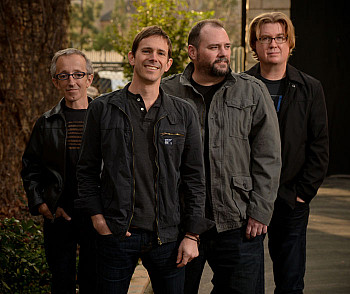
 With its jangle-pop sound and softly sincere lyrics, Toad the Wet Sprocket represented the gentler side of '90s alternative music. Unlike the grunge sound up the coast, this Santa Barbara group mixed lovely seaside vocal harmonies into their melodically memorable tunes, including the hits "Fall Down," "Walk On The Ocean" and "All I Want."
 Toad The Wet Sprocket broke up in 1998 and singer/primary songwriter Glen Phillips set out on a solo career. Although the group continued to tour together on and off during the 2000s, it wasn't until 2010 that the act officially re-formed, and in 2013 the group released its first studio album in 16 years, New Constellation.
Throughout his career, Glen has battled depression, which, as he explains, can be traced through his songs.
Glen Phillips: You are. It's always an embarrassing song to talk about from a lyrical standpoint, because maybe a couple of weeks before I wrote the lyric, I had gone on a trip with my wife up to Orcas Island and hung out at Doe Bay hot springs with a bunch of hippies - it was great. But it was a five-minute lyric. It was supposed to be a scratch lyric. Todd [Nichols] had written the music. We were doing a demo and I didn't want to just go, "Blah, blah, blah, blah, blah."
Orcas Island is part of a group of islands off the coast of Washington State called the San Juan Islands. Of the 11 islands in this cluster, it's the biggest one. Doe Bay is a tiny unincorporated region on the southeastern shore of Orcas Island, and home to the Doe Bay Resort and Retreat.
So I wrote down literally the first thing that came across my mind. The lyric and the chorus, I have no idea what it means, unfortunately. Then I tried rewriting it and nothing ever really worked. I tried to make the chorus mean something, and eventually said, "Well, it sounds like I know what I'm talking about." So we just left it as is. It was the least-conscious, least-crafted lyric.Songfacts: How interesting is that. Because, as a listener, as a guy that's heard it on the radio, I just thought, "Wow, that so deep!"
Phillips: Excellent.
Songfacts: It seems like there has to be something to those words you came up with, even if you're not aware of it.
Phillips: Well, that's the weird thing; I feel like as I age I want to know what my words mean. With a lot of the old lyrics, I would let things by where it was a little more stream-of-consciousness.
I mean, a song has to elicit an emotion, right? That's what it has to do. Has to make you feel something. And whether it's note for note, line for line, actually based on anything else, or as long as it makes you feel something, it's successful.
Nirvana songs are totally stream-of-conscience, and they're at a certain level not gobbledygook. It's nonsense, but it's evocative nonsense that makes you feel something really deep, so it doesn't matter if it's anything that you can understand or not.
Songfacts: That kind of goes back to early R.E.M. Another example I can think of is the Cocteau Twins.
Phillips: Yeah, "Fluffy Tufts."
Songfacts: The Cocteau Twins; I think they made up their own language.
Phillips: Yeah. I forget what album, I think their fifth album, she started writing words. So you can do something evocative that doesn't have to mean anything. And "Walk on the Ocean" is odd that way, but it's very narrative in the verses. But then it's complete nonsense, of course. [Laughing]
Songfacts: Well, I'm going to listen to it again and see if I can pick up on that. But it's interesting, in light of what you said about the new album and your newfound sense of contentment, the song "All I Want" brings to mind that feeling of being content.
So yeah, those songs - "I Will Not Take These Things for Granted" as well - are much more things for me to remember than a way I walk around feeling.
I feel like honestly, only in the last year or so, my relationship with depression changed a lot. I feel what I think is probably how normal people feel most of the time for the first time in well over a decade. But it's a practice, if that makes sense. And I guess that's why I talk about happiness in that way that it's not the destination. People who haven't experienced long bouts of depression think that it's about the things that happen to you, where I really think it's more of an internal process, kind of machines in the head that feed on sad stories. I can lay up at night and if anxiety hits, or depression hits, it doesn't matter what's happened or not happened. I'll find something to worry about, something to stress out about, something to ruminate about.
Songfacts: I'm like you. I do the same thing.
Phillips: For me what really turned things around was separating just enough consciousness from the stories that I could remember. "Oh, this is the trick my mind does." I think of it in terms of hygiene: Have I had enough sleep? Have I gone outside? Have I been around people? And if I haven't done these things, it explains why I'm freaking out. I'm freaking out because I haven't done any of the stuff that makes my mind get back to normal.
Songfacts: So it's like practical health?
Phillips: Yeah. It's practical health. And it was hilarious, after all the years of thinking I had to fundamentally change something about myself, what it really has taken is just sunlight and adequate sleep and a little bit of a weirdness. And life is kind of something I can do.
It's still at the edges. I have an overactive mind, and if I'm not doing something interesting with it, I go down the tubes really fast. So it's a gift, meaning if I keep busy, I have a lot of energy to do stuff. But idle hands are not something I'm equipped to deal with.
Songfacts: I imagine some of your best songs were written when you were in a depressed state. Do you worry about losing your creativity as your mental health improves?
 Phillips: No, I don't think so. Because you can get happy in two ways. You can get happy by shutting your mind down and asking no questions - a fool's paradise, I guess. I think complacency makes people bored and boring. Complacency is the enemy, and complacency is very different from happiness.
The Buddhist relationship to happiness is a very different thing than complacency. It's a practice; it's an active state as opposed to a passive state. And I think if you're active - as you're moving your body, as you're moving your mind - you're learning new skills, asking new questions, then you still keep your edge. And being happy doesn't mean you can't still be perceptive or even cutting, even edgy. You don't lose that. You just lose spending all your spare energy kicking the shit out of yourself. And I still can put a little bit of energy towards kicking the shit out of myself.
Songfacts: You're not going to be 100 percent content with yourself ever.
Phillips: Well, no. That would be being complacent. There's big room for improvement. But I try to cut myself somewhere close to the slack that I cut other people. Most people I want to accept flaws and all. You try to see that they're struggling, what they're dealing with, and that their flaws aren't necessarily weakness.
We're all dealing with our own kinds of insanity, and rather than just beating myself up for my own flaws, I try to see it a little from outside and go, "Okay, I don't have to be perfect. I don't have to live up to a completely unreasonable standard." I'm human like everybody else, and I forgive other people those things.
The enemy is allowing yourself to be bored, allowing yourself to stop being fascinated and allowing yourself to stop asking questions. That would mess up all the creativity, but I'm just trying to waste less time on hurting myself.
Songfacts: Let's talk about this new album and how Toad the Wet Sprocket is together again. What is it about the band that is different for you that makes it something that you keep coming back to?
Phillips: It's a variety of things. It's a combination of people and a sound. It's kind of amazing to get back together - it's like riding a bike. We play a song and it automatically sounds like Toad.
It was the first band we were in and we had too much history for a long time. I think taking a long break enabled us to all kind of grow up and get our own lives together and come back to it in a way where we could enjoy it for what it is.
Glen writes the bands' lyrics, but their songs are group compositions, with every member credited as a writer. The same four members have been with the group since their inception: Todd Nichols (guitar), Dean Dinning (bass), Randy Guss (drums).
The big difference coming back is that now it's a project, whereas when the band started it was the only thing any of us did and every song had to be siphoned into it. What was great this time was picking and choosing, sometimes writing something, thinking, "Oh, this would be great for the Toad record," and often writing directly for the band instead of writing songs I knew I could easily play solo acoustic. I would be writing songs that were based on counter melody, based on a big beat, and based on interweaving guitars, and I could start with the band in mind and go from there. So it was really great to have it be a project instead of the only outlet.Songfacts: So you approach it differently when you write for this band as opposed to a solo project.
Phillips: Yeah. Solo, the songs to some degree are reduced down to a single guitar and a single voice, and I'm willing to be a little geekier and a little less pop and a little more obscure on some of the solo stuff. Toad is generally more pop than what I do, so I embrace that and understand that it's broader and the gestures can be a little larger. It's cool to write with all that in mind.
Phillips: Maybe. I tend to have fairly central themes. I've fought with depression for most of my life, so there's a lot about waking up and being grateful; a lot about separating the story in my head from what actual reality is and trying to keep clear about that. Those things keep coming up.
With Toad, when we were together the first time we were all really young, and it was in that era of being in your early 20s and assuming that happiness is about getting those things you want and doing what you intend to do. And as people are in their 40s, happiness is much more of a practice at accepting what you have and appreciating what is, which doesn't mean you stop working or stop questioning or stop moving forward. It's hopefully a wiser way of looking at happiness: that it's not about controlling outcomes, it's about controlling your reaction. Those are the main themes.
Songfacts: Is there significance to the title?
Phillips: New Constellation? It happened to be that song, which seemed like the more positive of the song title oriented possible album titles. It seemed like the most forward-moving. We all liked the fact that it seemed to have some velocity.
Songfacts: Do you have a favorite constellation?
Phillips: I'll just say Cassiopeia, because it sounds good. The only one I can ever pick out of the sky is Orion. [Laughing] The belts of it give away.
Cassiopeia, in case you're looking for it up in the heavens, is W shaped, and comprised of five stars. Its name comes from the Greek mythological figure queen Cassiopeia. Orion, on the other hand, is named after a Greek mythological hunter. Phillips is right, in that this constellation is visible all around the world.
Songfacts: What's one of the songs on the album that you're most proud of?Phillips: I love "Golden Age," I'm proud of that one.
Songfacts: What is "Golden Age" about?
Phillips: I guess it's about a number of things. There are a lot more relationship songs on this album. I've been married, we just had our 20th anniversary.
Songfacts: Congratulations.
Phillips: Three kids, all girls. Statistically, it's one of the weirdest things about Toad. We realized just last week that three of us are married and we're still married to our first wives who we all married in our early 20s, which statistically should not happen in a rock band. Our divorce rate is very low for rock & roll. It's nonexistent.
But people think of marriage and relationships as this destination, and it's definitely a process. "Golden Age" is about this tendency to look back and idealize this task that never actually happened, or idealize a future that will never happen and lose the present.
To some degree the song is definitely about depression and just trying to face that.
I'm trying to talk more publicly about it because enough people have gone through it or have lived with somebody who's gone through it.
There are different types of depression. When my dad died, I got depressed. That's normal depression. And then there's end-of-the-world, not able to face anything. That came really close to destroying my marriage. Did a really good job of wrecking my solo career. And I wore a lot of people out. I wore a lot of audiences out when I was on the road. I didn't want to be alive, and there's nothing worse than paying a ticket to see somebody who doesn't want to be there.
The odd thing is, in contrast of when that overtakes me, I am apparently a pretty optimistic, happy person. But it's a weird disease and it has to be dealt with.
Songfacts: Why don't you tell me about the title cut, since you named the album after it, what's that about?
Phillips: Sorry. I don't know why I keep going back to depression. There's a bunch of songs on it. So the title cut, "New Constellation" is a bit of a mishmash, actually, for all I'm talking about trying to write so directly. It's a very devotional chorus; I just kept this image of writing someone's name in a new constellation, like this large act of celestial-level love. And once again, the darkness comes into it, too.
There's a bridge in the song which is about how there is a kind of madness in the arts, and if you look at patron saints somehow they understood that there was a tie-in there - there's actually a lot of crossover. I spent a lot of time Googling all the scenes.
[Saints mentioned in the bridge include St. Dymphna, St. Cecilia and St. Margaret.]
But the key to that song is awareness, devotion, gratitude. A fairly recurrent theme throughout the record.
As explained in just about every bio on the band, the name Toad The Wet Sprocket came from a Monty Python sketch. The bit is called Rock Notes and consists of Eric Idle describing the travails of fictional bands with names like Dead Monkeys, Poached Salmon, and of course, Toad the Wet Sprocket, whose electric trianglist loses an elbow.
They chose the name because they couldn't think up anything better and needed a moniker for an upcoming gig. "We were gonna think of something better," Todd said. "But it just never happened."
Songfacts: I want to talk about one last thing, and I hope you're not too tired of talking about it, but name of the band, is Monty Python related, and I was reading this thing about how Eric Idle had heard one of your songs and didn't realize that there was a band named after this skit that he created. So I have to ask you, have you ever met Eric Idle and talked about it?They chose the name because they couldn't think up anything better and needed a moniker for an upcoming gig. "We were gonna think of something better," Todd said. "But it just never happened."
Phillips: I have not. We sent him a gold record a long time ago. I've met John Cleese, because he's a Santa Barbara guy. But never actually met Eric Idle. Would love to.
Songfacts: A great songwriter, too, by the way.
Phillips: Oh, yeah. They're great.
Songfacts: It just sounds like you're in a really great place, which makes me feel good. You're probably a lot like me in that sometimes you'll listen to your favorite artists' albums and worry about them. You know, as people.
Phillips: Yeah.
Songfacts: But I get the sense of talking to you that I'm not going to worry about you.
Phillips: No, hopefully not anymore. There are universal changes that I think our generation has gone through. Our parents were some of the last generation where if you did your due diligence, if you got your degree, if you worked hard, if you worked for a company for your life, you felt like you could probably afford a house, you could even afford to get sick some days without fear of losing absolutely everything. There was this intact social contract.
And our generation, we were the firsthand witnesses to the erosion of that, and we've all been stepping into it ourselves and watching our kids step into a world with no promise at all of a social contract.
Songfacts: I totally agree with you. I've got kids, I don't tell them this directly, but I'm glad I'm not in their generation, quite honestly.
Phillips: I see my kids, and they're just following their passions. They're not going to try to make it work for anybody but themselves, and I think that's the wisest thing they can do.
I think there is a universal thing: What were my expectations about how this would go and what's the current reality? And in a way everything looks the same on the surface, so it doesn't feel like it's such a sea change. It's a basic idea of personal security - and not in a safety, cops-and-robbers way, but is the work I've done of value? Do I matter to anybody at the end of the day? Am I just disposable?
And I think if you grow up in a situation where there's a consistency through your life where even if you know that nobody gives a damn at the institution, at least you know that going in. You create your life and your family and your world to deal around that. We have seen this big change, and it's caused this big rise in kind of a fascist fundamentalism and it's caused a big rise in a kind of ecstatic escapism, and we're all trying to figure out how to deal with the change. So for me, these questions of gratitude and awareness are really fundamental to our generation.
Songfacts: To our survival.
Phillips: Yeah. I mean, so these questions, as much as I relate them back to the personal depression story, I also think in the same way we were asking the relevant questions for the people our age when we were first coming out, and it's a new set of questions now. We're all trying to find our way in this strange new world.
January 8, 2014. Get more at toadthewetsprocket.com.
More Songwriter Interviews