Scratch the surface of "(Can't Live Without Your) Love And Affection," the ebullient 1990 #1 hit for Nelson, and you'll find there's some real depth to the songwriting. It's about being on the outside looking in, which Gunnar Nelson says describes his life.
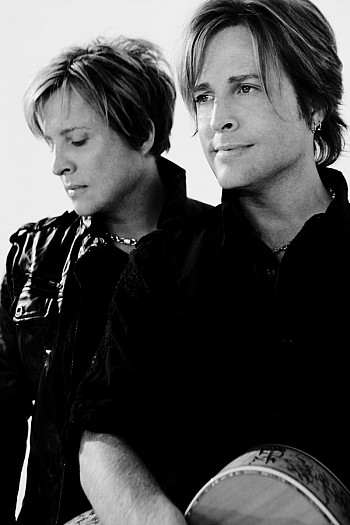
Gunnar and his identical twin Matthew are the sons of Ricky Nelson, a TV star and singer who was one of the first inductees into the Rock and Roll Hall of Fame. The twins were 18 years old and had already formed a band when their dad died in a plane crash en route to a tour stop in Dallas on New Year's Eve, 1985. Five years later, they released their debut album After the Rain, which made them video stars and Tiger Beat faves. Their dad didn't write his own songs until later in his career, but Matthew and Gunnar took their songwriting seriously from the jump, composing most of that first album.
Shackled to a teenybopper image and cast off by a changing musical landscape (grunge), Nelson lost their record deal in the mid-'90s. After a few independent releases, the brothers signed with the small Frontiers label in 2010, with whom they have issued four albums. The latest is 2015's Peace Out, a return to the melodic pop sound heard on their debut.
Gunnar spoke with us from Nashville, where he and his brother now reside.
Gunnar and his identical twin Matthew are the sons of Ricky Nelson, a TV star and singer who was one of the first inductees into the Rock and Roll Hall of Fame. The twins were 18 years old and had already formed a band when their dad died in a plane crash en route to a tour stop in Dallas on New Year's Eve, 1985. Five years later, they released their debut album After the Rain, which made them video stars and Tiger Beat faves. Their dad didn't write his own songs until later in his career, but Matthew and Gunnar took their songwriting seriously from the jump, composing most of that first album.
Shackled to a teenybopper image and cast off by a changing musical landscape (grunge), Nelson lost their record deal in the mid-'90s. After a few independent releases, the brothers signed with the small Frontiers label in 2010, with whom they have issued four albums. The latest is 2015's Peace Out, a return to the melodic pop sound heard on their debut.
Gunnar spoke with us from Nashville, where he and his brother now reside.
 Greg Prato (Songfacts): Looking back, do you regret the choice of the record company to market Nelson as a hair metal band?
Gunnar Nelson: That's a really great question. No, I don't. Actually, I regret the record company choice to market us as a teen-pop band. Hey look, neither one of those genres are bastions of credibility. But that really wasn't my intention. I started making music because I wanted to get chicks. You have to cast your mind back: in 1988, 1989, 1990, if you didn't have long hair and weren't in a metal band, you weren't getting any chicks. And so, that was kind of the natural way to do it. I grew up listening to Bad Company, Queen, Boston, Heart, and all the arena rock bands, and that was something that I wanted to be a part of.
But the drag is that unlike so many of these other bands that were out at the time, we actually wrote our own songs and we produced our own records and we did that out of the chute. I had my first instrument when I was six, and I was playing the LA club scene since the time I was 12. And the record company's decision to go the path of least resistance - which was giving all of our pictures to Teen Beat and Tiger Beat and Bop and all these other magazines - it was a real drag for us. It was inexpensive for the label, because these magazines were paying our record label for those pictures. It basically took care of all the marketing, but what it left for us was no room for anyone to talk about the fact that Nelson was something that Matthew and I put together. This is not something fabricated by a label or some Svengali manager. We never granted a single interview to one teen magazine, but we were all over them. It was great - I was flattered that we were millions of teenage girls' first crush. That's wonderful. But we never planned it that way.
And the aftertaste that was left for any kind of critics or anybody that was hell-bent to focus on credibility was to dismiss us as a made-for-teen marketing campaign, and that's never really what we intended. So that was really my only regret. Being a pop metal band? I've got to be honest with you, looking out at 22,000 screaming chicks was pretty awesome.
Songfacts: What was the lyrical inspiration of the song "(Can't Live Without Your) Love and Affection"?
Gunnar: That's about always feeling like being on the outside looking in - that was really my life growing up. I think a lot of people that grow up to be songwriters, our journey is really an internal one more than an external one, and we get really good at observing. The downside of that is life tends to live itself in front of you and you're observing and taking it all in, but not necessarily being a part of it.
When I was in high school, I certainly was not one of the popular kids. It seemed like all the hot chicks used to come to me to get advice about their dirtbag boyfriends, and I made them feel better about themselves, and they'd go right back to the dirtbag boyfriend. So that's where that lyric came from: a true-life experience of feeling that way. Feeling like you're observing this girl that you would kill to be with, and treating you like you don’t even exist. For some reason, I think a lot of guys can relate to that.
Songfacts: What about "After the Rain"?
When we started writing that song, it started out as a "What if?" song about relationships and really turned into something that was much more than that. It turned into a song about transcending what is never written in stone. Your future never is. It really does come down to attitude.
Songfacts: How did the songwriting process work for the new album, Peace Out?
Gunnar: It was pretty organic. As a guy who lives in Nashville it's kind of odd, but I don't make songwriting appointments - I wait until the ideas come to me.
This particular record was started without fail as ideas that came to me in that zone where I was going to sleep or waking up. I would record those on my iPhone, and go back to them later and listen to the song ideas and see which ones had merit. It was pretty clear to me when I got into this a couple of months in, that a brand new record was really shaping up. I'm really proud of this record - it's my favorite one I've worked on so far.
Songfacts: One of the songs on the album is "Rockstar." Tell me about that one.
I was having one of those days when I came up with the concept for the song. I was at a stoplight, and looked to my left and there was a guy who was brilliantly out of date: long hair, driving this beat-up Pinto. But he was rocking out to AC/DC, and he looked like he was on top of the world - bangles dripping off his arm, the whole thing. I thought, Man, that is really cool, because as far as that guy's concerned, he's in his limo and he's hanging out with chicks and he's on the way to the gig. And that's where the lyric came from.
Songfacts: As far as the songwriting in the band, is it a collaboration between you and your brother?
Gunnar: As it stands right now, I think I'm a little more passionate about writing songs for Nelson than Matthew is. We've been a year in Nashville, and it's a new trip... it's more like a modern Everlys thing, and Matthew is more geared in that direction.
But this stuff is really natural for me. The style of writing is something I'm passionate about, and because I am, it comes easily and effortlessly. On this particular record, I think Matt and I collaborated on two of the twelve songs, and he really came in and did a polish on them, which works out fine because a lot of these songs I pretty much hear completed in my head when they come to me. It doesn't really lend itself to that collaborative image of sitting down in a room together and working on an idea to turn that into a song. On this Nelson stuff, with a couple of notable exceptions, it's pretty much all me.
Songfacts: Why do you think so many songwriters are moving to Nashville nowadays?
Gunnar: I think Nashville is really a town that supports songwriters. There is a certain reverence to what it is songwriters do, and it's kind of nice to be in a place where it feels like you're not swimming against the current all the time. Here, you can walk into a bank and tell the banker that you're a songwriter, and they don't look at you like you've got six heads. That's kind of nice.
Although Nashville is long thought of as "the home of country music" (it's the home of the Country Music Hall of Fame and Museum, after all), the Tennessee town seems to be in the midst of a musical makeover. Such Nashville-based songwriters as Trent Dabbs (Ingrid Michaelson's single, "Girls Chase Boys," several songs for ABC's Nashville), Barry Dean (who co-wrote "Girls Chase Boys" with Dabbs), Dallas Davidson (who has worked with Selena Gomez and T-Pain), and Brett James ("Mr. Know It All" recorded by Kelly Clarkson, "Helpless When She Smiles" recorded by the Backstreet Boys, "Till We Ain't Strangers Anymore" recorded by Bon Jovi) have all written for pop, rock, or hip-hop artists. Jack White even put up a shingle, opening his Third Man operation there.
I come from a different background - my background is Los Angeles. Growing up in LA, you write a song, and the first thing people ask you is, "What does it sound like?" You move to Nashville, and the first thing they ask you is, "What's it about?" Two profoundly different things: one is lyrical content, and one is the melody.What's really been a lot of fun was coming out here and trying to blend both worlds, and I think that's happening more and more nowadays. It's nice for professional songwriters to be able to come out and be among their own kind, and it's easy to have co-writing appointments put together and trade ideas with your friends. It's a song-centered town.
Songfacts: So would you say you get more songwriting gigs in a town like Nashville compared to a town like LA?
Gunnar: It depends on what you're writing for. If you're writing for TV and film, and you're doing jingles and stuff, you should stay in LA. If you're trying to get a cut that's for an artist, you're going to have a much easier time doing it in Nashville - not to say you're going to have an easy time, because there's a lot of competition out here. You've got to make sure you refine your craft and your chops.
You can't deny the power of a hit song: when you play something that sounds like money, people are going to want to cut it. But nowadays, it is getting more and more difficult to make a living - pretty much anywhere - as a songwriter. But in LA, bands were always expected to write their own tunes. Out here, this is really the last vestige of a town that had professional songwriters, but prepared and played songs with professional acts. It's one of the last places that really does that. To have a shot writing songs for artists, you have a much better shot doing that in Nashville than anywhere else.
Songfacts: You had another hit from your first album with "More Than Ever." Can you take me through that song?
Gunnar: "More Than Ever" was written when that first record was almost done. We had already started recording it when we started co-writing "More Than Ever" with Marc Tanner. Of any song on the After the Rain album, that one has the most Marc Tanner in it. He came up with a couple of chord changes that I wouldn't have chosen myself, but we were learning, we were young. We were 17, 18 at the time when we were writing that.
Marc Tanner was a seasoned songwriter who helped Nelson through their novitiate, co-writing most of their early songs. The leader of the Marc Tanner Band (which issued two albums: 1979's No Escape and 1980's Temptation), Tanner has also co-penned tunes for Twisted Sister, Eddie Money, Ian Hunter, Berlin, and the Calling.
I had to write that as a "What if?" because to be honest with you, when I was 18, I really didn't have any great examples of awesome relationships in my life, so I had to put myself in the place that songwriters have to go. If you don't write songs from experience, you have to ask yourself "What if?" And on that one song, I had to put myself in a place and say, "What if I had this great relationship? What would I want to tell her?"The funny thing is, all these years later, I realized I was writing that song for someone that I hadn't met yet, who I wound up meeting years later and ended up marrying. She had that song as a part of her life when she was in high school, and she had my poster on her wall! So as a songwriter, asking yourself, "What if?" actually can work out for you.
Gunnar and Matthew were born in 1967 to Rick Nelson and his wife Kris, whose siblings are the actor Mark Harmon and actress Kelly Harmon. When Rick and Kris separated in 1977, the twins lived with their mother. In 1985, when they turned 18, they moved in with their dad, who showed them the inner workings of the music business. After Rick's untimely death, Gunnar and Matthew focused on their band, and in 1988 their demo tape got them a deal with Geffen.
Songfacts: Let's talk a bit about your dad - what type of person he really was, and if there are any misconceptions about him that you'd like to clear up.Gunnar: Well first off, for anybody who grew up with the Ozzie and Harriet show [The Adventures of Ozzie and Harriet], he was the guy that you saw on that show - he wasn't playing a part. He was genuinely that nice. Growing up, I never saw him have an off day with a fan. He was really just a sweet person with a great sense of humor. But he lived and died for rock n' roll. There was a point in his life and his career where he could have chosen to have gone down the arguably easier path of being a TV or film star, and he instead elected to go down the rock n' roll lifestyle route, and that was not a life of personal assistants and deli trays like being an actor. This was lugging your own gear into seedy bars, driving eight hours between shows every day, eating bad food and being away from family. But he loved music and he literally lived and died for it. He was doing 300 shows a year up until the day he died.
So as far as any kind of misconceived idea about Rick Nelson, this was not a made-for-TV rock n' roller. This was a rock n' roller who happened to grow up on TV, and he was the real deal. He was the guy that had a great song sense as well as a sense for picking amazing players. Of course, Memphis had its scene, which was the Sun Records thing, New York had the doo-wop thing, and California, man, it was really Ricky Nelson holding down the fort. In California, what became "the California sound" years later really came from his music and all that stuff. You had Gene Vincent, Eddie Cochran, and Ricky Nelson - those were the guys that started it on the left coast. I suppose for me, something I would like to clear up - if it even needs clearing up anymore - is that Ricky Nelson was the real deal.
Songfacts: As a side note, your dad is my mom's favorite rock n' roller of all-time.
Rick Nelson mentions Gunnar and Matthew in his 1967 song "Promenade in Green" with the line, "Up the street, around the square, Gunnar and Matthew are already there."
Gunnar: Oh, there you go! Straight up, aside from that, he was a darn good-looking guy. Holy crap. There was a whole legion of women - I don't know how old your mom is, but the guy was impossibly good looking. So, combine that with the fact that he was a really nice guy and he was not threatening because a whole generation of women grew up with him on their TV. And then he started to sing, and holy shit, the guy could sing! Pretty cool.Songfacts: My mom says that Ricky Nelson was even better looking than Elvis!
Gunnar: I agree! I'm biased, but I agree.
Celebrity Fit Club was a reality television series that ran for seven seasons from 2005-2010 on VH1 (hey... wasn't VH1 supposed to an all-music station?). As its title suggests, the cameras followed around overweight celebrities as they tried to lose the pounds. In addition to Gunnar, quite a few musicians appeared on the show, including the late Jani Lane, Biz Markie, Young MC, Carnie Wilson and Tiffany.
Songfacts: Lastly, what are some memories of being on Celebrity Fit Club?Gunnar: I kind of needed that in my life - it was a good kick in the ass. But it was an offer I couldn't refuse. I want you to remember, I got sports on one side of my family. I've got entertainment on the Nelson side, and on the Harmon side, my grandpa [Tom Harmon] won the Heisman Trophy at Michigan. My uncle Mark [actor Mark Harmon] played quarterback for UCLA. I'm pretty competitive, so they were going to offer me a competitive framework with a specified time limit and great financial compensation to basically work out. They paid me to work out! And I couldn't understand the other people that were on the show that were complaining about having to work out. Are you kidding me? They're paying you to work out. This is a dream job, this is incredible!
And it was amazing - I went from 22% body fat to 9% body fat in six weeks. And I worked hard, man. It was cool. I had a radio show I was doing in the morning, and I left from that and I went to the gym and worked out for three hours a day. I did that basically for six weeks straight and I loved every minute of it. Nothing was easy, but it was great. It kind of reminded me that if I ever let myself go - or if anybody lets themselves go - they can get it back in a very short amount of time. You've just got to want it.
May 22, 2015.
For more Nelson, visit nelsontwins.com.
More Songwriter Interviews