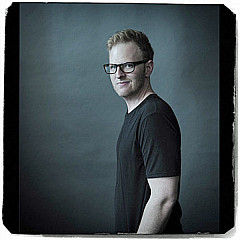
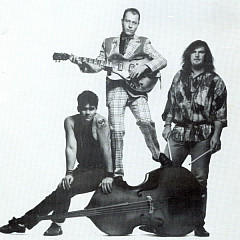
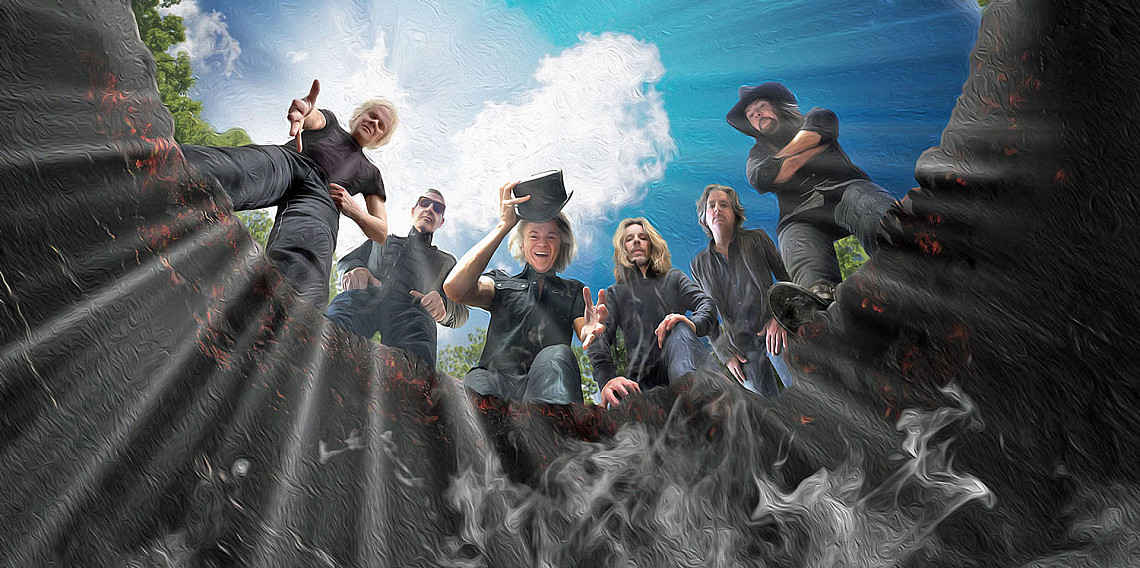
 Styx, left to right: James "JY" Young, Chuck Panozzo, Lawrence Gowan, Tommy Shaw, Todd Sucherman, Ricky Phillips
There is only one member remaining in the Styx lineup who can claim to have played every single full-length concert the band has played since their inception in 1972 all the way to the present day: guitarist James "JY" Young.
Starting out as a prog-rock outfit in the early '70s, Styx soon began incorporating melodic elements into their sound, as well as ballads. By the end of the decade - on the strength of such hit singles as "Lady," "Come Sail Away," and "Babe" - they became one of America's leading arena-rock acts, which they solidified further with the hit albums Paradise Theater (1981) and Kilroy Was Here (1983).
Since 1999 (after the exit of longtime singer/keyboardist Dennis DeYoung), Styx's lineup has been comprised of Young, singer/guitarist Tommy Shaw, singer/keyboardist Lawrence Gowan, drummer Todd Sucherman, while bass duties are split between Chuck Panozzo and Ricky Phillips. In 2021, a third guitarist was welcomed into the fold, Will Evankovich.
Young spoke to Songfacts shortly before the start of their next leg of their 2024 tour (they remain one of rock's most steadily touring bands), to discuss songwriting, the story behind several Styx classics, and an unexpected lesson in chemistry.
Greg Prato (Songfacts): How does the songwriting work in Styx today compared to back in the '70s and '80s?Starting out as a prog-rock outfit in the early '70s, Styx soon began incorporating melodic elements into their sound, as well as ballads. By the end of the decade - on the strength of such hit singles as "Lady," "Come Sail Away," and "Babe" - they became one of America's leading arena-rock acts, which they solidified further with the hit albums Paradise Theater (1981) and Kilroy Was Here (1983).
Since 1999 (after the exit of longtime singer/keyboardist Dennis DeYoung), Styx's lineup has been comprised of Young, singer/guitarist Tommy Shaw, singer/keyboardist Lawrence Gowan, drummer Todd Sucherman, while bass duties are split between Chuck Panozzo and Ricky Phillips. In 2021, a third guitarist was welcomed into the fold, Will Evankovich.
Young spoke to Songfacts shortly before the start of their next leg of their 2024 tour (they remain one of rock's most steadily touring bands), to discuss songwriting, the story behind several Styx classics, and an unexpected lesson in chemistry.
James "JY" Young: If we don't like something, we can digitally record stuff and move it around. We have more tools to reshape things if they're just a little bit off or if they're not happening. But you still have to have a song idea that resonates with what is going on in the world at this point in time, and what we do as songwriters and arrangers still sounds like who we are.
We've got a little different set of writers right now, but it seems like it's going OK.
Songfacts: Do you prefer when the band members were primarily writing the songs, or when there are outside songwriters contributing?
JY: Outside songwriters sometimes happen because we collaborate with friends or somebody who came up with an idea, then we take that idea and run with it and embrace it, so we become co-writers on something somebody else started. But I think the idea is to not put a roadblock for yourself because of a rigid strategy of composing. Just start bashing away, and if something sounds right then keep going on it.
Songfacts: And how would you compare Styx's most recent releases, Crash Of The Crown and The Same Stardust EP [both issued in 2021]?
JY: They're definitely different than going back to The Grand Illusion or Equinox. Honestly, we haven't done a whole lot of new writing... well, I've sort of stopped composing. I get involved in it, but Tommy seems much more driven to write, and Will Evankovich, who is his current collaborator writing, has now become a somewhat permanent member of the band at this point. So, I didn't really participate as much in the writing for the most recent two records.
But those guys are down in Nashville working hard at it. Tommy moved to Nashville - he's born in Alabama, so the South is a place that he's comfortable in. The writing is definitely different without Dennis here, but change is the only constant and I preach flexibility and adaptability.
Songfacts: I'd like to get your thoughts on some classic songs in the Styx catalog. Starting with "Lady."
JY: "Lady," Dennis deserves full credit for that one. Although I pushed the chorus - it's a rock ballad, but it does get uptempo.
It's kind of a trademark of Styx: the big three-part harmony choruses. You don't have to look far to find those three-part harmony choruses on any of our records.
And it's influenced by The Beatles, and maybe by Three Dog Night. They did a lot of covers, but those three singers together were very powerful. And Dennis, myself, and John Curulewski to start with, and then Tommy Shaw, Dennis, and myself.1 And now me and Tommy without Dennis, but Lawrence Gowan has got a tremendously strong, high voice, so we've got the voices to carry off these big three-part harmonies. That will probably be a trademark forever for us.
Songfacts: "Lorelei."
JY: "Lorelei" was really about the woman that became my wife [Susan Young]. The idea of co-habitation was still looked down upon in the old-fashioned world that I was born into. My parents weren't happy about it, but they adapted. We moved in together and my better half decided we should make it legal, so we went to city hall and got married. That's a pretty standard notion for a rock song: A man writing about a woman that he's in love with.
Songfacts: "Superstars."
JY: It's another one where you get the big three-part harmonies and it's a little different rhythm. I think Tommy wrote the verses on that. But it's the big harmony choruses. We used to have fun playing that song and the harmonies work hugely on that song.
 Styx, Left to right: Lawrence Gowan, Chuck Panozzo, Tommy Shaw, James "JY" Young, Ricky Phillips, Todd Sucherman, Will Evankovich
Songfacts: "Queen Of Spades."
JY: "Suite Madame Blue," Dennis was inspired to write it because it was the 200th birthday of the United States of America declaring independence from Great Britain [on July 4, 1976]. And then "Queen Of Spades" is really lifting the concept or structure of "Suite Madame Blue," where we start out slow and then build to the big chorus. We play it in the key of B minor.
Songfacts: "Rockin' The Paradise."
Songfacts: "Snowblind."
JY: Cocaine. Not that I ever had a problem with drugs at all. I tried it once or twice, but it seemed like a silly thing. If you're having trouble sleeping already, don't do cocaine! [Laughs]
But "Snowblind," the idea of me singing low and then doing the sort of "mysterioso" opening thing there, that's the part I came up with. And then we collectively figured out what else it needed to become a Styx song.
According to the Urban Dictionary, the phrase "snow blind" is "a person whose cocaine habit has left them incompetent, or has left them incapable of dwelling on anything other than their next fix." Quite a few rock musicians have been afflicted by snow blindness: Black Sabbath has "Snowblind," Ace Frehley has "Snow Blind," and Steppenwolf offered up "Snowblind Friend."
Songfacts: "Half-Penny, Two-Penny."JY: Actually, there's a gentleman named Ray Brandle that collaborated on the writing. That was his title. We needed a rocker, so I wrote the music. It was kind of a comment on capitalism.
Songfacts: "Heavy Metal Poisoning."
So, if there's too much heavy metal in your diet, that can mess with your blood cells and ultimately lead to heavy-metal poisoning. But it just seemed like a great title to work with. I am actually a heavy-metal music fan, maybe the only one in Styx, so it just seemed like it was the perfect title. And at that point in time with The Who having a big rock opera with Tommy, we did our Kilroy Was Here, and that was my contribution.
Songfacts: What are your thoughts on "Mr. Roboto" today, and would you say you have a love/hate relationship with that song?
JY: A while ago I would have said a love/hate relationship with that song, but it's our only 45 RPM single that sold a million copies for Styx, and it really brought us to a whole new audience because it became a hit single. A lot of our songs we stopped writing for Top 40.
I was against the song, but nobody else really joined me in being negative on that. And in hindsight, I'm glad I was out-voted on it, because we play it every night in our shows and people like it.
Songfacts: What was it like to play the song again in concert after not playing it for many years?2
JY: If there's a positive response to something you're doing on stage, typically, you want to keep doing that thing, because we like to get a positive response. And "Mr. Roboto," some of the purists - and I lean more toward the purists - said, "It sounds like a child's song." But it's our biggest-selling single ever, and I think the album went Platinum, as well.
Songfacts: What's the hidden gem in the Styx catalog?
JY: It's been a long time since I've gone back and listened to the whole catalog. I did love doing "Heavy Metal Poisoning," because it resonated with something I'd read about how we are poisoning our soil by some of these heavy metals getting into our water stream from certain manufacturing processes. So, it's sort of anti-Big Pharma.
Songfacts: And there's the obvious second meaning behind that song. Back in the '80s, some people were saying heavy metal was a bad influence on the youth, and the whole thing of putting warning stickers on albums.
JY: Right. Well, that's what brought it into our vernacular. And my wife had a rare illness she was born with and it took a while to diagnose it.
I have an aerospace engineering degree, and we had to take chemistry. It paid off in terms of helping diagnose my better half. We lost her just a couple of years ago, but she lived to be 70, and she saw the world with me and we had a great time. I miss her. But onward we must go.
March 18, 2024
For more Styx, visit styxworld.com.
Further reading:
Interview with Dennis DeYoung
Interview with Kevin Cronin of REO Speedwagon
Interview with Alan Parsons
Interview with Geoff Downes
Interview with producer Tom Werman (Cheap Trick, Ted Nugent)
Queen Photos and the Stories Behind Them
Photos: Todd Gallopo and Styx (1), Jason Powell (2)
Footnotes:
- 1] Shaw joined the band in 1976 for their sixth album, Crystal Ball. (back)
- 2] Styx retired "Mr. Roboto" at the end of the Kilroy Was Here tour in 1983. They started playing it again in 2018, to the delight of fans. (back)
More Songwriter Interviews