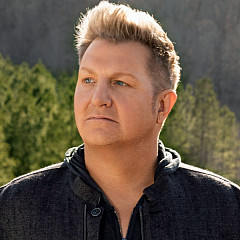
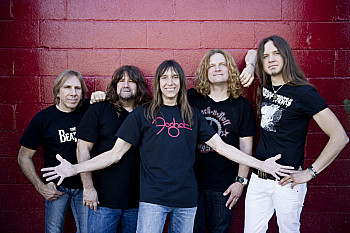
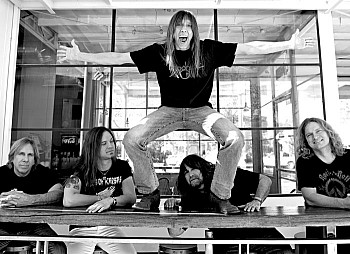
Tesla is entering its 30th year, still on tour and making music with four original members: frontman Jeff Keith, guitarist Frank Hannon, bass player Brian Wheat, and drummer Troy Luccketta).
Jeff is known as one of the most easygoing guys in rock, so agreeable that he embraces the label "Hair Band" to describe this Sacramento group. Tesla, however, has demonstrated much musical eclecticism than such a description might imply. The group's biggest hit, "Signs," dates back to 1970, originally done by a Canadian group called Five Man Electrical Band. Jeff and his bandmates have made their living on blue-collar rock, which didn't play well in the grunge era but has since returned to favor.
In 2014, Tesla released an album that defines this ethos: Simplicity. Among the tracks are a commentary on modern music-making called "MP3," and a deep meditation on the meaning of life and death with the moving "So Divine..." Jeff spoke with us about this latest effort, explained how that famous acoustic set happened, and talked about their defining work, "Love Song."
Jeff is known as one of the most easygoing guys in rock, so agreeable that he embraces the label "Hair Band" to describe this Sacramento group. Tesla, however, has demonstrated much musical eclecticism than such a description might imply. The group's biggest hit, "Signs," dates back to 1970, originally done by a Canadian group called Five Man Electrical Band. Jeff and his bandmates have made their living on blue-collar rock, which didn't play well in the grunge era but has since returned to favor.
In 2014, Tesla released an album that defines this ethos: Simplicity. Among the tracks are a commentary on modern music-making called "MP3," and a deep meditation on the meaning of life and death with the moving "So Divine..." Jeff spoke with us about this latest effort, explained how that famous acoustic set happened, and talked about their defining work, "Love Song."
 Dan MacIntosh (Songfacts): You called your new album Simplicity. What were some of the factors that inspired you to make an album like this, and especially to title it with something that suggests maybe simplifying life a bit?
Jeff Keith: Well, the first track on the record is "MP3" and it's about all today's technology. So that's where we took the title track, from part of the song [We've gotta get back to simplicity, all the world's out of touch with reality]. But with today's technology - Pro Tools and stuff like that - there's an endless supply of tracks.
It used to be 24 tracks on a reel-to-reel tape, and when you punched in and you punched out, they had to be on time, in the pocket, and then out. Nowadays you can take something that's out of time and put it back in time, and cut bass and all that stuff, which can get just crazy. It's so many tracks upon other tracks.
But we always have based off a live feel for the basic track, and we were always careful about not putting too many overdubs on it. So it kept it simplified and more real, like we always try to be. So with today's technology, it's very easy to go, "Uh oh, we built something but it took 172 tracks to get it there." We try to notch it down as simple as possible, because we are a simple, blue-collar rock and roll band. And we always stick to our roots, because that's all we've ever been was a band from the '80s, a hair band, which is still viable today.
And we still are passionate about writing songs. We just wanted to make sure we were careful with keeping it simple.
Songfacts: The song "So Divine..." has a lot of spirituality running through it. What was the thinking behind that song?
He was young, man. We watched him turn 21 when we were out on the road. And unfortunately another car hit him and he swerved and hit a tree. So that inspired us: losing somebody too soon. Then we started looking not in the music world, but in life in general, about how we lose so many great, beautiful souls way too soon.
So that was the first inspiration for the song. And then it just kind of grew and grew. And really the second verse, some people go, "Wow, it seems like you're talking about Keith." And it's like, "Well, that's not the intention. But we always try to keep songs open."
It turned into a very spiritual song. It's fun how songs start from one tiny little inspiration and grow into what it turns out to be in the end. It wasn't intentionally a spiritual song, but it ended up being about how we lose the best things in life much too soon.
Songfacts: When those kind of things happen, it makes you think about spiritual things, doesn't it? Does that person have a soul? Where did they go? Where are they now?
Jeff: Well, that's what the song's saying: all these people and things we lost too soon, they still are alive in our hearts. And that's just where it never leaves us. Their physical body may leave us, but their spirit lives on with us forever.
Songfacts: How was the making of this album compared to other albums? Was it an easy process? Difficult? A little of each?
 Jeff: It's a little of each. It's fun, it's hard, it's tough, it's frustrating, it's just so rewarding. And it's a major process to take an inkling of a song that's just a little idea, just a little riff maybe, and then I'll come up with a melody and then a vocal idea. Then we approach each other with it and go, "Hey, how does everybody feel about this?" "Okay, don't like it, let's try something else." If everyone around the table is liking it and everybody's excited, we build off that and build a song.
And then you try everything under the sun, even though you don't think it's going to work. And a lot of times it doesn't, but then sometimes you'll go, "Wow, I think it's going to work." And it's working, and then you take and you build it and you go over here and next thing you know you end up with the results of the songs that made it onto the record.
It's a fun process, but sometimes I hit walls, like mentally blocked off stuff. That's when we all come together as a team. Frank and Dave [Rude - current guitarist], once I have a melody going, an idea for a song, I'll explain to them what's behind the words - what I want to write about. And then they'll understand what the storyline is I'm trying to sing about, and they'll help me fill in the blanks for a second verse and third verse. Sometimes what I write originally becomes the second verse, so we'll go back and they'll help me write the first verse.
But they always help with the melody that I have, because I always start with a melody for a song. I come up with a melody - one that makes me feel happy, glad, sad, mad - and then they help me fill in the blanks.
Dave and Frank help me a lot with lyrics and sometimes they're more prolific than me. Listen, I'm just this dummy from a little hick town, population 900. Georgetown, California, up the hills, to junior high and high school in Oklahoma, which was a small town there. I'm just a small-town boy. I didn't join the band till I was 24. And never grew up with the magazines going, "I want to be a rock star." So they help me go, "Okay, well, let's knock it down." Because them guys can literally get to a Shakespeare sort of thing with words and go, "Hey, man, check out what I came up with." I go, "I know, but you guys, we need to knock it down to: I'm the salesman going door to door selling the vacuum cleaners." So it needs to be the perspective that hits me.
Songfacts: Now that you've had time to live with the album a little bit, do you have any songs that stand out as your favorites?
Jeff: Well, picking a favorite song over the entire album, that's impossible for me to do. Dude, I love them all. The one I can probably stand behind the most... I have a three-year-old son and I've got a 16-year-old daughter and a 22-year-old daughter. And leading any child, any person, down the path to try to find a way through this mad and crazy world is "Til that Day." Every single word, I just go, "Wow."
I just couldn't believe in that more. It's about trying to lead a child down a path for them to learn to stand on their own feet and not carry them and not protect them too much going down the path, but let them be aware of their surroundings and lead them so they can learn to become their own person.
In 1990, Tesla was on the tail end of the hair metal trend, but also at the start of another: acoustic rock. MTV Unplugged was into its second season, and starting to feature more rock acts (Stevie Ray Vaughan, Great White).
Thanks to their hit single "Love Song," Tesla found themselves opening for Mötley Crüe on the last leg of the Dr. Feelgood tour. July 2, 1990 was an off night on the tour, so Tesla played an acoustic show in Pennsylvania that became their Five Man Acoustical Jam album.
Songfacts: Let's talk about some of the better-known songs in your catalog as a band. You covered the song "Signs." Was that a song that you loved growing up? How did you come in touch with that song and decide to do it as a band?Thanks to their hit single "Love Song," Tesla found themselves opening for Mötley Crüe on the last leg of the Dr. Feelgood tour. July 2, 1990 was an off night on the tour, so Tesla played an acoustic show in Pennsylvania that became their Five Man Acoustical Jam album.
Jeff: Well, I was born in Texarkana, Arkansas, and at two years old moved to Georgetown, California, which is population 900 still to this day. It's up in the foothills, about an hour, hour-and-a-half out of Sacramento. Then I moved back to Oklahoma when my mom and dad divorced - me and my mom and my little one-and-a-half-year-old sister moved to Oklahoma.
I still remember sitting in a buddy's car in Oklahoma and listening to "Signs" - the song was big there.
When we went on tour with Mötley Crüe in 1990, there were five or six cities where they had prior commitments, so we had two nights off in a row. And Philadelphia happened to be one of them. So we decided, Hey, let's find a club that'll allow us to play our songs acoustically. And we each picked a cover song. Brian picked the Beatles, of course, "We Can Work it Out," Tommy [Skeoch - guitar] picked "Mother's Little Helper" from The Stones. Frank did the Grateful Dead, where we put "Truckin'" into "Comin' Atcha Live" with a different feel. That's something about doing acoustic: you can change things with a different feel. Troy picked "Lodi" because he was born in Lodi.
I said, "Hey, my choice would be 'Signs.'" And they go, "'Signs'? We've never heard of this." I guess in Oklahoma we heard it a lot, but in Northern California they didn't hear it much. But they said, "Get a copy of it, we'll learn it."
Somebody helped me dig it up, and I approached the band with the song and said, "This is it." They learned it and we did it. And next thing you know it became a hit.
Because Five Man Electrical Band did the original "Signs," we titled the record Five Man Acoustical Jam.
Songfacts: What about "Love Song," do you still enjoy singing that?
Jeff: It's got to make it in the set or I don't want to do the set, because it's all about the love. Tesla's always been about the love.
We play these rock festivals, and even though the crowd is there to rock, they go, "Wow, love, man" when we play it. Tesla's always been about the love, we'll always be about the love. That's who we are and that's what we are. And we will forever play "Love Song" every time we ever play. Because love is how we all got here. Love's what makes the world go 'round. Love stands above everything, even the hate. Love is what keeps the world ticking.
Songfacts: You did the title song to Last Action Hero. How was that experience and where does your song fit in the movie?
Jeff: Well, it was supposed to be on top of the building where the bad guy has the hatchet and he throws it at Arnold Schwarzenegger.
The band approached me with the music idea - they already had the chorus, they were singing, "Last action hero..." I'd never been approached by the band with a background vocal already established as a chorus, so I kind of had my hands tied. But I wrote the verse, the bridge, and the pre-chorus things. Then we had to do the "Last Action Hero" thing.
If you watch the end of the movie, it goes "Big Gun" by AC/DC, and then if you sit in your seat and watch the credits, after "Big Gun" ends, then "Last Action Hero" comes on. So if you stay there through the credits, you'll hear it.
That's okay, it was supposed to make it in the middle of the movie, but it didn't. Hey, life goes on.
January 28, 2015
More Songwriter Interviews