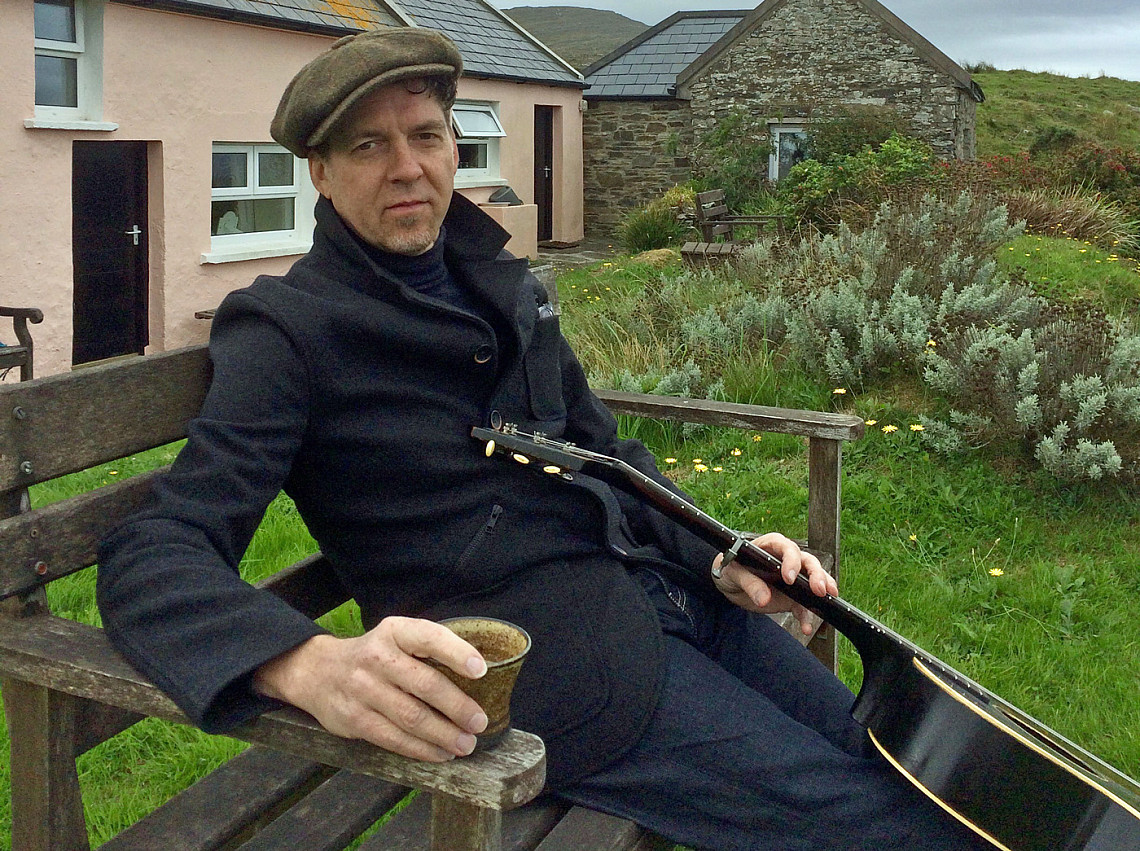
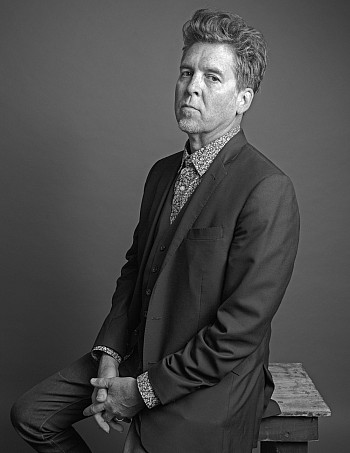
 If you listen to much music that's broadly categorized as Americana, you've already heard Joe Henry's work. If not as a solo artist, more than likely as a producer. He's worked with Bonnie Raitt, Elvis Costello and Joan Baez, which are just a few names on his long list of esteemed credits. However, Henry is also a thoughtful singer-songwriter who has released nearly 20 solo albums to date, including his 2022 release, All The Eye Can See.
In conversation, Henry is just as considerate and literate as is his music, and he took time out of his busy schedule to talk about his unique art. Aside from sharing the stories behind the songs on his new album, he told us how jazz great Ornette Coleman helped him channel Richard Pryor and why renowned Americana producer T Bone Burnett has had a lasting impact on his career.
 Dan MacIntosh (Songfacts): On the new album, All The Eye Can See, there's a song called "Karen Dalton," and I'm embarrassed to admit I didn't know who Karen Dalton1 was. What circumstances led you to write a song and then name it after her?
Joe Henry: Well, first of all, you shouldn't be embarrassed, you should be delighted that at this point of your life, there's still incredible artists to discover. As far as what inclined me to write a song titled after Karen, it wasn't the plan. It was in December of 2020, when my wife and I were making the drive across the country from Los Angeles, where we'd been living for 31 years, to the Midcoast of Maine, where we now live. I was at the wheel late one evening, driving through Nebraska, my wife was asleep. I just heard the beginning of a song start to unspool in my mind as I was driving. I try to be a faithful custodian and then just listen to it speak.
I didn't know how I knew it concerned Karen Dalton, but when I wrote a song singing in first person as Richard Pryor on my Scar album in 2000, I didn't know that was Richard either until I was pretty deep into it and just understood in some instinctual way that it was Richard that was speaking. And though I'm certainly not telling a story of Karen Dalton - it's not "The Ballad of Karen Dalton" - somehow the tension of that particular narrative, even though it's not a linear narrative, I still hear every piece of creative work as a story. She came to mind right on the heels of it, and I understood that it somehow involves her and an idea of living your life very far out on the fringe, very, very high up on a tightwire. It was just something I understood. It wasn't anything that I planned.
Songfacts: Let's talk about "Richard Pryor Addresses A Tearful Nation," which features Ornette Coleman.2 What's the story behind how he became involved?
Henry: I was driving in Los Angeles coming home one evening and started to hear the song take shape. I was singing aloud when I heard it in the car without any real notion of where it was going. And I'm certainly never trying to drive a song. I'm trying to follow a song. Always. And in an instant, I understood that although I was singing I, I believed that I was singing as Richard.
The next day, when I was in front of a piano and trying to get after the song in earnest and see what I could do with it, there was a moment as I played through it that I thought, Wow, I'd love to record this as sort of a languid orchestral blues, in the spirit of Duke Ellington. Not an electric-rock, blues conceit, but in a very lush and languid way I wanted to incorporate orchestration.
The very next day, the man who was my musical lawyer at the time in New York called me in Los Angeles, and we talked about whatever we needed to talk about and then he quite excitedly said, "Hey, by the way, you'll never guess who I'm having lunch with today."
I said, "Who's that?"
"I'm having lunch with Ornette Coleman."
I said, "No kidding. Listen, I know this is a first meeting and you've got to establish whatever relationship you need to establish, but if it goes well, I'm gonna ask you to deliver a letter for me to him because I think I need it."
I was emboldened by the fact that so seamlessly in the course of my journey with that song, Ornette just sort of stepped into my frame, or at least near enough that I knew that I could get a letter to him and be heard. I was very thoughtful in the letter that I wrote, wanting him to understand why I was reaching out to him and what I thought I might accomplish by inviting him in. I sent him a copy of what was my most recent record, which was Fuse.
I got a call back a short time later from a woman in his crew, who said, "Look, Ornette doesn't play sideman to people. He's been asked by everybody. He feels like if he said yes to you, and no to someone else, it's like he's judging the music and he never wants to do that. So, he's gonna keep doing what he's doing. You should keep doing what you're doing, and he wishes you the best."
I said, "Perfectly fine. I appreciate the call."
And then a weekend passed and the same woman called me back and said, "I can't believe I'm calling you. I've never made this call before, but Ornette spent the weekend listening to your record that you sent him and he says he understands exactly why you want to work with him, and he'd be delighted."
It was as simple as that. From then on, I recorded the bulk of the song in Los Angeles in a live session, but all of us involved in that would have been Marc Ribot and Brad Mehldau and Brian Blade and David Phelps. We all played leaving room in whatever way we could for the specter of Ornette to walk through the frame of the song's picture, because we knew he was going to be there ultimately, and that we had no idea what he would do. I had no idea what he would do other than be Ornette because he didn't know any other way. And he surpassed every expectation I had for what he might bring to the table.
Songfacts: How exciting is that! Now, Fuse was produced with Daniel Lanois3 and T Bone Burnett.4
Henry: Well, not exactly. I produced it. Dan mixed a song and T Bone mixed a song.
Songfacts: Okay, so they weren't as involved as you were, but I mean, those are two heavyweight producers and now you've become quite the producer yourself. Are there any things you learned from working with them that have stuck with you as a producer that you've applied to your own work?
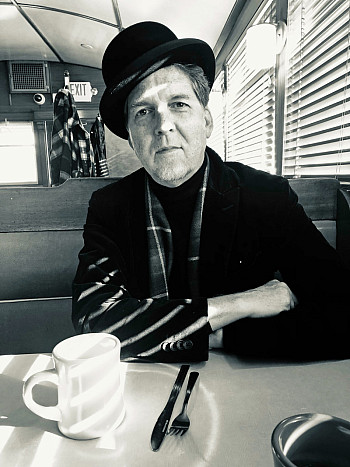 Henry: Well, Dan not as much, although I respect him terrifically as a producer. My wife5 was his manager for a dozen years, so I have known him for a very long time, though I don't see very much of him anymore, especially having moved across the country.
 T Bone, on the other hand, has been my mentor nearly my entire professional life. I don't think I would be producing records for anybody other than myself had it not been for T Bone. We're still involved together, and he produced a record for me in 1990. But he involved himself in my life even before we met. When I first sent out a handful of demos, I sent one to T Bone, very naively just addressed it - T Bone Burnett, care of Warner Brothers Records, Burbank, California. Now I understand how ludicrous it was for me to expect that he would receive it, but he did receive it, and he responded to me very warmly and encouragingly.
Years went by, and he was at A&M Records in New York, where I was signed at the time, and he overheard my A&R person talking to somebody else about the record I wanted to make and why they just couldn't let me do that, because I was a young person and clearly didn't know what I was doing, and that it would never sell. T Bone overheard this conversation and just said, "Oh, oh, that guy? Oh, man, he's great. You should let him do what he's doing. As a matter of fact. I'll help him do it." And he ended up producing my Shuffletown album.
My wife and I moved to Los Angeles shortly thereafter, and I went to work for him as a production acolyte. As his associate, he invited me in to help him with some projects. He had numerous going at the time, and he, for whatever reason, thought I would be good at it. And he's been one of my closest allies and friends ever since.
Songfacts: Are you able to pinpoint what makes Burnett such a great producer?
Henry: One of the most critical things that make T Bone's records so vivid and human and humane is that he's an excellent casting director. He knows what musicians to invite into the room. He never tells anyone what to play. He just encourages what's happening as he hears people making choices that are illuminating, and then anybody else who's hearing that being encouraged becomes influenced by that, like, "Oh, let's move that way." But I would say the most primary thing is that he regards music and songs, in particular, to be sacred, as do I.
Songfacts: I read that your parents were described as devout Christians, and I noticed even on the new album, there's the song "God Laughs," and another called "O Beloved." There's a spirituality that continues to run through your music. Is it a spiritual experience for you to create and write songs?
Henry: Of course. I think life is a spiritual experience. I'm a believer that we are all spirits having a human experience, but I don't regard myself as a Christian, per se. There are things to be learned from every religion in the world that has ever existed. Every religion that's ever been developed by mankind is an attempt to deal with a couple of very basic ideas. Most significantly, how do we live? How are we going to live robustly, knowing that one day we will cease to be? How do we hold and live the truth, that there are many more things that connect us than separate us? I think every world religion, at its core, means to grapple with that very critical border between our own humanity and then where we go from here. And in what way we impact each other's lives.
Songfacts: What can you tell me about the title track of the new album, All The Eye Can See? Why do you think it represents the album?
When I hear the title now, All The Eye Can See, there are two things that are alluded to. There's everything that we can see, and then there's everything that we cannot see. Because when we say, "All the eye can see," that might also mean, "Well, that's all we can see from here," which might not be very much at all, right? And we're always trying to reconcile ourselves with what we can fully understand and what is completely beyond us.
I've written a number of songs over the course of my working life where I believe that I'm honoring the architecture of the Great American Songbook standards as opposed to things I write that are based more in traditional folk idioms. I think everything is folk music, ultimately, but I'm a Sinatra freak and I listen to a lot of old jazz, more than anything else, just as pure nourishment. I'm deeply appreciative and steeped in those kinds of melodic ideas that those songs represent. "All The Eye Can See," even though my delivery of it is decidedly folksy and earthy, leans more in its sensibility towards the old American Songbook standards, more than, say, a Woody Guthrie song.
Songfacts: What can you tell me about the little boy pictured on the cover?
Henry: It's a photograph that I've owned for probably almost 30 years. It was a gift from a friend, Patrick McCarthy, the recording engineer from Ireland who's done a lot of work with R.E.M. and Waterboys, Robbie Robertson and U2. We became friends on the first record that I worked with as T Bone's production associate. But he gifted me that picture, and I don't know anything about it other than the note I make about it in the album notes. From what I learned, it was taken in 1913 in Ireland.
I'm just purely responding to this young lad's clear affliction. I mean, he has polio or something, yet he's carrying himself with such a regalness and a dignity that I find really moving.
Songfacts: I do see that it's kind of an odd juxtaposition. But it's about how both things are true at the same time - he's afflicted, but he also has great dignity.
Henry: Yeah, and that balance between the ways in which we are all afflicted and blessed is a tightwire that we all walk on whether we are aware of it day to day or not.
Songfacts: I'm probably reading too much into it, but it's like the title of All The Eye Can See, we're kind of handicapped by human limitations.
Henry: I hadn't thought of that, but I would never tell you that you read too much into it. I read into everything. As my son says to me, "You know, Dad, you're always looking for signs." And I say, "Yeah, but I'm always finding them."
Songfacts: Yeah, there you go. Is that the son that plays saxophone?
Henry: My only son, yes. I have a daughter as well, but my son, Levon, is one of my most significant and trusted collaborators and has been for years now.
He's a beautiful writer, arranger, songwriter, and singer. Although for my own purposes, I employ him as a reed player and arranger. I can't ever imagine making another record of mine that wouldn't involve him in some way. And he's on many records that I produced as well.
Joe Henry didn't watch the 2023 Grammy Awards, so he didn't see when Bonnie Raitt, a former collaborator, won three trophies for her work on Just Like That…. The title track, a poignant story of a mother meeting the recipient of her son's heart, won Best American Roots Song and, surprising everyone, the all-genre Song of the Year. The single "Made Up Mind" also won Best Americana Performance.
Henry and Raitt worked together on producing Raitt's 2012 Slipstream album, which also included two tunes from his Civilians album, "You Can't Fail Me Now" and "God Only Knows." They collaborated again on the follow-up, Dig In Deep (2016), for which he wrote and produced the track "You've Changed My Mind."
Songfacts: You have great taste when you take on assignments, but one of the ones that really stuck out, especially this week, is that you produced Bonnie Raitt's Slipstream album. Since you've worked with her, are you surprised that she has that ability to write so well?Henry and Raitt worked together on producing Raitt's 2012 Slipstream album, which also included two tunes from his Civilians album, "You Can't Fail Me Now" and "God Only Knows." They collaborated again on the follow-up, Dig In Deep (2016), for which he wrote and produced the track "You've Changed My Mind."
Henry: No, I'm not surprised at all. She has written some beautiful songs throughout her career. In fact, I've written a song for her, and I've written a song with her. She's remarkable, and I'm just so incredibly proud of her and pleased. Pleased is too soft a word for it.
On "Just Like That," she seems so inside for what her voice can do. It's basically her acoustic guitar and an organ, and it's just really, really beautiful storytelling. It resonates with me deeply when a writer trusts us enough to not have to fill in every hole. When we gesture out to things other than trying to nail everything to the floor, we just kind of open the fences for the different ways it might be received by a number of listeners. It's almost like there's a lot of ways into them and either it works for you or it doesn't. I certainly try, and I recognize Bonnie trying and succeeding in this case where if you pay attention, you absolutely know what's going on. She leaves enough doors and windows open that there's more than one way into the house.
March 6, 2023
For more information about Joe Henry, visit joehenrylovesyoumadly.com.
More Songfacts Interviews:
Daniel Lanois
Maria Muldaur
Gary LeVox
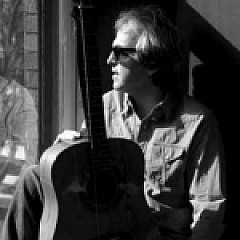
Photos: Melanie Ciccone (1,3), David McClister (2)
Footnotes:
- 1] Dubbed "the folk singer's answer to Billie Holiday," Karen Dalton was a country-blues singer who was part of the '60s Greenwich Village scene alongside Bob Dylan and "Everybody's Talkin'" songwriter Fred Neil. She released two studio albums: It's So Hard To Tell Who's Going To Love You The Best and In My Own Time. (back)
- 2] Ornette Coleman was a jazz saxophonist and composer who was known as the founding father of the free jazz genre thanks to his innovative 1961 album, Free Jazz: A Collective Improvisation. (back)
- 3] Canadian producer Daniel Lanois is known for collaborating with Brian Eno on several U2 albums, including The Joshua Tree and Achtung Baby, and Peter Gabriel on his hit 1987 album, So. (back)
- 4] T Bone Burnett is a renowned Americana/roots-rock producer who was integral in launching the careers of several acts, like Counting Crows, Gillian Welch, Los Lobos, and Sam Phillips. He also helped ignite a bluegrass revival with his work on the Grammy Award-winning soundtrack to O Brother Where Art Thou. (back)
- 5] Henry's wife Melanie is Madonna's sister. In addition to being her brother-in-law, Joe has also been her co-writer. They teamed up on Madonna's songs "Don't Tell Me," "Falling Free," and "Devil Wouldn't Recognize You." (back)
More Songwriter Interviews