 Vanessa Williams had a hard time finding songs when she fired up her music career in the late '80s, a few years after turning in her Miss America crown. Williams was found to have posed naked when she was 19, a scandalous offense in 1984. The top songwriters and producers wanted nothing to do with her.
Enter Kipper Jones. Trained at Motown, he was in an R&B band called Tease that had recently split up. With his Tease bandmate Rex Salas, he wrote "The Right Stuff," Williams' first single and the title track to her debut album. It was a #1 Dance hit, starting Williams down a path that left the Miss America dust-up a mere footnote in her career as a singer and actress.
A few years later, Kipper's songs launched another soon-to-be superstar: Brandy. He co-wrote three of her first four singles, including her debut, "I Wanna Be Down."
In this wide-ranging discussion, Kipper tells the stories behind his hits and breaks down his creative process, with some detours along the way to talk about his time as a Soul Train dancer and what happened when he met Rick James.
Kipper Jones: Here is the oddly serendipitous part of it. In 1983, when she was Miss New York and a Miss America contestant along with Suzette Charles, who was Miss New Jersey, it was a historic thing. They were talking about these Black girls that could be Miss America.
I was in the breakfast room of my grandmother's house watching and going, "I've got to know her. I've got to know that girl right there." Well, later that night she won and became the first Black Miss America. Then, all the rest of life happened, and I heard she was working with a bunch of people on some music she wanted to do. She was working with George Clinton, and I'm thinking to myself, that's an odd pairing.
I was working with a publisher at the time who had a connection with a gentleman named Ed Eckstine, who was the president of Wing Records, which was a Mercury subsidiary, and he had just signed said former Miss America and was looking for songs for her. Now mind you, five years prior, I'm freaking out, going, "I've got to meet this girl," and then I get a call from this publisher who was like, "Hey, man, Ed Eckstine wants to know if you might have a song for this Vanessa Williams girl." And I'm like, "Absolutely I do! Are you kidding me? Of course I do."
I didn't. But it's like I tell the kids all the time: Whenever they ask you, say yes and get it on the way to the meeting.
So I spent the time between the question and the meeting putting together a song for Vanessa, what I thought Vanessa Williams should be doing.
I'm a former Soul Train dancer and I had the most enormous and ridiculously stupefying crush on Jody Watley. She was just everything to me, and I was a huge Shalamar fan. All three of them I loved for separate reasons. I loved Jody because of her persona and her style, and Jeffrey Daniel was the best dancer ever, and Howard Hewett had the best voice ever, and they were the best group ever to me. So I'm thinking Vanessa should be in that lane. She should be this Jody Watley kind of sassy R&B chick, so I came up with this really cheeky, sassy song called "The Right Stuff." I put my best Jody Watley ears on and went for it.
Vanessa came down to the little studio where we were working at the publisher's house in Watts in LA. She was pregnant with her first daughter, and she came back and listened to the song. At that point we had two or three songs for her, but she loved "The Right Stuff." She was concerned that this was not her wheelhouse, and I was like, "Do not worry. I got you. When we get in the studio, just listen to me, listen to everything I say, and we will be fine." And sure enough, we went in, we cut the song, and she was like, "Wow!"
On the liner notes of her record, she says a special thanks to "the lick master, Kipper Jones." I'm like, "OK, I'm going to be explaining this for the rest of my life."
When we were in the studio, I gave her all the ad libs and the phrasing and all of the inflection and everything, so that's why she called me "lick master."
Jeffrey Daniel from Shalamar was one of the choreographers and stars in the video. It was a full-circle moment for me and a wonderful, wonderful experience.
Songfacts: What's going on with the French vocals in the song?
Jones: When you listen to the record, you hear the the Frenchman: "Je réside en Paris, Voulez-vous venir." That's me in my absolutely imperfect French.
Whenever I write a song for anyone, I do my best to be as involved in the vocal presentation as I can, because I write it like I want to hear it back. I'm a singer-songwriter. There are songwriters like Diane Warren, who is one of the greatest songwriters of the last century or so, but she's not a singer, so it's a different experience with her. I'm what you call a vocal producer, and I will probably be the guy that's in there coaching you through the vocal. I'm the lyric and melody guy.
Songfacts: What does the French part mean in that song?
Jones: I live in Paris, would you like to come?
And there is the lyric in the second verse:
I live in Paris, don't you want to go?
I know you must be all alone
So that's where that comes from.
Songfacts: You tell a story in that song. It's 7:15, we're getting picked up, things are happening.
Jones: Sure. It was a time when you could write a story into an R&B song. I'm a huge country music fan because that's still where stories live, and I'm just a fan of that style of songwriting.
Songfacts: I was surprised that this was the first hit song with the title "The Right Stuff." It seems like somebody would have jumped on that, especially after the movie.
Jones: It's funny, because I like catchy phrases and themes, and I try to catch them before anybody else does. But I was surprised too. Then there was Backstreet Boys, which had one I guess a little after us.
Songfacts: I think you're thinking of New Kids On The Block.
Jones: Same thing.
Songfacts: Ha! Backstreet Boys were like a decade later. I take it you're not a boy band fan.
Jones: First of all, that phrase "boy band" is such a misnomer. A band is, to me, a group of musicians. You want to call them a "boy group," fine. But "boy band"? How dare you? I grew up in bands and it was an insult. We worked long and hard and played four-set gigs in smoky, nasty dives to be called a band, and these guys who are put together and don't even know each other and make a gazillion dollars get to be a band? No!
Songfacts: You have some samples in the song. This was 1988, which was a precarious time for that because I don't think anybody was clearing samples. What was the deal with that?
Jones: People were still figuring it out. It was early in the game. Two years later I did a solo record for Virgin and I was sampling anything and anybody. I never got any cease and desists because the whole sampling phenomenon was in its infancy, so people didn't know how to clear samples or know how to go after people who were using their samples. It was just a different time.
Now, that mix you hear with the "get on up" and all that stuff was a mix that Hank Shockley of Public Enemy fame made. He did that mix with the James Brown samples and the Keith Sweat samples and everything. That was the kitchen sink. That's the version that ended up being the single.
Songfacts: You released your own album in 1990 and you even made a video or two. What happened there?
The album I did for Virgin was called Ordinary Story. It was a critical success. USA Today rated it very high - one of the best R&B records of the year. The LA Times gave it a glowing review. But commercially, we just didn't get the push. There was some infighting between the promotion department person and the A&R person who was doing my project but didn't sign me to the label. The person that signed me to the label left during the making of my record, so I didn't really have a champion at the label, and those things are important when you're at a major record label.
I'm so happy to be alive during this independent period where you don't really need that anymore. If you can put a team together and decide to work hard for yourself, you are your own record business now, and that, to me, is much more appealing than being left to the wiles of major record companies. If you're just the stuff that they throw against the wall to see if it sticks, it can be really horrible, very disenchanting.
So after that first record with the great reviews and all that stuff, it sold about 12 copies. I was like, "Yeah, let's not do that again."
Songfacts: Well then Vanessa Williams comes with her next album and you've got the title track.
Jones: I was always writing. I was writing for Tease in '86 and '88, and then I did Vanessa's record in '88 as well. Then while I was still writing and working on my record, I did a couple of songs for a movie called The Five Heartbeats, which was also a Virgin Records release, so that was very cool. I did a song called "In The Middle," and then they culled a song from my album that's also in The Five Heartbeats - it's not on the soundtrack but it's in the movie - called "Carry On." So all the time I'm still writing, and then Ed, because "The Right Stuff" was such a great success and her first record did really well, he called and said, "Hey man, let's get started on this second record. Let's take a meeting with Vanessa and see what's up with her."
That's become part of my songwriting MO. If I'm writing for you, I want to talk to you. I want to sit, get in your head, get your speech pattern. I want to know what you're talking about right now, how you're feeling. What are you passionate about right now? All those kinds of things because I want to write from a standpoint that you, who has to convey the song, feel very comfortable and feel like you can deliver it. If I don't believe you, then we shouldn't be doing this.
So we got with Vanessa, sat and talked to her, and I was like, "How you feeling? What's going on?"
She's like, "I'm just good."
As a matter of fact, we went to the set of a movie she was filming with Richard Pryor and Gene Wilder called Another You. We had a conversation in which she said, "You know, everything in my life is very cool right now. I'm in a really comfortable place."
And I said, "I got you. We'll see you in a couple of days."
So I went back to the producer that I was working with at the time, this young man named Reggie Stewart, and Reggie and I worked with this very Soul II Soul-ish beat - Soul II Soul was really hot at the time. Vanessa had just turned me on to Omar Lye-Fook from London. We were both into that Euro-soul sound.
So Reggie came up with the track, and that evening I wrote "The Comfort Zone." We took it back to her and she was like, "Yes, and let's do it."
Songfacts: You did another song on the album for her as well. "Freedom Dance."
Jones: I, at that point, was really delving into this whole dance music thing. House music was getting really big in '86 through '90. Madonna had done "Vogue" at that point. I told Reggie I really want to do a dance record with Vanessa. She's got a big gay following that is a dance-crazed audience, and she needs to address that audience, so he came with this track, and I didn't quite have a lyric for it, but one morning, I woke up and Nelson Mandela was being released from prison. And "Freedom Dance" was born.
That's where the lyric came from, but then it was also about how I was a very closeted gay kid. I didn't know how to do any of that, and I didn't have any tutelage, so it was also a cry for help. All these years later, "Freedom Dance" is a huge LGBTQ anthem, and I didn't even know that's what I was doing when I was doing it. But that's what I did, and it is, and I'm so happy and honored by that. If it helps anybody, then great.
Songfacts: It's almost like your subconscious was telling you what to do.
Jones: Absolutely. It was prophetic in a way. Like I was being used as a vessel to do it.
Songfacts: When you were talking about "The Comfort Zone" and how you talked to Vanessa, she was in a good place, and that inspired it, that puts an interesting perspective on the song because a lot of times you think about getting out of your comfort zone, but there's also something to be said for getting into your comfort zone.
Jones: I'm writing it for an artist, but there's still a lot of me in it. At that point in my life I was desiring for something settling, something familiar. Something safe. That was my impetus. My destination was to point to someplace safe.
Where do you go when there's a need to be loved like you need to be loved?
I'll let you know just what to do and where to go.
Now, we're in the new millennium and we know that if we stay in our comfort zones, we never get what we want out of life. But this was a different time, and it was OK to be in a comfortable and familiar place. It's a destination I think a lot of us still strive to find. You don't always have to bust out of your comfort zone. Sometimes you need to find and seek comfort.
Songfacts: Well, you think about what Vanessa Williams went through, and that song almost sounds like her epilog, like she was able to overcome all this stuff and now she's enjoying it.
Jones: She's such a classy individual. She's never sought retribution. She's just a classy lady who has played the cards she was dealt, and played her hand, superlatively, and with class and grace.
Songfacts: Tell me about the open of that song. There's some crazy sound design where she turns on the radio and "I Heard It Through The Grapevine" comes on. What's going on there?
Jones: You're turning on the radio and you're turning the dial because you're just looking for that comfortable place, and she lands on it when the guy goes, "Hey, check this out." Bam! You're there.
You hear this woman say, "Bienvenue dans la zone de confort." Again, the French voice, but I didn't want to do it this time. I had a friend who was a French teacher, and I called her up and asked her how you say, "Welcome to the Comfort Zone," in French. She's on the phone, and she goes, "Bienvenue dans la zone de confort," and I recorded it. We put it in the record.
Songfacts: And then you have the flute in the song.
Jones: Our engineer, the enormously gifted Mr. Gerry Brown, had an idea. He wanted a flute solo, and he had a connection with Hubert Laws, the legendary jazz flautist. He called Hubert, who said, "Sure, I'd love to do it," and came over and knocked it out.
I like the whole orchestration of it. It lifted it and took it somewhere else. That was a cool call for Gerry to make.
Songfacts: You talked about how you like to talk to the songwriter, get their MO, figure out what's in their head, then write based on that. Then you end up having to write for Brandy, who is a completely different animal than Vanessa Williams.
Jones: It's so interesting that you bring that around. We had done "The Right Stuff," sold a million records. Then we did The Comfort Zone where Vanessa has this enormously successful record called "Save The Best For Last." So with this second record, we're Double Platinum. At this point, I'm writing with a few different people around town, still living in Los Angeles, and one of the people I was writing with is my dear friend Keith Crouch. I went by his apartment this one particular day, and this track he was playing, I was just, "Oh my God, that is mesmerizing. What is that?"
He says, "I don't know man, just something I'm working on." So I went and got my book and came back in and came up with the line, "I wanna be down." So, Keith, his brother Kenneth, the soul legend Rahsaan Patterson, and a bottle of Hennessy were just traipsing around the room singing, "I wanna be down... with what you're going through."
We were like, "Yeah, that's great." I said, "I'm going to step in the other room and try to write some verses right quick." I went in the other room and came up with, "I would like to get to know if I could be..."
I just wrote one verse, went in, put the verse down, and Keith just stopped the recorder and we all looked at each other like, "This is special." It was a really dramatic pause, like, I think we got something.
So we finished the song, and all this time I'm thinking, we sold a million records with The Right Stuff, two million with The Comfort Zone, we are going to sell three million records of this song with Vanessa like it ain't nothing.
I was all set to be cutting it on Vanessa and then Keith calls me. He had a manager at the time named Darryl Williams who was also an A&R rep at East West records, which was an Atlantic Records subsidiary at the time. He said, "Listen, we just signed this little girl over here who I think would do a smash job at that song. Why don't you just let us demo it and see how she does?"
And I got to tell you, I was "feeling myself" as they say, at that point in my life and career, as a 32-year-old man with a Platinum record and a Double Platinum record with Vanessa Williams. I was like, "I don't want some unknown little 14-year-old girl singing my song, bruh. I got Miss America over here."
Keith was like, "Kipper, stand down, let the girl demo the record and check it out."
So he takes her in, they cut the record, and he let me hear it. I literally said, fuck me, because there was no way in the world this voice was 14 years old.
Unbeknownst to me they had already played the song for [Atlantic Records executive] Sylvia Rhone, who said, "Yes, absolutely yes, and can we have another one?"
I didn't tell this story to Vanessa until about three or four years ago. Her career was going in a different trajectory. "Save The Best For Last" was a whole 'nother thing. Her audience became something else. Her entertainment schedule became something else. She became a superstar, and she wasn't pressed about doing another R&B record, that was not even a thing for her at that point.
Brandy, from what I understand, they had finished her album already, so when they took "I Wanna Be Down," they took somebody else's song off the record and put that song on the record. Then they asked us for another one, so Keith, Rahsaan and I wrote "Baby," which of course they took right away and took somebody else's song off the record. I ended up having four songs on that record, Keith had five all together, and then Kenneth had one too, so from our camp, there were six songs that were taken off of that record and our songs were put on. We ended up selling like five million albums, and some of those other producers on that record have gone on to be enormously popular and prestigious. Damon Thomas at that point was producing by himself, but then he teamed up with Harvey Mason as The Underdogs, who went on to have enormous success. Harvey Mason Jr is now the president of the Recording Academy. Also on that album was a 17-year-old Robin Thicke. It was an enormously fun record to make, and a record-breaking record. The second single off of that album, "Baby," was the fastest-selling single in Atlantic Records history. That's because if you wanted the remix of "I Wanna Be Down," which has Queen Latifah and MC Lyte and YoYo on it, then you had to buy the new single, which was "Baby," and it just shot to #1.
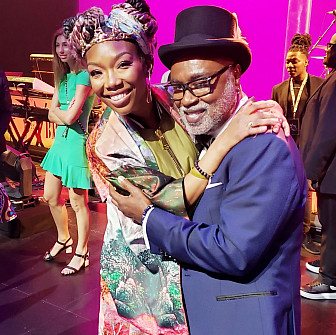 Kipper and Brandy in 2019. Photo from Kipper's collection.
Jones: Oh, it was out of here. It was crazy. When Keith first played it to me I was like, "That's crazy." I think Dana - Queen Latifah - was the only one who requested publishing for her contribution. She said, "If you want me on it, this is how it's going to be." And she killed it. It was certainly worth it.
Songfacts: It's interesting how you wrote this song without thinking it was going to be recorded by a 14-year-old, but it does sound like something a teenage girl would say to her friends. It's hip, but not too edgy, and it worked really well.
Jones: Absolutely. That was a very serendipitous outcome, but from then on, writing for her took a very serious turn because in 1994 I'm a 32-year-old man and she's a 14-year-old girl. What in the hell am I doing writing for her? How do I come up with a ballad for this very soulful-singing 14-year-old girl? It was a tremendous challenge, but one I think we really rose to because when we came up with "Brokenhearted," which was the biggest challenge because Sylvia wanted a ballad for her, understanding that this little girl is more soulful than most adults, and subject-matter-wise, we had to play to her audience, which was other 14-year-old girls.
When you write for someone, you do an assessment: Who are they? Who is their audience? What is the message they're trying to convey to that audience? What is the call to action? And with Brandy, her audience was other 14-year-old girls. And what do 14-year-old girls talk about? School and boys. When they talk about boys, what's the deal? Well, they get their hearts broken. So then what is the call to action? You get your heart broken, but you get over it, and that was the message we wanted to convey: [sings] "Well, I guess I'm lonely, brokenhearted. Life's not over. I can start again."
Her mother just absolutely loved it. Those are the kinds of things I would like to see more young people saying to each other. Even then, and especially now, I think a lot of the messages are less than helpful.
Songfacts: Did you know Wanya Morris was going to be on the track?
Jones: Wanya was not on the original version. I toured as a background vocalist with Babyface in '95. It was Brandy, Boys II Men and Babyface. So while we were on the road with Boys II Men, Wanya came and was like, "Kipper, I want to do a remix to that 'Brokenhearted' song. I love that song."
I'm like, "Hey, man, that's a great call but it ain't my call. That's that's a label thing - you gotta take it up with them." So he did. He got in touch with Darrell and they got in touch with Soulshock & Karlin, who I was also doing a lot of writing with at that time, and they did that remix.
That remix was part of the Boys II Men greatest hits collection, and on Brandy's greatest hits collection.
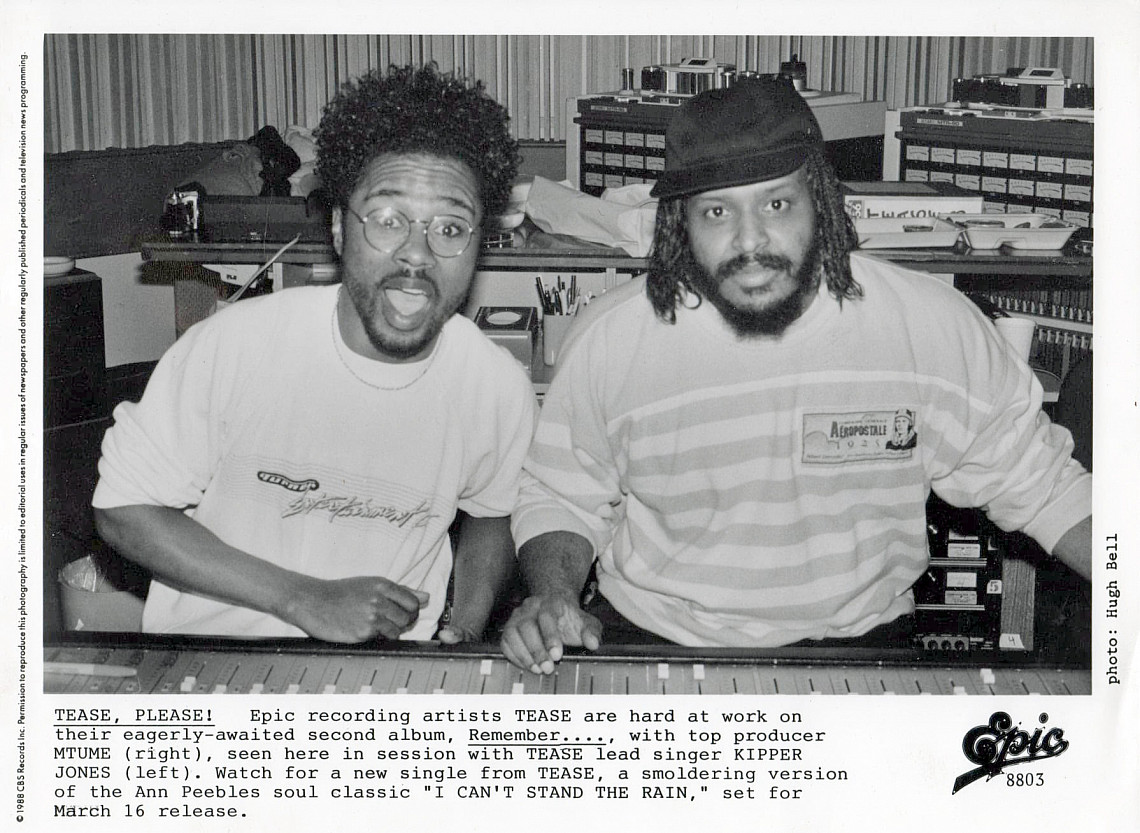 Kipper Jones and MTUME in 1988
Songfacts: Getting back to "Baby," it's a fairly simple song, but it's one of those songs that just gets in your head. I read about how you had some Motown roots, and I was thinking of The Supremes used to do that all the time.
Jones: Every time I'm writing, everything, that stuff is always in my mental Rolodex. My first job was as a Motown demo singer for Marilyn McLeod and Pam Sawyer, who were a hit songwriting team. They wrote "Love Hangover" for Diana Ross and "Walk In The Night" for Junior Walker. I got a chance to watch them work in the Gordy method and soak it up.
Some of my favorite records I refer to not just lyrically, but stylistically, like "Itching In My Heart" from The Supremes and "Tears Of A Clown" by Smokey Robinson. Those are pillars. That's just fundamental songwriting stuff that I'm so glad I have it in my toolkit.
But but with "Baby," that guitar sample, which is crazy, is Glenn McKinney, now Pastor Glenn McKinney of the St. Stephen's Church of God in Christ in San Diego, California. He's a hell of a guitar player, and that's a really interesting signature. Sonically, everything we did on that album is not like anything else that was happening at the time. When you listen to "Best Friend," "Want To Be Down," "Baby," "Brokenhearted," when you hear the bass, that sub is like nothing else that was happening at the time. It was in the era of New Jack Swing, so that record stuck out like a sore thumb that you were trying to slam your thumb in the door because it was so good and there was so much sonically about that record that stood out. Maybe people weren't aware of it, but they were drawn into it.
Songfacts: What is the Gordy method of songwriting?
Jones: Say you've got $2. Are you going to buy a sandwich, or are you going to buy this record? Gordy would ask that question in a roomful of songwriters and producers, and if the answer was "sandwich," he'd say, "OK, next."
You have to get your product to a level that makes somebody have to have it. That was his quality control.
When I say "the Gordy method," that's what I call it because that's how I see things. I don't like to write a song that doesn't have a bridge - it doesn't feel finished to me. I think a song has to have a melody. Especially in the '90s, there was a lot of Jagged Edge, Jodeci, just begging and pleading and singing. They were singing the lights out, but there were no melodies, and melodies are key to me. And what's the story? Who are you talking to? All those kinds of things.
I'm also a student at Berklee College of Music in the music business degree program, and I've had a creative writing class where you talk about person and tense and those kinds of things, and it's funny because I've always done that because it was taught to me as the proper thing to do.
Songfacts: Seems like you should be teaching at Berklee, not taking a class.
Jones: God bless you. That's my aim. I want to end up in the classroom.
Songfacts: You were talking about how in the '90s you had Jodeci and these scorching R&B hits that didn't necessarily have melody. One you came up with that did is a song you did for Silk called "Hooked On You." Can you talk about that?
I didn't know we were writing for Silk at the time. We just wrote this song: [sings] "There's no living without you, got me hooked on everything you do."
Soulshock & Karlin were very melodic, very musical in their creative process so a lot of the stuff that we did during that time was very melodic. I think that song ended up going to Silk well after we finished it.
Songfacts: It's one of those heartbreakers where the girl is treating you wrong, but it doesn't have that languor to it that you get with a lot of those songs.
Jones: Yeah, it's got a little lilt to it, so it's kind of happy. You got shot, but you're happy about it. That's a weird place to be.
Songfacts: Especially in the '90s, the R&B world was very heterosexual. Was that a challenge for you?
Jones: Yes. Heteronormativity and toxic masculinity and all of those kinds of things were headed on a collision course at that time. Yeah, I get it. Everybody has a right to express themselves, I just feel like not at the behest or degrading consequences of another.
So I saw that coming and it was hard for me. I didn't fit in, in a lot of modes, and I think that's what started to shut me out. After the late '90s, you don't see my name on a lot of records. The atmosphere was not conducive to being creative to me. I just wasn't getting it.
Puffy flew me in to New York to work with a group of girls he had. I went in the studio with them, and I was trying my best to write for them, and it wasn't working. I was like, "This is not what I do. I don't get it."
Puffy called me in because he heard "I Wanna Be Down" and he thought that's what he would get. That's what I was trying to give him, but the group that he had me working with, there was not a singer anywhere near Brandy's level who could execute anything like that. That's what I was trying to write, and he came in and he said, "Oh, you're trying to write for a singer. Nah, I need you to do something more like she's talking to somebody."
I was like, "Yeah, I don't do that."
It was more of a hip-hop thing. I was a hip-hop fan, but it wasn't something that I had invested myself in creatively, so I didn't really know how to do that.
That group ended up being Total, who had enormous success with Biggie and all that kind of thing, but that just wasn't my get down. I discovered that there's a certain thing that I do, and it doesn't work for everybody.
Being in this independent era has been so cool for me because I work with who I want to work with, when I want to work with them, and that can be musically very vast. There's a guy here in Atlanta named Joe Gransden who has a 17-piece big band. I wrote the title song for his last album and arranged the horns with his horn arranger, Wes Funderburk. I'm working on a group right now called The Black Bettys. They are twin sisters from here in the Atlanta area, and they are amazingly talented. I'm having the time of my life writing for them. It's a more clear channel now than to have to work in the major-label atmosphere that's high pressure, low pay.
Songfacts: What was it like being a Soul Train dancer?
Jones: High anxiety. But it was enormously fun. Soul Train, for a young Black kid who grew up in the '70s, it was everything. It was where you saw yourself. It's where you got your identity. It's all we had. Bandstand had been around since the '50s, but we didn't get Soul Train until 1971.
It was almost like a rite of passage. As a young Black guy growing up in South Central LA, it was an enormous mark of success to say that you danced on Soul Train. It was a big deal to stand outside those gates and get chosen to go in. There was a talent scout who stood at the door - Chuck Johnson was the guy - and he decided who would get in and who wouldn't, much like Studio 54. The difference is, these are kids.
You were dancing for a box of chicken and a soda every weekend, and it was all you could do to just be there. It was beautiful and legendary and it was Black history. I'm just honored to have been a part of that. I am so grateful to the person of Don Cornelius. I hate the fact that he took his own life because I don't know if he was ever told how important he was to Black society in particular and what a big deal he and his vision were for us.
Songfacts: From what I understand, when he moved the show from Chicago to Los Angeles, he was shocked at the kind of dancing you guys were doing, and he was really put off by it at first.
Jones: Stylistically, I'm sure it was a shock. In the early '70s in LA they were already doing locking. I came in 1980 when I was 18, and at that point it was a well-oiled machine.
On Soul Train, I was in the same room with Rick James and Teena Marie, which is interesting because my first night as a Motown demo singer, when I got the gig, my mom took me to the studio and my little sister was with us. We get there and this big studio door opens and all this smoke comes out, and who is it? Rick James. He saw my sister, who had broken her finger and had a finger splint, and he goes, "Oh, hey Mama, what happened?" She's like, "I broke it."
So, he leans down and kisses her hand, and my mother's like, "Oh, get him away from me." She's disgusted by the whole thing, but I'm so excited I'm about to bust. So he says, "Hey, y'all got a second man? Come here, I want you to hear something."
We go into his studio and it smells like all the marijuana in the world. My mother is just fit to be tied at this point. He says, "I want y'all to meet somebody," and it was Teena. They were working on "I'm Just A Sucker For Your Love." He let us hear it and he introduced me to Teena, who I was friends with until the day she died.
You hear me say the word serendipitous a lot, because it's been a charmed life. There have been very, very difficult moments, but it seems like I'm always in the place I need to be in to do the job I'm supposed to do and meet the people I'm supposed to meet.
Songfacts: I just have one last thing for you, Kipper. Is there a song that you spent a lot of time deconstructing, trying to figure out how it was made, that informed the way you ended up working?
Jones: Yeah, it is a song by a young man named Mykal Kilgore, and the song is called "The Man In The Barbershop." It is a song about a guy who sees another guy in the barbershop and goes, "This is the guy I want to spend the rest of my life with, but it'll never happen." It is the most unrequited, honest piece of music I have ever heard in my life and it thoroughly made me go back and re-examine everything I've ever written. Like, why did you say that if that's not what you meant?
That song is just an enormous testament to the power of music, and I told Mykal that. I'm so grateful because now I know I can be just as authentic and just as honest in my approach to songwriting from now on out. I don't have to hide. I don't have to accommodate. That song really revolutionized my whole way of thinking.
March 7, 2022
Check out Kipper on Instagram
Further Reading:
Interview with Lamont Dozier
Soul Train Stories
Interview with Kristine W
More Songwriter Interviews