Kurtis Blow gets a lot more airplay these days than he did in the '80s. That's because back in the day - when the long-term viability of hip-hop was in question - only a handful of stations played rap music. Now that hip-hop is entrenched in the popular culture (with subgenres, no less), pioneers like Kurtis are rightfully celebrated, but it's not mere nostalgia: The music holds up.
"The Breaks" has everything we love about old school: clever lyrics, a party vibe, and a grooving beat that leaves plenty of space in the waveform for oxygen. It was Kurtis' big hit, but not his only one. "Christmas Rappin'" - from 1979 - was the first holiday rap song; "Basketball" is still the most popular song about that kind of ballin'. And then there's "If I Ruled The World," a hip-hop landmark that Nas brought back to the forefront with a 1996 cover featuring Lauryn Hill.
In this interview, Kurtis tells the stories behind these songs and explains how he and his crew pioneered the use of drum machines and samplers in hip-hop. He also talks about two all-star collaborations he was part of: Artists United Against Apartheid with "Sun City," and the King Dream Chorus And Holiday Crew with "King Holiday."
"The Breaks" has everything we love about old school: clever lyrics, a party vibe, and a grooving beat that leaves plenty of space in the waveform for oxygen. It was Kurtis' big hit, but not his only one. "Christmas Rappin'" - from 1979 - was the first holiday rap song; "Basketball" is still the most popular song about that kind of ballin'. And then there's "If I Ruled The World," a hip-hop landmark that Nas brought back to the forefront with a 1996 cover featuring Lauryn Hill.
In this interview, Kurtis tells the stories behind these songs and explains how he and his crew pioneered the use of drum machines and samplers in hip-hop. He also talks about two all-star collaborations he was part of: Artists United Against Apartheid with "Sun City," and the King Dream Chorus And Holiday Crew with "King Holiday."
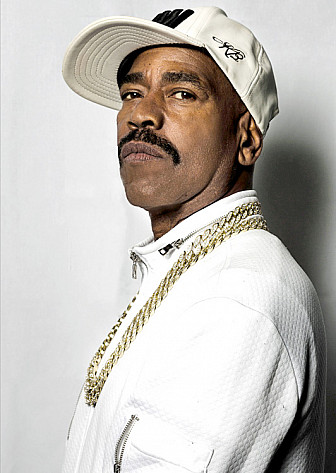 Kurtis Blow (press photo)
Kurtis Blow: The concept was created as a tribute to all the breakers in and around the South Bronx and Harlem back in the early days of hip-hop. I wanted to do a tribute song with many breaks so that the breakers could get down and do their thing, because that was the whole thing about B-boying during that time: We danced during the breaks of a song. That was our time to go off or to do our best moves, and I wanted to make a song like that.
So I took that concept to my producers, J.B. Moore and Robert Ford. J.B. came up with this idea: you have all different kinds of implied meanings. Of course, "The Breaks" was a song for the breakers, but then you had the other implied meaning of brakes on a bus or a car, good breaks or bad breaks in one's life. And he referred back to this old song, a philosophy song that came out in 1920 or something, where the guy was talking and saying, "Oh, so your girlfriend left you, and you lost your job and your car got towed away. Well, don't worry, tomorrow the sun will shine. Everything will be all right." You know, like one of those good breaks or bad breaks that could happen in one's life, but don't worry, because there's always another tomorrow.
So we wanted to repeat that concept and have the many meanings of the song. Within one song we would have different kinds of implied meanings. So that's where the concept came from.
We put it together, had the greatest musicians play on the song. John Tropea on guitar, Jimmy Bralower on drums, and Larry Smith, who went on to produce Run-DMC and Whodini, plays the bass. You also have Denzil Miller on keyboard.
It was the first certified Gold song in hip-hop, and it's actually the second certified 12-inch Gold record in all of music, the first one being Donna Summer and Barbra Streisand's "Enough is Enough" that came out in 1979.
Songfacts: Yeah, that song had a lot of firsts. How did you guys market it? There was really nothing like it in the mainstream at the time.
Kurtis: Well, there's not real marketing for the song. There was no plan. We just wanted to make a kick-ass record, and that's exactly what we did.
The clubs ate it up. You couldn't find a club in America during December of 1980 that would not play this song around midnight, 1:00 in the morning - the highlight of the night, that was your dance song.
That's what we did. Just like "Planet Rock" by Bambaataa in 1982 was the piece, and also "The Message," it was a hot, hot club song.
Songfacts: Leading up to this, you got signed to a major label, didn't you?
Kurtis: Uh huh.
Songfacts: And this was released on, what, Mercury Records?
Kurtis: Yeah.
Songfacts: I'm trying to figure out if you made this with Mercury or if you already had the song and then they signed you and released it.
Kurtis: No. I had one song that came out called "Christmas Rappin'," that was my first song. That came out in 1979, actually. It was the first hip-hop song on a major label. But not only that, it was the fourth hip-hop song ever, fourth or fifth. And "Christmas Rappin'" opened the door for my deal. I got the deal through "Christmas Rappin'." They gave me a two single deal with the option that if I was successful with both singles, then I would get an album deal.
So the first single went Gold, the second single went Gold, almost Platinum. And so they had to give me an album deal. "The Breaks" was the second single. "Christmas Rappin'" became an annual classic and sold every Christmas.
Songfacts: Do you remember what it was like writing that song, coming up with it?
Kurtis: J.B. Moore wrote the first half of the song, the Christmas part. And I did all of the party part, the second half of the song. I wrote all of that on a train ride on my way down to the studio.
Songfacts: Was it around Christmastime?
Kurtis: It was around Christmastime. Yeah, it was December. We released the song December 19th, so I guess it was early December.
Songfacts: I saw that was sampled on "Too Close" song by Next.
Kurtis: Yes. It was. And also won ASCAP song of the year in 1999.
Songfacts: Yeah. That was a big ol' song.
Kurtis: Number 1 hit in 1999. I think it was eight or nine weeks on Billboard's pop chart #1.
Songfacts: And then you had a song a few years later, "Basketball."
It was a pleasure working with the NBA back in the mid-'80s. I remember going around doing shows for the NBA during their basketball games. Like, say the Atlanta Hawks would play the Cleveland Cavaliers. That was before Lebron James, of course. They'd have maybe in attendance 7-10,000 people in a 25,000 seater.
So I'd come in, do a show after the game, and they would sell out. And I'm doing 10, 12 of these shows. So I got to meet a lot of the players. I met the Ice Man, I met Dr. J up in person, Dominique Wilkins. Man, I know a lot of these basketball cats throughout the years since I made that song. I'm a really big fan and I got to meet these guys, and they're fans of mine so there are no problems with that "Basketball" classic. No problems at all.
Songfacts: That's great. Because baseball has classic songs, but we didn't have any for basketball.
Kurtis: I've been thinking for about three years to do a football song or a baseball song. I got close to doing a Yankees song, like with "Take Me Out To The Ballgame" as the chorus, but make it kind of funky and hip-hoppish. Maybe I'll make an attempt to do it.
Songfacts: What's your basketball team?
Kurtis: I happen to like three. The Lakers, the Knicks, the Nets. I like so many of them. I like San Antonio, I like Sacramento, I like Houston. But I've been a fan all my life. I remember the ABA, when Dr. J was playing for the Nets.
Songfacts: Let's talk about your song "If I Ruled the World."
Kurtis: "If I Ruled the World," wow, what's really, really great about that song is, it was the first time a sample loop was used in hip-hop. Sort of revolutionized the industry again. Of course, I was the first to use a drum machine, with J.B. Moore and Robert Ford, who were my producers when we used the drum machine.1 And then we used the first sampler. It was a Fairlight machine, a $250,000 sampler back in the '80s.2 And then we went on to use a sample loop. A loop is continuous play of a section of a record.
Getting back to the breaks, the get down part, going off, that great section of the record. Like if you have a drum loop of one bar, you take that one bar, that one section, four beats - one, two, three, four - take it and loop it, play it repeatedly one after another so that there's no pause in between the loop so it sounds like a continuous drum beat, that's a sample loop because it's looping around again, it's playing repeatedly.
We took a song by Trouble Funk, go-go music out of DC: "Pump Me Up." There's a percussion that plays after that "pump pump pump it up." We took one section of it, looped it, and put it up under the music to "If I Ruled The World." And we revolutionized the whole industry with it. It's incredible.
Songfacts: Now, just getting to the sample loop, I'm just trying to wrap my head around this. It's not an actual piece of tape, is it?
Kurtis: It could be a tape, but it's taken into a sampler. And the sampler that we used was an AMS sampler that people used to just sample snares or something like that. You would sample a snare and loop it so it would play once every bar, so that you could trigger your sync track off of it. That's how we used to do it back in the old days in analog systems. Now they have digital readouts that automatically have your sync track and you have MIDI now and all this stuff.
So we used this machine to sample a whole section of a record. So it wasn't a tape, it was a record. The first thing we used was a record because that's how the DJs used to play. They used to take the sections of the record and repeatedly played them. You'd have two records of the same song and keep the break going by looping it within your turntables. You'd play the break over and over and over again and have just the break play for five minutes, and that's what we used to rap over. That's how rapping really started, because the DJ extended the break.
So that whole concept evolved into the studio when we started making records. We wanted to keep that funky loop going, that funky break, that quick mix, so we could rap over it. And when the drum machine started coming out and we were the first to use a drum machine in hip-hop, that revolutionized the whole industry.
But it sort of made the music sound mechanical and electronic, because there wasn't a live drum. You didn't have the soul. The soul of a live band was lost. How we used to record in the '70s when we first started with hip-hop, we'd have the whole band come in and we'd record our band. But now you just have musicians come in and record onto a track. So when that evolution - or revolution - happened, when the drum machine came out, then things got mechanical. So when the sample loop came around, we used to sample records, but old records in the '70s, those breaks we used to play in hip-hop that Kool Herc and the old DJs used to play.
So those breaks were live drummers, and when you sampled and looped it, it made the live drummer feel come back into the music, so it brought the soul back into the music. That's what the sample loop did, and that's how it revolutionized the music industry again by bringing the soul back into the music.
Songfacts: So when you were cutting "The Breaks," you had a live drummer doing that?
Kurtis: Live drummer. But "If I Ruled the World" was a drum machine, but a sample loop. A sample loop playing under the drum machine, but it's a sample loop of a live drummer, so there's that live drummer feel.
Songfacts: So when you say you're the first to use a sampler, you're not talking just about hip-hop, you're talking about in all music?
Kurtis: Oh, no, no. In hip-hop. I was the first to use the drum machine in hip-hop. First to use a sampler in hip hop. And that was early. I may have been maybe the third or fourth person to use a sampler, period.
Now, other people have used loops, like "Trans-Europe Express," that song by Kraftwerk. That was a loop. People say that was actually the first sample loop, but I don't know. I think it was just a loop.
Songfacts: I've heard the stories about how guys will make an actual tape loop by running it around mike stands and stuff to get the sound going over and over.
Kurtis: Right. We used to do that. A lot of editing and a lot of crazy ways of producing songs and making songs back in the '80s. It was really, really mechanical. Because it was analog, that was still primitive, dirty, but soulful.
Songfacts: Now, you ended up playing the song in Krush Groove, right?
Kurtis: Yes.
Kurtis: It was a blessing. I was fortunate enough to have a career that was really, really, cool at that time, but I was really working hard. I was producing The Fat Boys album,3 I was producing the soundtrack to Krush Groove, and I was producing my album. Three albums I produced during that whole month. We shot the film in three weeks, and it was a lotta lotta lotta work. I actually got burned out.
Songfacts: And then Nas comes and covers that song.
Kurtis: Yeah. What year was that?
Songfacts: I think it was '96.
Kurtis: Was it '96? I tell everyone '96 when I sing it live.
Yeah, it went triple Platinum or something like that. It's still today his biggest hit, and it was great. Wonderful.
Songfacts: Did you know it was coming or did you just hear it on the radio one day?
Kurtis: They sent me a tape of the song and I heard Lauryn Hill in the background and knew it was her. They sent me a third generation demo, but it sounded great. I played it over and over and over and over. It was incredible.
Songfacts: So you're very happy with that cover?
Kurtis: Oh yeah. I knew it was going to be a mega, mega hit way before it even came out. When they sent the demo, I knew it was going to be triple Platinum. Oh my God, how big this song is going to be.
Songfacts: How did that remake affect your life?
Kurtis: Well, I made a little money from it. And I guess it resurrected the song. You know, when I sing it live it's in a different key still. I'm major key, a major over a minor. I think they kept it all minor. But yeah, it worked very, very well. I was running around town with my head up.
Songfacts: Another song that gets discussed a lot on Songfacts is "Sun City." What was it like working on that?
Kurtis: Wow, that was another blessing. Just incredible. Little Stevie put that together. The Boss's younger brother. You know Stevie?
Songfacts: Oh, yeah. Steven Van Zandt.
Kurtis: Right. So he calls everybody together and he calls me up and says, "Hey, I want you to do this song for the people, the plight in South Africa." He went, "We're not going to play Sun City, and we want everybody to know all of the injustices that are going on down there. We need to let everybody know that we're not happy and we're not going to play in South Africa until things are changed over there."
So he got together with Ray Barretto, Jimmy Cliff, Melle Mel, and The Boss and all of these people. I met all of these people in the studio doing this thing. It was an incredible, incredible project. And the video was most incredible, too.
I got to meet Ray Barretto and he knew who I was. I was like, wow. I was really, really top of the world. And it was for a good cause, because a lot of people opened their eyes when that song came out. That was the beginning of the change in South Africa. And a couple of years after that they let Mandela out.
Songfacts: What was it like recording that song? You've got all this talent in one place. How did you actually do it?
Kurtis: I was there doing the session when they had Ray Barretto and also Jimmy Cliff there, so I got to hang out with those guys. Everybody didn't record at the same time. There were individual sessions going on and he pieced it all together. So I just got the chance to hang out with Ray Barretto and Jimmy Cliff and it was great. I met everybody else when we shot the video.
Kurtis: That was incredible. It was a blessing. That was like "We Are The World" before "We Are The World," right?
Songfacts: Yeah. That was.
Kurtis: Sure was. The whole atmosphere was God-like, almost. You have all of these people together that are so famous and it's like you feel the spirit. There's definitely a spirit in the room. Almost like you're not there. You're floating and not real. Seems like a dream.
Songfacts: I'm just amazed they got you all there in the same place at the same time.
Kurtis: Yeah. Everybody supported Stevie Van Zandt, that's the whole thing. At that time, The Boss is real hot, it's a good cause, everybody was united in this thing. We jumped at the idea to be a part of it. It was too strong of a cause for us to turn down. Then you have this white cat who's doing it. So, hey, this is like really what America stands for, and we all wanted to be a part of it.
Songfacts: Do you remember where the video was shot?
Kurtis: Several places. Downtown, I think we shot somewhere really political, like city hall or something.
Songfacts: Are there any songs that you've produced or that you've worked on in the early days of hip-hop that have some stories about them you'd like to tell?
He started telling me this whole story, and I'm like, "Yeah, right. Who is this?"
"No, this is really Dexter Scott King, and I'm Martin's son. And I want you to do this record."
"Yeah, right. Come on, stop playing."
I didn't believe this guy to save my life. He had to call me back. I hung up on him a couple of times, but he called me back. We finally got together and put all these people together.
And that was right after the "Sun City" record. Actually, Stevie got kind of angry with me because he wasn't a part of it, but I just totally forgot, I blanked out. Because once I started setting the whole thing up, Dexter Scott King's people took over and they started calling everybody, and I think I went away to Europe.
It was big. We had Whitney Houston on there when she was just starting out. And Menudo when Ricky Martin was a part of the group. And New Edition and Kool & The Gang, Stephanie Mills, all these people. It was a great, great, great song. I just had a ball producing that song.
Songfacts: Did you write the song?
Kurtis: I co-wrote it along with Phil Jones, and Melle Mel also wrote one of the rap lyrics.
This interview took place October 4, 2003. We used it for various Songfacts entries and published it in this format on June 22, 2022.
Further reading:
Interview with Millie Jackson
The Roof Is On Fire: An Old School Rap Story
Cozmo D of Newcleus
Footnotes:
- 1] Kurtis used a drum machine on his 1983 single "Party Time," with a Linndrum programmed by Jimmy Bralower. That same year, Run-DMC released "It's Like That," produced by Larry Smith and Russell Simmons with an Oberheim DMX drum machine. Kurtis worked on that track - he's credited with mixing. But our pick for first rap song with a drum machine is "Planet Rock" in 1982. (back)
- 2] The Fairlight CMI, the first digital sampler, was introduced in 1979. It was popularized by British artists like Peter Gabriel, Kate Bush, and Heaven 17. Because it was so expensive, it was out of reach for most artists, but Kurtis was signed to Mercury and making them lots of money, so he had access. (back)
- 3] That Fat Boys album Kurtis produced was The Fat Boys Are Back, which was a Gold record. Kurtis also wrote or co-wrote six of the eight tracks. (back)
More Songwriter Interviews