Since the early '90s, Boulder, Colorado's String Cheese Incident has been categorized first and foremost as a "jam band." And with good reason - if you do a search for "String Cheese Incident" on YouTube, the vast majority of their single-song live clips come close to or surpass the ten-minute mark.
But when the band's longtime keyboardist, Kyle Hollingsworth, chatted with Songfacts, we learned that you shouldn't judge a book by its cover - it turns out some of his favorite songwriters are known for their succinct composition skills rather than improv (to avoid spoiling any surprises, you'll have to read on to see who these songwriters are).
Hollingsworth also discussed SCI's sixth studio effort overall, A Song in My Head, as well as the stories behind several SCI classics.
But when the band's longtime keyboardist, Kyle Hollingsworth, chatted with Songfacts, we learned that you shouldn't judge a book by its cover - it turns out some of his favorite songwriters are known for their succinct composition skills rather than improv (to avoid spoiling any surprises, you'll have to read on to see who these songwriters are).
Hollingsworth also discussed SCI's sixth studio effort overall, A Song in My Head, as well as the stories behind several SCI classics.
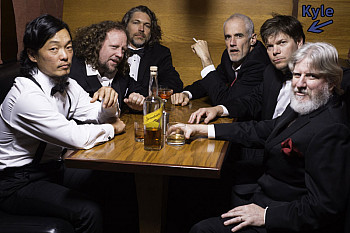 Greg Prato (Songfacts): Let's start off by talking about the latest album A Song in My Head. From what I understand it took nine years between this album and the previous one.
Kyle Hollingsworth: [Laughing] About nine years, yes.
Songfacts: How is it different or similar to previous albums in terms of songwriting?
Kyle: The last album, boy, I wonder what that was. That's a really good question. Do you know off the top of your head? Was it One Step Closer?
Songfacts: Yes. It was One Step Closer from 2005.
Kyle: The songwriting in 2005 was strong, as well. We had done a lot of co-writing during that time period. The recent album's a little bit more just us - the last album we were co-writing with Jim Lauderdale. I also wrote a song with Robert Hunter ["45th of November"]. So we did a lot of co-writing for the last album. So the last album was more collaborative, and this one's more just us.
It seems like this album we're focusing more on just bringing our own songs to the table. In some ways I think having a producer brings out different parts in the band, brings out different elements in the band.
Sometimes it can be better songwriting, but it may not translate as well because the producer's pushing it in a certain direction. For example, last album, I think the songwriting was very strong, but it wasn't produced that well, so for me it was kind of lacking. All the cool elements of a good CD or album weren't there. So a lot of times it didn't matter how good the songs were if they didn't translate very well.
Songfacts: Is there a specific reason why it took so long between studio albums this time?
Kyle: That's a good question. Well, between the two albums we took a break, which is one of the reasons. Also, I think based on our last experience, we weren't that excited to jump back into the studio - we were more focusing on live performance. But that didn't stop us from doing a lot of writing. We were doing a whole lot of writing on the road and a whole lot of writing in our home studio, especially after the two-year break.
So eventually it came to the point where we were like, Maybe it's time to actually put these down onto tape and release them. The funny thing is, we've been playing some of these songs for the last three-and-a-half years, so it wasn't quite that new for the fans right out of the box. There weren't any new songs that people that had seen us live hadn't heard. So we were just ready, it was time. We were excited to kind of put these to bed. You know, when you write a song, in a lot of ways when you finally get it done, you can let it go.
Songfacts: Would you agree that the band is best experienced live rather than listening to a studio album?
Kyle: Here's my honest opinion: I do think we're a better band live in some sense. But this recent album is one of my favorites - I compare it to our second album [the band's third studio album overall, but second with Kyle], called Outside Inside, in the sense that it's very much String Cheese. It feels like if you went to a concert, that's what you would be seeing if it was in a studio setting.
So I like what we've made - it's one of my favorite albums - but I still think there's a little bit more passion that comes out in our live performance. It's a little bit harder to capture on CD for us.
Songfacts: Is that because playing in front of an audience makes it better than playing inside a studio?
Kyle: That's definitely part of it. We haven't really been great at crafting the studio time to match the quality of song. What I mean by that is I feel like in a lot of ways, the songs don't come across as well on a studio album as they do in a live performance.
Although best known for co-penning the lyrics to some of the Grateful Dead's best-known compositions ("Truckin'," "Uncle John's Band," "Casey Jones," "Box of Rain," "Ripple," "Dark Star," "Touch of Grey," etc.), Robert Hunter has also written for other artists, including Bob Dylan, Bruce Hornsby, Little Feat, and as Kyle mentioned earlier, the SCI tune "45th of November," off 2005's One Step Closer.
Songfacts: How was it working with Robert Hunter?Kyle: It was awesome. It was a little bit of a cyber collaboration. I'd met him, but we didn't sit down at that time and do writing. We'd talked and then I went back and sent him some MP3s of songs, and he chose one and sent me back lyrics. Then I suggested some changes and he said, "No. This is how I want it to go." So I was, like, "Okay."
So it was amazing to work with such a great writer - a lyricist that knows what he wants. I sent him the music and he sent me the lyric, and we met in the middle. There wasn't a whole lot of "Can I try this lyric?" or "Do you want to try this line?" I think part of it is because we weren't in the same room together.
I've talked to people who've written with him. I think Jim actually did something with him at some point, and there's more flow. But when you're on the Internet, I feel like it was a little less that way.
 But the song came out great. It's one of my favorite songs I've written. Musically it's good, and the lyrics seem to match the song very well, which for me, as a writer, didn't always jibe. Off the disc there's a song called "Can't Wait Another Day," which I think is the first time in a long time that I've connected the two: the music and the words came together perfectly. That isn't always the came - sometimes you have the great music, but not the best lyric.
Songfacts: Was it intimidating at all working with Robert Hunter?
Kyle: Not at all. He was really cool. He was super cool. He was awesome.
Songfacts: Did he happen to share any cool Dead stories?
Kyle: I know, right? Come on, now! No. But Talking Heads is probably my favorite band of all time, and working with Jerry Harrison there were plenty of stories to be had there.
Songfacts: By and large, how would you say that the songwriting works in the band?
Kyle: A lot of times people come in with pretty complete songs. Mainly Billy [Nershi], Kang [Michael Kang], and I do that. And then Keith [Moseley] more so brings "song seeds" and we work with developing them. I sometimes yearn for a little bit more all of us writing together. I was watching a show about great bands from the '70s, and one of them was Genesis. They were all talking about how they got together and they wrote the song together, and I was like, "Wow." We do that sometimes - a song like "Colliding" off the new disc was different than I envisioned it to be. So in a lot of ways, that was a lot more of a collaboration than the rest of the songs that I'd written.
But it varies. A lot of times, people come in with pretty concrete ideas. Like "Colorado Bluebird Sky" was already pretty much there, just the middle jam was us. So maybe a better way to say it is people come in with pretty good lines, then it kind of gets developed. Especially in the jam world, they'd be a little bit wider and deeper when all is said and done.
Songfacts: Would you say that you prefer writing with others or do you prefer writing on your own?
Kyle: I prefer writing on my own. I don't know yet how to write that well with others.
Songfacts: Who would you say are some of your favorite songwriters?
Kyle: I love Anders Osborne. I love his lyrics. I listened to Ben Folds recently, of Ben Folds Five.
Songfacts: Before, you mentioned Jerry Harrison from the Talking Heads, and I've always thought the Talking Heads and especially David Byrne is underrated in terms of songwriting.
Kyle: I know. He's so awesome. I should have said that earlier. The first album I ever got was Remain In Light, and I got that album because I'd gone to the store and heard My Life in the Bush of Ghosts [a 1981 collaboration by Brian Eno and David Byrne], and I thought, "Oh, kind of wacky. I love sonically what's happening, it's challenging to me." And I'm like, "What the heck is that sound?" So then I got Remain In Light and got into the Talking Heads kind of backwards that way.
So for me, it was the sonic world that brought me in. That's the songwriting. But as I got more into it, I discovered not only great songwriting, but that also he's underrated as a vocalist, too. There's a lot of great range that he has that people don't quite get. He's less of a squawker than people think.
Songfacts: I agree.
Kyle: Squawk is not a good word, but he has a lot of personality in his voice. I'm going to stop there!
Songfacts: I know the members of Phish also said that they're big fans of Talking Heads [Phish covered the entire Talking Heads album Remain in Light in 1996, issuing it as Vol. 15 of their multi-volume Live Phish series in 2002]. I've always found it interesting that bands that people consider to be "jam bands" are big fans of the Talking Heads. The Talking Heads are more of a punk or art type band.
Kyle: Right. Did you read that David Byrne book called How Music Works?
Songfacts: No, I haven't read that yet.
Kyle: It's great. He actually has a lot more respect for improvisational jam music than I ever thought he would. He talks about how cavemen first made music all the way through Devo through dubstep. He kind of goes through everything and describes it. It's really way deeper than I thought it would be. It's a really good book.
Songfacts: I'll have to go check that out because I've always been a big David Byrne fan. And then from a songwriting perspective, what would you say is your favorite String Cheese Incident album?
Kyle: That's a good question. I really like this one. This is a close first or second. And then if I was going to go down it would probably be Untying the Knot and then maybe Outside Inside. I really like Untying the Knot. It's a very exploratory album for us electronically, and it also kind of pushes realms.
Songfacts: Why did you select the latest album as one of your favorites?
Kyle: The first thing I like is the vocals. Jerry really concentrated on making us sound good vocally. In fact, a lot of times he would change the keys of the songs to make us sing a little bit out of our range so we'd get a little more emotion. And in a lot of ways, compared to the other albums we put out in the last 20 years, I feel like this album represents where we are right now and also represents the scope of what we do. So for me it's more exciting that way.
Songfacts: Let's discuss some songs, starting with "Can't Wait Another Day."
So I developed the song really easily, and then I said, "Okay, let's not bog down this song with a bunch of complicated lyrics. Let's find a chorus that people can say 'oh, oh,' or something like that." So I just started singing, "Ohhhh ohhh," and came up with the melody. I kept changing all the lyrics all around and eventually I came to something that made sense for me. So I just came up with the chorus.
And then I said, "Okay, let's work backwards from there." And from there I just pieced together my experience while waiting for my child to be born, and it was really simple. The whole song was probably done in five days.
I was so proud of myself that I was able to rhyme "discombobulated." I got discombobulated in a song! [Laughing] One word you don't often hear in music. So that's how that went down.
Songfacts: What about lyrically?
Kyle: Lyrically, it was based on essentially waiting for my new daughter to be born. All the lines are very real. A lot of my songs, at least in the past, are not preachy, but they definitely have a stance. Like, "You need to change" or "wake up" or something. And this one I was like, "I don't want to be the preacher person. I want to say this is what's happened in my life." So I wrote lyrics: "Every day I pace the hall waiting for your call."
But, "Anticipating your next move has got me bouncing off the walls" was as literal as I could have been. I just sat down and said, "This is what happened in the days preceding my new child's birth." It wasn't anything too complicated, and the chorus was hooky.
It was like, "I'm done! I'm not going to overthink this one."
Songfacts: What about the song "Lost"?
Kyle: "Lost" is the opposite of that. "Lost" is based on my love of New Orleans funk and Little Feat, so the groove was set up pretty easily. I think it was based on Little Feat's song "Skin It Back." So I was kind of going for this kind of funk with the organ on the offbeats.
All my songs, especially early on, I was just rewriting the same song, possibly in a different key. And "Lost" lyrically, I was trying to have a moral to the story, so it was speaking more so about being focused on what's real and less about commercial interests. I was being more introspective and less concerned about outward appearance - less concerned about commercialism and being more true to yourself.
That's the kind of thing I've moved away from to some degree in my writing, because I don't want to make people feel like I'm trying to tell them to live their life in a certain way.
Songfacts: What about the song "Way Back Home"?
Kyle: These are great choices, because "Lost" is way early on and "Way Back Home" is about a middle one. Billy was writing "Restless Wind." We were all writing songs, because we were traveling so much. We were deep in travel at that point, 325 days a year or something like that.
I loved the Paul Simon aspect of the rhythm. I had written the music way before the lyrics. I recorded it on a four-track, brought into the band, and they liked it and we kind of developed it. That was a song that came together as a whole band. I said that doesn't happen very much, but that's a good point, that does actually happen. That was one of the songs where it came together and we worked it out.
Then lyrically, we were all driving down the road and we're like, "On my way, way back home." I was like, "Okay, this is exactly what we're doing." So I guess I was writing in the moment.
Songfacts: What about "Who Am I"?
Kyle: "Who Am I," I wrote that on guitar, funny enough. I don't play guitar. But I like the chord progression, descending line. I was like, "Oh, this is cool," and the melody came out pretty quickly. I wanted some Beatles influence and a section of 3/4.
Lyrically, it was about the passing of my father. The song was co-written with Randi Michaels. I only did one song with her. She was actually more so helping me contain my ideas and making it coherent. A lot of the lyrics were coming from me, but she was like, "Oh, you could say it this way," or "Move these words here."
But essentially, it was about the passing of my dad and different verses about different moments in time when that was all happening, like the actual passing, the moment, and then also at the gravesite. It's a very introspective song. In the end, as hard as the concept is for me, I'm part of my dad, even though I didn't really know him. He wasn't part of my life.
Songfacts: What are your thoughts on the song "Johnny Cash," and how it is playing it live?
Songfacts: Are you comfortable with the "jam band" tag that seems to always be following String Cheese Incident?
Kyle: It's what they do. I have to come to grips with it, come to terms with it, and I think I'm fine with it. If people want to call us that, that's fine. I don't really see us moving out of the genre that we're in, so whatever genre that is...
Everybody you talk to is like, "I don't want to be a jam band, I don't want to be pigeonholed." But everybody gets pigeonholed into something, I'm starting to realize. I was watching some show and I saw Elton John do a dubstep song or a super-electronic song. I was like, "That's weird. Why is Elton John trying to do dubstep?" So I have a perception of what he should be doing, which isn't fair to him. It's not fair for fans of us to be, "Why are you playing Bollywood music? You should be playing funny songs that String Cheese plays."
So in a lot of ways I feel defensive, because I'm like, "We should be able to do whatever we want to do." But in the end, I get it, because I see it from the other side. I wouldn't want Dominic from Big Gigantic to play a polka set. I'm there to see something very specific. That kind of thing.
So if "jam band" is our stigma or our label, then I'm okay with it right now, because that's what we do.
Songfacts: Let's talk a little bit about your solo disc. Also, I was curious to hear how you compare playing solo or writing solo as opposed to writing or playing in String Cheese?
Kyle: Writing solo outside of String Cheese is sometimes a blessing, sometimes a curse. I think sometimes it's great to be able to do exactly what you want. The musicians I hire, which are from a band called The Motet, they do exactly what I want, but they're not necessarily going to challenge me and be like, "That isn't the best bridge."
So there's a lot more complete trust in yourself to say, "This might not be the best song or the best bridge I've ever written, but there's no one else to bounce ideas off of, so I'm going to go for it."
The new disc [titled Speed of Life], I call it the celebration of collaboration. Because for me, my solo band is essentially Dave Watts and Garrett Sayers from The Motet. I met those guys back in '97 or something. Dominic from Big Gigantic is on it, and Bonnie from Elephant Revival, some great singers vocally, some horns. So the album's kind of a mixture of all the different flavors from Boulder, the music scene in Denver/Boulder.
And writing-wise, it's one of my stronger albums. As soon as I finished the String Cheese disc, I had the bug. I had, like, six or seven songs, so I just went in my studio and wrote two more funk instrumentals and another vocal tune and then a quick afro beat tune. Then I brought in the band, and it was really nice. It was almost like a songwriting camp for me - we were kind of sequestered away and just dug in. It's definitely a different thing when you're on your own.
In some ways, it's nice to kind of control your music, especially the production. I'm in my basement cutting and pasting exactly what I want to happen. "This guitar solo was awesome and this one isn't" versus the five or six of us discussing. Everybody has equal say in String Cheese, so sometimes it's nice to just grab the reins.
February 9, 2015.
For more String Cheese Incident, visit stringcheeseincident.com.
Fore more Kyle, visit kylehollingsworth.com.
More Songwriter Interviews