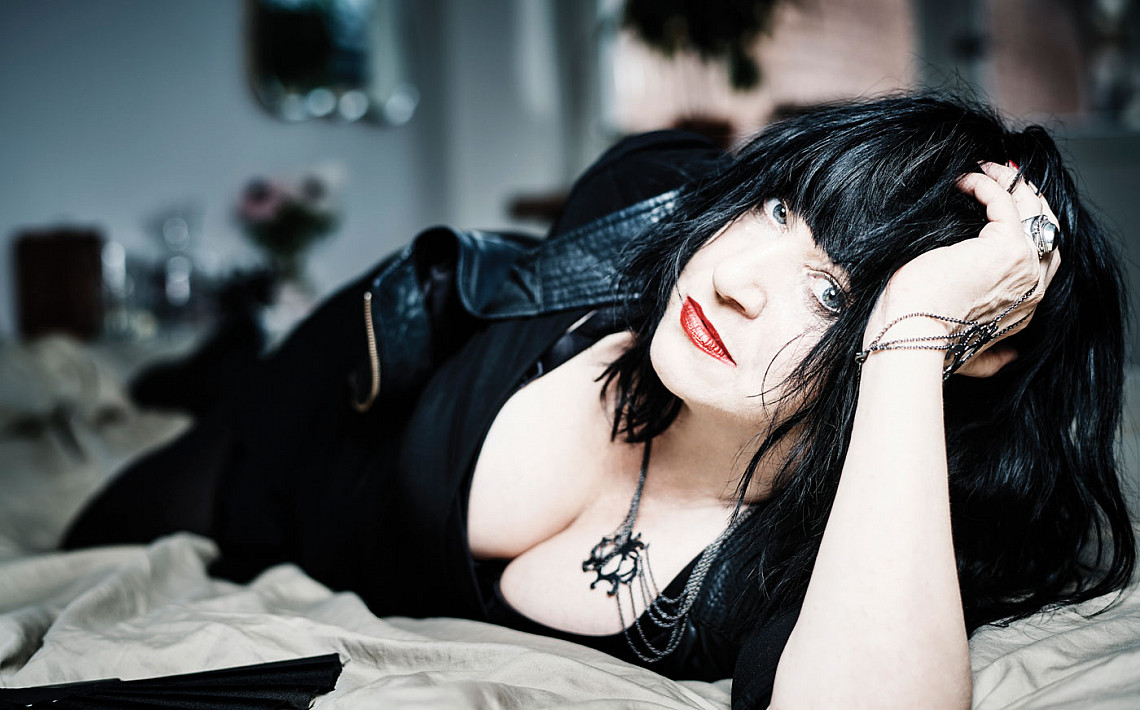
Lydia Lunch is many things, to many people. Yes, she started her career fronting Teenage Jesus And The Jerks, which eventually found her lumped in with the East Coast no-wave musical movement, a New York City downtown avant-garde period. However, that was merely the beginning, as Lunch has gone on to work in film, literature and spoken word, and dips her hand into all of these artistic expressions to this day.
Lunch is the subject of The War Is Never Over, a comprehensive 2021 documentary that looks at the artist from multiple perspectives. In this interview, we focus on some of her many musical projects and collaborations, including Teenage Jesus And The Jerks, Retrovirus, 8-Eyed Spy, and assorted solo material. While she can be quite the imposingly confrontational figure when performing, she revealed a sweet, thoughtful side while answering our questions.
Dan MacIntosh (Songfacts): Did you have the ambition to be a rock singer?Lunch is the subject of The War Is Never Over, a comprehensive 2021 documentary that looks at the artist from multiple perspectives. In this interview, we focus on some of her many musical projects and collaborations, including Teenage Jesus And The Jerks, Retrovirus, 8-Eyed Spy, and assorted solo material. While she can be quite the imposingly confrontational figure when performing, she revealed a sweet, thoughtful side while answering our questions.
Lydia Lunch: Hell no! That came later. No, I had the intention of coming to New York to do spoken word. But it was the time of post-Patti Smith rock poetry, which I didn't want to do, and pre-slam poetry, which was not what I'm about, either.
At the time, until I started curating shows of spoken word, it was kind of a dead zone. What's interesting is that both myself on the East Coast and Exene (Cervenka), Henry Rollins, Jello Biafra on the West Coast, we all started doing spoken word at the same time, which was under the horror that was Ronald Reagan.
Songfacts: So, going back to that first band, which of those songs stand the test of time best, and are there any of those songs that you still perform live today?
Lunch: You're talking about Teenage Jesus?
Songfacts: Yes.
Lunch: Well, I guess "Orphans," which I can't say was popular because it was not popular. But we did "Orphans" for a while with Retrovirus. With Retrovirus, the beauty is, we can go back through my wide catalog and pick and choose. But we change up the songs we do, so for a while we were doing a couple of Teenage Jesus songs: one of the instrumentals - the 30-second bomb blast of sonic destruction "Red Alert" - and probably "Orphans." But the set changes. With Retrovirus, we cover everything from [solo albums] Queen of Siam, 13.13, Shotgun Wedding, so it's like the Lydian jukebox.
 Songfacts: It gives you the opportunity to go wherever you feel, you can pick and choose.
Lunch: But also, a lot of these songs were not performed live, or were [originally] performed for such a limited audience. When they were performed, they were performed for whatever the concept was.
And also, using musicians like Weasel Walter and Bob Bert, they bring you life and energy, but maintain the same necessary vibration of what the material was originally. Weasel Walter is the only guitar player on the planet that can perform my guitar, Robert Quine's guitar, Rowland S. Howard's guitar, and countless others. Trust me, my guitar is not that easy to impersonate. The more you know, the harder it is.
I had to decode why it was, because greater musicians than I have tried to cover me. But back with Teenage Jesus I didn't even own a guitar, and if I had one it would be tuned in such a way that all these weird harmonics would come out. So, it would be really hard for people to figure out what was really going on there. That's kind of the secret to Teenage Jesus. It's all in the downstroke. I don't really give a shit about compliments, but when a metal guitar player comes up to me and likes Teenage Jesus then I just cackle like a maniac.
Songfacts: I was listening to your song "Sway," which is really musical, especially when compared to the no wave that you were associated with. Are people ever surprised to learn you can actually sing well?
Lunch: Well, that's a great question because one of the reasons I had to get out of 8-Eyed Spy, which people loved, was because people looked at me, like, "Why don't you sing?" And I was like, "Why should I?" I can, and I've released many "musical" records. I've done swamp rock. I did a whole covers album years ago. Four people I covered on that album just mysteriously died not long after. I'm like, "Is Bon Jovi next?"
Smoke In The Shadows, which is where "Sway" is from, is like jazz noir. I have all different kinds of music. What format does the snake need to take now?
Songfacts: Another song that's gotten a lot of attention is "Death Valley '69" [a collaboration with Sonic Youth]. I read where it was called one of the 50 most evil songs ever.
Lunch: Obviously, they haven't heard the other 49 that I probably co-wrote as well.
Lunch: Not at all. That's a happy pop song. Read into it what you will. Evil? I guess. I have far more malignant material than that. More terrifying, that's for sure.
One of my co-stars in the film Fingered, Martin Nation, he grew up in Topanga Canyon, and when he was about 12, they [the Manson Family] had a bus propped there and they tried to wrangle him onto the bus.
Songfacts: Speaking of serial killers, (which is one of the oddest interview transitions I've ever spoken), the documentary about you talked about songs you wrote that were inspired by another famous Southern California serial killer, Richard Ramirez. Which songs were they, and why was he so fascinating to you?
Lunch: Well, this is the perverse part. Memory plays tricks on us. My album 13.13 was recorded with Dix Denney, who was in The Weirdos. The bass player was also in The Weirdos, and Cliff Martinez went on to play with Captain Beefheart, Red Hot Chili Peppers, etc. But it's a very dark album, and I find Los Angeles – in spite of the happy weather and beautiful architecture – is one of the creepiest fucking places in this country. I thought Richard Ramirez had already existed, but I wrote those songs as if I'd frickin' invented him, but he did exist.1 There were also the Hillside Stranglers from Glendale, where I eventually lived. One of them, Kenneth Bianchi, did a series of murders in my hometown when I was about 11. Murdering 11- and 12-year-old girls. The last girl he killed was found running naked for a mile and nobody stopped. And he wasn't busted for that until after he was busted as one of the Hillside Stranglers.
On the album 13.13, there is a song called "Afraid Of Your Company," there's one called "Lock Your Door," "This Side of Nowhere." They're all pretty much about madness and murder. It was a Los Angeles state of mind.
Lunch: I had a band called Harry Crews,2 named after the writer Harry Crews, and every song was based on one of his books. And one of his books was called The Gospel Singer. But I mean, vaguely inspired. It's one of my favorite songs. I'm glad you pulled that one out.
Songfacts: Why do you like that one so much?
Lunch: It's badass boogie. Sometimes you just have to get raunchy.
Songfacts: You sing almost with an accent on it.
Lunch: That's because it brings out the Southern white trash in me. I've got a little bit of that and I'm not even from the South.
In 1981, Lunch crossed paths with the experimental Australian band The Birthday Party, whose members included Rowland S. Howard on guitar, Tracy Pew on bass, and Nick Cave on vocals. Lunch and Howard recorded a cover of Lee Hazlewood's "Some Velvet Morning," which was released in 1982. That year, Lunch toured with The Birthday Party as their opening act and made some recordings with the group, but they had a falling out (she told The Wire, "They did too many drugs and I didn't"). Those recordings, including one with a Nick Cave vocal called "Done Dun," were released in 1987 on her album Honeymoon In Red. Lunch and Howard teamed up again in 1991 for an album called Shotgun Wedding and subsequent tour.
Songfacts: One of the collaborators you worked a lot with was Rowland S. Howard. Why did it work so well, and what were some of the best songs you created together?Lunch: Rowland S. Howard was less prolific than we think, but every note mattered on every song that we wrote, whether it was on one of his solo albums like Teenage Snuff Film - which was one of my favorite albums - or with Crime & The City Solution or The Birthday Party.
I love the economy of sound. That is the hardest thing for musicians to understand. They want to make more noise than necessary sometimes, and with Rowland, every note mattered. I call it a space between breaths. I'm doing it now [pauses] to illustrate a point. Like in conversation, it's the pauses that have power. The pauses between those delicate, sinewy notes that he would bring out.
I went to see The Birthday Party when they first came to the States after the release of their first album, and just immediately went up to him right on the spot. We collaborated on "Some Velvet Morning," the Lee Hazlewood song, and I was surprised because not many people knew about Hazlewood then. I'd already covered "Lightning's Girl" that he wrote for Nancy Sinatra. So, our first track was "Some Velvet Morning." I loved covering "Black Juju" by Alice Cooper on Shotgun Wedding.
Songfacts: With the other Birthday Party member, the more famous one, Nick Cave, you did "Done Dun." Were there others that you did together?
Lunch: There might be one or two songs. I mean, who am I gonna go for, the person who writes the songs or the one that just sings 'em occasionally? Rowland was more practical and he understood my sensibility about making something swampy and stripped-down.
He brought me to New Orleans to record our album. It had a vibe that I find – being a young vampire himself – he would appreciate. The Birthday Party was one of my favorite bands to see and tour with, mainly because of Rowland. And Tracy Pew. And the songs. They were amazing.
Songfacts: You mentioned Exene Cervenka earlier. You've done spoken-word collaborations with her. Have you ever done anything musical?
Lunch: We haven't. We wrote a book of poetry, Adulterers Anonymous. We recorded Rude Hieroglyphics and went on a 30-city spoken-word tour. It was like a spoken-word tag team, both on the stage at the same time - that was fantastic. We haven't done any music, but who I have had on a few tracks with me is Carla Bozulich of the Geraldine Fibbers, and she's one of my favorite vocalists.
Songfacts: I find you and Cervenka to be really similar a lot of times, at least musically. Has she ever said that you're an influence on her?
Lunch: No, but I think we came up pretty much at the same time. I remember the first show in New York, and that was when her sister was helping with Teenage Jesus. And her sister's husband at the time was in Teenage Jesus. But X was always more rock and roll, and I put that onus on Billy Zoom. I always preferred guitar players that were way more avant-garde.
Songfacts: Since we're talking about spoken word, how do you decide if something is going to be spoken word or a poem or if it's going to be a song?
Lunch: There's a difference. When I first started doing spoken word, I would only do 10 minutes. That's all anyone could take. And really, there's a limit. Jello Biafra goes on for three hours, I do not.
In the same way that I'm a musical conceptualist, there would be a spoken-word arc or point or theme. So, that would take the form of monologues. Then I would write, also, some essays. After 26 rejections, that becomes a series of essays or short stories. Then there are poems that sometimes turned into songs or the lyrics.
I don't sit with a box of unpublished volumes under my bed. When I'm going to write something and the urge is there, the need, it's always in a sense for a purpose. I'm not just doodling. If I'm going to write a book, there's a certain discipline for that. It really just depends how it's going to formulate or what form it's going to take.
Songfacts: So, you need a project or a kind of a goal.
Lunch: Yes. Sylvia Black and I just did a very jazz-noir, very forensic LP that's not out yet. What's interesting about collaborating with her, there are some pieces that are more like spoken word, with freaky, psycho-ambient kind of jazz-noir backdrops, and then there are songs, which she sings, and I do spoken word on, or we both sing. But it's got a very creepy, post-Smoke In The Shadows vibe.
 Songfacts: When you write songs, do you write on guitar, or do you play other instruments?
Lunch: It really depends. Sometimes I just write and say, "This is the way it goes." With Teenage Jesus, I wrote the songs on guitar. Beirut Slump on guitar, 8-Eyed Spy I wrote the music. With Rowland, I wrote some of the songs on that. It's always very different. But I always have the concept of the sound before I set about finding people to bring that theme, that concept, to life.
Songfacts: Have you ever tried to write a hit song, and if so, what is that song called and how did it turn out?
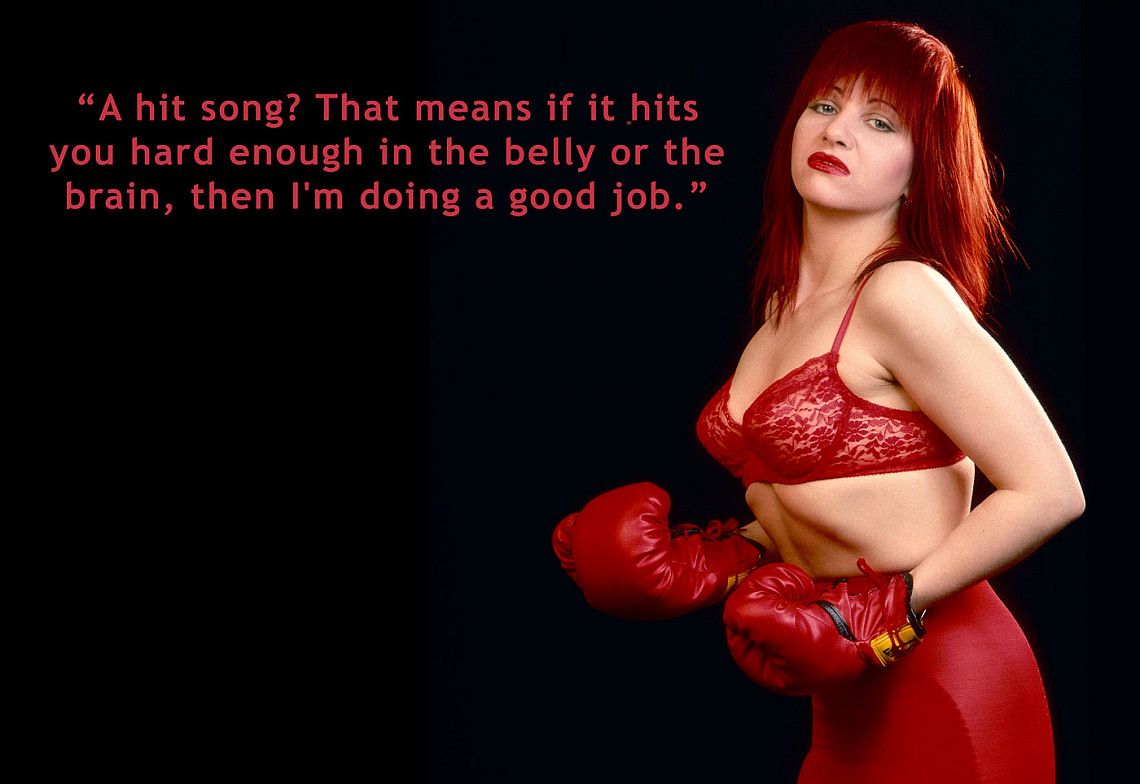
Lunch: [laughs] Honey, I do punish rock, not punk rock. A hit song? That means if it hits you hard enough in the belly or the brain, then I'm doing a good job. No. Why would I need to do that? How would I fluke upon that ridiculous concept?
I love simple. I love T. Rex. It doesn't get any dumber than that. I love Tom Petty. It doesn't get any dumber than that, but why it's not dumb is it's so genius because it's so minimal. But that's not my goal or my job and I have no idea how you do it.
Songfacts: Do you have a list of songs that one day you'd like to cover?
Lunch: Well, I just did a whole covers album and I covered, for instance, "Midnight Rider." Oh yeah, he died, Gregg Allman. I covered "Low" by Cracker - do you remember that song? It's a great song. I covered Bobbie Gentry. I covered Hank Williams Jr., Elvis Costello's "I Want You." "T.B. Sheets" by Van Morrison.
And one of the most hated bands of all time, I had to do it. It's interesting because I tried to do this song 25 years ago with JG Thirlwell. But I did cover it, and I use it as kind of a Rorschach test. I start playing it, and go, "You know this song. You've heard it a million times. You hate this fucking band." Steely Dan. "Back Jack, Do It Again." The lyrics are all about gambling. It's a great fuckin' song if it's not played by Steely Dan. I'm just sayin'.
Songfacts: Also, you mentioned Bon Jovi.
Lunch: That would have been "Blaze Of Glory." I thought when I was doing this covers album it was a real joke. So, my good friends Suicide, early on, Bruce Springsteen covered one of their songs ["Dream Baby Dream"]. And Bruce Springsteen kind of copped Alan Vega with his album Nebraska.
August 2, 2021
More at lydia-lunch.net
Further reading:
Exene Cervenka of X
The Meatmen Story
Victoria Williams
Photos: Anders Thessing (1), Annie Sprinkle (2), Jasmine Hirst (3)
Footnotes:
- 1] Ramirez didn't start killing until 1984; Lunch released the 13.13 album two years earlier. (back)
- 2] Kim Gordon of Sonic Youth was in this band, which was all-female. (back)
More Songwriter Interviews