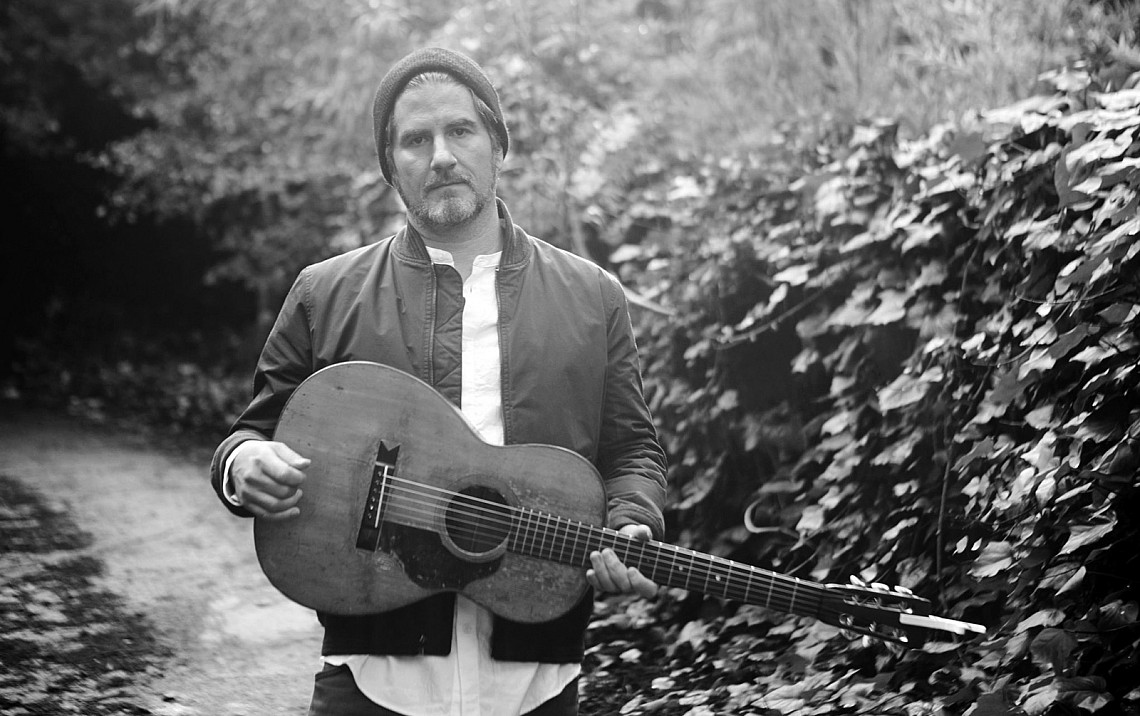
Matt Nathanson has captivated fans with his candid lyrics, vibrant musicality, onstage wit, and charisma for 30 years. The San Francisco-based songster has garnered a loyal following since his first release, Please, in 1993, due in large part to his honest storytelling and organic harmonies. His breakthrough came in 2007 with the song "Come On Get Higher" from his album Some Mad Hope, which as he explains, came at a seminal time both personally and professionally.
His latest album, Boston Accent, finds Nathanson returning to his roots with a stripped-down approach to songwriting at its core. Reminiscent of some of his first releases, the album is self-reflective and earnest, blending contemplation of the modern future with reminiscing of the past. Nathanson embraces his Boston upbringing, coming to terms with a past he may have shied away from before. Less angsty than earlier albums, here we see Nathanson as his true self: evolved, hopeful, accepting. There is a shift in him from other records - a vulnerable artist open to telling his own stories, including the positive ones.
Getting the record out did not come as easy as the songs for Nathanson. Going into the studio just before the pandemic, when the world went on lockdown, so did recording. It took 2 ½ years to get Boston Accent released, but it was worth the wait.
We spoke with Nathanson on the day the album was released: July 29, 2022. He was taking in feedback on social media shortly before the call. As he told the stories behind the songs, it became clear that he's very enthusiastic about them and eager to play them live, which he'll do on his upcoming tour with Donovan Woods. To use his metaphor, they have a "hybrid car vibe," meaning the audience becomes his charging station.
Nicole Roberge (Songfacts): Congratulations on the release of Boston Accent. It must be exciting to finally have this out into the world.His latest album, Boston Accent, finds Nathanson returning to his roots with a stripped-down approach to songwriting at its core. Reminiscent of some of his first releases, the album is self-reflective and earnest, blending contemplation of the modern future with reminiscing of the past. Nathanson embraces his Boston upbringing, coming to terms with a past he may have shied away from before. Less angsty than earlier albums, here we see Nathanson as his true self: evolved, hopeful, accepting. There is a shift in him from other records - a vulnerable artist open to telling his own stories, including the positive ones.
Getting the record out did not come as easy as the songs for Nathanson. Going into the studio just before the pandemic, when the world went on lockdown, so did recording. It took 2 ½ years to get Boston Accent released, but it was worth the wait.
We spoke with Nathanson on the day the album was released: July 29, 2022. He was taking in feedback on social media shortly before the call. As he told the stories behind the songs, it became clear that he's very enthusiastic about them and eager to play them live, which he'll do on his upcoming tour with Donovan Woods. To use his metaphor, they have a "hybrid car vibe," meaning the audience becomes his charging station.
Matt Nathanson: Yes, thank you! This record was finished in May of 2020. I went back and rerecorded a couple songs and put a new song on after a year because I had the time. I had this moment this morning watching people responding to it on social media and doing listening parties on Instagram and Facebook Live. I can't believe how important getting feedback is for me. I don't like to think that's how I shape who I am because I don't think it is. Just being able to put something out that you created in a real way, especially something that's been delayed as long as this has been delayed, it's an incredible feeling.
There's a bunch of gratitude and I'm super fortunate to be able to have this big group of people to give me feedback.
Songfacts: Your music has always reached people when it needs to - you have a unique way of making people feel less alone. You really reached out during lockdown by doing livestreams when people needed something. People, probably yourself too, needed that connection and found it through music.
Nathanson: That's rad. I did it, and like you said, I needed that so badly. I needed to connect. It's funny now that the tour is finally here. We rebooked four times. To finally have that happening, I'm just gonna lose my mind with how psyched I am. Connecting on the internet was satisfying, but playing shows is gonna be like being plugged into the sun. To be able to have that reciprocal thing. I call it the "hybrid car vibe."
Doing the livestream is great, but it's like a gas car. It gets you where you need to go, but you need to stop and refill the gas tank. The hybrid idea is, you give out and then people give back. So I guess it's more like the livestreams are hybrid and the live shows are an electrical car? I have no idea. I just can't wait to get out there and feel people's energy and be able to feed off that.
I see shows as parties that I throw. It's like a potluck and everybody brings their own thing, it's just at my house essentially.
Songfacts: What was your feeling going into recording the album pre-pandemic versus during/after? Did your vision, or the mood of the songs, change because of the pandemic and what the world, or you personally, went through?
Nathanson: Going in, I was getting to make a record with Butch Walker, who's been a friend of mine for a long time. And we've worked together1 but we've never worked together on a whole record. We started the record two weeks before lockdown.
We got a lot done prior to lockdown. My idea was that I really wanted to make a singer-songwriter album in the way of records that I love: Cat Stevens, Paul Simon, Joni Mitchell, Indigo Girls. Records where things hang on the performance of the artist that's making it. It's not so much a production thing. That was the intent going in. I had a Spotify playlist of 50 great singer-songwriter songs.
I'd been running away from making a record like that since Ernst [1997]. I made those records and then I was like, I can have a drummer, I can rock? And then I was like, I like rocking, I wanna rock. And since I love that kind of music, I would lean into it.
I love pop, and I'd make singer-songwriter records, but I might surrender to the arrangement or how great the drummer is, so I might change the way I play. That was really fun to do.
For this record, it's like I'm True North and everything's gotta hang off of me. Going in, I was psyched to work with Butch and do the singer-songwriter thing. When the pandemic happened, I had written a ton of new songs but they didn't necessarily feel like they aligned with the Boston Accent record. They felt incongruous. It felt like it was its own thing. But there was one song called "Pigeons" that came up during it. It felt like the record had been missing this song.
We recorded songs called "Future's Here," "Soundtrack," and "Pigeons." "Pigeons" feels like we rooted the center of the record. It felt like the record was kind of like a boat on the ocean being knocked around by the waves and then we recorded "Pigeons" and the whole record just anchored and felt like it all had a topography and a purpose. I'm a super nerd for that kind of thing. I don't think anyone else on this earth cares about the topography of a record, but to me it was super important. I was psyched to have been able to have the time, but that was one of many we wrote, and it was begging to be put on Boston Accent.
Songfacts: You have another song called "Beginners" with the lyrics:
Before the world slammed us shut
Before we knew way too much
Didn't worry about what we didn't understand
When we were beginners
Was that recorded prior to lockdown?
Nathanson: Yeah, how crazy is that? There are moments on this record that when I hear them back, it's like, How did we know that?
I wrote "Beginners" with Lori McKenna and Hillary Lindsey in December of 2019. It was my last songwriting trip before going home for the holidays and before making the record in 2020. It was one of those things where the weight of what happened after that song, happened. Hillary recorded her vocals during the pandemic.
It's funny how lyrics shift based on the experience you're having. It definitely made that song feel heavier, because none of us are beginners anymore. We've all been through this traumatic, PTSD experience.
Nathanson's previous albums see him struggling with acceptance of the world around him. Modern Love from 2011 was the push and pull of relationships, the advancement of technology that caused a decline in dating and culture. On the 2018 breakup album Sings His Sad Heart, he laments a broken relationship with one-sided regret. He once claimed "Little Victories" from his 1999 album, Still Waiting For Spring, was the only positive song he'd ever written. He seemed to embrace a jaded outlook on the world, and did so with flair. Boston Accent is the first time we've really seen him deviate from this theme. Even when he speaks, he seems to have a renewed sense of enthusiasm, a positive outlook that spreads through his music.
Songfacts: The album has themes of modernism ["Future's Here," "Type/Erase"] while being self-reflective and reminiscent about the past, but in a genuine way people can really relate. Nathanson: That's rad, thank you. It definitely feels looky-backy, but it doesn't feel as pissed off. I think I might be done - not done with being pissed off - but I feel strongly that I'm done with the "why didn't you love me?" songs. I think that I've finally got those out. Most of them. And this record was the first one where I celebrated.
"Soundtrack" is a celebration of my wife. "Sway" is kind of a celebration. There's a lot of celebration of what I've got, which is crazy because I don't think I truly appreciated what I've got in a real way until during and after the pandemic.
Songfacts: "Boston Accent" - the song - hits home for you and shows a real connection to the East Coast. You've been in San Francisco a long time. Was that a song you felt you had to write? Does home still feel like home even when you're disconnected, or you try to get away from it?
It's a crazy thing because I don't subscribe to teams, I don't want to be part of a group, it isn't the way I live my life. But every time I hear a Boston accent somewhere, I stop and say, "Where are you from in Mass?" It's this crazy allegiance. I think this record is really about accepting who I am versus who I wanted to be. I moved to California 31 years ago but the record's called Boston Accent.
Songfacts: Is "German Cars" along that vein also?
Nathanson: "German Cars" is about growing up as a kid at boarding school and not being rich, but having rich kids go to Nantucket and Martha's Vineyard and the Cape and having amazing summer jobs while I moved office furniture. So "German Cars" is more about that and "Boston Accent" is about this pullback.
Family for me is a weird thing. My family doesn't work like a normal family. We're not close, we don't really even like each other, and that's fine. We don't have relationships. It's weird to have a pull to the place you're from, and I've kind of fought that, and I've also fought being a singer-songwriter. Like, I don't want to just play acoustic guitar and sing, and when I do, I'm like, Oh, this is how the song works best for me. So the whole record is about accepting the things I thought I saw as limitations that are actually my strengths. We spend our lives pushing for other shit, when really the stuff that's magical and our superpowers are there. So this record is about that.
Songfacts: "German Cars" is a lovely song and also features a love interest you call "West Coast JV." It's an understated and melodic song, and you put out a heartwarming animated video to it. How did that come about?
It's exceptional. It's one of the greatest things I've ever been a part of and I had nothing to do with it, except I wrote the song. And it's fun that my buddy Bill, who was my friend as a kid at an all-boys camp in the woods with no electricity - we used lanterns to get around - made it. Some of my closest relationships are with people from that experience, so it was fun to reconnect with him and to have him be a monster talent.
Songfacts: It's really beautiful. Is "JV" a real person?
Nathanson: Yeah. JV can be whoever you want them to be, but for me it's a little bit of a combo of a couple people. I like the idea of JV, junior varsity. I don't know where it came from. It's a weird thing, but I definitely have a person or two in mind when I sing it, depending on the verse. I have a specific person in mind for all the heartbreaking stuff.
Songfacts: You have a song, "Sky High Honey," that references another connection to Boston ("No more late night drives to Boston") and San Francisco ("I take the streetcars around San Francisco"). So, you've had this theme and it seems like something you've carried with you for a while.
Nathanson: Yeah, it keeps coming up, and more so now than ever. When you see that Saturday Night Live Dunkin' Donuts skit with Casey Affleck or the Bill Burr one with Sam Adams beer. As much as everyone likes to think their state has specific things that makes them unique, Massachusetts really triples down on it in a way I've never seen anywhere else. It's a crazy universe in itself.
I'm writing with Lori McKenna and she lives in Stoughton where she grew up. People come to her house.2 Taylor Swift went to Stoughton when she wrote with Lori. It doesn't mean that Lori doesn't go to Nashville, but that's so Boston. Like, come to Stoughton and write with me. It's a very weird, powerful group of human beings in that area that's impenetrably great. No matter how hard I try to be from somewhere else or not be from somewhere else, I just feel aligned with it.
Songfacts: People embrace you so much in Boston too.
Nathanson: Oh, yeah! It's the best. The other thing that's so great is that every time I go, I'm like, oh yeah, this is my home!
Songfacts: You're also celebrating the 15th Anniversary of your album Some Mad Hope. Why is that album significant to you?
Nathanson: It was a weird record. It was a record that had my biggest song, "Come On Get Higher," on it. It was a record I made pretty much by myself in between being on a major label and signing with an independent label. I made that record the way I wanted to make it, without anyone telling me how to.
Some Mad Hope, we play the songs in rehearsal and they're in my fingers. They're a part of my genetic makeup. It's a cool thing to be able do that. As I get older and my brain forgets shit, here I am going back to a record that's 15 years old and I can play anything on it. That record is a seminal moment in my life on many levels. It's a heartbreaking time about a relationship and tells a story. Of all my records, it's the one that really benefits from being played as a whole. The songs segue into each other in a way that's really important.
Songfacts: Do you feel like you need to tell a story with an album?
Nathanson: You try to. There's some that really work and there's some where you're forcing a narrative. Some Mad Hope just showed up. Some Mad Hope is a title, an idea that I'm just using now. You've gotta have mad hope in this life to survive. That title was written for a specific experience I had but I had no idea it was tied into my reason to be. I am a very hopeful person. It's how I've survived in the music business so long.
I just love music and when I write a song the intention is, how do I write the best song? That's all I care about. It's kind of naive. Anyone else who did this job would say, "You can do it any number of ways." Any time I write a new song I get invigorated in such a way it feels like life is worth living. I feel promise. When I write a verse or melody I like, the feeling of endlessness I feel after that, I don't get that anywhere else in life.
Sometimes I feel stuck or don't know which direction to go in, but then you play the guitar or sing and this thing comes out and it makes you vibrate and it's like, Oh this is great, life is magical. And it all stems from being able to do this thing. I guess it's hope and connection.
Songfacts: Your song "Wedding Dress" on that album. There were people very proud to have that as their wedding song at the time. That was very big. Was the meaning misconstrued?
Nathanson: I think it's great that anybody likes anything that I made. I used to think you can't interpret this as a love song, it's about divorce, near-divorce. But what I've realized is human beings see things only the way they want to see things. If the past five years have taught me anything, it's that people can take factual information, if it's very clear-cut, and make it about anything they want. I'm just psyched that the music moved them enough for them to interpret it any way they want to interpret it. I used to think, I'm not doing my job right. But no, people misinterpret the Constitution, people misinterpret the Bible. I'm psyched just to be thought of in any way.
Songfacts: You've said before that "Bill Murray" is your favorite song you've ever written. Does that still hold true?
Nathanson: I have to say "German Cars." It's one of the only songs on the record that I didn't co-write, and it feels like I've been cowriting a lot, but I've also been writing by myself a lot, and I think "German Cars" is my favorite song I've ever written at this step in the game. With "Boston Accent" close by. But "German Cars" just does a thing that feels really me, to me, so that would be my favorite.
August 11, 2022
Get tour dates and more info at mattnathanson.com.
More interviews:
Jennifer Nettles of Sugarland
Donovan Woods
David Gray
Footnotes:
- 1] Butch Walker worked on Nathanson's songs "Best Drugs" and "Way Way Back." (back)
- 2] Lori McKenna told us about life in Stoughton, which is about 20 miles south of Boston: "A lot of people stay in this town. You know, my husband and I both grew up here and a lot of our friends from high school still live here. So we know all the police officers and all the firefighters, and it just seems like a small town, I guess, because of that."
McKenna became a top songwriter while raising five kids in Stoughton. Her credits include "Girl Crush" by Little Big Town and "Humble And Kind" by Tim McGraw. (back)
More Songwriter Interviews