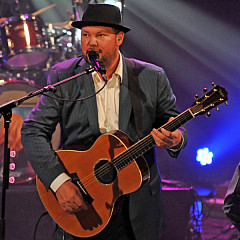
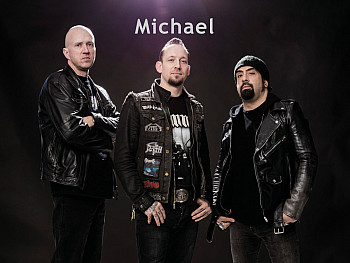
There are not very many hard rock/heavy metal bands that are comprised of Danish and American members... but then, there is Volbeat. Up until 2015, the band was comprised of three Danes (singer/guitarist Michael Poulsen, bassist Anders Kjølholm, and drummer Jon Larsen) and one American (lead guitarist Rob Caggiano) - before Kjølholm exited the group before the recording of their sixth studio set overall, Seal the Deal & Let's Boogie.
Although Poulsen has roots in death metal, Volbeat's heavy sound also incorporates melody and arena-sized choruses into the equation, as evidenced by such earlier radio hits as "Heaven Nor Hell," "Still Counting," and "The Hangman's Body Count," as well as the leadoff single from Let's Boogie, "The Devil's Bleeding Crown." Poulsen spoke with Songfacts a month before the arrival of the aforementioned album, and was up for discussing songcraft, lyrical inspiration, and his favorite songwriters.
Although Poulsen has roots in death metal, Volbeat's heavy sound also incorporates melody and arena-sized choruses into the equation, as evidenced by such earlier radio hits as "Heaven Nor Hell," "Still Counting," and "The Hangman's Body Count," as well as the leadoff single from Let's Boogie, "The Devil's Bleeding Crown." Poulsen spoke with Songfacts a month before the arrival of the aforementioned album, and was up for discussing songcraft, lyrical inspiration, and his favorite songwriters.
 Greg Prato (Songfacts): How does the songwriting work primarily in Volbeat?
Michael Poulsen: It's pretty much been like in the beginning, but there has been a slight change. I pretty much write everything at home, and then I bring it to the rehearsal room and I play it to the other guys, and we put on the rest of the instruments. There will be songs where maybe Rob has a certain idea for a middle part, then we might change it. John, the drummer, may have an idea for something, and then we change it. That's pretty much how it works.
Normally, I will write a whole song and show it to the other guys in the rehearsal room and we play it. Other times, I will come with a half song, and we finish it up on the road in soundcheck, or we write backstage. This time, Rob has been there when we start writing, so he had a few ideas. He wrote most of the song, "The Loa's Crossroad," and he was writing with me on a song called "You Will Know." He had a middle part in "The Gates of Babylon." So he had his impact here and there. But I would say I write 95 percent of the music and I write 100 percent of the lyrics.
Songfacts: Do you prefer writing on your own, or in collaboration?
Poulsen: Mostly I find it more comfortable to do it alone, because I really like to be locked into that zone - in my own little bubble - where I can go over the details. Basically, just being in my own little world. But at the same time, sometimes you can be pretty locked into a song, and really don't know where to go with it. Sometimes, it's cool when other people are there to say, "What if we do it like this?" And I say, "Wow, that's a good idea!" Both things can work out really good, but I mainly like to sit alone at home and write.
Songfacts: From a songwriting standpoint, which is your favorite Volbeat album?
Poulsen: I know it's a cliché, but I have to say the new one. It's not to promote or sell the new record... of course, it is in some ways. [Laughs] But I have to admit that I think our new record is our strongest work so far. I'm damned proud of it, and I'm really proud of every Volbeat record so far.
For a long time, my favorite Volbeat record was Guitar Gangsters, and then it was Outlaw Gentlemen. But with this new one, there are so many things that I have accomplished when it comes to songwriting and with my vocals and everything. I'll say so far, our latest album is our strongest work.
The two albums that Michael lists as his pre-Boogie Volbeat favorites also turn out to be amongst his band's most commercially successful. 2013's Outlaw Gentlemen peaked at #1 on the Denmark Album Charts (and cracked the US Top 10), and spawned the hit singles "The Hangman's Body Count," "Lola Montez," and "Cape of Our Hero." Guitar Gangsters also topped the Denmark Album Charts, and spawned the single "Still Counting."
Shan Dan Horan directed the video - English and Danish versions. He told us: "I really wanted to convey the message that everything seems great when you look at past memories, almost blissful. But everything tarnishes with time. Even though things rust and get worn they are still beautiful in a different way."
Songfacts: What is the lyrical inspiration behind the song "The Bliss"?Poulsen: "The Bliss" was inspired by when I met my girlfriend the first time. Sometimes, you meet people where you are somehow attached to them or drawn to them, and you don't know why. You're looking for answers. Sometimes, you feel you've seen them before or met them before. Other times, it goes deeper than that - you can't really explain why you're drawn to them or why they speak to you without saying anything. I was pretty much going through those emotions, to figure out who she was.
And at the same time, the lyric also says something about how even though we're all very different, we're all pretty much the same. Does that mean that we have to leave the earth on the same path? It's actually very deep.
The world is huge and it seems like we all pretty much are going to die, but does that mean that we're going on the same path? We'll never know. But when it comes to sharing a life together with another one, we like to believe we can share everything and go on the same path when we leave earth.
Songfacts: "Heaven Nor Hell"?
Poulsen: Oh man, now I've got to dig into an old brain I had! [Laughs] As I remember it, it's a song that tells people to believe in themselves instead of using anything else as a crutch. We're not a religious band - we don't believe in the devil and we don't believe in God or anything else. We do believe in the spiritual world; we do believe in the spirit in every human being. So as I remember, it's a song I wrote for myself and people to believe more in themselves, instead of leaning up against any kind of religious belief.
The devil is something that we create in our own mind - that's how it exists. And God, I don't know anything about that - He hasn't shown himself in all the time people have been talking about him. Or what it is, some kind of force. If people can get anything positive out of it, peace with that, but I'm just not a religious person. There are good things in everybody and bad things in everybody - it's just our responsibility in normal-day life to have that balance where we can work as good human beings. I like to think that to be able to do that, you have to respect yourself, and then you have to respect the people around you and believe in yourself, and believe in people around you.
Songfacts: "Sad Man's Tongue"?
He just wants to have a simple life, and he doesn't see any kind of responsibility going into Uncle Sam, and doing work for him. He refuses to bear weapons, because nobody has done anything harmful to him, so why should he be a bad guy to anybody else but himself? So he pretty much tried to live the free life.
Songfacts: Lastly, who are your favorite songwriters and lyricists?
Poulsen: That's a good question. I really think Mike Ness of Social Distortion is a great lyricist, and he's a great songwriter, too. I think he's very underestimated, actually. I also think James Dean Bradfield from the Manic Street Preachers is a great, great, great songwriter, and writes some really great lyrics, too. That's just to name a few.
May 11, 2016.
For more Volbeat, visit volbeat.dk.
More Songwriter Interviews