By the mid-to-late '90s, the rock world was mesmerized by pop-punk bands, as evidenced by the massive success of Green Day and Blink-182. But did they appear out of nowhere? Of course not - they were predated a decade earlier by the trailblazers of melodic hardcore, the Descendents.
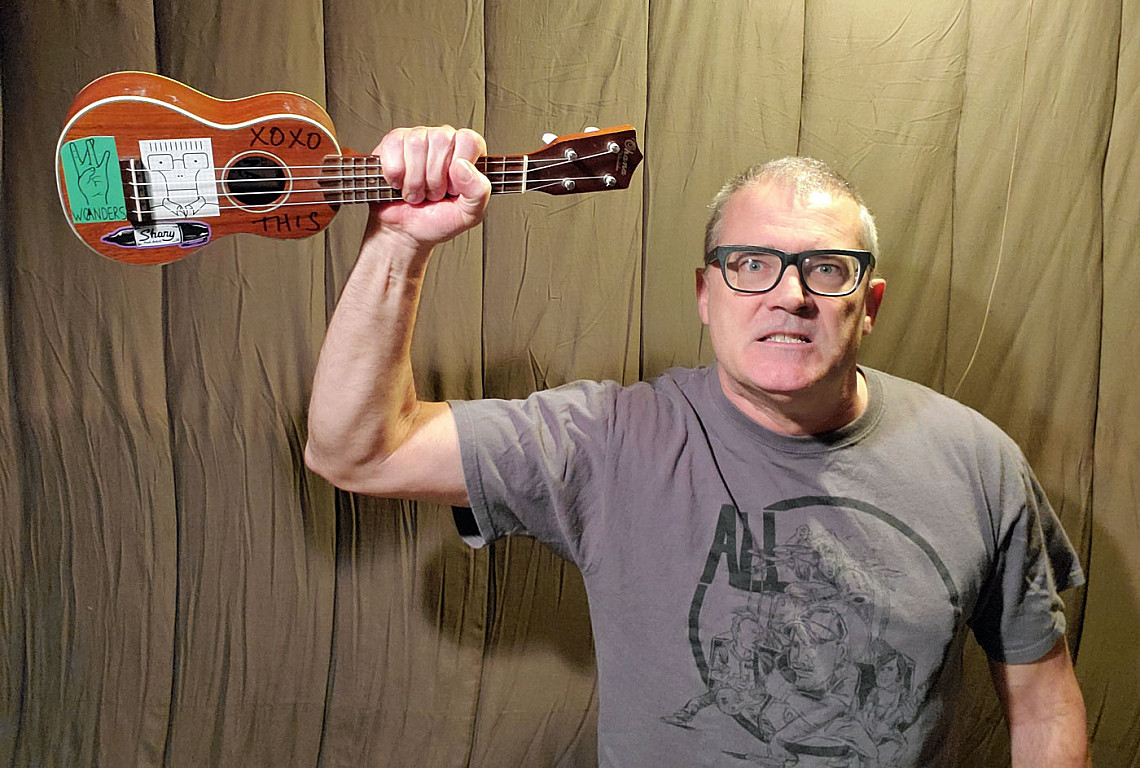
Fronted by bespectacled singer (and biochemist!) Milo Aukerman and hailing from Manhattan Beach in California, the Descendents first came up as part of the golden age of indie rock, which gave us such classic acts as Black Flag, Hüsker Dü, the Minutemen, and the Meat Puppets. And in the process, gave us such landmark albums as 1982's Milo Goes To College and 1985's I Don't Want to Grow Up.
Milo Goes To College, the band's debut, is a landmark: it landed on Rolling Stone's list of the "40 Greatest Punk Albums of All Time," Spin's "50 Most Essential Punk Records," and Pitchfork's "200 Best Albums of the 1980s." In 2025 it was reissued on LP, CD, and cassette via org music.
Shortly before the arrival of the Milo reissue, Aukerman spoke with Songfacts about what Cali-punk was really like in the early '80s, the stories behind several Descendents classics, and his thoughts on his band's influence on subsequent punk generations.
Greg Prato (Songfacts): Listening back to Milo Goes To College in 2025, what are your thoughts?Fronted by bespectacled singer (and biochemist!) Milo Aukerman and hailing from Manhattan Beach in California, the Descendents first came up as part of the golden age of indie rock, which gave us such classic acts as Black Flag, Hüsker Dü, the Minutemen, and the Meat Puppets. And in the process, gave us such landmark albums as 1982's Milo Goes To College and 1985's I Don't Want to Grow Up.
Milo Goes To College, the band's debut, is a landmark: it landed on Rolling Stone's list of the "40 Greatest Punk Albums of All Time," Spin's "50 Most Essential Punk Records," and Pitchfork's "200 Best Albums of the 1980s." In 2025 it was reissued on LP, CD, and cassette via org music.
Shortly before the arrival of the Milo reissue, Aukerman spoke with Songfacts about what Cali-punk was really like in the early '80s, the stories behind several Descendents classics, and his thoughts on his band's influence on subsequent punk generations.
Milo Aukerman: We play a lot of those songs live, so I don't listen to the record that much these days because we play a lot of those songs anyway. But it's a testimony to the record that people still want to hear those songs. But I think it stands the test of time in terms of sound quality and just putting forth something that jumps out of the speakers and is really kick-ass.
Milo Goes To College was produced by Spot (government name, Glen Lockett), known for his work with various punk rock pioneers. The rest of the Descendents catalog was produced by their drummer, Bill Stevenson, who also did time in Black Flag and produced albums for many other bands, including NOFX and Rise Against. He died in 2023 at 71.
Songfacts: You just mentioned the album's sound quality. How much did the album's producer, Spot, have to do with how it came out? Besides the Descendents, he was producing Black Flag, Meat Puppets, and other punk bands at the time.Milo: Oh yeah, he has everything to do with it. We were just four kids. Bill went on to become a very well-respected producer, and to this day, still produces bands. But that was maybe his second or third time in a recording studio, so we were relying on Spot, really, to bring it all home.
And yeah, he'd done all the Black Flag stuff, so we had a real good feeling about working with him. He'd done the Fat EP with us as well, before that, and we got along great. I remember when we were cutting some tracks for the Fat EP, he had to sequence the Minutemen's The Punch Line record, and he said, 'Hey, watch me do this. Watch and learn.' I watched him splice together bits of tape to sequence that record, and it was fascinating to watch him. But he was such a friendly guy, too. He was a real sweetheart.
Songfacts: Since the Descendents were on the Minutemen's label, New Alliance, do you have any fond memories of D. Boon?
Milo: Well, yeah, we did a lot of shows with them back then. I remember watching the Minutemen practice in Torrance - we shared a practice studio with them, as well. And I was always amazed by the kind of influences that they brought into their band that were to me, just completely unknown, like Captain Beefheart or some jazz stuff. They were one of my favorite bands just because of how unique they sounded.
We drove up to San Francisco with them to play at On Broadway - it was that or Mabuhay, one of the two in San Francisco - and shared a van with them. There was a lot of farting going on. I'm going to blame D. Boon for a lot of it. But anyway, we had to keep the windows down most of the trip.
Songfacts: Was it a difficult decision for you at the time to go to college and put the band on hiatus? [Note: Milo went off to attend UC San Diego, earning a degree in biology].
Milo: At the time, it was not a difficult decision. It became more difficult later on when I rejoined and then quit for grad school. Every time I've joined the band and then taken a little break from it, that's been harder because of the fact that it seems more and more likely the further that we went into it, that, 'Oh, you could actually pay the bills with this.' When I left the band to go to college in '82, there was no hope of any of that. It was like, 'This band is not going to pay the bills.'
The romantic notion was, 'Well, who cares? Just do it because it's fun.' And it was fun, but I was always thinking about what my career was going to be, and it just didn't seem like music as a career was even an option back then. So that made it pretty easy to go. Plus, I had this other passion that was really tickling my fancy, and that was biology. I have equal passion for both, basically.
Songfacts: Did you ever get recognized at college?
Milo: Yeah, occasionally I'd get recognized down there. It wasn't that far away from LA, so I'd get recognized.
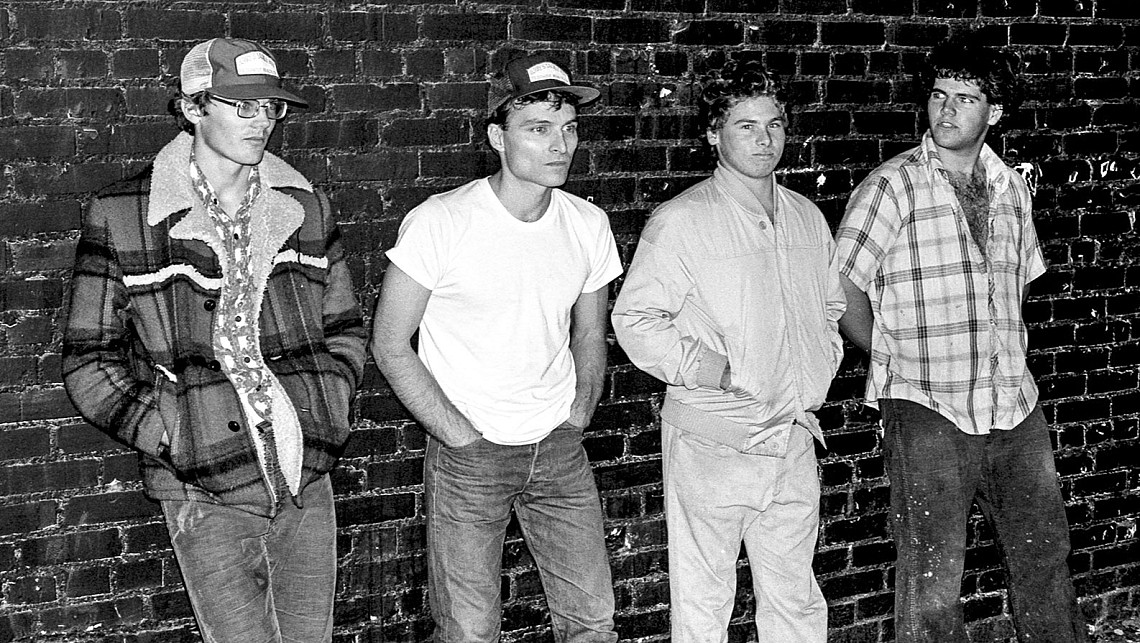 The Descendents, L-R: Milo Aukerman, Tony Lombardo, Frank Navetta, Bill Stevenson. Photo by Ed Colver.
Songfacts: Was it legitimately dangerous to be a punk rocker back in 1982, when Milo Goes To College came out?
Milo: Well, I think the real period of danger was probably 1980-1981 when the skinheads started to be this kind of force in the punk rock community. They were located in Orange County for the most part, but they'd come into the South Bay or they'd go up to Hollywood, and they would try to kind of establish their skinhead rules or whatever. That got to be a situation where you didn't want to walk around and look like a hippie, because they just didn't like the hippies. So, I think that that was a danger period.
My most vivid memory is going to see the Germs - their last show at the Starwood [on December 3, 1980] - and being at the front of the stage waiting for the Germs to come on. I look behind me, and the pit is starting to form. There's this guy with chains wrapped around his fists, and I'm thinking, How'd that guy get through security?
But of course, security didn't exist back then. He just brought these chains in with him. I looked at him, and he just looked at me like, "Fuck you. Turn around and watch the show. Don't even look at me." And I said, "Okay, that's what I'm here for."
That, to me, was probably the height of it. I could be wrong, but by 1982, hopefully the skinhead thing had calmed down a little bit.
Songfacts: You just mentioned the Germs. Listening back to Milo Goes To College, your vocals reminded me a bit of Darby Crash from the Germs. Was he an influence at the time?
Darby always brought the most amazing lyrics. His lyrics are like poetry, and I never developed that talent to just be a poet with my lyrics. Our lyrics are off-the-cuff, very obvious kind of lyrics. I never learned how to write poetry lyrics like Darby could, but I definitely worshiped him.
Songfacts: Since you had the opportunity to see him perform live, was Darby Crash as great an artist as some make him out to be?
Milo: Well, I saw him play with the Germs and I saw him with the Darby Crash Band, the two times. This was a few days before he died [on December 7, 1980]. I had loved the Germs' record [1979's (GI)], but we didn't have a chance to see them until that point. I don't know if this is true of both shows, but of course, his big Achilles heel was always the drugs, and he'd get up there and he'd be just completely wasted.
So, as a performer I'd say that the audience probably has to go in with the mentality of, "Well, this isn't going to match the record very close. In fact, he's going to be missing half the lyrics, he's not going to be singing half the time, and that's just how it rolls."
It's the spectacle, I guess. But the songs are so great. I guess if you're just stuck with the spectacle and then some shoddily performed songs, maybe that's okay.
Songfacts: What's the song by another artist that had the biggest impact on you as either a songwriter or performer?
Milo: The other band that we were worshiping at that point was this band called The Last. They were from our area in Hermosa Beach, and they were doing a kind of an aggressive power pop kind of thing, very Beatles, very, '60s tinged, but with aggressive vocals. And the songwriter, Joe Nolte, was just this amazing songwriter.
Bill and I devoured everything that they put out and would see them whenever they were playing out. But we both were on the quest to write the next Last song. For example, "Jean Is Dead" is probably headed in that direction. Or "Silly Girl," for sure, that Bill wrote later on. We all wanted to emulate them.
Songfacts: Let's discuss some of the stories behind the songs on Milo Goes To College, starting with "Hope."
Milo: "Hope" was probably the first song I ever wrote for the band, or at least the first song I wrote in totality for the band - I wrote the lyrics for "M-16."
"Hope," I put together this chord progression or the series of chords, and I showed them to Bill and said, "Here's my song."
Of course, realizing that a song needs lyrics, I just figured I'd show it to Bill, and he goes, "Ah, I like that. It kind of inspires hope." And I thought, "Well, OK, that's the name of the song, 'Hope.'" And then I had to write lyrics along that theme. And as luck would have it, I was breaking up with my girlfriend at the time, so that provided a good theme for a song about hope. And that's how it got written.
Songfacts: "M-16."
Milo: Tony [Lombardo] had this bit of music that he worked out with Bill and Frank [Navetta]. And I said, "Well, I'll put some words to that." This is probably pre-"Hope," too, because I thought, Well, I've got to take baby steps if I'm going to be a songwriter. Maybe just write a lyric first, and then later on you can learn how to write a real song.
So, I wrote the lyrics to "M-16" about my high school friend who was going off to West Point [United States Military Academy]. He was all proud to go off to West Point and fight wars or whatever. I'm pretty much a peacenik and not really into that.
Songfacts: Although you didn't write the song "Suburban Home," if you wouldn't mind discussing that song, as well.
He wrote that really unironically. No tongue-in-cheek at all - he really wanted it.
We would laugh at him, because it would be like, "Tony, what are you writing about here? That you want to be stereotyped? You want to be classified?" And he's like, "No, no, no. I want a suburban home."
So that was a funny twist on the whole idea, because, of course, people would hear it and be like, "Oh, he's dissing on suburbia." But it's kind of the opposite of that. And now, of course, the other irony is that we all have suburban homes! And we're all like, "Yeah, that's what we want."
Songfacts: "Myage."
Milo: Yeah, that's written by Bill, and I think it's the first song that he ever wrote. The story that he tells me is that he was out in front of his house, walking down the street, and he came across a garbage can that had a bass in it - someone was just throwing out their crappy old bass with like two strings on it. And he figured, "Well, I'll take that home." He started messing around with it and came up with the bassline for "Myage," and that's what begins the song. Putting that bassline together as his first musical creation is pretty cool.
And "Myage" just refers to, "It's my song." He didn't know what to call it, so he just called it "my song," or "Myage," basically.
Songfacts: "I Wanna Be a Bear."
Milo: That's written by Frank and Bill. I think mainly Frank, though, writing those lyrics. And that is, again, indicative of his personality. His whole thing was what we call bitter resentment towards all living things, or towards all humans. Like, "I just hate humans." But he especially hated the poser people at his high school, and the fact that he struggled with girls, and that became a target of sorts.
Unfortunately, in that early stage when we were all young and full of energy and full of resentment and bitterness, sometimes it gets targeted towards certain groups. It comes across almost incel during this phase of our existence - you could consider it incel, but back then it hadn't been utilized as a term. And if we were incel, I think we were more like harmless incels - not really toxic incels, I hope.
Songfacts: And how about "I Don't Want To Grow Up," the title track off the next album?
But he had a way of presenting himself - at least his behavior, his personality - as a young person. And he was in a punk rock band. He loved punk rock music and new wave music, and was just a friendly, chipper guy. And did not look like he was in his mid-30s - he looked mid-20s. I think he was on to something where music is what keeps us young. Punk rock keeps us young. He was an early aficionado of that. Like, "I'm going to do this music and it's going to keep me young." And that was his way of putting it into a song.
Songfacts: What are your thoughts on the pop-punk bands of the last 20-30 years that have listed the Descendents as a prime influence?
Milo: I guess that started happening in the '90s, and it was out of left field for me. I was not aware that it was still resonating with people. And since the mid-'90s, it's just been this continual, very gratifying referencing of us. You gotta be flattered by that. I'm totally flattered. We didn't set out to do anything other than make music for ourselves, and our music must have reached people in a deeper way than we would have expected.
I guess what that means is that you can make music for yourself and it can resonate with other people, and that's obviously what ended up happening. That's the icing on the cake for me. I love playing music, but the fact that other people can come to the show and rock out to it and have a good time, that just makes it all that much more worthwhile.
Songfacts: Are there any modern-day punk bands you enjoy?
Milo: I've been listening to this band Little Chair. But the reason why I'm listening to it is because my daughter's in it. That's a North Carolina band.
I like Turnstile. I guess they're not really punk anymore or hardcore, they're kind of more mainstream, but I do like some of that Turnstile stuff. And then we've toured a lot with bands like A Wilhelm Scream - they're really good.
And we just came off a tour with this band Liquid Mike, and I really like what they've got going. It's kind of Weezer-influenced, but a harder version of Weezer, that type of pop-punk mentality. We're touring with the Buzzcocks in Canada. They're not new, but they still play around. I like them a lot.
August 26, 2025
For more Descendents, visit facebook.com/thedescendents
More interviews:
Fat Mike of NOFX
Tim McIlrath of Rise Against
Anthony Raneri of Bayside
East Bay Ray of Dead Kennedys
Keith Morris of Black Flag
More Songwriter Interviews