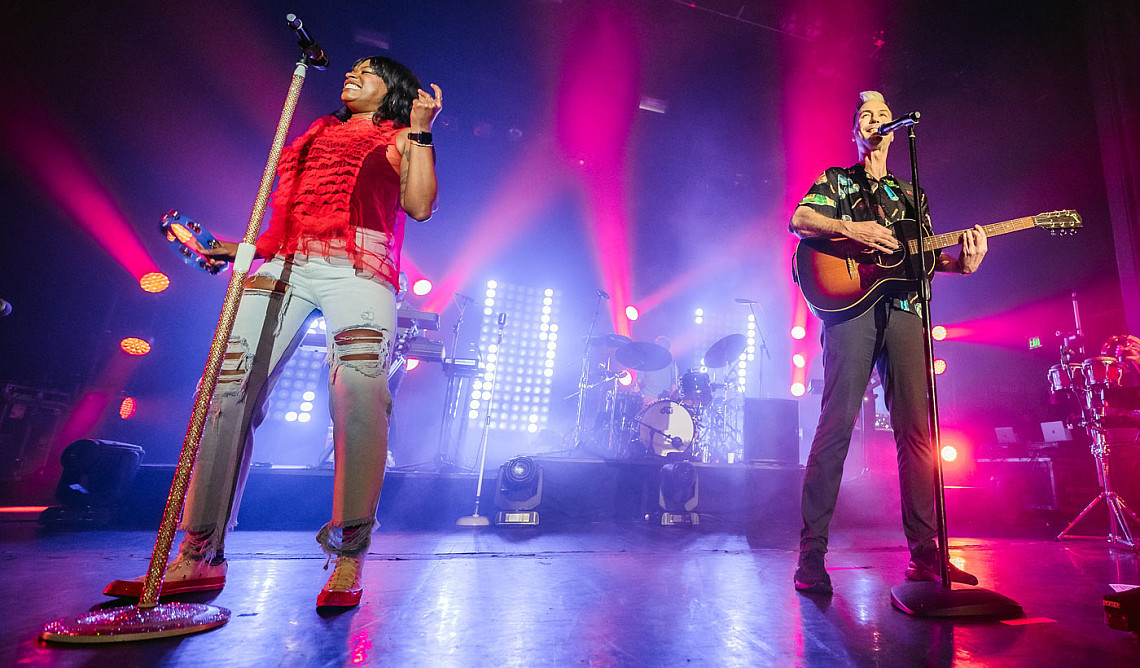
 Noelle Scaggs performing with Fitz and the Tantrums at the Regency Ballroom in San Francisco, January 25, 2023. Photo by Ana Wigmore.
Noelle Scaggs is best known for her dynamic vocals that blend seamlessly with her Fitz and the Tantrums co-singer, Michael Fitzpatrick. The band formed in 2008 and has been performing magic since, with Scaggs and Fitzpatrick as co-lead vocalists and co-writers on many of their songs. It is a formula for success. The energetic pop-rock and soul songs make fans want to dance, with clever songwriting that has resulted in multiple hit singles. Scaggs is not only a powerful singer and performer, she's also a solid songwriter who got an early start to her career in Los Angeles, collaborating with artists such as Dilated Peoples and Damian Marley, as well as recording background vocals to the Elephunk album by the Black Eyed Peas and Must B 21 by will.i.am.
Scaggs' writing credits include the breakout hits "Out Of My League" and "The Walker," and in 2018 she released her sultry solo debut, Great For You, stunning fans with her emotive vocals and sincere songwriting. This collaboration with LA-based BRÅVES was a break Scaggs needed to get perspective on her own music and voice; a voice Scaggs uses not only in her songwriting, but also to raise awareness about causes dear to her.
In 2020, a time of upheaval for many, Scaggs looked at the world and reflected on her place in it. Not only the world as a whole, but also her home in the music industry. Realizing that there aren't always many opportunities for people of diverse backgrounds in the music and touring industry, Scaggs started Diversify the Stage - a program that makes careers in the music industry more accessible for BIPOC, LGBTQ+, female-identifying, and gender-nonconforming communities. Her hope is that the obstacles she faced early in her career will no longer be a problem for young talent, and to also raise awareness for more inclusive hiring practices.
It is this dedication to inclusivity that has earned Noelle Scaggs the honor of being a recipient at the 2023 She Rocks Awards, which pay tribute to women in the music industry who display leadership in their field. Scaggs stands amongst other notable women including Judy Collins, Mary Spender, Shelly Peiken, Katherine Wing, Stacey Ryan and Lisa Johnson. Songfacts spoke to Scaggs just before she attended the awards and she shared with us what this honor means to her, her dedication to DTS (Diversify the Stage) and the hit song by Fitz and the Tantrums that almost wasn't.
Scaggs' writing credits include the breakout hits "Out Of My League" and "The Walker," and in 2018 she released her sultry solo debut, Great For You, stunning fans with her emotive vocals and sincere songwriting. This collaboration with LA-based BRÅVES was a break Scaggs needed to get perspective on her own music and voice; a voice Scaggs uses not only in her songwriting, but also to raise awareness about causes dear to her.
In 2020, a time of upheaval for many, Scaggs looked at the world and reflected on her place in it. Not only the world as a whole, but also her home in the music industry. Realizing that there aren't always many opportunities for people of diverse backgrounds in the music and touring industry, Scaggs started Diversify the Stage - a program that makes careers in the music industry more accessible for BIPOC, LGBTQ+, female-identifying, and gender-nonconforming communities. Her hope is that the obstacles she faced early in her career will no longer be a problem for young talent, and to also raise awareness for more inclusive hiring practices.
It is this dedication to inclusivity that has earned Noelle Scaggs the honor of being a recipient at the 2023 She Rocks Awards, which pay tribute to women in the music industry who display leadership in their field. Scaggs stands amongst other notable women including Judy Collins, Mary Spender, Shelly Peiken, Katherine Wing, Stacey Ryan and Lisa Johnson. Songfacts spoke to Scaggs just before she attended the awards and she shared with us what this honor means to her, her dedication to DTS (Diversify the Stage) and the hit song by Fitz and the Tantrums that almost wasn't.
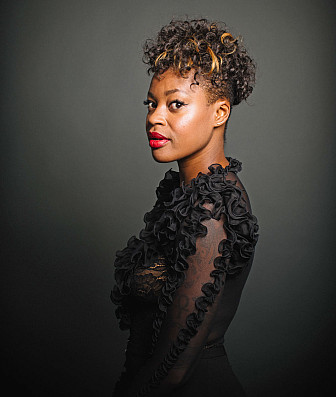 Photo: Catie Laffoon
Noelle Scaggs: I received an email from some of the people coordinating the event that made the decision to honor me, asking me if I could make the event. It's really cool to be seen by your peers, especially when we're thinking of the creative community. Just to have this honor amongst all these other women that are being represented and handed their flower for their impact, for their creativity and innovation, is very humbling that I'm amongst all of them. I've had quite a career myself but it's just an award for me. There's always that factor of being amongst other human beings that are being recognized for their accomplishments that I don't take for granted.
Songfacts: Women have such a presence in the music industry as advocates for women and others in the industry trying to succeed. Did you have that influence growing up or as you rose in the industry?
Scaggs: I think because of where I came up in the music industry, being here in LA, there seemed to be a lot more diverse faces when I was coming up in the music industry than there were when I became more popular.
I came from the background of DJ culture, people that were really influencing music and the music that we listened to in the LA music community. So, there was a lot of diversity as it related to different types of cultures and backgrounds and women doing their own thing. What there didn't seem to be a lot of was women-led industry - it was all kind of co-ed. If you were a hip-hop dancer, there were female dancers who had their collective crews, or they were a part of it. You were just really starting to see female DJ culture expanding the territory and making their mark.
My friends were leads of this DJ company called The Beat Junkies and it was primarily male-dominated. They started implementing these workshops that advocated for female DJs to start leading within the culture of that music. It's just really the influences that were around me, the diversity, but there were not a lot of women-led things. This stuff is all new to me now. Seeing the number of women and gender-fluid-led organizations that are advocating for the inclusion of women is really only in the last four years that I've been privy to it. Because it was never really a part of my everyday happenings as I was growing as an artist. There was a lack thereof. Which is one of the reasons I started DTS.
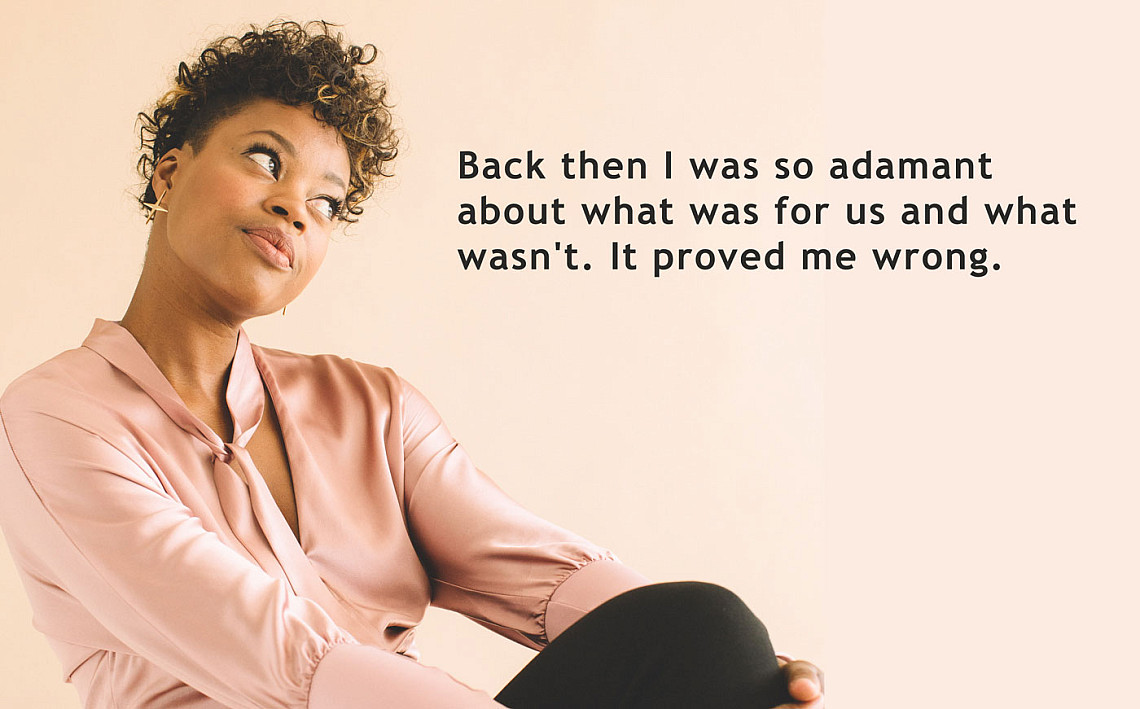 Photo: Catie Laffoon
Songfacts: It's incredible how Diversify the Stage targets not just musicians of diverse backgrounds, but all levels of the music industry (stage crew, marketing, talent buying, etc.), which are crucial because there are so many aspects to make music happen. What motivates you to do this work?
Scaggs: I started Diversify the Stage for a number of reasons. There seemed to be a universal time that gave me the space to ask questions and really connect with other people in the industry that have had similar experiences or have been in the game longer than I, and have the wave of different types of exclusion of being a person on the ground and management keeps you off the tour because they find out you're Black after you get there. There have been a number of stories that I've discovered through the process of creating what has become the organization.
The initial thing for me was feeling like I now had the opportunity to actually activate something that I could empower and control. I was getting so frustrated by the world, especially stuff that's going on here in the States. Coming to terms with my reality as a Black woman in this country and in the world and how my racial background will always be a barrier to certain access points for me. To live the best life possible, I have certain obstacles that are unconscious to some people. There's a glass ceiling that is not always intentional, it's just how it is. It was recognizing that and knowing that I didn't want anybody else to have that same walk.
Coming up in the industry as I recognized I had - realizing that I was often the only person of color in a room but also the only woman of color in the room in significant spaces too. Not even just a concert I performed in that happened to be an alternative-focused concert. It was all the time. It was big spaces with corporate giants. It felt like, Why is this normal? There are so many folks that create music, this rainbow tribe of individuals. The universal language of music should not be this uninclusive in a space that puts us on the road, or that builds up a career. So it was trying to figure out a way to utilize my platform to force larger conversations, to force actions, to motivate human beings to be ok with sharing their journey and stories. Talking to different executives, finding out that they've been wanting to orchestrate better programs for their companies, analyzing the roadblocks they're hitting with reaching different communities - there was a lot of stuff I was able to start pushing for and primarily because I was an artist. There were not a lot of artists who were vocalizing this from this position, looking at the behind the scenes of the music industry and shining a light on inequities and diversity from behind the scenes.
I was really empowered to create Diversify the Stage out of need and out of recognizing there's a lack of education about career paths in this industry, so I created a platform to enable you to learn about it. I created, along with my team, an ability for people to give back in time, resources, space, and finances, to support young people who are trying to enter the space, so that when there is a turnover of hiring, there's a larger pool of candidates to pull from.
Songfacts: Your voice has been very powerful in these conversations, and you have also used music in the past to raise awareness on certain topics, as in "Kiss The Sky" with gun control. How do you think music can create and spark conversations?
I often find that when we're having dialogue about something as simple as gun control or as simple as the banning of books in schools that are looking toward the history and teachings of the community of color, and you see zero artists on their platform raising hell about it, it makes somebody like me who's never really been afraid to challenge the establishment in any way feel alone in these larger spaces. Unless we have to do it on a platform that is PR-driven where nothing happens. It's one of the reasons I love Lizzo so much in that she raises hell for the inclusion of people with different bodies and advocates for social impact people and puts them on the stage so people can know who they are. She does stuff like that. There may be other variables that I don't know about, but seeing that kind of advocacy for communities that often don't have those voices for them, it keeps somebody like me going. It lets me know that I'm not alone in my peer group. Sometimes we need that. It's so easy nowadays to have your voice heard and not hide behind whether you're gonna lose some fans. At the end of the day, it's "What do you want your real legacy to be?" The one that stood by because you were able to maintain a check, or someone who stood up for a whole community of people who may also be buying your music.
Songfacts: Your songs do reach a broad group of people. A song like "Out Of My League" - did you know when you were writing it that it was going to be a success?
When I really think about songs, it's whether or not I can visualize what the song will look like on film, or how it will be conveyed in a visual sense. Is there a way of creating a human element to this song that you can see on screen? When I can do that, I know that a song is done. I know there is a larger way for this song to touch people's lives. That's how I think about my music. Whether or not it hits or makes it big, is really on the listener. It's all subjective at the end of the day.
Songfacts: It's interesting to hear you say that you have this visual sense in your songs. "The Walker" was used all over film and TV (Identify Thief, Academy Awards, Major League Baseball, The Umbrella Academy). Having that theatrical element really makes sense as it ended up being used in so many mediums.
Scaggs: I think of all those visual learners out there. Not everybody can listen to a song, and it captures the way that it would if they saw it with something, where you can connect the dots on a meaning or see where the artist's head was at. A creative little picture. I always take that into account because I'm one of those people. I'm a visual learner. It's always really important to me to capture my emotions in a way that can be seen.
Songfacts: Opposite of that, your solo song "Great For You" is emotive and a change of pace from your work with Fitz and the Tantrums. It really pulls us into your voice more and your soulful storytelling. Did you want to slow things down and write something different?
I can play around with my creativity, I can get some space, I can also offer fans what they've been asking for as well. A lot of fans have said, "We want to hear Noelle more. It'd be really great to hear her do something solo." It was really nice to have something I could throw out into the world. If they were into it, they would play it, and we did pretty well not going to radio with it, just keeping it for whoever accessed it. Whoever follows me got an opportunity - anybody who wanted to put it on a playlist. It was great. I really loved that video. I loved being able to work with my friends and put out something that felt authentic to myself.
Songfacts: You have quite a catalog of music. What song or project are you most proud of?
Scaggs: Honestly, I'm really proud of everything I've done in my career. Even those things that I didn't think were that big of a deal have somehow found their way in impacting someone's life. I'm just happy I've been able to record, and people have been wanting to buy it. Or come to our shows. I think especially with the band.
"Out Of My League" was not even a song I was considering for us. I wrote that song for a completely different band and played it for Fitz because I was a little bit nervous about pitching it to them. He was like, "I want to record this song," so it became a Fitz song. It was one of those songs that I didn't think was for us and ended up being for us. And it's still our #1 streaming song, across Spotify, and it streams like crazy. I'm super proud of that song. I'm super proud of where it brought us. I'm super proud I gave it a chance with the band. Back then I was so adamant about what was for us and what wasn't. It proved me wrong. I love that song for that reason.
Songfacts: What band were you writing it for?
Scaggs: I was writing it for Young the Giant.
Songfacts: You've had an accomplished career and you've really paved your own way. How do you think your path would be different if Diversify the Stage had been in place when you were getting your start?
Scaggs: Oh man. Honestly, I don't know. I don't know if I would've pursued artistry. I think I would've really tailored more into the behind-the-scenes work. When I got into the industry, I was really interested in the music publishing side of things and how people discover artists and help them navigate their business. I probably would've started my own record label or created my own publishing company or become a music manager. I probably would've done any one of those things. Now, this is good enough for me. Creating something that's free for youth to utilize and create their own destiny with support from leaders and workforces. I think I'm doing alright.
April 28, 2023
Follow Noelle Scaggs on Instagram
For more on Fitz and the Tantrums, visit fitzandthetantrums.com
More interviews:
Sam Hollander, who tells the "Hand Clap" story
Linda Perry
Joan Armatrading
Footnotes:
- 1] The Chicks famously sparked controversy with their outspoken stance against the US-led invasion of Iraq in 2003. When they took the stage at the Shepherd's Bush Empire theater in London, England, lead singer Natalie Maines said the group was ashamed that President George W. Bush was from their native Texas. The comments got them largely blacklisted from country radio in the States, and they lost the support of many of their conservative peers and fans. (back)
More Songwriter Interviews