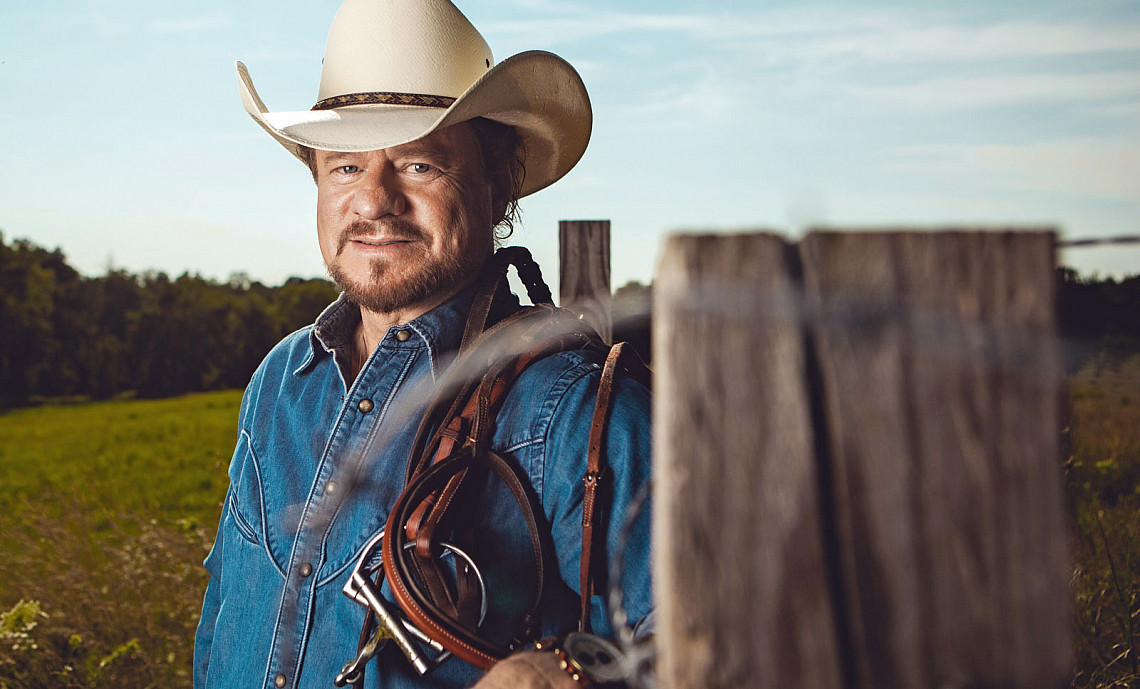
Country songs tend to be profoundly dysfunctional, with tears in beers and cheatin' hearts. But Paul Overstreet has made a long and illustrious career writing songs about our best selves, those moments when we dispatch the devil on our shoulder and do the right thing.
Many of these songs have become classics: "On The Other Hand" and "Forever And Ever, Amen" by Randy Travis; "Look At Me," recorded by both Alan Jackson and Carrie Underwood; "When You Say Nothing At All," first by Keith Whitley, later by Alison Krauss and Ronan Keating. But his best known composition might be one that tells a very different story: "She Thinks My Tractor's Sexy," a big hit for Kenny Chesney which, as Paul explains, came out of a trip to a farm supply co-op when his wife got a little frisky.
Overstreet was born and raised in Mississippi and, after high school, made his way to Nashville with a stop in Texas. He set out to be a recording artist, but found more success as a songwriter, landing a hit for George Jones with "Same Ole Me" in 1982. He married his second wife, Julie, in 1985, which is when he went on an incredible run, becoming one of Travis' top tunesmiths and also writing for the likes of Tanya Tucker, Marie Osmond, and Michael Martin Murphey.
In 1986, Overstreet formed a group called S-K-O with two fellow songwriters, Thom Schuyler and Fred Knobloch. They had a #1 Country hit with "Baby's Got A New Baby," but Overstreet left the following year. Teaming with Paul Davis, he wrote a song called "I Won't Take Less Than Your Love" for Tanya Tucker and ended up singing on it with Davis when Tucker decided it needed three voices. Soon after, Overstreet rebooted his solo career with the 1989 album Sowin' Love, which contains one of his best-known songs, "Seein' My Father in Me." He's been writing and recording ever since, amassing a collection of hits and hidden gems, nine albums of which have recently been released to streaming services. Among them, A Songwriters Project Volume I, which includes his interpretations of songs like "On The Other Hand" and "Same Ole Me," and two volumes of My Favorite Demos, with some really clever tracks - our picks include "One Right Thing" and "Blank Sheet Of Paper."
In this interview, Paul tells the stories behind many of these songs and shares insights into his motivation and inspiration, including the passage from the Bible that helps guide him.
Carl Wiser (Songfacts): You, more than just about any songwriter I've encountered, write about fidelity. And your very first hit song as a writer is a song with that theme called "Same Ole Me." An irony is that George Jones recorded it at a time when he was one of the most notorious hell-raisers in music. And it was before you settled down yourself. Can you talk about that song and what was going on in your life?Many of these songs have become classics: "On The Other Hand" and "Forever And Ever, Amen" by Randy Travis; "Look At Me," recorded by both Alan Jackson and Carrie Underwood; "When You Say Nothing At All," first by Keith Whitley, later by Alison Krauss and Ronan Keating. But his best known composition might be one that tells a very different story: "She Thinks My Tractor's Sexy," a big hit for Kenny Chesney which, as Paul explains, came out of a trip to a farm supply co-op when his wife got a little frisky.
Overstreet was born and raised in Mississippi and, after high school, made his way to Nashville with a stop in Texas. He set out to be a recording artist, but found more success as a songwriter, landing a hit for George Jones with "Same Ole Me" in 1982. He married his second wife, Julie, in 1985, which is when he went on an incredible run, becoming one of Travis' top tunesmiths and also writing for the likes of Tanya Tucker, Marie Osmond, and Michael Martin Murphey.
In 1986, Overstreet formed a group called S-K-O with two fellow songwriters, Thom Schuyler and Fred Knobloch. They had a #1 Country hit with "Baby's Got A New Baby," but Overstreet left the following year. Teaming with Paul Davis, he wrote a song called "I Won't Take Less Than Your Love" for Tanya Tucker and ended up singing on it with Davis when Tucker decided it needed three voices. Soon after, Overstreet rebooted his solo career with the 1989 album Sowin' Love, which contains one of his best-known songs, "Seein' My Father in Me." He's been writing and recording ever since, amassing a collection of hits and hidden gems, nine albums of which have recently been released to streaming services. Among them, A Songwriters Project Volume I, which includes his interpretations of songs like "On The Other Hand" and "Same Ole Me," and two volumes of My Favorite Demos, with some really clever tracks - our picks include "One Right Thing" and "Blank Sheet Of Paper."
In this interview, Paul tells the stories behind many of these songs and shares insights into his motivation and inspiration, including the passage from the Bible that helps guide him.
Paul Overstreet: That was one of those rare moments. I had gone down to Mississippi for a while and I was staying at my brother's house. I lived with him my last two years in high school. I lived with his family and played football in Prentiss. That town closes up at sundown, but the parties are outside of town at people's houses or out in the woods. I was bored, so I went in the living room and sat down. My nephew came in, lay on the couch and went to sleep. The dog was laying on the floor asleep. And for the first time, I actually saw the song, saw the beginning, middle, and end. So I just wrote what I saw.
Eddie Rabbitt used to tell me about that. He'd go, "You know how you see a song, you see the beginning, middle and end?" And I'd go, "No."
Sometimes I'd write songs and didn't know how they were going to end. But on that one, I saw it, and I just wrote what I saw. When I went to Nashville I played it for Tony Brown one day and he said, "We gotta demo that." I didn't think there was that much to it. I read the lyrics to my brother on the way to the airport the next day, and he said, "I don't really hear anything." So I was surprised when Tony wanted to demo the song. The Oak Ridge Boys took it to George's producer and said, "You always said if we thought we had a song for George that you'd record it. Well, if you record it, we'll sing the backgrounds." That was how it happened.
Songfacts: In your personal life, something very different was going on, wasn't it?
Overstreet: Yeah, at that time I was dabbling in a lot of different things. I'd smoke weed, drank quite a bit. If somebody had a party and someone had something, I'd do a little bit of it. But I didn't have any money at the time, which was a good thing - I would have hurt myself if I had much money.
Songfacts: I'm trying to get from where you were before you found the love of your life and settled down.
 Overstreet: That was a process I was going through. I just made a change. I wrote a lot of sad songs during those times. I would pick up the guitar and start writing sad songs. Then I started reading some pamphlets and things about thinking positive, and that made a change for me. So as I read that, I also started reading the Bible, trying to get through it by myself, but it was so confusing with the begots and the begats - I couldn't keep up with it and was like, "Dang, this is hard." But growing up as a preacher's kid there was a theme that I went back to, and that changed my life.
Songfacts: Were you married before you met your current wife?
Overstreet: I was. Not for very long, probably a year and a half.
Songfacts: I read somewhere that your first wife was Dolly Parton's sister. Is that true?
Overstreet: Yeah, her younger sister Freida. We were hanging out and writing songs together, and it was just kind of a natural thing. We just bonded in that way.
But it was difficult. I was way too young to be married, and I hadn't settled down. I was kind of a wild guy. But after that marriage ended I didn't really trust myself in that kind of relationship, so it was eight years later before I met my wife.
Songfacts: Many songwriters are fueled by heartbreak and turmoil - that's when they write their best songs. But you seem to be fueled more by stability, commitment. You've made an incredible career out of it. Can you talk about how that works for you and bring up a song where that comes into play?
Overstreet: With all the positive things that I was reading and studying, there was one scripture that really meant something to me: As a man thinketh, so is he. So I started writing things about what I wanted in life, and what I didn't have as a kid. My mom and dad divorced when I was young.
"Seein' My Father In Me," me and Taylor Dunn wrote that, but it had both of our relationships with our fathers, which is why I think it meant so much to people.
Songfacts: Who are the people in the video for that song?
Songfacts: That's very genuine. You can tell they're not acting.
Overstreet: Yeah. I didn't even know that until afterwards. They told me one of the guys and his son hadn't spoken in a long time. Why they came to do the video, I don't know. Maybe they just wanted to be on TV, but it's great that they did it.
Songfacts: Getting back to the fatherhood songs, you have other songs that deal with fatherhood as well, but one that's striking and seems closest to the experience you went through is "The Day My Daddy Didn't Come Home." Can you talk about that?
Overstreet: I was the youngest of five, and when I was a kid, my dad got a job at a church that didn't have enough money to pay him to be a full-time preacher so he had to drive a milk truck. And things happen when you're out driving a milk truck. He and my mom, there's not a lot of people who teach you how to be married. Marriage is hard, but we don't have schools to teach you how to do it. They just didn't make it.
Us kids were always waiting for him to come home because he drove a milk truck, which had ice cream - it was a freezer truck. And he just didn't come home one day. He was gone to California with this lady that he had met. I was too young to understand exactly what was going on, but I remember all the pictures in my mind.
I wrote that with Allen Shamblin, and we started out writing about his situation with his family, and for some reason we wound up telling my story - I wish we'd have told his story. Sometimes the truth is needed, but I felt bad when I put it out because my dad was still alive. He goes, "Well, I'm not proud of what I did." I think it hurt him a little bit and I wished I hadn't have done it, but I felt like it was a song that needed to be heard.
Songfacts: A lot of people don't understand that when you come from a divorced family, especially when dad is gone when you're young, it's really hard to become a good father because you don't have anything to model it on.
Overstreet: That's true.
Songfacts: But you've managed to raise six kids?
Overstreet: Yeah. A lot of those songs, I wrote them from what I wanted to experience with my kids. That's what I was writing about more than what actually went on in my life.
Songfacts: That makes me think of a song that really connected when I heard it: "A Long Line Of Love" [recorded by Michael Martin Murphey]. Where it's like you're starting this legacy where your kids will become good fathers.
Overstreet: Thom Schuyler and I wrote that, and it was his idea. We would sit down and write, and we also wrote "I Fell In Love Again Last Night," which was another song about a guy falling in love with his wife over and over again, because that's where Thom was with his wife in his relationship. I wasn't married and hadn't met my wife yet, and I met this girl, so I told him, "I fell in love again last night" - you know how that happens. So I wanted to write that, and he goes, "Well, what if we did it like this."
So that was his direction, and "A Long Line Of Love" was a similar idea. I thought that was a beautiful term and a good way to put it.
One of Paul's most enduring songs is "Forever And Ever, Amen," originally recorded by Randy Travis in 1987. He wrote it with Don Schlitz, the man who wrote "The Gambler."
Both Travis and Overstreet titled their memoirs after the song; Overstreet's was published in 2001, Travis' in 2019.
Songfacts: I read somewhere that you slipped in a nod to your wife in at least one of your songs. I think it's "Forever And Ever, Amen," where you're taking about how if she's losing her hair, you'll still love her.Both Travis and Overstreet titled their memoirs after the song; Overstreet's was published in 2001, Travis' in 2019.
Overstreet: Yeah. There's a cool story about that. After we got married my mom came up to visit. My wife's a hairdresser and she did makeup for a lot of album covers and things like that, so they went to the salon. I know that mother/daughter-in-law relationship is real fragile, so I told my wife, "Whatever you do, don't mess up her hair."
They went in and she cut her hair short and dyed it. It came out green. I was like, "Oh, no. This is not a good start."
So when Don called me I had played about 36 holes of golf that day, and Don says, "I've got this idea we have to write." His new fiancée's little boy was learning the Lord's Prayer, and he was going around saying "forever and ever, amen" after everything. He would say, "Mommy, I love you. Forever and ever, amen." So Don said, "We've got to write this." I said, "How about tomorrow?" He says, "No, now."
So I went home, took a shower. He came over, we sat on the front porch and started writing it. I told him about my wife messing up my mom's hair, and we toyed with that until it came to the place where we wrote that it all fell out, but I love her anyway.
I got this letter from Randy Travis, his office. There was a little girl who had cancer and she'd had chemo that made all her hair fall out. So this became a whole different thing we didn't even think about. I always feel like God uses things in certain ways. She wouldn't even go out and play because she was embarrassed that she lost her hair. She wouldn't play with her friends. Then when she heard that song, she said, "If Randy Travis could love somebody without hair, my friends should be able to love me." And she started going out and playing with her friends again.
Music is so amazing how it touches people's lives.
Songfacts: A much more lighthearted song that might have a connection to your wife is "She Thinks My Tractor's Sexy."
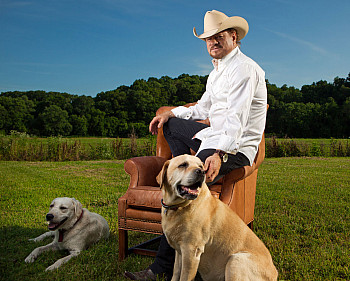 Overstreet: It did. It started out as a joke to embarrass her a little bit. We raised six kids but at the time we had five living with us. They just kept us busy all the time. So this day we left them at home with the nanny and went off looking at farm equipment. As we left the co-op, she flipped the little divider up and started getting frisky. It was like when we were dating. We went over to some friends' house after we left, and they said, "Are you writing any new songs?" I went, "Yeah, I got one I'm working on called 'She Thinks My Tractor's Sexy.'" Because we were looking at tractors.
She turned red and didn't say anything, but they started laughing really hard, so I thought maybe there was more to it than just a joke. So the following Monday, I had a writing appointment with a couple of guys. We were struggling to find an idea so I threw that one out there. One of the guys said, "I don't want to write that dumb stuff, let's write something serious." So we didn't write it. Then after the session the other writer, Jim Collins, called me and goes, "Man, I want to write that idea with you."
Before we wrote it, he went to his publishing company and told the title to the lady at the front desk, and she told Tim McGraw's people, and they said, "We want to put that on hold." And the song hadn't even been written. He called me and said, "Tim McGraw wants to put a hold on that song. We better write it."
So he came over and we wrote it. He did a killer demo on it, but Tim did not record it, so Renee Bell from RCA put it on hold for Kenny immediately. So that's how it got to Kenny.
Songfacts: It's one of those titles that's just really funny. I was listening to your Demos album, and "Shut Up Honey Money" is another one. I'm guessing it's easier to come up with one of these crazy titles than to actually write a song around it.
Overstreet: Well, it's all about having fun, and I have fun with writing. Being a preacher's kid you have to behave so much, you just get a mischievous part of you, so sometimes I write things that people go, "I can't believe you wrote that." But it's just fun.
Songfacts: One of your songs that's really connected with people and taken a life of its own is "Look At Me," which both Alan Jackson and Carrie Underwood recorded. Can you talk about that song and why it made such an impact?
Overstreet: Jim Collins and I wrote that song and I had the demo with just guitar and vocal on my iTunes. It kept coming up, and it always moved me. I got a call that they were making a movie about Billy Graham's earlier life, and they wanted a love song. So I sent that to Renee Bell and she sent it to them. Alan Jackson did a version and so did Carrie, after the movie came out.
Songfacts: Another is "When You Say Nothing At All." A wide range of artists have recorded it, and what a great sentiment, the idea that without words you can convey so much. Would you talk about how you came up with the spirit of that song?
Overstreet: Don Schlitz had a dream about it. We wrote on Monday and Tuesday of every week. We went in to write and he told me about the idea. We started writing it right then. It's kind of hard to explain, but did you ever see the old Dick Van Dyke Show?
Songfacts: Yeah.
Overstreet: You know how Buddy and Sally and Dick would all be in the room and they'd start brainstorming and throwing ideas around? That's kind of what we do in Nashville. So Don and I were just throwing out ideas. The line where it says, "Old Mr. Webster could never define," I thought that was cool.1 When I was a kid all we had was the encyclopedias and dictionaries and stuff like that. Nowadays you've got Google.
But it was such a fun song to write with the melody. I'd run into Keith Whitley at the airport. He was coming out, I was coming in, and we just stopped and talked for a while. He goes, "Man, would you write a song for me?" I said, "Everybody wants to write you a song." He was on his way up like a rocket ship.
So the first place we took the song was to him. Garth Fundis2 was a friend of mine, and Garth loved the song. They cut it, and then 10 years after Keith died, they did a tribute album and Alison Krauss chose that song to sing. When I got a copy of it, they said, "This is Alison's version. It's not as good as Keith's." But when I put it on, all the hair stood up all over my body. I was like, "Are you kidding me!?" She sang it great. And because of her version, they used it in the movie Notting Hill. Ronan Keating of Boyzone sang it in that. In 2020, Ronan did a version and had Alison Krauss sing on it with him.
Songfacts: What's a song we haven't talked about that's very important to you?
Overstreet: I've got funny songs that I love. Last night I played for this church group and the pastor asked me to sing "She Only Loves Me For My Willie." I said, "You seriously want me to do that?" And he goes, "Absolutely." They just loved it.
Songfacts: I love the song "The Truth About Men." Did you get any static from that one?
Overstreet: We got some from disc jockeys because it said, "We don't like Steel Magnolias." One of the DJs, Gerry House, goes, "I love Steel Magnolias, why would you say that?"
We were just putting testosterone in it.
Songfacts: How did that song come about?
Overstreet: A friend of mine, Dick Furman, I went down to the Cayman Islands to go scuba diving with him, and Franklin Graham was there too. He was telling us his marital advice: All you have to do is touch your wife, rub her back for 15 minutes a day and everything's going to be great. I was like, "OK."
But they owned this car with another couple, and they took the car to get air in the tanks to go scuba diving. We came back and he told us, "I'm a doctor, and when I scrub up, if I get there to prep a patient late, they're mad, so I just tell them, 'I was wrong, I'm sorry, it will never happen again.'" That was his marital advice to me and Franklin. That's all you gotta say. What can they say back?
Well, we were in the garage working on the tanks and his wife comes out with the mad-at-you quick-step, saying, "I thought you were going to be back in 40 minutes." And he says, "Well sweetie, we were back..." He just started arguing with her. He walked away and I said, "Where was the I'm sorry, I was wrong, it's never going to happen again?"
So I was telling some guys and Rory, the other writer, about that, and we just turned it around: "We ain't wrong, we ain't sorry, and it's probably going to happen again."
Songfacts: What's the song by another writer that most impressed you?
Overstreet: "Ain't No Sunshine" by Bill Withers. That song is just so good. I love the way it's produced. It sounds like a demo to start with and then the strings come in, and you go, "Oh, this is an important song," and it is.
June 2, 2022
Info on Paul's shows and releases is at pauloverstreet.com
More interviews:
Joey + Rory
Dean Dillon
Catt Gravitt
Gary LeVox
Footnotes:
- 1] In Ronan Keating's version, this line is changed to "Try as they may they can never define." (back)
- 2] Fundis was one of Keith Whitley's producers and helmed his original version of "When You Say Nothing at All." (back)
More Songwriter Interviews