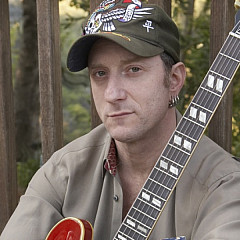
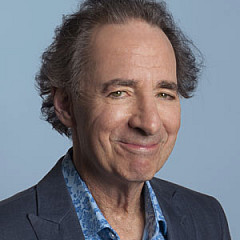
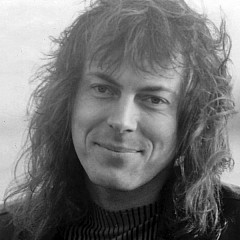
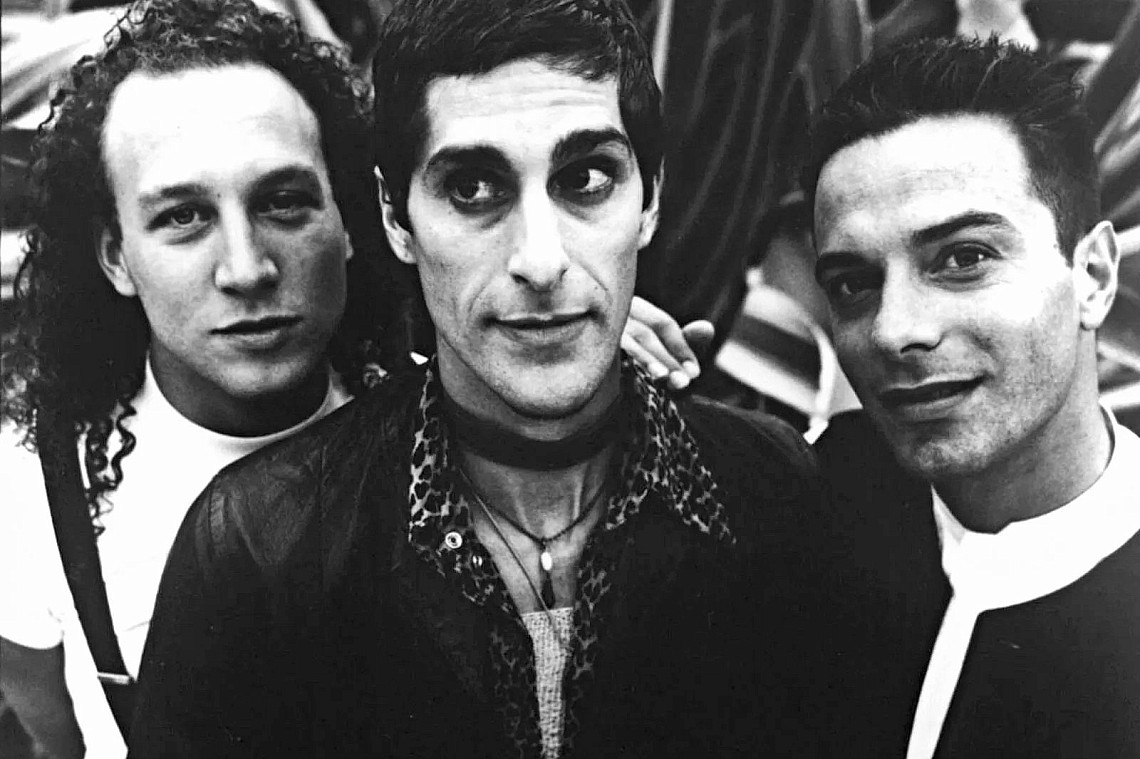
 L-R: Stephen Perkins, Perry Farrell and Peter DiStefano of Porno for Pyros. Photo courtesy of Super Evil Genius Corp.
Jane's Addiction, led by the fantastical frontman Perry Farrell with future Red Hot Chili Pepper Dave Navarro on guitar, lasted just two albums and one Lollapalooza tour (which Farrell organized) before disbanding in 1991. The next year, Farrell formed a new band, Porno For Pyros, pushing even deeper into transgressive musical territory.
On guitar was Peter DiStefano, who became a key songwriter in the group and helped them craft a sound that was distinct from Jane's Addiction, or anything else for that matter. They released two albums, the second of which, Good God's Urge, came out in 1996, the year DiStefano was diagnosed with cancer. He beat the cancer, but as he details in this interview, he had a harder time with addiction. Porno For Pyros officially broke up in 1998; that year DiStefano played on Scott Weiland's solo album 12 Bar Blues and finally got sober after eight tries in rehab. He went on to play with Peter Murphy and make music for films, including the Shrek and The Equalizer movies.
Pyros started playing together again in 2020 when they played the virtual Lolla2020. In 2023, they released a new single, "Agua," followed by another called "Pete's Dad," which is indeed about DiStefano's father, Vito. The band is slated for their reunion tour, which will also be their farewell, starting in February 2024. When we spoke with DiStefano, he had just wrapped up a practice in Studio City, California, with Pyros bass player Mike Watt and drummer Steve Perkins.
Carl Wiser (Songfacts): How's the band practice going?On guitar was Peter DiStefano, who became a key songwriter in the group and helped them craft a sound that was distinct from Jane's Addiction, or anything else for that matter. They released two albums, the second of which, Good God's Urge, came out in 1996, the year DiStefano was diagnosed with cancer. He beat the cancer, but as he details in this interview, he had a harder time with addiction. Porno For Pyros officially broke up in 1998; that year DiStefano played on Scott Weiland's solo album 12 Bar Blues and finally got sober after eight tries in rehab. He went on to play with Peter Murphy and make music for films, including the Shrek and The Equalizer movies.
Pyros started playing together again in 2020 when they played the virtual Lolla2020. In 2023, they released a new single, "Agua," followed by another called "Pete's Dad," which is indeed about DiStefano's father, Vito. The band is slated for their reunion tour, which will also be their farewell, starting in February 2024. When we spoke with DiStefano, he had just wrapped up a practice in Studio City, California, with Pyros bass player Mike Watt and drummer Steve Perkins.
Peter DiStefano: It's going great. I came to a realization when I was driving away from Steve's house in Studio City. I heard Mike Watt talking about recording Double Nickels On The Dime, the Minutemen album, and then Perkins talking about recording the Triple X Jane's record at the same place with the same person, and that Perry wanted to record there because that's where the Minutemen recorded. I'm like, I'm in a band with both these guys. It's pretty cool.
Songfacts: It seems like Mike Watt has cloned himself. He shows up with so many bands on so many projects.
DiStefano: He calls me every morning and we talk about jazz. Every morning before the sun comes up at 5:45 a.m., whether it's Christmas, my birthday, his birthday, New Year's... it doesn't matter. He calls me, religiously. It's a huge honor, I talk to him every morning.
Songfacts: Peter, what came first, the song "Porno For Pyros" or the band name?
DiStefano: The band name. There was a guy named Stuart Ross who was like a tour manager with Jane's Addiction. Perry said, "I want to start another band," and was looking at a fireworks catalog. He got to the centerfold and then Stuart, over his shoulder, goes, "Wow, that's like porno for pyros." Perry goes, "That's great. That's what we're going to name the band."
So the band was named and then when the riots happened we wrote the song "Porno For Pyros." It was the Rodney King riots in 1992.
Songfacts: When the band formed, what was your musical vision?
DiStefano: Perry and Stephen had Jane's Addiction and then Perry wanted to start a new band. We went on a surf trip to Puerto Escondido, Mexico. He had a roommate named Greg Lampkin - God bless his soul, he's not here - who was friends with me and I met through Eric Avery [Jane's Addiction bass player], who I grew up with. We went to high school together in Santa Monica. Greg I met through Eric, and we became good friends and then he wanted to manage me, my solo stuff. He thought my guitar solos sounded like The Stooges, so he was trying to help me get gigs.
And then there's a guy named Mike Cassel who started a clothing line in Venice called Bronze Age, and he goes, "Hey Greg, if you can get Perry to come on a surf trip, I'll pay for all of you guys to come." So Perry said he would do it and we all went. Perry and I sat next to each other on the plane. We hit it off and became friends before the band formed. We surfed together and there was a guitar. I picked it up and started doing classical finger-picking, and he was really impressed with that. He's like, "I want to start a new band. We should try to get together and jam."
So I came back to LA after that surf trip in Mexico and we got together and jammed. Then he and Casey [Farrell's girlfriend] stayed at my house for like a week and then we went to Skatemaster Tate's house in Hollywood off of Melrose - Skatemaster Tate was a DJ/skater. We jammed with a DJ, and he played "Riders On The Storm" and we wrote a song called "Orgasm" over "Riders On The Storm." So we were doing mashups before mashups were invented.
We ended up doing "Cursed Female," "Orgasm" and "Meija" all that one night with this DJ. I was like, "This is different than Jane's Addiction. It's more jazzy. We're going to use jazz loops, jazz chords, and there's a DJ in the band, so it's different." So I was like, "OK, I'll be in the band."
I didn't want to be the world's most hated musician. Jane's Addiction was impeccable at that point. They were at the peak - they were like Los Angeles Led Zeppelin - so I was scared. But then when I saw we were doing something different, I was like, "Yeah, let's do it." We auditioned bass players but I already knew it was going to be Martyn [LeNoble]. We started writing and recording, and the rest is history.
Songfacts: You mentioned some of those early songs. Do you have any insight on the lyric for "Meija?"
DiStefano: I do. I can say that it's about Casey Niccoli, who Perry was dating at the time. She would run to go score heroin or coke or both at the same time, and the dealers are like, "Where are you going Meija?"
"Meija" is like "little girl." She would get the drugs and then run off, so it was like, "Where you going, Meija? You got your money in your hand and your mind's already out the door." It's about partying.
Songfacts: You mentioned "Cursed Female," which also came with "Cursed Male." I don't know if you guys had those songs together. Can you talk about those?
DiStefano: "Cursed Female" and "Cursed Male," we wrote most of the songs acoustically on a nylon-string guitar. Perry had a house in Venice and I think we wrote those two in his house. I would just sit there with a guitar and he'd write lyrics, and I'd just start strumming chords and melodies.
"Cursed Male" has a lot of chord changes. I like to use sevens and nines like jazz chords. I wanted to make us different than rock and use more jazz scales more jazz chords - coordinate stuff.
Plus, Perry had such a great range, I wanted to write songs all over the neck, so I did think about that. I wanted to take advantage of his vocal range.
Songfacts: I read that "Pets" was inspired musically by a tragedy, something completely different than the lyric. Can you talk about that?
DiStefano: Yeah, no one knew about that. I just brought that up a couple of years ago. No one in the band knew. I had a song called "Vriana Dean." It was very tragic. She was murdered in the '70s in Santa Monica. I had a crush on her when we were in seventh grade.
I wrote a song called "Vriana Dean." It was like a picking song, and there's still picking parts to "Pets," but I started doing that and then Perry goes, "Ooh, pick it up." I picked it up and the song was written, but the core of it, the mantra of it, was for Vriana.
Songfacts: What can you tell me about the video for that song?
Songfacts: I didn't know how much you guys were involved in the visuals for the group.
DiStefano: Perry was very involved in everything. I was more into writing the songs and recording them and playing live and wearing suits. The look I was going for was Jerry Lewis in The Nutty Professor. He would drink the potion and become Buddy Love, a womanizer with suits and stuff. Plus the funeral look with the ruffled shirt. It was a mash-up of the funeral look plus Buddy Love.
Songfacts: I'm guessing the song "Sadness" has to do with drugs, but I don't know for sure. Can you talk about that song?
DiStefano: It's not about drugs, it's about how anything that causes pain is going to pass. Everything passes. It's a moment, and if you can just hang on, it will pass.
"When you laugh they can't kill you." It's ways to deal with sadness. It's a sign that it's going to be OK and we can get through our sadness. It's just a part of life.
Songfacts: What is the story behind the song "Tahitian Moon"?
DiStefano: We went to Tahiti on a surf trip. Our manager Roger went out surfing. It was getting dark and he didn't come back. Perry said, "Where's Roger?" We didn't know. So he says, "I'm going to take a canoe and go out to the spot to see if he's out there. It was a far paddle out. He took a canoe that was off the beach and he went in it. He was paddling, and it was dusk.
The canoe just exploded. It went poing, ping, pung, and all the windings and everything fell apart, and it just sank. So he was in the middle of the ocean, and then he got lost at sea.
We had search teams looking for him and we couldn't find him. We thought we lost Perry.
It's really interesting what he went through out there. I've heard him say that he was out there screaming, and then he screamed out really loud, "Jesus!" He was throwing everything out there while he was swimming, and then he just washed up on shore. Perry's Jewish, so it was really interesting.
He had some faith. He was swimming on his back and looking up at the stars, but he thought he was going to die. He got lucky.
Songfacts: The dynamics on that song musically are incredible.
DiStefano: Thank you. Yeah, I'm really into classical music and and I like to do the chromatic chords, the jazz thing using stuff like that.
Songfacts: Did you guys shoot the music video in Tahiti?
We also went to Sumatra and did filming out there in Indonesia.
Songfacts: It sounds like these surf trips really were a creative wellspring for you guys, even up to your new single, "Agua."
DiStefano: "Agua," Perry and I started it off when we went to Western Samoa. We wrote that out there.
Songfacts: Is the song "Good God's Urge" about your father?
DiStefano: Yes. My father had cancer, then recovered, and then some stuff happened where it went to his bones, so he was fighting that. He broke his back falling off a roof or something, so he was in bed and we didn't think he was going to make it, but he made it and he got back out and started walking again. We made the song and then he recovered - it was beautiful.
But we didn't think he was going to leave the bed. We thought he was going to die.
Songfacts: And the song "Pete's Dad" is also about him.
DiStefano: Yeah, that was in the beginning when we first met. My dad had prostate cancer and then he did the operation and it went to zero, so we got a call that it's all cleared up.
Songfacts: Another song I was thinking about when we were talking about "Tahitian Moon" with the water and these surf trips is "Porpoise Head." Can you talk about that?
DiStefano: Yeah. "Porpoise Head" was another song written in Tahiti. We were surfing out there and there were dolphins. I said to Perry, "I'm having a hard time sleeping," because I was addicted to heroin and was trying to get off of it. I was on methadone. I'm 26 years sober now so I can talk about this without being affected, but at the time I couldn't sleep.
There are two parts to the song. There's stuff that Perry has and stories about stuff that he went through, and then for me, I have an endorphin gland that's stuck wide open like a porpoise hole. I needed to start working again so I could sleep and feel a natural pain killer, because I jammed it wide open with heroin. That's part of it and then there's a lot more to the lyrics that Perry has but are sort of personal. But what I get out of it is that my endorphin gland is stuck open and I can't sleep because of drugs.
Songfacts: Were you an addict when you joined the band?
DiStefano: Yeah. There's different stages of addiction and alcoholism, and maybe there was a point where I was Stage 1, Stage 2, but by the time I got in the band I was maybe a Stage 3, and then I crossed that invisible line with heroin and cocaine that I couldn't stop. I was a Stage 4.
Songfacts: Was everybody in the band dealing with something similar?
DiStefano: No. Steve Perkins never had a problem. It was me, Martyn and Perry who would get up. But Perry, I have to hand it to him, he could always clean up. He could go, "OK, it's time to clean up," and he would just kick and get to work. I wasn't that guy. I could never kick. I always needed to be on it full-time. That's what made the band finally fizzle out. I got cancer and then I went to eight drug rehabs. I had a really hard time. So they got back on Jane's Addiction and I didn't die. I pulled it together and got sober from an out-of-body white light experience. I'm still following that that spiritual experience.
Songfacts: Did you say you had eight rehabs?
DiStefano: Yeah, I went through eight drug rehabs. I was very, very sick. Scott Weiland, one time the Oasis guys were bragging about how much coke they did, and Scott says, "Peter has spilled more coke than you guys have done." So I was really a mess. It's a miracle that I got 26 years sober.
Songfacts: What is a Porno For Pyros song that's meaningful to you that we haven't talked about?
DiStefano: "Agua," "Little Me" and "Fingernails" - three new songs.
"Little Me" is going to come out in a couple weeks. Perry had a girlfriend at the time and he thought she was pregnant - he thought he was going to have a kid. Then it turned out that she wasn't pregnant. It's a love song, but it's a wild love song. I love the guitar riff.
And then "Fingernails," that's a song about healing, like getting over a girl or a lover that's hurt you. It takes the speed of a fingernail to heal to get over it. Like the time it takes a fingernail to grow again. If you marked your fingernail at the bottom of it, by the time it gets to the tip of your finger, that's usually how long it takes to heal over anything physically, emotionally, mentally, so we believe in that.
Songfacts: Is there a specific song you grew up deconstructing that was a big influence on you?
DiStefano: "Dazed And Confused" from Led Zeppelin, the live version from The Song Remains The Same. That whole movie was a huge influence on me.
And then Joni Mitchell, Shadows And Light with Jaco Pastorius on bass and Pat Metheny on guitar and Michael Brecker on sax. That was a huge influence on me because it was like pop jazz. I wanted to do punk jazz in Porno For Pyros. Mike Watt, Jane's Addiction and the Minutemen, they were punk to me, like LA punk, and I wanted to do punk jazz. They call it alternative, but to me, it's punk jazz.
January 22, 2024
Check out our interview with Mike Watt
Get Porno For Pyros tour dates at pornoforpyrosofficial.com
More interviews:
Johnette Napolitano of Concrete Blonde
Curt Kirkwood of Meat Puppets
Brian "Head" Welch of Korn
More Songwriter Interviews