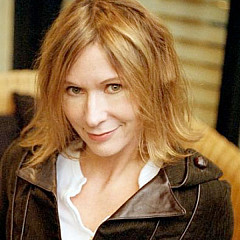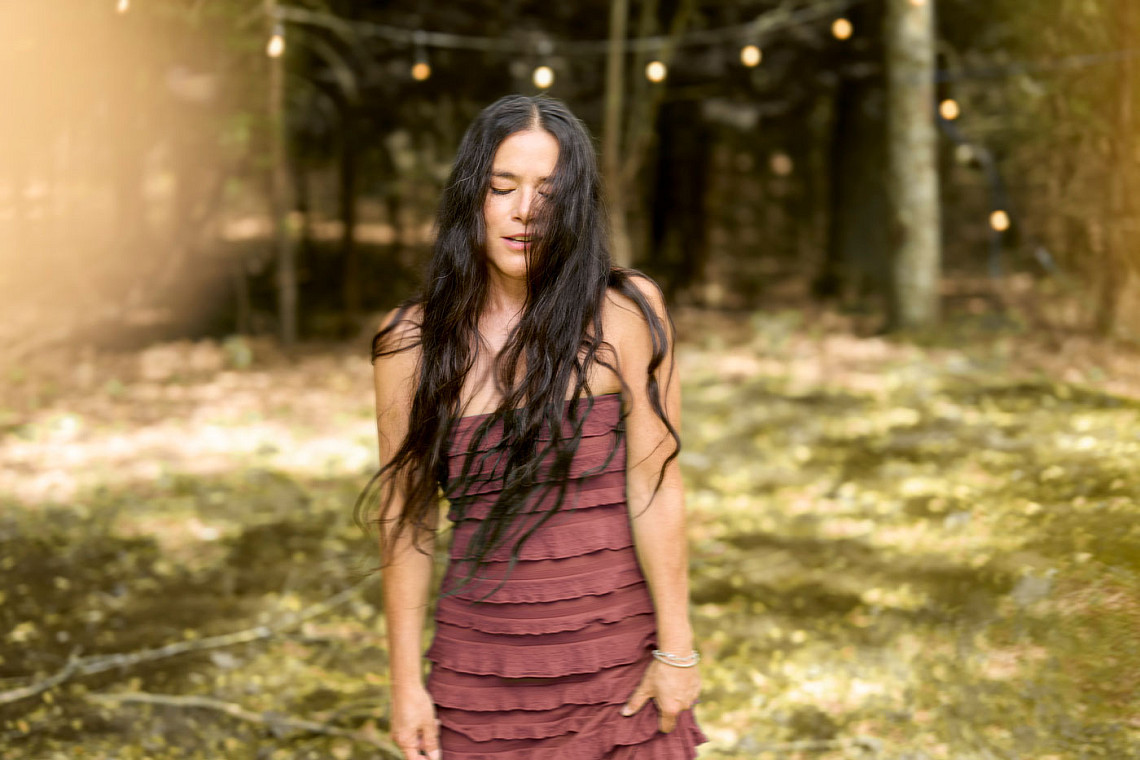
Rachael Yamagata is back with Starlit Alchemy, her first full-length album in nine years. I've always liked her smoky voice and the quiet yearning in her songs, which unfold like an enthralling cast of characters, the kind you'd meet in a novel you can't put down. There's a presence in her music that exists somewhere between an exuberant muse and a friend confiding a secret over tea - a happy co-conspirator.
On this album, her soulful voice, infused with a buoyancy that reflects wisdom well beyond her years, seeks truths hidden in the shadows. The lead single, "Birds," finds her loved ones revealing themselves in the form of birds crashing into windows. Other tracks sit softly in the breeze, a whisper overhead if we are brave enough to listen. Songs such as "Backwards" reveal these stories, while the celebratory "Carnival" bellows loudly, beckoning us to listen, an anthem of being our authentic selves. "Somebody Like Me" unveils a quiet sincerity, bravely exposing the oft-felt conundrum of "Is there anyone who ever feels like me?" Yamagata takes a bolder leap on the metaphysical "Galaxy" while the ethereal "Reprise" reconnects us with ourselves and the greater unknown.
Through the process of recording Starlit Alchemy, Yamagata developed TMJ disorder, which affects her jaw. As we met over Zoom to discuss the album, she was working towards recovery while gearing up to tour.
Nicole Roberge (Songfacts): I hope your jaw is doing better. Has that affected your approach to singing and preparation for the tour?On this album, her soulful voice, infused with a buoyancy that reflects wisdom well beyond her years, seeks truths hidden in the shadows. The lead single, "Birds," finds her loved ones revealing themselves in the form of birds crashing into windows. Other tracks sit softly in the breeze, a whisper overhead if we are brave enough to listen. Songs such as "Backwards" reveal these stories, while the celebratory "Carnival" bellows loudly, beckoning us to listen, an anthem of being our authentic selves. "Somebody Like Me" unveils a quiet sincerity, bravely exposing the oft-felt conundrum of "Is there anyone who ever feels like me?" Yamagata takes a bolder leap on the metaphysical "Galaxy" while the ethereal "Reprise" reconnects us with ourselves and the greater unknown.
Through the process of recording Starlit Alchemy, Yamagata developed TMJ disorder, which affects her jaw. As we met over Zoom to discuss the album, she was working towards recovery while gearing up to tour.
Rachael Yamagata: It's crazy. I'm literally just starting to sing. The past couple of days, I've been running the set. I'm having to learn how to sing in a new way because I can't fully open my mouth yet. It's a challenge.
It can work, which is the positive part, but my jaw feels pretty stiff after I do it. I can feel it sort of falling out of alignment again. It's going to take a lot of good energy for this one, but I think I'll be fine. This close to a tour will be interesting.
Songfacts: It seems like you have a lot of support with this album. Through the singles you've released so far on Starlit Alchemy, fans have had this gravitational pull to the songs in a very powerful way. Did you expect that people would be so connected to it?
Yamagata: I always hope that it reaches the people it needs to reach. I mean, we've been through the wringer. I think of 2020 and I'm like, how did people start just going back to life? It mystifies me. I feel like we haven't processed millions of people dying, and now it's just a continual overwhelm of crazy.
I also think there's a collective shift that's happening in consciousness and awakening, whatever you want to call it. I think people are, on many levels, reaching out for a hard connection, like they're sensing that other things are developing and there is a different life. There are different possibilities and structures are crumbling and all the things. I feel like it's in the air, it's in the energy. People are done with the old ways of being.
Were we ever meant to live a life where it's just surviving and struggling? No. No human wants to see another human suffering. You know most of us don't anymore, our compassion is off the charts.
So, I don't know what I expected. I knew that I had to make this record before I could move on to some other project, and this was not an easy record to make. It was not an easy record to get people on board to want to take on, or to even try and help market. It's not made for radio. It's not made for major labels. So that alchemy of it has been very long and very trying, so anybody who finds it, to me, is like, "This is for you," because it took me so much to get there. And whatever you're going through, if you resonate with this, then, you know, soul sister, I'm with you 100%.
Songfacts: "Birds" reflects on the theme of grief and receiving signs. Was this something you were experiencing during the process of making the album?
The song is very different for me melodically. It's not something I typically write, and rhythmically it's really challenging to get it right because it's not on a click track. When I was with John Alagía, a longtime collaborator who produced a lot of this record, we got to that song and knew that it was most likely the heart of the record. It reaches the deep material in that it's sort of hopeful and it acknowledges what's happening, but it leaves it where it is. That there is something bigger than us, and we can trust it and we can go through the darkest parts of our human experience and still have a confidence that there is this other thing... there's literally a spider coming into frame right now.
[Spider crawling down camera on Zoom]
Hi, which one are you? Like signs, signs all the time, you know what I mean? Look, it can be so magical. Can you see him?
Songfacts: Yes, I can. He's just literally hanging out now.
Yamagata: So, I got the message. I'm trying to spread the message. Oh my God. Aunt Judy? Is that you? I had a sweetheart aunt pass a few days ago. He's making a web. There's just magic all over, so I hope this can be a little stamp of magic. I know people get that from it.
Songfacts: I think it's comforting to have that connection because I think you'll hear people share signs they've received also.
Yamagata: There's a really fun thing you can try which is like a test. Think of something that you would never run into — the first thing that comes into your mind — for a sign from someone. Like, there's no way I'm gonna run into XY and Z, and just wait. Wait about a week and you'll forget it. I did it the other week, and I was like, pink bunny — there's no way I'm going to see a pink bunny. I randomly had a friend ask me over a week later. I totally forgot about it and I'm sitting, waiting for her. She's coming down her driveway and she's got a bunch of books on her porch. I pick up this book and sure enough, there's a pink bunny.
Just try it out. It's so fascinating. Have you brought this into your experience, or do you have guides that knew you were going to run into that?
Freewriting is good too. We can all channel - that's what songwriters do. We're just getting little things from other places. And if you write in the morning, it just picks up speed, and you're like, wait a minute, what is this? Is this me? Is it the higher self? Is it other people? Is it all of those things? It's really cool.
Songfacts: "Heaven Help" feels like a beautiful follow up to "Birds," almost as if they're dance partners. Were they written together?
Yamagata: "Heaven Help" was one of the early ones, and "Heaven Help" and "Reprise" used to be one song. I split them up because this album is kind of like a journey. You go a few steps forward and then you go backwards and then you discover all these things where you know something's changing, something's transforming. You have these "Carnival" moments of like, "I've got it, I'm done with the old me," and then you get sucked back into the trauma of something's really sad, and it's sort of how our lives work. Something's always coming out of the corner, good or bad, hopeful or not, and we just work through. We surf the waves.
So "Heaven Help" was one of the early ones, and that one in particular was in 2020. I kept looking at everybody in their homes and the ones who were alone, and looking to the skies to send them a sign that you're thinking of them and that we're going to get through this. And "Reprise," after this journey of the album, becomes this reminder for us to see you. It's not that you've got the journey figured out, it's that we're on it together and it's a continual thing to remind us of the magical experience.
Songfacts: I think it's sad when you said no one wanted to hop on this album, because then you have a song like "Carnival" that's this powerful, liberating anthem where you declare: "I'm no longer a carnival; there's nothing to see here anymore... I'm no longer a willing player." It's such a strong statement. Did that come from a musical standpoint or elsewhere in your life to form this bold declaration?
Yamagata: It's like, I'm done with what weighs me down, whether it's relationships, an industry, or preconceived expectations, anything that draws away from what my authentic me wants to express. And it's being comfortable in your own skin and not wanting approval, like you're no longer playing a role for anybody else.
For me, it's for women. It feels like the kind of song that's coming in to your own power, and the freedom and the enjoyment and the epic crest of that. It's so funny that one of my doctors was like, "Maybe you should take that off the setlist if that's triggering your TMJ." I'm like, "I can't take that off the setlist."
So it's not easy, but it is an anthemic song. It does have this thing that I feel people either love it or they don't get it. It's never quite a lukewarm reception to that particular song, so it will be really interesting to see who responds to it, but it was super fun to write.
Songfacts: On the other hand, you have "Somebody Like Me," which feels almost like a mirror to "Carnival." It's so honestly eloquent, and there's such beauty in your vulnerable earnestness. It's brave to put those feelings out there, and relatable, because everyone feels like that sometimes, though maybe not everyone wants to put that into a song. Was that hard to write and put that vulnerability out there?
I even have this piano version that's much slower and more internal. I thought, "This isn't for the record." I literally gave the piano and demo and vocal to Michael Chaves, who's a longtime collaborator, and he took it and ran with it. He made the whole track out of that demo and then I re-sang the vocal eventually.
But people are telling me, "Oh, I can relate to this," and as I thought about it I realized other artists, or in whatever venture, are also wondering, "When will my day come?" It's a stage of this journey. So it took some convincing to get it on the record, but I'm very happy that people relate to it.
Songfacts: You mention Michael Chaves and John Alagía. Did recording it at home with people you have this comfort level working with enhance the process?
Yamagata: Yeah. It wasn't always easy, but there's such a trust level between everybody. I've known John and Michael forever. Pete Hanlon, who's my partner and sound engineer, he's the hardest to work with. We drive each other nuts, and that was very challenging. But he's brilliant, which is so infuriating. He believes in me so much, which is also infuriating to him, I'm sure.
Every song got a different person at the front of the pack. Sandy Bell and Jeff Lipstein are two dear friends of mine. Sandy is an incredible artist. Jeff is her partner, and being the producer and drummer, he mixed a lot on the record, and the two of them produced some tracks like "Jesse," but they really get my vocal nuance at the deepest vulnerable place. Everybody brought such wonderful collaboration to it. In doing it at home and at Michael's studio outside of LA, that just makes it fun and there's no clock running. It's such a different, and fun, experience.
Songfacts: How was the trajectory of writing and recording Starlit Alchemy different from others in the past?
Yamagata: It was hard. There's a lot of trial and error on the songs. There's a long version of "Backwards." We tried to rearrange the verse and chorus. They're not traditional. So there was a little construction for some of these.
"Birds," figuring out the tempo of the free-flowing verses, but then figuring out the more rhythmic chorus. That was figured out the night there was a thunderstorm and I found it from this thumb piano and started doing these weird textures.
There was some crafting that was different for this record and some of it was surprising. "Blue Jay" and "Jesse," we got piano and vocal takes one right into the other at a studio, on a full moon on a night where it was just me and a giant empty room and a piano. I was feeling like my friend's spirits were there helping me along. It's so, so delicate and so tender. That was new for me, and beautiful. This record was not easy, but I knew I had to finish it.
Songfacts: It's been 21 years since Happenstance was released, which is still very loved and revered. A song like "Be Be Your Love" has taken on a different form live. How do keep your songs evolving with you?
Yamagata: With the early songs, we have to find ways to make them fun because the themes of broken hearts and love stuff were such a 20s and 30s area of age, and what really crushes my heart now is different. There is such a different threshold as you get older and have people leave your life or watch devastating world events, whatever it is that's ripping you to shreds in a new way. And you've also just seen so much. So, when you go back to playing some of those songs, for me, they get enriched by thinking of the core emotion of it and relating it to something new. As long as there's an emotional content of a song, I can perform it with that emotional content so at the core, even if I'm not referencing what I initially wrote it about, I can perform it that way. And then we just try and change up the arrangements to keep it fresh.
Songfacts: What song in your catalogue do you feel most connected to?
Yamagata: It's hard to say. Right now, I feel pretty connected to this record for sure. "Carnival" is where I am. This is the song where I'm like, that's that song for me.
Also "Elephants," which is on a record called Elephants... Teeth Sinking Into Heart way back in the 2008 time frame. I always loved that one because it was my first song where I wrote it so quickly, walking down this mountain. It's the most poetic, imagery-wise, song that I've ever done. And I was like, this is channeled. I didn't know where it was coming from, but the lyrics just kept coming and I had to race back up the mountain and get a pen. I don't even think we had cell phones at that time. That one I feel very connected to for that reason: it just felt so gifted.
And it's been an important song to link me to two very important people in my life. One who I knew very well who has passed and infiltrated this new record in spirit. "Elephants" was the one that drew him to me. Another person is a guide who also responds to that song. There's something about that song that's been really important in my experience for sure.
Songfacts: How do you hope this album resonates with listeners?
Yamagata: I tell everybody, and I know you're not supposed to give instructions for listening, but I do say this is a collaborative listening experience. If you want the best, most profound connection with it, I highly suggest taking the time to go for a walk or a drive, lay under the stars, put the vinyl on or whatever it is, but have an experience that allows you some time to process whatever's going on - good, bad, great, whatever - as a full 45 minutes. I know we have such short attention spans. It's really not to play on your computer necessarily, and I definitely wouldn't play it at a dinner party — they will be like, "What is happening?"
But allow yourself the time. Some songs blend into the next - they're very intentionally sequenced. It really does move in a fluid way that will be more powerful. Every artist is going to say, "Listen with headphones." I'm no different. But there's just something about this one.
October 27, 2025
Get tour dates at rachaelyamagata.com
More interviews:
Missy Higgins
Gavin DeGraw
Ingrid Michaelson
More Songwriter Interviews