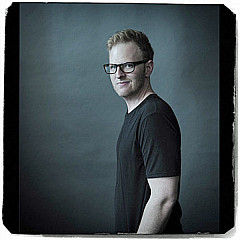
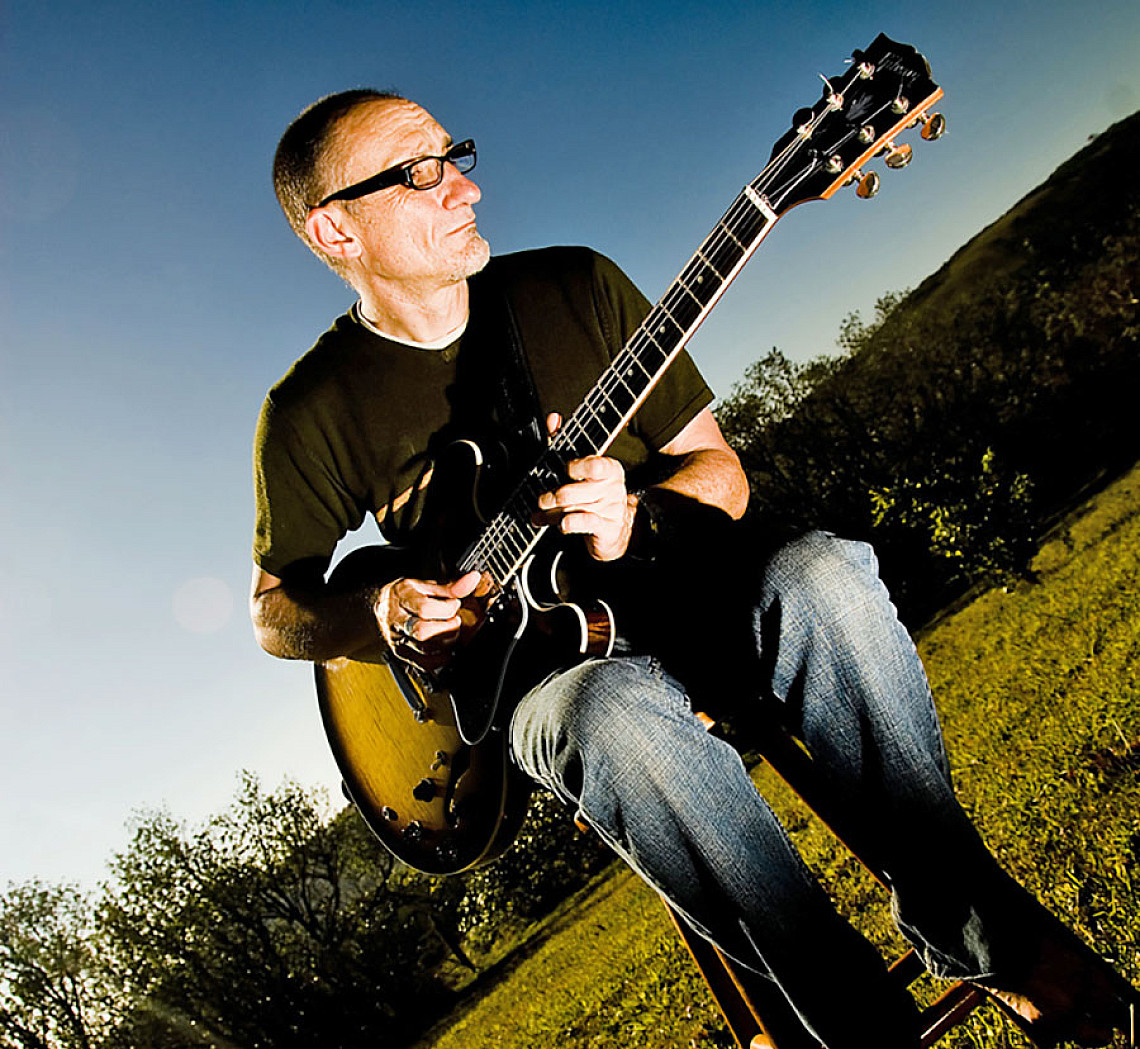
 Photo: Jamie Midgely
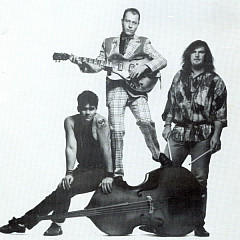
Robert Dean was a major player on the British New Wave scene, a transformative time when music got a glossy sheen, which as Dean explains, wasn't limited to synthesizers. He was the guitarist in the band Japan (fronted by David Sylvian) for their first four albums before heading to Los Angeles in 1981 to join Vivabeat, a Los Angeles band that came ever-so-close to stardom but couldn't quite crack that nut. They're back in the news with the 2025 release of the compilation The House Is Burning: The Best Of Vivabeat, which includes one of Dean's key contributions, the song "The House Is Burning (But There's No One Home)." On July 11, an expanded edition of Vivabeat's album Party In the War Zone is set for release.
Dean was part of Sinéad O'Connor's band when she released her first album, The Lion And The Cobra, in 1987. He now lives in Costa Rica, where he formed a band called Light Of Day that released the album Dimensions in 2020. Life in Costa Rica supports two of his other interests: ornithology and illustration. His illustrations appear in the definitive field guide The Birds of Costa Rica.
Carl Wiser (Songfacts): Can you give us some insight into the song "The House Is Burning (But There's No One Home)"? It seems like it might be a Cold War commentary.Dean was part of Sinéad O'Connor's band when she released her first album, The Lion And The Cobra, in 1987. He now lives in Costa Rica, where he formed a band called Light Of Day that released the album Dimensions in 2020. Life in Costa Rica supports two of his other interests: ornithology and illustration. His illustrations appear in the definitive field guide The Birds of Costa Rica.
In any case, the story is that Marina was in the shower and was sure she heard Mick singing the line "The House Is Burning (But There's No One Home)" over and over, in another room. Very strange, as he wasn't singing it, but they immediately recognized that it was a powerful lyric. Mick fleshed it out with a stalker/jilted lover gone arsonist angle. It was one of the first songs we worked on in rehearsal when I initially moved to LA, and in that respect, I seem to remember it came together quite quickly.
Songfacts: What's a song in the Vivabeat catalog that stands out for you?
"Blue Guitars" was one of the later songs that Vivabeat developed. Mick wrote it, and it was a big step forward for him and the band in terms of musical and emotional sophistication. Initially, it was sung by Marina and two other women as part of a Vivabeat side project that was formed while our lead singer, Terrance Robay, was off shooting a movie with Dennis Hopper in Germany. The "girl" incarnations used the names See Jane Run and Neko Meka and the songs at that time were never performed live.
While assembling the new The House Is Burning: The Best of Vivabeat compilation, Mick discovered a one-take vocal of Terrance singing the song. He was able to finesse it into the original backing tracks, replacing the trio's lead vocals. The fact that the song was called "Blue Guitars" made me feel a particular responsibility to make the guitar the principal driving musical element, and evoke a mournful feel, as the title might suggest.
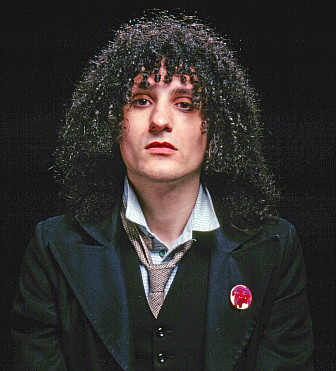 Robert Dean with his famous corkscrew hair in 1978. Photo: Brian Cooke
It took groups like Kraftwerk, and some of the other Krautrock bands to emerge, for synthesizers to feel more accessible and fun than the technically proficient neo-classical approach that the progressive rock bands had pioneered. Brian Eno, both in his solo work and in his collaborations with Roxy Music and David Bowie, melded synths with glam, inspiring the integration of songwriting and technology for countless fledgling bands who had followed in the wake of punk. Musicians with a lot of creativity, but not necessarily a lot of technical ability, could suddenly infuse their projects with boundless new ideas and textures. They could not only incorporate traditional instrumental sounds such as cello, pipe organ, and gamelan, but also out-of-this-world new and wacky sci-fi sounds. It was an empowering time which brought forth not only music, but also the emergence of multimedia performance art just in time for MTV.
It wasn't just restricted to keyboard instruments. It also infiltrated the sound of guitars, bass and drums. In retrospect, this explosion of glossy, fabricated sounds - which dominated the commercial music scene throughout the '80s - is now instantly recognizable, and therefore can often sound quite dated. Nonetheless, it is unquestionably a key element to the even more simplistic, immediate, and disposable pop of today.
Songfacts: One of Japan's most popular songs is "Quiet Life." Please tell us about that song, including how you got that guitar sound.
This song - as was usually the case - was originally written and presented to the rest of the band by the lead singer/songwriter as a simple chord-driven guitar song. In our small rehearsal studio in Willesden, North London, we then set about creating the arrangement, starting with the sequencer part, and then constructing the bass and drum parts over which I would play the rhythmic guitar parts. Once we were happy with the basic ideas, it was then ready for the more organic creative elements that would evolve during the recording process.
This took place at AIR studios with John Punter (the producer of our favorite Roxy Music albums, among others) at the helm. Up until this point, we had not worked with someone who was so keyed into our wavelength, and understood what we wished to achieve. Consequently, the entire process was the most satisfactory of my career with the band.
I had just acquired a new Gibson guitar which incorporated revolutionary and unique Moog technology in its pickup design, and I was able to create clean, rich, ringing tones as well as thick sustain. It was also the first time that I had applied the eBow - an electric string vibrating device in the instrumental break of the song - which soon became something of a signature in my playing style.
Songfacts: Another song that's held up well is "Life in Tokyo." Please tell us about that one.
By this point, after the release of [1978 album] Obscure Alternatives, we were all heavily impressed by the sequencer-driven works of Giorgio Moroder. We were particularly drawn to his pioneering work with Donna Summer and his stunning soundtrack to the film Midnight Express which had just earned him an Academy Award. He had a connection with our then German-based record company, Ariola/Hansa, and he agreed to work with us on a single. We were then flown to Los Angeles and he presented us with a theme he had initially recorded for the film Foxes which was crafted into the "Life In Tokyo" single.
The song was essentially created almost from scratch in a two-day recording session. It was a very controlled environment crafted towards Giorgio's process. The drum kit was set up to create his standard "sound," we used his usual vocalists as our backing singers, and the integral sequencer part was created and played (manually with delay) by his then synth programmer Harold Faltermeyer. For my guitar part, I knew it needed to be something simple, yet catchy, and I thus created a distorted octave riff which is present throughout. We were content with the results, and it was the forerunner of the sound which was to come for the band and resulted in the Quiet Life album.
Songfacts: What's another song from your time in Japan that makes the grade?
Songfacts: What do you recall about working on Sinéad O'Connor's debut album The Lion and the Cobra? According to her memoir, she was 20 years old and pregnant during the sessions.
Prior to the original album recording sessions, we had rehearsed solidly for around a year. When I became a part of the band, I couldn't help but be impressed by Sinéad's undeniable talent and charisma. Even in those early days, she was a very easy person to get on with and very open to any of the band's ideas, soaking up all our experience like a sponge. The first sessions for the album were not short of problems, however, due to the choice of Mick Glossop as producer. His previous work with Van Morrison and The Waterboys, amongst others, had been a decidedly old-school process. Consequently, the band and Sinéad recorded predominantly live in the studio, and overdubs - apart from horns and orchestral arrangement in the case of "Troy" - were kept to a minimum.
Little of those original recordings made the finished album because they were deemed unsatisfactory by her record company, and we subsequently re-recorded them with a new producer, Kevin Moloney. Once those sessions were finally completed, the release was put on hold due to the imminent birth of Sinéad's first child. It was during this time that I had the opportunity to leave the UK to spend time in Australia, a move which ultimately led to the formation of my own band, The Slow Club, which was signed to Virgin Records. We recorded one album, World of Wonders, which I co-produced and for which I wrote the majority of the material.
As for my time working with Sinéad, I am extremely proud of that period and working with her was never less than a delight. I think of her with nothing but admiration and warmth.
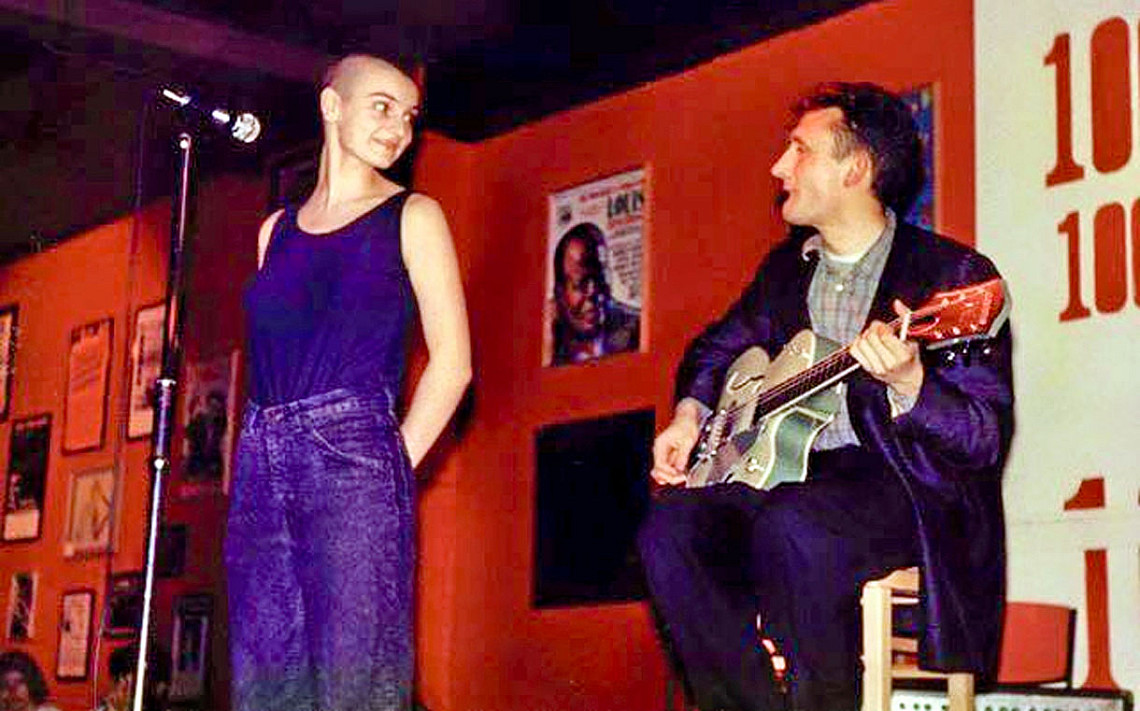 Dean performing with Sinéad O'Connor at the 100 Club in London. Photo courtesy of Rob Dean.
Songfacts: There's a song on that album called "Drink Before the War" which is just incredible. Please share your thoughts on that song.
As with all the songs, we recorded two distinct versions. The first with Glossop was a very organic, band-driven, traditional sounding ballad. We had rehearsed and fine-tuned it for many months. It most certainly had its attributes but was probably too conventional for the audience the record company wanted to attract. It is indeed a simple and beautiful song, and was nonetheless well represented on the finished record.
When Sinéad - accompanied by me and bassist Spike Holifield - made her live TV debut on The Old Grey Whistle Test, we previewed this song along with "Just Like You Said It Would Be," but sadly it did not make the broadcast. We appeared on Whistle Test alongside U2, in Belfast, on the eve of the release of The Joshua Tree.
Songfacts: You have a writing credit on her song "I Want Your (Hands on Me)." Please tell us about that.
This song was created entirely by the band in rehearsals from a series of funky jam sessions. Throughout the initial recording of the album with Mick Glossop, it went by the title "Sex Jam," and during those sessions a 9-minute version with full horn section (still unreleased) was created. The released version from the second round of recordings with Kevin Moloney, is a far more economical and simplified track - instrument and arrangement-wise - as was typical of those sessions.
Songfacts: Just a few years later Sinéad O'Connor became immensely popular and then highly controversial. What's your take on O'Connor?
Unfortunately, I believe that it is only after her death that Sinead's true significance and worth as a pioneer in her field has been realized, bolstered by the recent release of the very moving documentary. She was unique, had an earth-shattering vocal talent, and was unquestionably strong-minded, which clearly put her in hot water time and again. But she was not afraid to speak out about injustice and stand up for what she believed in, and for all that I can only applaud her. She paved the way for the independent spirit of many a female performer who came to prominence after her.
Songfacts: Please tell us about the song "Dimensions" with your Costa Rican band Light Of Day.
The lyrical content was intentionally minimal and somewhat undefined, being little more than some key repetitive phrases, and I regard it as simply that, rather than the creation of actual "songs." This was the first serious recording project for me in almost three decades, and as such was quite an eye-opener, revitalizing my passion for musical creativity, arrangement, and the studio process in general. Personally, I think what we created was successful and achieved our artistic aims. I am as proud of this as anything I have been involved with musically. It is, however, a distinct one-off and unlikely to be repeated.
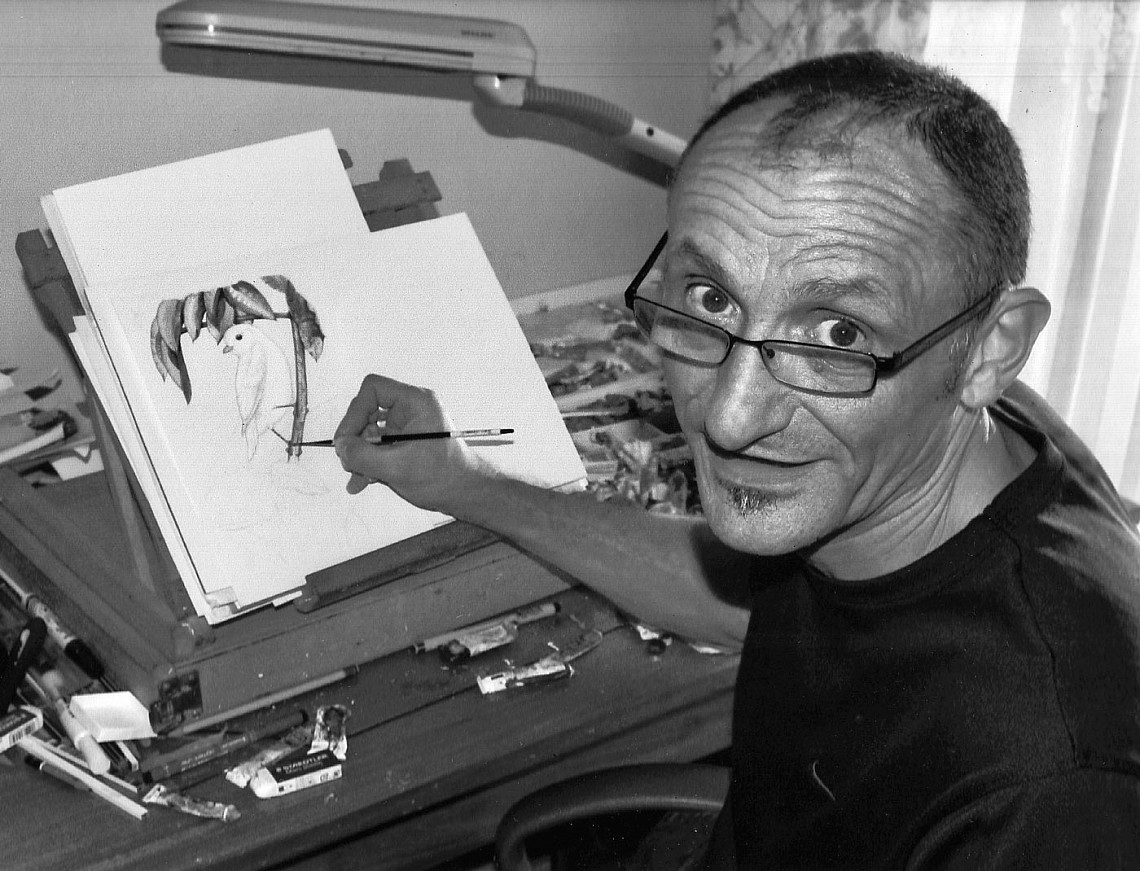 Dean in Costa Rica working on an illustration
Songfacts: Has living in Costa Rica provided you with any new insights or approaches to songwriting? Has the local culture influenced you?
I wouldn't say that I have been culturally influenced, but you could claim that there are, inevitably, some distinct Latino influences in some of the pieces. Living amidst such verdant natural beauty on a daily basis is in stark contrast to the first half of my life, when I lived exclusively in some of the largest and most influential cities in the world. My current environment has certainly altered my perspective on my life and creativity. Music now is not the center of my being, as it used to be, and therefore I don't have to, nor desire to, make it the central focus any more. In some ways, when the creative juices do flow from time to time, it makes it more interesting and challenging without the inherent pressure of being forced to create something with an aim of being commercially successful. I really just have to satisfy myself, and satisfying others is a bonus.
Looking back on my musical career, I must say it is rewarding, and not a little surprising, to see how the releases I was involved in have suddenly started popping up again - after three or four decades - in new and improved incarnations. I am grateful how these, such as the new Vivabeat titles, now have the opportunity to reach an unexpected new audience.
July 7, 2025
At Bandcamp, you can get The House Is Burning: The Best Of Vivabeat and Party In The War Zone: Expanded.
More Songwriter Interviews