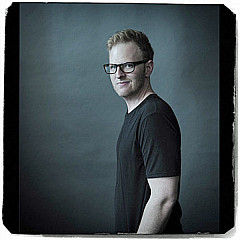
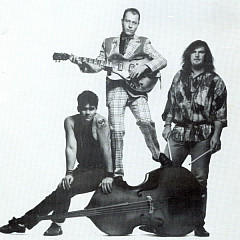
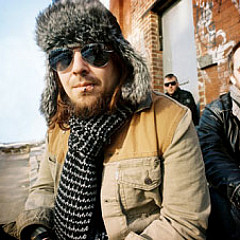
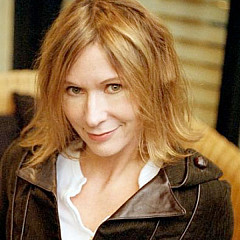
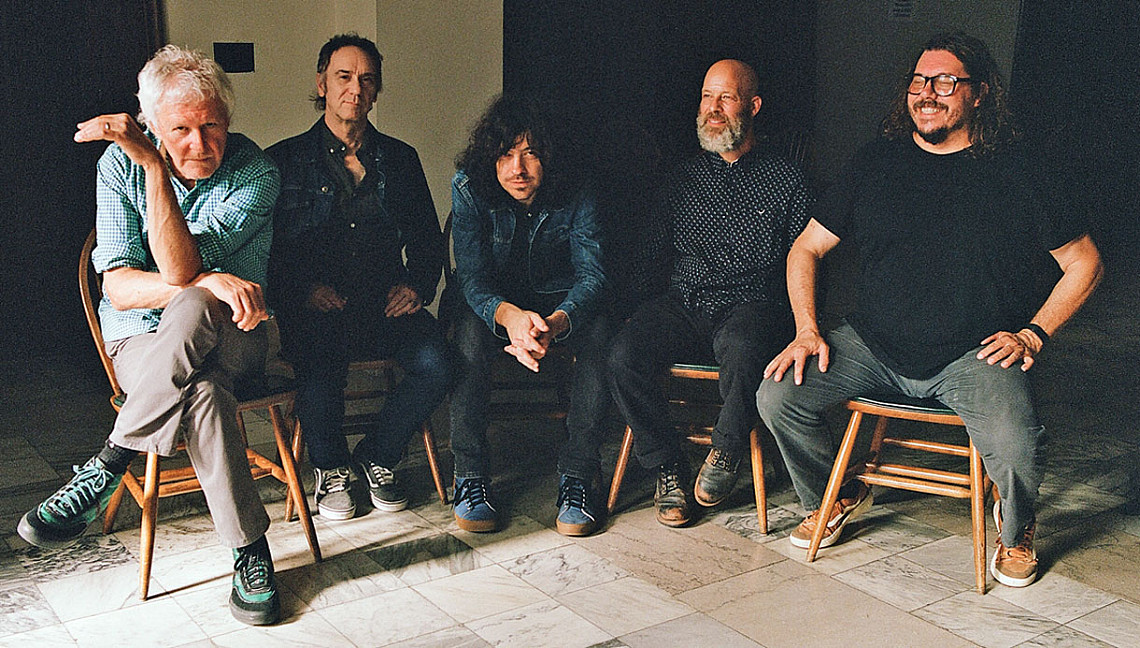
 Guided By Voices (L-R): Robert Pollard, Doug Gillard (guitar), Mark Shue (bass), Kevin March (drums), Bobby Bare Jr. (guitar). Photo: Trevor Naud.
With its fluid lineup, the band Guided By Voices has quietly logged four decades together. Somewhat fluid, yes, but lead vocalist and songwriter Robert Pollard has been at the helm since 1983. Now with grey hair, Pollard has never lost his enthusiasm for creating and performing joyful rock and roll. He still fronts the band like a latter-day British Invasion rocker from another (national) mother.
In addition to some obvious British Invasion influences, one can also hear psychedelic rock, garage rock, progressive rock and even a little punk in GBV's sound. With 2603 published songs (at last count), 39 Guided By Voices albums, and dozens more as a solo artist and with various side projects, Robert Pollard is one of the most prolific songwriters we've ever encountered, and he shows no signs of slowing down. The pace has quickened as the band has matured. For their first 11 years, members of Guided By Voices still had their day jobs (Pollard was a fourth grade teacher) and they put out seven albums. That seventh, Bee Thousand in 1994, was the one that clicked - Spin ranked it on their list of the best albums of the year, and Sassy put them on their Cute Band Alert (oh yeah, they also played Lollapalooza that year).
Pollard revamped the lineup in 1997 and called it quits with one last show on New Year's Eve 2004 at the Metro Theater in Chicago. By that time they had 15 albums. It was not their final farewell: Pollard pulled the original lineup back together in 2010 and did six more albums before shutting it down in 2014. The current lineup has been active since 2016 and has issued a bewildering 17 albums, most recently Nowhere To Go But Up in November 2023. We took this opportunity to learn about some key tracks and find out how Robert writes and creates.
Dan MacIntosh (Songfacts): You've said that much of the inspiration for your songwriting came from time spent hanging out with your high school friends from Dayton, Ohio, a group you call "The Monument Club." Since that was a long time ago, how would you describe your songwriting inspiration these days? What inspires you to write songs?In addition to some obvious British Invasion influences, one can also hear psychedelic rock, garage rock, progressive rock and even a little punk in GBV's sound. With 2603 published songs (at last count), 39 Guided By Voices albums, and dozens more as a solo artist and with various side projects, Robert Pollard is one of the most prolific songwriters we've ever encountered, and he shows no signs of slowing down. The pace has quickened as the band has matured. For their first 11 years, members of Guided By Voices still had their day jobs (Pollard was a fourth grade teacher) and they put out seven albums. That seventh, Bee Thousand in 1994, was the one that clicked - Spin ranked it on their list of the best albums of the year, and Sassy put them on their Cute Band Alert (oh yeah, they also played Lollapalooza that year).
Pollard revamped the lineup in 1997 and called it quits with one last show on New Year's Eve 2004 at the Metro Theater in Chicago. By that time they had 15 albums. It was not their final farewell: Pollard pulled the original lineup back together in 2010 and did six more albums before shutting it down in 2014. The current lineup has been active since 2016 and has issued a bewildering 17 albums, most recently Nowhere To Go But Up in November 2023. We took this opportunity to learn about some key tracks and find out how Robert writes and creates.
Robert Pollard: First of all, it's simply the satisfaction of writing songs and making albums. The entire process all the way through to fruition. I get inspirations from a lot of things. Movies, things I hear people say. Listening to music, especially '60s and '70s music.
Songfacts: It's been said you've written over 3,000 songs. Why are you so prolific?
Pollard: It's just what I like to do. I do it for a living, so I have a lot of time to think - not having many other distractions, other obligations.
I've always loved great songs, especially rock, and from listening and studying my entire life I've just kind of absorbed the lexicon. What goes into making a song interesting.
Songfacts: Having written so many songs, what are some of the ones you're most proud of, and why?
Pollard: "Alex Bell," "I Am A Scientist," "A Good Circuitry Soldier," "Just To Show You," "Game Of Pricks"... I don't know, there are just so many to pick from.
Songfacts: Narrowing it down, what are some of the best lyrical lines you've written, in your humble opinion?
Pollard: "My life is dirt, but you seem to make it cleaner, reduce my felony to a misdemeanor."
That's a pretty decent rhyme and it's a nice thought on a relationship. It's from "Drinker's Peace" on Same Place The Fly Got Smashed [1990].
"I'll climb up on the house, weep to water the trees, and when you come calling me down, I'll put on my disease" from "Game Of Pricks."
I'm sure there are better ones but it's hard to think of out of three or four thousand songs.
Songfacts: Is there a songwriting process? Do you sit down with the purpose of writing songs, or do you only write whenever you feel inspiration?
Pollard: I write when I'm inspired, and it usually takes one good idea that triggers the process of creating an entire album's worth of songs. It takes a few days, and it happens two or three times a year.
Songfacts: Have you ever collaborated with other songwriters? If so, what were these experiences like?
Pollard: Yeah, I've done a lot of songwriting collaborations, but it's a different process than most. They'll send me music and I create the lyrics, melodies, and art for whatever the project is. I've done collaborations with Doug Gillard, Toby Sprout, Gary Waleik, Richard Davies. Probably more that I'm forgetting and I apologize.
Songfacts: When you write a song, do you start with a title and then build a song around it, or does the title sometimes come last?
Pollard: I approach the process from a lot of different angles. Sometimes a title. Sometimes a lyric. Sometimes the music comes first.
Songfacts: Does the melody or the lyric come first when writing songs?
Pollard: Both ways. It can be successful either way.
Songfacts: "Hold On Hope" is a big fan favorite. Can you describe the events surrounding its creation?
Pollard: It was on the original cassette of demos that I sent Ric Ocasek for Do The Collapse [1999]. I actually dreamed it. The melody and main line anyway. I apologized to Ric because I thought it might be a little cheesy and slightly embarrassing because it came from a dream, but he said, "No, it's the power ballad that radio is looking for," and that really scared me.
I ended up liking it later down the line, especially when Glen Campbell covered and validated it. I guess it's got a good message, I don't know. It's not very punk, is it?
Songfacts: I think "I Am A Scientist" was my first introduction to your music. It's such a smart song. Do you see songwriting as a kind of science, and if so, how?
Pollard: I don't see it as a science because songs come very naturally to me, but I guess it could be. Sometimes I take a lot of time structuring a song and sometimes they feel pretty autobiographical. Sometimes a song can be somewhat of a study on a topic I'm interested in.
Songfacts: Who are some of your favorite songwriters?
Pollard: Carole King, Phil Lynott, Pete Townshend, Scott Walker, Jimmy Webb, Colin Newman and Graham Lewis, Ron Mael, Freddie Mercury, Lennon and McCartney, Arthur Lee, Burt Bacharach, Brian Wilson, Barry Mann and Cynthia Weil, Alex Chilton, Holland-Dozier-Holland, David Bowie, Jagger and Richards, Robyn Hitchcock, J Mascis, Chris Stamey, Peter Holsapple... come on, this could go on forever.
Songfacts: What are some songs you wish you would have/could have written? Are there any that make you feel a little jealous?
Pollard: Yeah, a lot of them. A lot of them written by the people I just mentioned. Just too many.
Songfacts: You've also recorded solo albums. What makes a song a Guided By Voices song different from a solo work?
Pollard: I see no difference. When I write songs for Guided By Voices, I tend to think about how they might translate to the stage.
Songfacts: Have you tried your hand at other types of writing, such as stories or screenplays? If so, how did that go?
Pollard: No, I don't steer too far away from what I think I'm pretty good at.
Songfacts: Your song "Demons Are Real" makes me wonder if you consider yourself a spiritual person of some kind. If so, what are a few of your more spiritually-oriented songs?
Pollard: I'm pretty emotional sometimes and I guess that can translate to spiritual. "I Am A Scientist," "Queen Of Spaces," "Zodiac Companion," "Island Crimes," "Other Dogs Remain," "Please Be Honest," "Volcano," "Arrows And Balloons," "Love Is Stronger Than Witchcraft," "Dolphins Of Color," "You Own The Night," "Official Ironmen Rally Song."
Songfacts: Guided By Voices has had a lot of membership changes over the years. What does it take to be a successful GBV band member?
Pollard: Respect and enthusiasm for the record and for the stage.
Songfacts: Are there any of your songs that are too personal to perform live?
Pollard: Probably a few. More like maybe too embarrassing.
Songfacts: You're one of the best live performers I've ever seen. Would you consider GBV more of a live act than a studio band, or are these two different sides of the same coin, so to speak?
Songfacts: Who are your favorite vocalists?
Pollard: Roger Daltrey, Robin Zander, Roy Orbison, John Lennon, Carole King, Arthur Lee, Alex Chilton, Scott Walker, Greg Lake, Jeff Connolly, James Brown, Mick Jagger.
Songfacts: What factors go into deciding whether or not to record a song you've written? Are there ever times where you dusted off something old, for instance, and put it on a new album?
Pollard: I work on old stuff that I find all the time. Not In My Airforce [1996] and Earth Man Blues [2021] are both comprised completely of old songs I found on cassettes that I stashed away and forgot about. I mix and match sections from different song ideas and different time periods.
Songfacts: Thank you for taking the time to answer my questions. Don't ever stop making music! You're loved.
Pollard: Thank you. I appreciate the continued interest and I'll do my best to keep it up.
December 11, 2023
For tour dates and latest releases, go to guidedbyvoices.com
More interviews:
Jimmy Webb
Jody Stephens of Big Star
Victoria Williams
Lamont Dozier
Greg Lake
More Songwriter Interviews