Saffron is the co-founder and frontwoman of Republica, the English outfit responsible for "Ready To Go," a shot of musical adrenaline that still pulsates though stadiums whenever sports are played. I saw them at a club in Hartford in 1996 when they were barnstorming America to promote the song. My friend Ryan had on a ridiculous straw hat that Saffron somehow ended up wearing.
She's an engaging performer who really connects with the crowd, a talent that translates to her work these days as a health and social care officer at a mental health facility where she cares for patients with severe mental disorders, including some who are non-verbal (Saffron learned sign language), and others with epilepsy, autism, or dementia. She's what's known in England as a "frontline keyworker," a role she took on during the pandemic. In her remaining hours, Saffron keeps Republica going. She still performs with the band and they're still making music, with a new album called Damaged Goods on the way.
Saffron came on my radar after I interviewed her ex-boyfriend, Fast Leiser of Fun Lovin' Criminals. He explained that she's highly influential in the world of electronic music, not just with Republica but also as a performer with a beloved techno act called N-Joi in the early '90s. It took a while to nail down the interview because of her many commitments, but it was well worth the wait. Saffron offered insights on "Ready To Go" that will make you hear it in a whole new way, and explained about how the house music scene emerged in the late '80s. She also talked about Wes Craven's personal appeal to use the Republica song "Drop Dead Gorgeous" in his movie Scream, creating an Easter egg in the film that clues the killer.
Carl Wiser (Songfacts): What's going on in the lyric to "Ready To Go"?She's an engaging performer who really connects with the crowd, a talent that translates to her work these days as a health and social care officer at a mental health facility where she cares for patients with severe mental disorders, including some who are non-verbal (Saffron learned sign language), and others with epilepsy, autism, or dementia. She's what's known in England as a "frontline keyworker," a role she took on during the pandemic. In her remaining hours, Saffron keeps Republica going. She still performs with the band and they're still making music, with a new album called Damaged Goods on the way.
Saffron came on my radar after I interviewed her ex-boyfriend, Fast Leiser of Fun Lovin' Criminals. He explained that she's highly influential in the world of electronic music, not just with Republica but also as a performer with a beloved techno act called N-Joi in the early '90s. It took a while to nail down the interview because of her many commitments, but it was well worth the wait. Saffron offered insights on "Ready To Go" that will make you hear it in a whole new way, and explained about how the house music scene emerged in the late '80s. She also talked about Wes Craven's personal appeal to use the Republica song "Drop Dead Gorgeous" in his movie Scream, creating an Easter egg in the film that clues the killer.
Saffron: Growing up my inspirations were always singers that had a different vocal delivery than your normal singers, that had different, original voices and a message about real life and their experiences, which came out in the punk era. The glass ceiling finally was smashed and we could talk about life in lyrics that weren't existential or just a love song. That, to me, is quite empowering.
Singers like Toyah Willcox and Poly Styrene, Siouxsie Sioux, Blondie, John Cooper Clarke,1 Robert Smith, Paul Weller from The Jam... those lyrics were really reaching me. So it was important to learn my skill in craft as a songwriter, to be the best that I could be with what skills I had. For me, "Ready To Go" is about my life. This is what happened to me and this is how I felt, but in an empowering way - someone said this to me, but I don't allow that. I will not allow that to affect me, because I'm strong. I have a voice. Make it a positive. The energy behind it is about independence and confidence.
Saffron: Not specifically. It was a broader sense, a collective sense of young women and girls growing up in the '90s, because radio would not even listen to any female-fronted band that wrote their own songs.2 You had to fight so hard in a business that's very cutthroat and is predominantly male dominated. So it was like a battle cry.
No Doubt had been going for years, and finally MTV played "Just A Girl." You've got to keep bashing down these doors that keep closing on you until one opens. You can't give up.
Songfacts: How did you get that unique Republica sound?
Saffron: I always knew exactly how I wanted my band to sound, so I found people who were into that kind of music: Simple Minds, Depeche Mode, Kraftwerk, Talk Talk, Thomas Dolby... people that were brave enough to do something that no one had ever tried to do. We bought all our own equipment and built our own little studio in somebody's front room to try to achieve our goal. At the time, everyone was laughing us, telling us it would never work, mixing electronica with guitars and a punky vibe. But I believed in it.
All of us had this tenacity to make a new sound. There's drum machines, there's old analog synths that we collected, a lot of Moog and Minimoog.
Republica formed when Saffron, born in Nigeria and living in London, teamed with the keyboard wizards Tim Dorney and Andy Todd. They rounded out the lineup with guitarist Johnny Glue (also known as Johnny Male) and drummer David Barbarossa, who brought a massive tribal sound to his previous bands, Bow Wow Wow and Adam And The Ants. The current lineup is Saffron, Dorney, and Glue.
Songfacts: You also had that drummer from Bow Wow Wow and Adam And The Ants. How did he fit in with the techno sound?Saffron: We didn't realize until we had to play the album live that we'd made the most difficult conundrum possible. Our tracks were 160 BPM, which is as fast as a techno record, and there aren't many live drummers that can play or sustain 160 BPM. So to present it live, we got multiple electronic channels going as well as live keyboards, live guitar, and obviously, live vocal, which is very, very fast and has loads of lyrics, so I got very out of breath.
Republica's second album is the excellent Speed Ballads, released in 1998 as their label, Deconstruction Records, was imploding. It wasn't issued in America, murdering all that momentum they built up from touring there. On Record Store Day 2023, it was issued on vinyl for the first time. Lines formed around the block at a store where Saffron signed copies.
The lead single from Speed Ballads was "From Rush Hour With Love," which reached #20 in the UK but, like the album, wasn't issued in the US.
Songfacts: Let's talk about the song "From Rush Hour With Love." It has very abstract lyrics.The lead single from Speed Ballads was "From Rush Hour With Love," which reached #20 in the UK but, like the album, wasn't issued in the US.
"From Rush Hour With Love" is a take from the James Bond theme. And traffic is such a huge thing in London. I'm sure you understand that rage: Why is this happening to me? That sense of overwhelming. You've allowed something that only later do you realize you've enabled. So it didn't work out, but hey, I'm in rush hour with love. You've got to pull yourself back together.
It's a positive-behavior view on things. People are so quick to be offended by things these days, and that incites fear to talk or to communicate, which I don't agree with at all, worrying about what somebody else may think or feel about you.
There's a continuum in my lyrics. It's like looking in the mirror: you are actually looking at the opposite. Like the yin and yang. We're all trained to smile for the camera, but that's just a moment in time. What's really going on there? How do you feel while you're stuck in this rat race, stuck in the rush hour. What's that film where Michael Douglas loses it?
Songfacts: That's Falling Down.
Saffron: It's like that, but with road rage. And in no way, shape, or form do I agree with that, but I do understand that people do have a limit, and if you're pushed down or things happen, it's OK to not be OK. Don't let anyone put you down or disarm you from expressing how you truly feel. Focus on those things that are in your control to change and don't ruminate on something that might hurt you. You are not here to live up to anyone else's expectation.
Songfacts: You have a background in house music and electronica, and a big part of that is the song you did with N-Joi called "Anthem." Can you talk about that?
That song, actually, was written about me. We were all teenagers in London, part of the club scene. I was in the musical Starlight Express because when I grew up, I wanted to be in a dance group called Hot Gossip. Their choreographer was Arlene Phillips, and she choreographed Starlight Express, which was a show on roller skates, and I was the electronic carriage. They put me in military-style boot camp to learn how to roller skate, and I did a stadium tour of Japan and Australia, then I did the West End.
Then in 1988, acid house music hit the club scene and the gay scene in Soho, and me and all my friends were going to all these places, and this new music was amazing. It was coming out of Chicago and Detroit and Ibiza. People were making their own records in their bedrooms. It was this massive underground movement that changed the whole culture and social landscape.
N-Joi and The Prodigy, we were all friends. They were like, "We want to make records and DJ. You sing on the stage, do you want to come with us?" So I did. We were playing in fields and illegal warehouses and things like that. It was completely underground, organic. It was something new but something that anyone could get involved in. Just get a TB-303, an 808 or a 909 drum machine and add your beats. It was open to anyone.
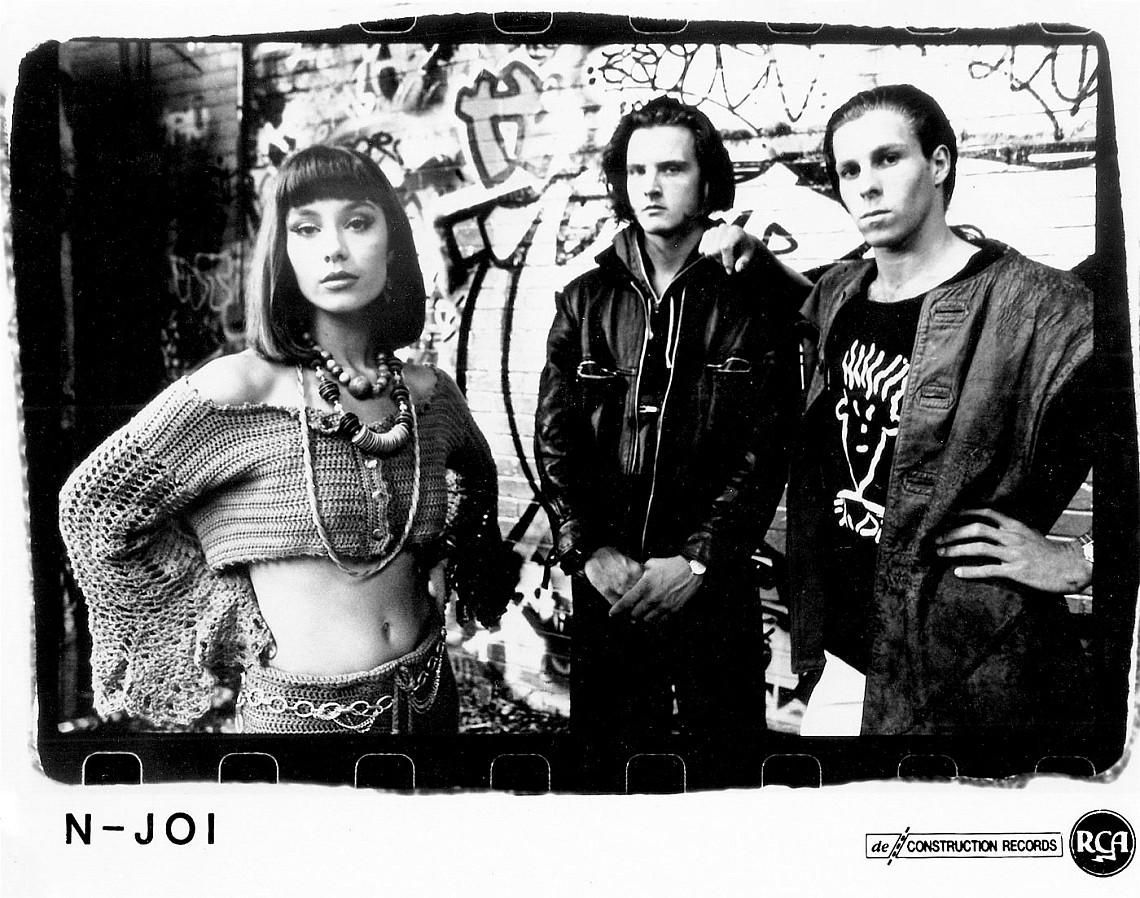 Saffron in a publicity photo with N-Joi
Songfacts: Did you say the song was written about you?
Saffron: Yeah. It's kind of ironic that I got to sing it live.
Songfacts: Did you have a person in mind for the song "Drop Dead Gorgeous"?
Saffron: I had a couple of people in mind, but over the years I've heard from so many people who think it's about them, trying to claim it. I'm like, "Umm... no." Someone even told me they should get royalties from it.
But the song is about boosting someone's confidence, self-esteem. If something's happened to you, an amazing thing to do is fuel that rage, scream and shout about it. It's cathartic. Get it out there how you really feel. And what's brilliant, it was a hit record, and if that hadn't happened to me, I wouldn't have written the song.
It came when I had a dream about it. I woke up, and it was like automatic writing. I ran to the studio and said, "I've got it!" I sang what I had and Johnny and Tim were like, "Saff, keep going, you're on to something!"
Songfacts: I've never heard a song about that before, a song from a woman singing about how she sticks with her boyfriend even though he's horrible to her, all because he's so good looking.
Saffron: It's true! But it's in an empowering way because people do it. No one had ever actually said it in a song because it's not politically correct, which is why I'm so proud that the whole gay, LGBTQ community took it up almost like an anthem.
Songfacts: Did you did you have somebody in your life that was like that, who you just stuck with?
Saffron: Yeah, it happened a couple of times.
I had this chorus in my dream and I woke up and the whole thing came to me. It was almost like automatic writing. The "drop dead gorgeous" part just came to me, and once I had that, the rest of the story was why I thought that. Like, "For God's sake, he's coming 'round again."
 Songfacts: How did the song end up in the movie Scream?
Saffron: We were on the tour bus in Nashville and our RCA rep came in sweating. He said, "Saffron, we've got a film director named Wes Craven on the phone, he wants to talk to you. He's the guy that did Freddy Krueger." I said, [frightened voice] "What for?"
In my head I was like, "Nope," because I had written the song from a dream, Carl. So I talk to Wes Craven and he says [sinister voice], "Hi Saffron. I've got a new script."
"Oh, good. Is it a horror film?"
"Yes, and your song is the exact storyline to my movie. Can I please use it?"3
He sent me, and I still have, an original rough cut screener. I'm like, "Oh my God, Drew Barrymore gets killed! I really love her!"
I said yes because it actually is the story: My boyfriend lies, he does it in disguise, he does it every time.
Then we all go to this premiere thing and we had no idea what to expect because it was a horror film and Wes Craven hadn't done anything for a while. But you just don't know what art means to other people. I was outside having a cigarette and was talking to this woman, saying, "I don't like these films. I bloody hate them but I had to come to be polite and everything."
I walked back into the premiere and that same woman was on the screen! It was Courteney Cox. I'd never seen any of her films or her show so I didn't know who she was.
We played at the aftershow party and I saw her and was like, "I'm really, really sorry. I didn't know who you were." She liked that I had no idea who she was. She was lovely and so nice to me. Then Scream suddenly became this huge film.
Songfacts: You have a lot of songs where there is a guy who is the lead character in the song, and sometimes, you even give him a name, like Jimmy in "Try Everything."
Saffron: That was Johnny's thing, but funny enough, Jimmy is the name of my first boyfriend, so for me it still was something of a truth. Johnny and I, in our dyslexic communication, talk about our daily lives and how we feel, and I was feeling a bit weird and discombobulated. But it's actually quite a good song. The message of "Try Everything" is still empowering.
Songfacts: You do have some names in your songs. Victoria shows up in "From Rush Hour With Love," and then there's "Christiana Obey."
Saffron: Yeah, that's a play on words, like "Christ" but feminine. Christ... Christian... Christiana.
It's that whole thing about "You will obey!" Why would I obey you? No. I was brought up Catholic with nuns and stuff, so that whole thing is very strict. I rebelled and got into punk and indie music.
And Victoria was a queen, and you've got Victoria Station were most trains go into London. That's where Starlight Express was - the Apollo Victoria Theatre where I started.
Songfacts: And "Holly" is another with a name.
Saffron: Yeah, for Hollywood. Because everybody wants to get there, and when you do, they find that all that glitters isn't gold. It's shattered because it's actually nothing like what everyone says.
Songfacts: Had you been to Hollywood when you wrote that?
Saffron: Yeah. It's the opposite of that shiny light. The stars are what people walk on, stomp on, where dogs poop - they're on the pavement. It's like The Wizard Of Oz. It's actually quite tragic.
Songfacts: So you saw the seedy side of Hollywood?
Saffron: Completely. People around the world don't understand that Hollywood is a specific area, and it's like where I lived in London when taxi drivers wouldn't cross the bridge to the south of London. It was like Bette Davis in What Ever Happened to Baby Jane? This tragic story. Not all superstar glam and glitter.
 Republica: Tim Dorney, Saffron (Samantha Sprackling), Johnny Glue
Songfacts: What's a Republica song that's very meaningful to you that we haven't talked about yet?
Saffron: Gosh, there's so many. We're setting up release for our new album, Damaged Goods. We actually wrote it pre-Covid, but it's quite topical now in a sense. So there are a few songs on that.
It's so hard because you don't want to have a favorite, but "Ready To Go" has had this huge life and transcended for sports fans through generations. They don't know who we are, but they love the song because it's their team or it reminds them of going to a match.
I feel like I've betrayed the others. I like "Kung Fu Movies" and also "Drop Dead Gorgeous" because that's quite personal to me.
Songfacts: What instruments do you play?
Saffron: I play lots of keyboards and make lots of silly noises, but Tim's a lot better at doing that. A bit of guitar. I used to play acoustic in the church, which was the only way my mum could get me to go to church.
Songfacts: I was reading Sinead O'Connor's book, and she wrote about how she at first sang without her accent to sound American. Did you ever try to change your accent?
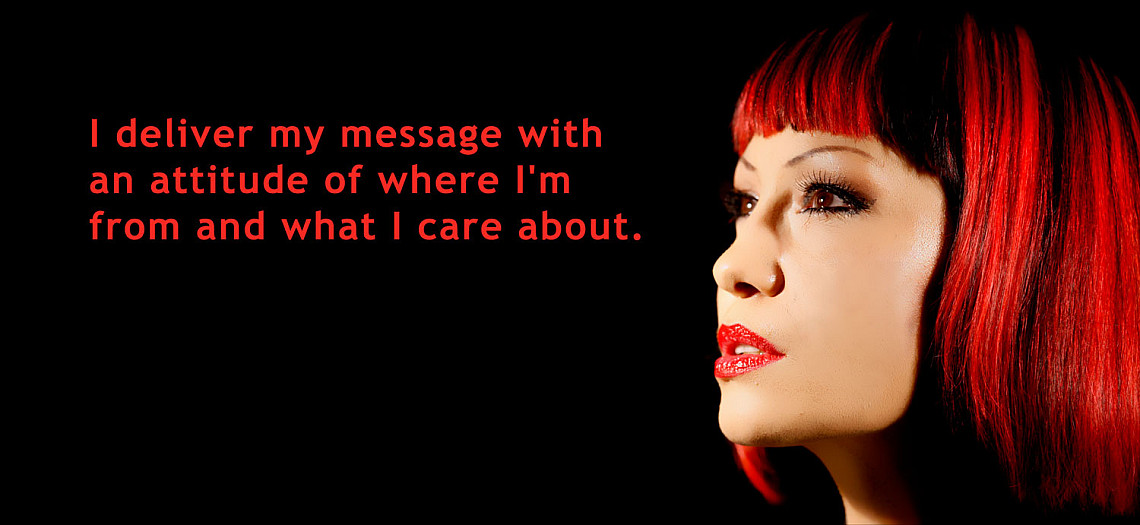
Saffron: No. If anything, I did it more, because that's who I am. That's the whole point. I deliver my message with an attitude of where I'm from and what I care about.
Songfacts: I always thought that gave you a distinctive quality. Especially in "Ready To Go" when you sing, "It's a crack," but it sounds like, "It's a crock," which is a saying over here, like, "That's a crock."
Saffron: Going back to Sinead, funny enough, I had done a demo in Sinead O'Connor's bathroom. I was recording a vocal and that was the only place they had. It was with Jah Wobble from Public Image Ltd. He met me and liked me and helped me, as did Mick Jones from The Clash.
All it takes is one person to go, "You can." They told me, "Don't change for anyone. Just be you."
It's important not to be clipped. Like when dogs go to a dog show, they clip them and stuff. Just be scruffy!
Songfacts: It created an interesting line because "It's a crock" means something in America.
Saffron: Yeah, but we didn't know that! And we also had no idea that people say "ready to go" a lot. Because they don't say that in England. When we came to America, we said, "Why is everyone saying that?"
Songfacts: So to you, the phrase didn't mean anything like that?
Saffron: It just means, "Come on! We're ready for a party! A crack!" But in America they keep saying it.
Songfacts: Yeah, for us, it's "Ready to go to school? Ready to leave?"
Saffron: We had no idea. We don't say that.
Songfacts: Why did you get into the mental health industry?
Saffron: I just so enjoy meeting individuals who are different and finding out how they think and communicate. I sometimes prefer to be around them because it's pure and it's the truth. I've learned sign language so I can communicate with people who can't talk. You have to put yourself in their shoes so they can be able to express themselves like I've been able to express myself through my music.
We are all equal, and they should be included and be respected. Not have funding taken away from their drumming lessons and things like this. I met a young gentleman with Down syndrome who is partially deaf. I saw him in the crowd at a festival and he came on the stage and he got onto the drum kit and did the most amazing drum solo. It was like an epiphany.
This is so very important, this mental health crisis. We have to make sure it's not just physical treatment, that people have access to speak and it's not a stigma anymore.
May 24, 2023
You can find Republica on Facebook
Further reading:
Disco Lemonade: The Strangest Songs of the '90s Explained
Interview with Tracy Bonham
Interview with Crystal Waters
Footnotes:
- 1] Saffron wants you to know about John Cooper Clarke, an English wordsmith who often puts his poems to music. She calls him the "original punk poet" and recommends his song "Beasley Street" as an entry point. "He's only now getting the respect and wider audience he deserves," Saff says. (back)
- 2] It wasn't just radio that stymied female artists in the mid-'90s. Tour promoters did as well, which is why Sarah McLachlan started the Lilith Fair in 1997. (back)
- 3] If you pay attention to the songs used in Scream, you can probably suss out the killer. Early in the film, a subtle acoustic version of "Don't Fear The Reaper" plays when Billy, portrayed by Skeet Ulrich, pays a visit to Neve Campbell's Sidney to rekindle their romance. (back)
More Songwriter Interviews