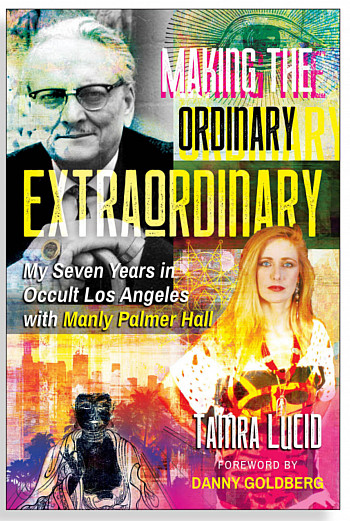
At the time of this writing, Lucid's name (sometimes her real name, Tamra Spivey) is circulating through the internet primarily for two things. First is her role as associate producer of End Of The Line: The Women Of Standing Rock, nominee for the 2022 Emmy Award for Outstanding Social Issue Documentary. Second is her role as author of Making The Ordinary Extraordinary: My Seven Years In Occult Los Angeles With Manly Palmer Hall, published by Inner Traditions in December 2021.
 Tamra during the making of Lucid Nation's 1999 album DNA. Photo by Spike Vain.The subject of her book may be nebulous to most readers, but it's a big deal to those interested in esoterica and the occult. Manly P. Hall was one of the most important modern figures in the field - a true legend of alternative spirituality. For the purposes of this interview, the story is notable because it takes us back to Tamra's early evolution as a musician, her growth into the riot grrrl movement, and the formation of Lucid Nation.
Today, Lucid Nation is Tamra and husband Ronnie Pontiac (real name: R.C. Hogart). Former members include Greta Brinkman (L7, Pigface, Automatic Slim), Larry Schemel (Death Valley Girls, Kill Sybil, Midnight Movies), and Patty Schemel (Kill Sybil, Hole, Courtney Love).
Lucid Nation has released 11 studio albums, with Tacoma Ballet having been a bona fide college radio hit in 2002 and earning the band recognition from Rolling Stone. They have performed with '90s-street-cred legends like Bikini Kill and Sleater-Kinney. Through it all, they have maintained a creative edge that makes them impossible to define and subsequently difficult to package for distribution. For that consistent edge they are lumped into the outsider-bin known as "experimental rock."
The success of Tacoma Ballet could have been a springboard to commerciality, but Lucid instead followed it up with an experimental album titled Mung Jung Bushi with jazz drummer LaFrae Olivia Sci and Mecca Normal team Jean Smith and David Lester. That move is basically a microcosm of Lucid's career. It brings to mind figures like Captain Beefheart, who simply never would (or maybe never could) bow to the norm.
Who knows how many records Lucid Nation could have sold if selling records was their priority? Really, who cares? Their legacy is their legacy. How it's measured depends on which system of units you decide to measure it in.
What's certain is that Lucid Nation's music is always interesting, and Tamra Lucid is one of the most genuine artists I've communicated with (though I do wonder if she secretly cares about recognition more than she likes to project). She's philosophical, insightful, and always interesting.
Whether it's her spirituality, politics, or music, Tamra Lucid walks the walk. Most of all, she gives one hell of an interesting interview.
Jeff Suwak (Songfacts): How did you get involved as associate producer of End Of The Line: The Women Of Standing Rock?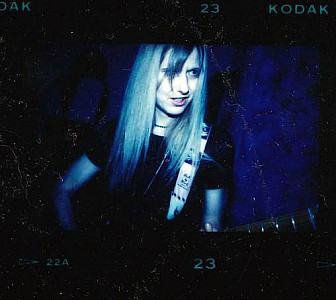 Tamra during the making of Lucid Nation's 1999 album DNA. Photo by Spike Vain.
Today, Lucid Nation is Tamra and husband Ronnie Pontiac (real name: R.C. Hogart). Former members include Greta Brinkman (L7, Pigface, Automatic Slim), Larry Schemel (Death Valley Girls, Kill Sybil, Midnight Movies), and Patty Schemel (Kill Sybil, Hole, Courtney Love).
Lucid Nation has released 11 studio albums, with Tacoma Ballet having been a bona fide college radio hit in 2002 and earning the band recognition from Rolling Stone. They have performed with '90s-street-cred legends like Bikini Kill and Sleater-Kinney. Through it all, they have maintained a creative edge that makes them impossible to define and subsequently difficult to package for distribution. For that consistent edge they are lumped into the outsider-bin known as "experimental rock."
The success of Tacoma Ballet could have been a springboard to commerciality, but Lucid instead followed it up with an experimental album titled Mung Jung Bushi with jazz drummer LaFrae Olivia Sci and Mecca Normal team Jean Smith and David Lester. That move is basically a microcosm of Lucid's career. It brings to mind figures like Captain Beefheart, who simply never would (or maybe never could) bow to the norm.
Who knows how many records Lucid Nation could have sold if selling records was their priority? Really, who cares? Their legacy is their legacy. How it's measured depends on which system of units you decide to measure it in.
What's certain is that Lucid Nation's music is always interesting, and Tamra Lucid is one of the most genuine artists I've communicated with (though I do wonder if she secretly cares about recognition more than she likes to project). She's philosophical, insightful, and always interesting.
Whether it's her spirituality, politics, or music, Tamra Lucid walks the walk. Most of all, she gives one hell of an interesting interview.
Tamra Lucid: I wanted to go to Standing Rock to join the protest, but I was told by the Water Protectors I was in touch with that the elders wanted me to keep doing what I was doing where I was: sharing updates on social media, networking, doing interviews for the original Reality Sandwich, keeping in touch with people who could tell us what was needed so we could share that all over. I kept hearing about a woman making a doc, Shannon Kring.
She's an amazing creative force. Let's put it this way, two out of the six docs nominated this year for the Library of Congress/Ken Burns award were produced by Shannon, and neither one is End Of The Line. I interviewed her and did what I could to get the word out about fundraising, I helped her get in touch with Linda Black Elk, a medic at the protest she wanted to interview, and others. I did whatever I could to help out along the way. I have some experience producing docs, so I shared advice, encouragement, and contacts.
It's been a constant source of inspiration to witness how the Water Protectors, our late producer Pearl Means, Shannon, and the mostly female crew battled to get this film made and seen. I was honored when Shannon gave me an unexpected credit as associate producer. I'm humbled to be in the company of such exceptional women. This wasn't just a film - it was a mission.
Songfacts: In Making The Ordinary Extraordinary: My Seven Years In Occult Los Angeles With Manly Palmer Hall, you discuss your experience with one of the modern era's most important esoteric/occult thinkers. Do your esoteric beliefs influence your music?
Lucid: My esoteric beliefs are an influence on my music. In the book I tell the story of how we were asked to make up some songs by the bartender in an empty club in Little Tokyo in LA. I thought of something Manly P. Hall had taught me. About the bodhisattva leap of faith. That there would be support. So I winged it and was stunned to find lyrics and guitar chords flowing from somewhere else into my brain. The song was so much better than our composed songs.
Eventually we recorded Tacoma Ballet freestyle. Not jamming. More like Zen circle painting. Trying to create arranged songs on the spot. Sometimes miraculous things happen. For example, I can hear the band, but they can't hear me, and yet when I pivot the lyrics to a different mood, they change on a dime to reflect that mood as if they had heard me.
I'm also not above putting winks at esoteric doctrine and symbology here and there in songs. Sometimes we have been overt, like Ronnie's song "Kali," which quotes Ramprasad.
Lucid: On our first tour, we stopped at City Lights Bookstore in San Francisco where Ronnie bought a copy of The Society Of The Spectacle by Guy Debord. Riot grrrl zines criticized and satirized mainstream corporate culture because of the way it creates unrealistic expectations about how a person should be. About 30 years earlier, Debord and the Situationist movement he inspired talked about how celebrity worship, with its mirage of fame as an endless holiday, is at the core of alienation in our culture. Ronnie and I were talking about that a lot.
A guitarist friend named Yves challenged Ronnie to write a song with three chords, a la Oasis. At the time, Ronnie told me this was his Situationist love song to me.
Also, this is one of my favorite songs, so I'm so happy you noticed it. This was videotaped at Fortress Studio in Hollywood during a rehearsal.
Songfacts: Can you tell us about the song "Tacoma Ballet?"
"German guilt," he responded.
He suggested we take a break to go outside to see the beautiful moon. He noticed that I kept glancing over at the boarded-up, abandoned clapboard building next door lit up in the moonlight. It looked like what everyone envisions as a haunted house for Halloween, or the set for a horror movie.
"You want to know the story of that place?" Wes asked me.
This was deliberate. This was an engineer with sound-effects records he'd been saving for what he suspected was this very occasion. He told us all the story, but he was talking to me.
A while back, that creepy building had been a squat for runaway punks where Wes saw Nirvana play their first gig in Tacoma. But he had history with that place that went back to being a kid with his friends daring each other to go inside. They knew it had been a school.
As they explored, they found everything was exactly as it was left. School desks with paper, pencils, and open lesson books in Japanese and English, covered by years of dust and cobwebs, frozen in time.
Wes and his friends left it undisturbed, leaving only footprints in the dust. Wes later learned that after Pearl Harbor, a bus had shown up one morning, and the soldiers ordered the schoolchildren outside.
The children thought they'd be coming right back. But instead, they were put in the bus and driven to an internment camp. After that, we went inside and recorded the song. Later Wes kicked us all out of the studio and those sound-effects records he had been saving found the song to which they belonged.
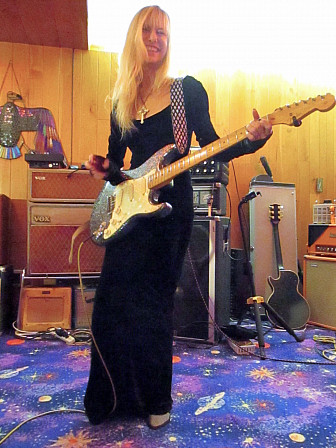 Tamra in 2019. Photo by Ronnie Pontiac.
Lucid: We made plans to record a full improv experiment with Jack Endino and a band with Patty Schemel of Hole. Patty's brother Larry, who now plays with Death Valley Girls, and I had invited Donna Dresch to play bass, but then she was unable, so we got Greta Brinkman of Unseen Force and Moby's band.
This all happened because of Diane Naegel, the keyboard player, who had never played keyboards with a band before. She had just interviewed me for her online zine Ruby Slipper. Probably the most stylish person I have ever met in my entire life. At the time she was Patty Schemel's girlfriend.
But Jack couldn't make the gig so he told us to call his friend Wes at Uptone in Tacoma. Wes's collection of classic synthesizers and sound-effects records added a lot of flavor to our recordings.
Rick King of Guitar Maniacs, a music store in Tacoma, loaned us incredible gear, including an original Fender Nocaster and a 1967 Gibson Flying V. The sessions were magical, but the day that we were going to fly home from finishing mixing the record, our flight was canceled due to 9/11. I'm going to keep this brief, but there were many synchronicities, many foreshadowings, and many moments in the music. But that's what happens when you open yourself up to inspiration.
Songfacts: Let's dip into the Beat-writer songs. Can you talk about the song "Naked Lunch?"
Lucid: "Naked Lunch" started as conversations about what we had gone through as riot grrrl faded. We went on to anarcho-punk, and then garage rock. I was disillusioned.
At first, we were all on honeymoon when we arrived in riot grrrl, and we thought it was a utopian community, and a sea change. But we soon found that behind the facade all kinds of ugly things were going on: exploitation, exclusion, cruelty, elitist cliques.
On the other hand, we also got incredible help, generous support and encouragement, and revelations about art, life and society. But sometimes the thing that gave you healing turns poisonous. That's part of the human condition.
The title was a sardonic remark I made to Ronnie about all this, sort of abbreviated code for a sad tale of addicts and control freaks. I felt that people who had the desire to control riot grrrl for their own benefit tore it apart.
Ronnie was an outsider witness to all this. Probably played more riot grrrl shows than any other male of the species. Often but not always made to sit out on the curb until our set. We would sit with him.
Songfacts: How about "Kerouac?"
Lucid: Kerouac was an improvisation with a band we had never played with before. One of the biggest storms that had ever hit LA was pouring down on Ronnie's birthday around midnight, and we were playing the underground radio station of a Catholic college. A couple years before that, Ronnie had given me the gift of The Kerouac Collection, a box set of recordings by Kerouac in his own voice, which I devoured.
On our national tour, when I was feverish and deathly ill in the back of the van with our equipment, as we drove many hours gig to gig, I stared out the window waiting for glimpses of the full moon and listening to Kerouac talk. I always felt like he was speaking to me directly: If you want to write something decent, that people might care to remember, then you better go deep, and you better keep it real. We listened to him as we drove our gear in a pickup truck to the gig through the storm with our tarp flapping behind us in the backdraft, so it was natural that I wanted to sing about him that night.
Songfacts: Time for aliens. What inspired "Everyone's Got An Area 51?"
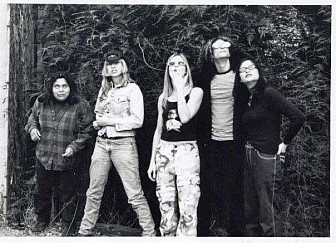 Lucid Nation in the DNA era. Photo by Danielle Lopez.
In a fever vision I apparently saw something that I don't remember. I'm told I said I saw a light that moved in a way that did not fit my sense of reality, and it scared me. Somehow the riff reminded me of that experience.
But the song is more about fear of each other, which is really fear of ourselves. We all have these secret places inside us where we keep the aliens at bay, as it were. We're afraid they're going to escape and wreak havoc.
This song is shadow work in the area of paranoia. Jung's theories about psychology are a big influence on my music, so much of which is shadow work. Also, in this song I'm playing a character. Not all my songs are sung by characters, but sometimes I'm playing a role.
Songfacts: How about "Kindred?"
Lucid: What the constraints of conformity do to you. The anxiety of choosing to be yourself.
When you conform but it doesn't lead to the life you want, you realize the sacrifice of giving up your self wasn't worth it. And all the darkness of frustrated life we contain seems to look back at us from people we fear as other, while most are really much more like us than not.
Songfacts: How about the "Happy" song?
Lucid: The funny thing about "Happy" is that after the first reviewer described it as a cover of the famous Keith Richards song, many other reviewers repeated that, including Rolling Stone. But the song wasn't a cover. I mean, I guess it could be taken as a satirical cover, but I was thinking of Ren and Stimpy more than The Rolling Stones, as much as I like The Stones.
It's another character song. It's the great North American dad demanding the family have fun when everyone is actually miserable. My dad worked for the post office, as the lyrics near the end reflect. But it was also a slight nod to my time in metaphysics where I met certain types whose strict enforcement of happy wasn't very happy at all.
Songfacts: Can you tell us about "Ghosts Of Laurel Canyon"?
Lucid: That's funny because we pulled "Ghosts" off most platforms except Bandcamp last month. It takes a while to happen.
It was definitely a result of lockdown and a reaction. Sadly, so far we can't find the hard drive with recordings of the third vocalist/12-string guitarist.
We were deliberately trying to imitate Crosby, Stills & Nash. I was taking the Stills voice. Ronnie the Graham Nash voice. And our friend and engineer Phoenix was the Crosby harmony. I'm not even sure why we put the recordings out. I think we felt they were situation specific. I think they are more sketches than songs. They need the other instruments and the three-part harmony to really take flight. I hope someday we can accomplish that. If not, at least these are on Bandcamp.
As a musician you're hoping those ghosts will inspire you to make your music as memorable and interesting as theirs, to take us deep into the harmonies. It's an archetypal place, that canyon. But it's also the ghosts of the indigenous people who lived there, and of the old Hollywood whose stars first built chalets. Over there Jim Morrison lived and that is where he shopped. That was where Frank Zappa's huge ramshackle house stood. And over there the ruins of Houdini's place. So it was just the two of us exploring the music that was made in that canyon. A denial of the pandemic lockdown as we picked apart and attempted our own dumbed-down versions of what the hell were those hippies doing in that canyon.
But compared to them, we felt like ghosts under a dusty orange sunset.
Songfacts: As you look back now with 2022 eyes, how do you see riot grrrl as a "movement" or "phenomenon" or whatever best classifies it? How do you see your time in it?
Lucid: Riot grrrl accommodated people who felt completely damaged and unable to express themselves, giving us a safe space to be as unabashedly expressive and creative as we wanted to be. Like grunge, it said all those terrible feelings you're feeling, that's the art form, the healthy expression of it, of something everyone recognizes. If you expressed yourself well, you were shocked at the support you would get.
Despite its name, most of my memories of riot grrrl are quiet, serene, gentle and loving. Sitting in a coffeehouse making posters, chatting with sisters, deciding what cause to champion at that week's show. Sharing experiences. Strangely, finding the humor in our traumas.
We could put on shows, release zines and records, tour nationally, all outside the corporate music business. But the end of the network of all-ages clubs that supported all that indie and DIY activity was just around the corner. Our first national tour we were shocked how many of the established clubs were being forced to close by city councils and fire marshals. That would be around 1998.
Kathleen Hanna [Bikini Kill] had warned me in the mid-'90s that the shit was over. I had definitely arrived late to the party, but riot grrrl still changed my life.
Songfacts: Can you talk about the new project you've got going?
Lucid: I'm finishing a book being published next year, a collaboration between Ronnie and me, called The Magic Of The Orphic Hymns. It's a bit of a tie-in with my first book, Making The Ordinary Extraordinary. I'm also gathering all the notes I have for a follow-up memoir that includes my experiences in music. I'm still processing what has happened in the world recently, like an observer in a crow's nest surveying the entirety of what I see.
As for new music, the way I like to make music no longer feels the same - there's a threat, a shadow in the room with us. I make art from the energy of my musicians, which is different now, and the images the collective unconscious provides. Presently? No, thanks. The atmosphere is unstable. Not a good time to fly.
Eventually I want to record another improv experimental record, maybe with John X at his Earth Star studio. Then again there's Sunset Sound where so much great music was recorded. I hope fate will smile on us, but right now the weather is mighty inhospitable.
Songfacts: During our correspondence, you mentioned that it felt "strange" to read old reviews of your music.
Lucid: My world was once this thriving community: first PRS, then riot grrrl, then indie. Websites, all-ages clubs, writers, zine makers, radio stations, the ladies at the post office, we were all in on it. Now it's gone. The websites are gone. The community is gone.
I know it's like that all over the music world and the economy in general and that it's the natural way as the generations evolve, but I can't help feeling it when I encounter that vista of disappearance, if that makes any sense.
 Songfacts: That is very sad the way you portray it.
I just finished a biography of the great mystic G.I. Gurdjieff. It talked about how all his efforts collapsed in the end. He died concerned only with simple indulgences like figs and cigarettes... none of the grand tomes of great wisdom around him or apparently even in mind. Your answer reminds me of his fate. What to make of this life?
Lucid: It is sad, Jeff, but it's also beautiful.
Are you familiar with the Japanese phrase "Mono no aware?" Look it up if you aren't. I think it applies to Gurdjieff, too. Same thing's true of Manly P. Hall, too. Dragged around in a motorhome while his wife pursued her impossible mission. Undignified end for such a dignified man. But there's something beautiful about it.
Like when you look back at a pet you loved (God, that sounds condescending, but I think you know what I mean), your heart is still broken by the absence, yet there's the warmth and beauty of the memories, there's the love.
We're all in this sandbox to learn our lessons, and everything here eventually returns to the sand. But we are not only sand, we are stars.
September 12, 2022
Follow Tamra Lucid on Twitter
Get Making The Ordinary Extraordinary: My Seven Years In Occult Los Angeles With Manly Palmer Hall, on Amazon
More Songwriter Interviews