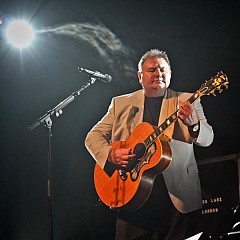
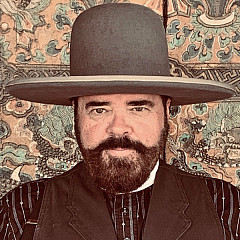
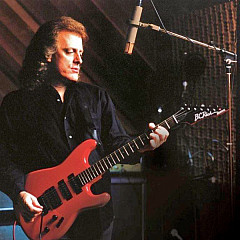
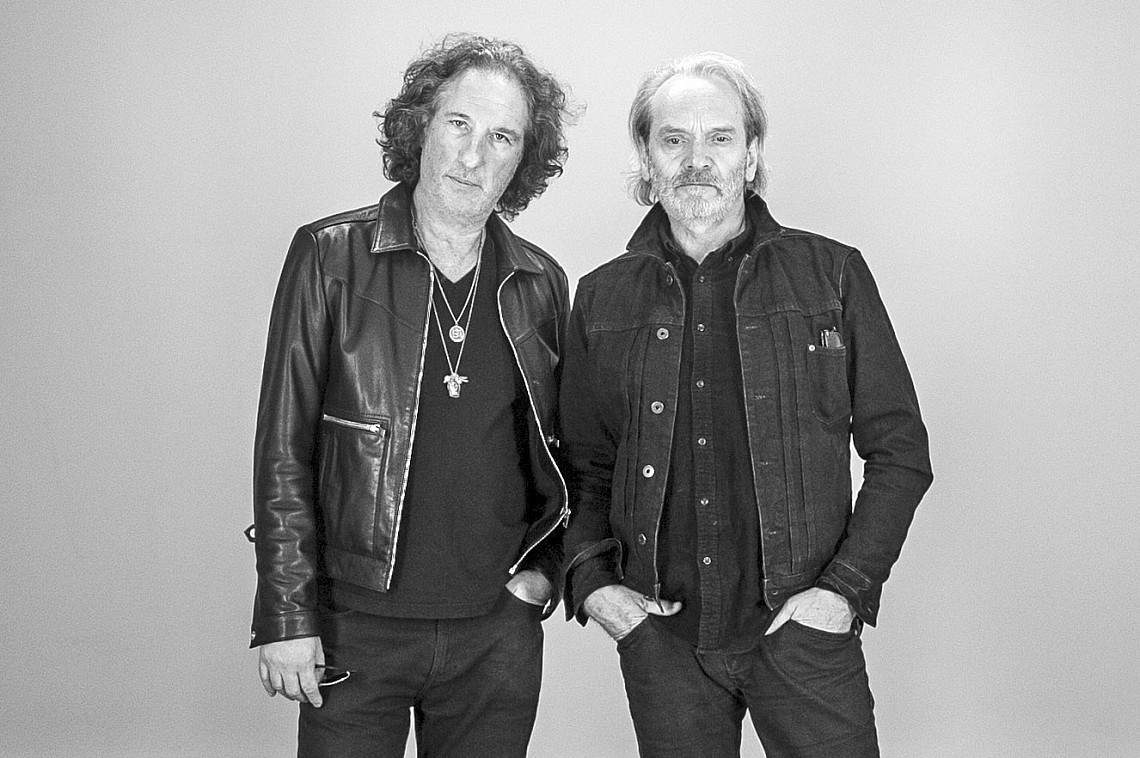
 Wang Chung: Nick Feldman (L) and Jack Hues (R)
Of course, no '80s playlist is complete without the Wang Chung hits "Everybody Have Fun Tonight" and "Dance Hall Days," but what do they consider the top tracks of the decade? Here, Nick Feldman and Jack Hues of Wang Chung make their picks with detailed analysis - you'll never again hear "Sign O' The Times" without listening for the perfectly timed move to the middle eight. Nick and Jack came up with some familiar favorites, but also with a Bowie rarity and an oddity from the brilliantly eccentric Frank Zappa.
On June 13, Wang Chung hosted a totally awesome virtual '80s concert with a dream team from that decade:
A Flock Of Seagulls
Cutting Crew
Naked Eyes
Animotion
Nu Shooz
Annabella from Bow Wow Wow
The Vapors
Tiffany
Downtown Julie Brown
Richard Blade
Billed as "Back To The Basement" because that's where many of us watched these artists on MTV, merch sales and donations went to the Direct Relief organization, which is helping those with the greatest need get through the pandemic. Watch it at abductedbythe80s.com.
Here are the picks.
On June 13, Wang Chung hosted a totally awesome virtual '80s concert with a dream team from that decade:
A Flock Of Seagulls
Cutting Crew
Naked Eyes
Animotion
Nu Shooz
Annabella from Bow Wow Wow
The Vapors
Tiffany
Downtown Julie Brown
Richard Blade
Billed as "Back To The Basement" because that's where many of us watched these artists on MTV, merch sales and donations went to the Direct Relief organization, which is helping those with the greatest need get through the pandemic. Watch it at abductedbythe80s.com.
Here are the picks.
Jack Hues
Prince - "Sign O' The Times"
The first verse goes back to the intro arrangement - no harmony, just a descending melody for the vocal. The lyrics are direct, serious and straight to the point. The second verse is just as spare with an enigmatic bell sound providing decoration. Guitar enters on the second line with a great blues sound playing minimal licks and preparing to groove on the chorus, which consists of one word: "Times."
The move to the middle eight is perfectly timed and the chord contrast is classic - listen to the synth pad sound and how it drifts around quite extended harmonies without really stating anything definitive. The second middle eight goes even further out. No bass in this section, apart from a few little twitches, so when chord one returns you really have that feeling of "home."
The vocal performance holds center stage throughout and is definitive - I can't imagine it sung differently. I have tried playing this song live. It's great to do it, but it's something to do among friends with compassion - you're never going to get close to Prince's feel on this track.
"Sign O' The Times" Songfacts entry
The Blue Nile - "Easter Parade"
The opening gesture of rising piano arpeggio and answering fall is beautifully orchestrated with bell-sound synths. Paul Buchanan sings with the command and textural opulence of Scott Walker, but whereas Scott makes you feel you are listening to a theatrical performance (which I love!) Paul is sitting next to you on the settee at home, quietly telling you what he saw. The lyric is like looking at a Cartier-Bresson photograph. Paul Joseph Moore sculpts a sound as the first verse concludes - that never fails to move me.
It has that unforgettable quality that you hear in some of Stockhausen's work, but here this abstract noise hits an emotional spot in the service of the song. The song is totally satisfying in its AABA structure and the elements that constitute it: the harmonic sophistication, the vocal melody, the choices of instrument and particularly the sound design, the brevity - add up to something close to perfection.
"Easter Parade" Songfacts entry
David Bowie - It's No Game (Part 1)
But Bowie is always shining light, playing with light on the surface, and this vocal throughout makes me smile. I love too that he is wrestling with the whole boring task of writing lyrics for the verses - his solutions are many and varied, but Michi Hirota gives him all the attitude he needs! Robert Fripp creates a demented alter-ego to counterpoint the voices and everything is delivered in that big live room acoustic that made Low and Heroes so exciting and completely original.
The structure of the song is linear, dictated by the poem that he uses for a lyric, so no chorus as such, but hooks are everywhere. Very much in the manner of songs on Blackstar. A song that reminds you that, as Miles Davis was keen to tell his more studious players, "Attitude" is everything.
"It's No Game" Songfacts entry
Nick Feldman
Frank Zappa - "Watermelon In Easter Hay" (or to use its full name, "Playing a Guitar Solo With This Band is Like Trying To Grow a Watermelon in Easter Hay")
I am a huge Zappa and especially Mothers of Invention fan from the '60s, and my obsession with the great man was a not insignificant factor in us choosing to work with Peter Wolf as the producer of our Mosaic and Warmer Side of Cool albums. The reason for this is that Peter was Zappa's keyboard player for a number of albums and tours including Joe's Garage and on this track too.
In 2010, on the anniversary of what would have been Zappa's 70th birthday (he of course had died in '93), Dweezil Zappa played in London with his excellent Zappa Plays Zappa band, and I took my son to initiate him (successfully I'm glad to say) into as near an approximation of the real thing that I had been so lucky to have experienced so many times over the years before Zappa's untimely passing.
During the show, Dweezil projected video footage of his Dad playing "Muffin Man" from 1975, but with his father's guitar part sonically isolated, so Dweezil and the band played along with him, effectively bringing Frank into the band live right there on the Roundhouse stage in 2010.
As I stood there taking this in, I had a real moment of epiphany. I realized that if I had known back in 1975 that 25 years on in 2010 I'd be watching Frank's as-yet-unborn son playing with him in concert, and that I would be watching all this with my son, who himself wouldn't be born for another 15 years after 1975, I would have found it conceptually pretty hard to get my head around. The fact that my son Max was blown away by the concert just completed the circle of what was a beautiful and profound moment for me!
"Watermelon In Easter Hay" Songfacts entry
Talking Heads - "Once In A Lifetime"
This was developed and explored much further of course, once David Byrne started his collaborations with Brian Eno. In 1980, Byrne and Eno made what I consider to be one of the most influential and amazing albums, My Life In The Bush Of Ghosts, which was truly ahead of its time in its use of musical and vocal samples (in place of traditional lead vocals and melodies), music and drum loops, varied rhythms, grooves and soundscapes. Eno, as he had done with Bowie a bit earlier, was expanding David Byrne's musical palette in an experimental way into unknown territories. This new creative chapter of their collaboration is clearly present in the overall sound picture of the next Talking Heads album, Remain In Light. The band were very involved in the creative process too and they experimented with African polyrhythms, funk and electronics, recording instrumental tracks as a series of looping grooves.
The main hit song from that album is "Once In A Lifetime," with its almost randomly cacophonous keyboard burblings, the wonderful bass line and rhythm section groove and David Byrne's slightly preacher-like vocals, again redolent of some of the vocal samples of exorcists and preachers from the Bush Of Ghosts album, but in a formalized way by Byrne.
When my personal life started to unravel many years later, the lyrics to this song still resonated for me. Byrne's mesmeric and intense physical performance in the video to this track still compels today, and compliments and reflects the music it is interpreting. Both Jack and I were very into this album.
[When we spoke with Glen Ballard, whose many accomplishments include co-writing "Man In The Mirror" (which shows up in the next entry) he also cited "Once In A Lifetime" as one of the greatest songs ever recorded.]
"Once In A Lifetime" Songfacts entry
Michael Jackson - "Thriller"
That was an an incredibly exciting prospect for an emerging yet-to-be-successful band like us. Some lyric changes were suggested, which we fooled around with, but in the end nothing quite stuck. And thanks to the lack of "Dance Hall Days" on it, the Thriller album and Michael Jackson went on to fall into failure and obscurity. OK, maybe that didn't quite happen, but "Dance Hall Days" became a huge hit for us instead and put us firmly on the pop music map in 1984.
I love Thriller the album and I love the title track with its killer bass line and groove, great chord changes, brilliant vocal, topped off with Vincent Price doing his thing over the final act of the track, underpinned by the drama-filled chord progression.
The track "Thriller" combines the best of Jackson, with Quincy Jones' mastery and of course, as ever, the massively talented Rod Temperton, who actually wrote the song. Another link we had later on to the Michael Jackson camp was Siedah Garrett. Siedah sang backing vocals on our huge hit "Everybody Have Fun Tonight" and on various other tracks on our Mosaic album. She soon would write "Man In The Mirror" for Jackson's next album, Bad, as well as guest vocalling on it.
Anyway, in '87, whilst hanging a bit longer in LA before returning to the UK at the end of a long Wang Chung tour, I got together with Siedah to begin writing a song with her that was in contention for her solo album that she was recording with Rod Temperton there. She and Rod invited me over to his house where he was doing some preproduction, and he told me he was a massive fan of Wang Chung's album and instrumental score for the Friedkin movie, To Live And Die In LA that had been released in '85. Coming from Rod Temperton, that seriously made my day! My song with Siedah never got finished though... can't win 'em all!
"Thriller" Songfacts entry
June 11, 2020
Wang Chung Songfacts
Interview with Tiffany
Interview with Nick Van Eede from Cutting Crew
photo: Armando@kinetic-image.com
More Songwriter Interviews