With each passing year, there are fewer and fewer musicians remaining who can honestly be credited with lending a hand in the creation of punk rock. MC5 guitarist Wayne Kramer is one such gentleman. And as read in his book, The Hard Stuff: Dope, Crime, the MC5, and My Life of Impossibilities, he is a true survivor, having served a prison term, endured several failed marriages, and battled long-term drug addiction and alcoholism.
While his turbulent post-MC5 life certainly makes for some stimulating reading, it is for his musical work that Wayne will undoubtedly be best remembered, especially the three albums issued during the MC5's brief but fiery career: Kick Out The Jams (1969), Back in the USA (1970) and High Time (1971).
In 2018, the group's music was back on display where it belongs - on the concert stage - as part of the MC50 tour, in which Kramer was joined by a rotating cast of renowned rockers celebrating the 50-year anniversary of the recording of Kick Out The Jams. The guitarist spoke to Songfacts about the book and tour, the stories behind several proto-punk classics, and his thoughts on revolution and rock.
While his turbulent post-MC5 life certainly makes for some stimulating reading, it is for his musical work that Wayne will undoubtedly be best remembered, especially the three albums issued during the MC5's brief but fiery career: Kick Out The Jams (1969), Back in the USA (1970) and High Time (1971).
In 2018, the group's music was back on display where it belongs - on the concert stage - as part of the MC50 tour, in which Kramer was joined by a rotating cast of renowned rockers celebrating the 50-year anniversary of the recording of Kick Out The Jams. The guitarist spoke to Songfacts about the book and tour, the stories behind several proto-punk classics, and his thoughts on revolution and rock.
 Greg Prato (Songfacts): 2018 is a busy year for you - between the MC50 shows and your book.
 Wayne Kramer: I love playing music for people, and I wanted to do some shows. The fact that we were coming up on the 50th anniversary of the recording of Kick Out The Jams seemed to be significant enough to warrant a tour, so I started to ask my friends who was around that might be available, that would be interested in doing this with me.
And I got really fortunate in finding guys like Kim Thayil, Brendan Canty, Don Was, Matt Cameron and Marcus Durant. Billy Gould from Faith No More is coming on board to play bass, and we did some shows with Dug Pinnick from King's X. Each of these guys has their own connection to the music of the MC5 separate from their relationship with me. And I thought that was important: that each of them had their own reasons for wanting to play this music and to perform it, and to play it well.
And mostly, I wanted to get people who were good people, that I would enjoy their company. Because touring is tough work. It looks like a ball from the outside, but from the inside it's hard: You never sleep well, you never eat well, and everything is done in motion. You're on the move all the time. Whether you're The Rolling Stones or a wedding trio, the work is basically the same. You have to get your body to the next show, and you have to perform with some enthusiasm. You have to deliver. And then you have to get up and do it again tomorrow.
So, it was most important to me that I had good people. Genial people who are experienced, that know how to tour, and know that sometimes you're not going to get enough sleep, and this is a job. Sometimes, it's uncomfortable, and you have to make the best of it.
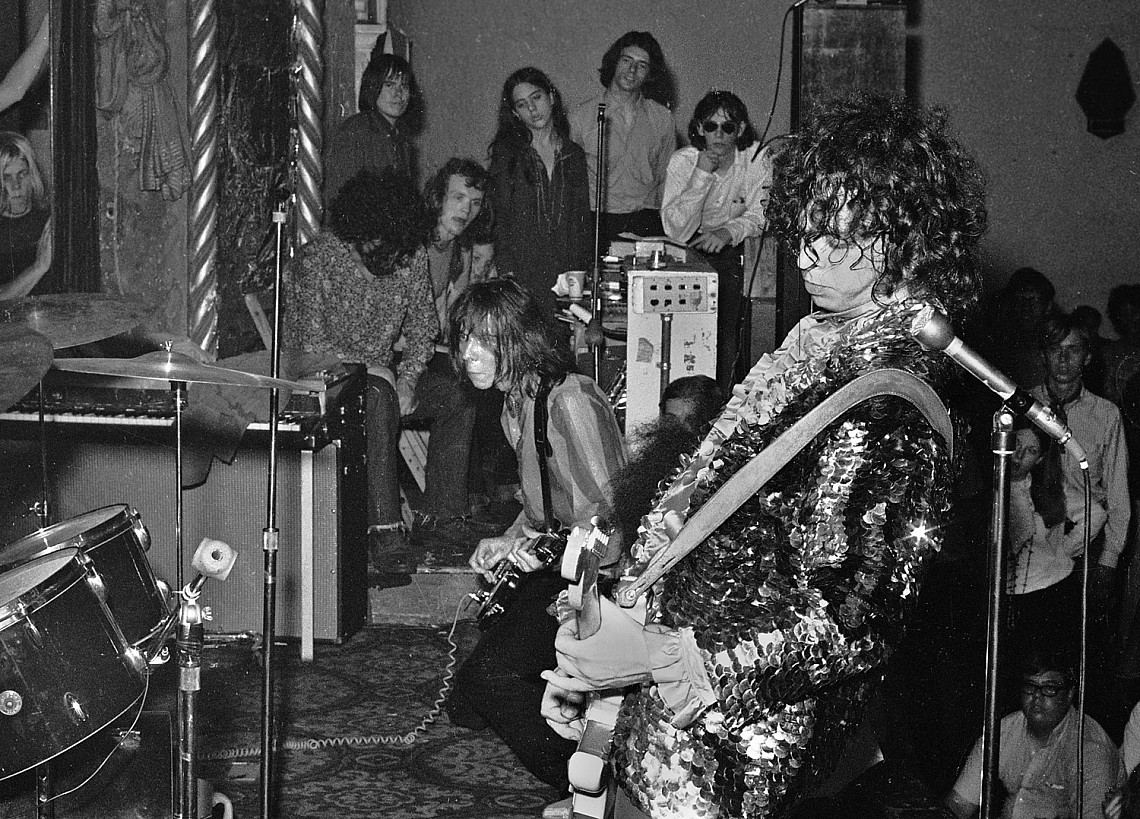 Kramer and Fred "Sonic" Smith with the MC5 at the Grande Ballroom in Detroit
Songfacts: You also wrote a book.
Kramer: It wasn't my intention to write a tell-all book or a get-even book. I don't have any vendettas against anybody. But I did want to tell the truth about what I went through, what happened to me, terrible decisions that I made, and take responsibility for getting it wrong a lot. I've read a lot of autobiographies and memoirs, and there's this annoying trend where whoever the author is, they never got it wrong. They never made a mistake. It was always the manager's fault, or the ex-wife, or it was somebody else's fault that everything went sideways. That never rang true to me. I don't think real life works that way. And, it's bad storytelling.
So, it was important for me to tell the truth about what happened, and try to give the reader a front-row seat at what it was like to be in the MC5 in those turbulent times. We were getting hammered from all sides. We got hammered from the establishment - the police and the FBI. We also got hammered from our friends on the left - our political allies criticized us. And we got hammered from the music business establishment who thought we were way more trouble than we were worth. We got it from parents and teachers. We were constantly under attack. I know it may sound like I'm complaining, but I'm not. I'm just stating a fact: The MC5 had to endure challenges that most rock and roll bands don't have to contend with.
And yeah, we created most of our own problems, but a lot of it I would put it squarely where it belongs, and I put that on the doorstop of a government run amok in its attempt to squash protests and dissent. A government that ultimately broke the law to try to silence young people from expressing themselves. And it all came out in our court case with the Supreme Court. The court ruled in our favor that we are a nation of laws and not of men - contrary to what people may believe of the current resident of the White House, or what he may believe about how the law works. We have protections in life.
The court case Wayne is referring to is United States v. U.S. District Court, 407 U.S. 297 (1972), also known as "the Keith case," in which the Supreme Court ruled that warrantless wiretapping was unlawful under the US Constitution. The reason for the wiretapping? The MC5 were associated with a far-left organization known as the White Panther Party, whose members - including early MC5 manager John Sinclair - were accused of bombing a Central Intelligence Agency office in Ann Arbor, Michigan, on September 29, 1968. Here's the entire knotty backstory.
Songfacts: I recently saw a video clip of Frank Zappa from 1987, and when asked about rock music in the '60s, he said, "There was a lot of revolutionary rhetoric, but there never was a revolution." What do you think? Kramer: Well, I think that might be a little cynical, because there was a revolution of consciousness. Young people around the world were in agreement that the way our parents were handling their responsibilities was less than optimal. That this war in Vietnam was an undeclared war and an illegal war, and certainly, an immoral war. There was no justification for it. With the benefit of history now, we can look over that period and say, "The communists never threatened the United States." That was a myth cooked up by the White House and the military-industrial complex to justify their actions.
 And it's a myth that's been repeated in the Middle East - we've been at war now for 17 years in Afghanistan. Afghanistan doesn't pose a threat to the United States. This is a myth that generals and politicians perpetrate, and nobody has to pay for it. There's no draft now, so it's an all-volunteer army, and the Army is off by themselves fighting this war. The American people have no skin in the game - they're not even being charged for it, let alone fighting and dying in it. It's not good.
Songfacts: What do you recall about the writing of the song "Kick Out The Jams"?
Kramer: We were going through a very creative period. The band had just moved in together for the very first time. There used to be a building in downtown Detroit that was a dentist's office on the second floor, and we all moved into different rooms in the dentist's office as our bedrooms. And then downstairs was a storefront. I covered the walls with egg crates and made it a rehearsal studio, so for the first time we could rehearse whenever we wanted to - all day, all night if we wanted to - and we all lived there.
So, it became possible to really develop some songs and some music. And Tyner [Rob Tyner, MC5 lead singer] and I developed a little habit of sitting down at the kitchen table with a couple of joints of reefer, a little amp, my electric guitar. He'd have a notepad, I would just play guitar riffs, and he would listen and say, "Wait, wait... play that one again. No, change that a little bit. OK, play that again. Play that four times." And then we would start to cobble the songs together. That was where "Kick Out The Jams" was born.
We had the expression. We were using the expression for a long time, because we would be critical of other bands that came to Detroit that the MC5 would open for. They'd come into town with this big reputation, and then they'd get up on stage and they weren't very good. So, we used to harass them. We'd yell at them, "Kick out the jams or get off the stage, motherfucker!" Finally, one day we said, "I like that expression. We should use that as the title of a song." So Tyner knocked it out.
Songfacts: What is the story behind "Ramblin' Rose"?
It was a song that he had discovered [the song was written by Marijohn Wilkin, Fred Burch, and Obrey Wilson] and recorded, and I used to hear it on soul radio in Detroit. We had a couple of soul stations that just played R&B. I thought, Man, that's a great song. I want to work this up with the band. I gave it a try, and I admit that I don't sing it as well as Ted sings it. If you ever hear his version, you'll hear how it really was supposed to be sung.
We used to find obscure covers to do. We had a lot of material that we thought were just great songs. For example, we did a version of Jody Reynolds' "Fire of Love," which was a power ballad before there were power ballads. We did a version of a song that Nina Simone did called "Why? (The King of Love Is Dead)" - it was about Martin Luther King. It's just a great song. A lot of this obscure material we used to do.
Songfacts: What is the lyrical inspiration behind the song "Poison," which is solely credited to you?
Kramer: I was trying to come up with a metaphor for the corruption. I was becoming aware that, for example, in Detroit, these giant manufacturing facilities - the steel companies that forged the steel that went into automobile manufacturing - were spewing tons and tons of pollutants into the air. I just thought, That can't be good for you.
I could see it. In the '60s, when you would fly around America and you would come down out of the clouds to land the plane, if you were coming down into Pittsburgh, Detroit, Newark, New Jersey or Gary, Indiana, you would see this line where the air turned brown as you descended down to the airport. I thought, That can't be good to breathe.
This was really a poison, but the poison was larger, and it was more pervasive than just in the air. It was in the way that big business controlled government. So I wanted to talk about that in a metaphorical way.
Having successfully dodged the draft, the MC5 were at the forefront of the burgeoning Detroit music scene in the late '60s, but drugs, internecine conflict and the various hammerings Wayne described led to a swift decline following the release of Kick Out The Jams in 1969. They ended up on Atlantic Records, which released their next two albums and then dropped them. (Kramer recalls a meeting with label boss Ahmet Ertegun where Ertegun took a phone call and spun around in his chair so all they could see was "the back of his bald head.") By 1973, they were done.
Grand Funk became Detroit's breakout act; Kramer ended up selling drugs to make ends meet. In 1975, he was arrested for selling cocaine to undercover federal agents. He served two years in Lexington Federal Prison in Kentucky. The Clash song "Jail Guitar Doors," released in 1978, begins: "Let me tell you 'bout Wayne and his deals of cocaine."
Songfacts: Is it true that The Clash's "Jail Guitar Doors" is about you? Grand Funk became Detroit's breakout act; Kramer ended up selling drugs to make ends meet. In 1975, he was arrested for selling cocaine to undercover federal agents. He served two years in Lexington Federal Prison in Kentucky. The Clash song "Jail Guitar Doors," released in 1978, begins: "Let me tell you 'bout Wayne and his deals of cocaine."
Kramer: Yes. When I got back from prison, just after I got home, The Clash came to Detroit. I went over to meet them, because one of my friends told me that they had written a song about me. So, I went backstage and said hello to Mick Jones and Joe Strummer, and they gave me a copy of a single, and they had written, "To Wayne Kramer, #1 in the USA." I was very proud of that.
I didn't know these guys - they were just brothers from across the sea who displayed some solidarity with a fellow musician and wrote about his bad behavior in a song. And it was ironic that it turns out all these years later that's what we call our independent initiative that works in America's prisons.
Songfacts: Yes, let's discuss your Jail Guitar Doors organization, which provides musical equipment to prisons.
Kramer: Our guitars are in over 120 American prisons. And we run rehabilitation workshops using music in 10 California prison yards, in the California Youth Authority, in the Cook County Jail in Chicago, the Austin County Jail in Texas, at Rikers Island in New York, and in eight Massachusetts youth offender facilities. And, we just launched a program in my hometown of Detroit, in the Michigan Department of Corrections. I'm very happy about that.
August 11, 2018
Further reading:
James Williamson of The Stooges
Marky Ramone
Dick Wagner
Jello Biafra
JJ Burnel of The Stranglers
For more Wayne, visit facebook.com/waynekramer.
Photos: Jenny Risher (1), Charlie Auringer (2), Jeremy Bannister (3)
More Songwriter Interviews