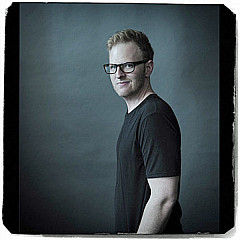
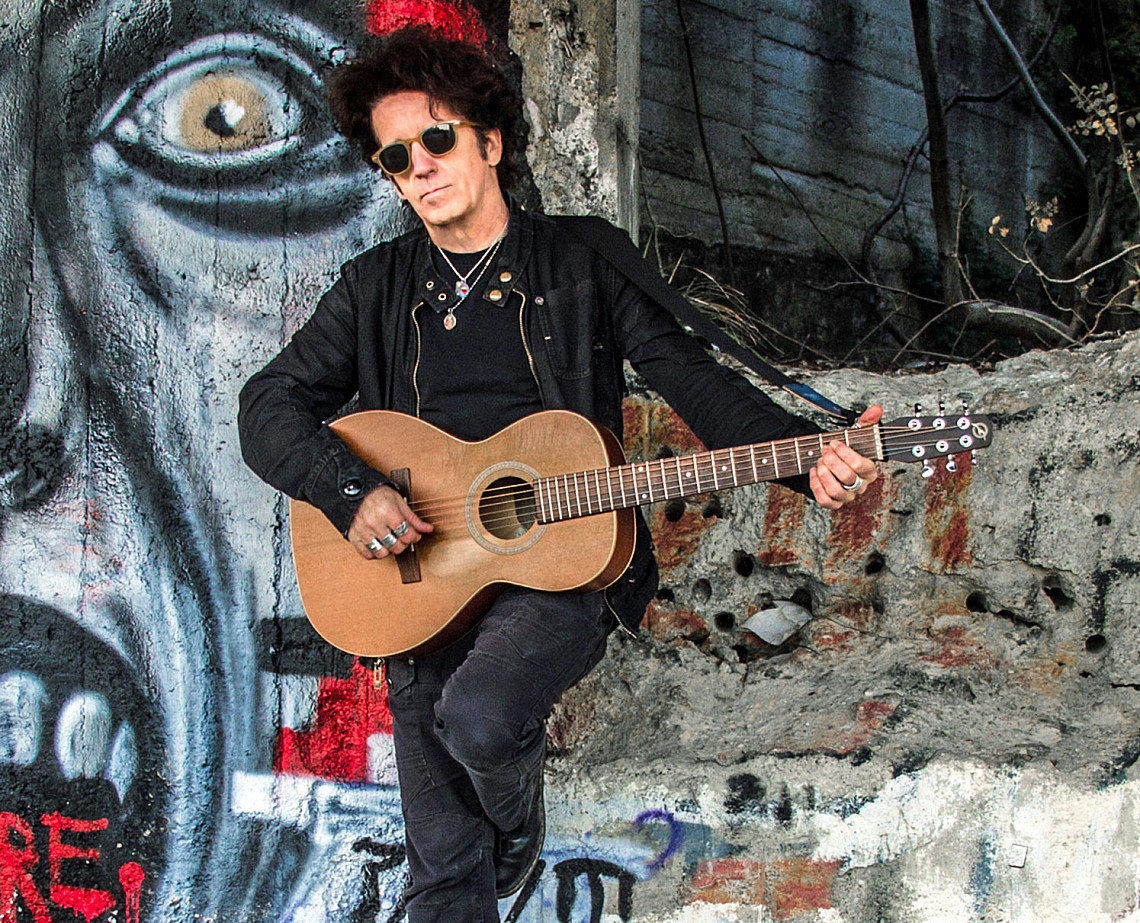
 Willie Nile has been writing and recording strong albums for more than 40 years - not that he could celebrate the four-decade mark last year amid the pandemic. But the COVID crisis and its lockdowns did inspire a number of songs on his new album, The Day The Earth Stood Still, released August 13, 2021 on River House Records. We talked to Nile in New York as he was just starting a live US tour for the first time in 17 months to find out about the new songs, getting Steve Earle to sing with him, his connection to politicians, and how some of his song titles predated those by Bruce Springsteen and The Rolling Stones.
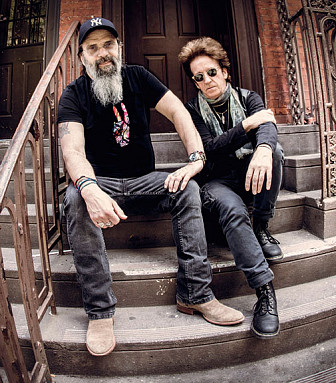 Nile with Steve Earle
Willie Nile: I had some songs in mind. I was thinking about making an album. I had a few in hand. But when I wrote "The Day The Earth Stood Still," I knew I had my title track. I said, "That's it." I was in Italy a bunch in the fall and wrote a number of songs there. One of the songs was "Time To Be Great." Watching TV, dealing with this whole past year of madness and nightmare, I thought, What do we do as people? What do you do in a situation like this? And I thought, You know what, we pick ourselves up and try to do the best we can. We try to be great. You be great, I'll be great, and let's just try to help each other, pick each other up. Something upbeat, you know: Shed a little light in this darkness.
Songfacts: There's also a song on the album called "Blood On Your Hands," your duet with Steve Earle.
Nile: Steve's a neighbor of mine. He lives three or four doors away from me, right around the corner, and we bump into each other all the time. He's a great guy. We played together at City Winery in New York.
We made the album in January, all masked up. Twelve to 14 hours, Sundays, it was all masks. We got it done, the band played just great, and I'm thrilled with how it came out. Then we're getting near mixing the album and I thought, You know what? Steve Earle might sound great singing on "Blood On Your Hands." I texted him, "Hey Steve, I've got this song." I sent him the song, and he just wrote back and said, "OK." It couldn't have been easier. He came in the studio, sang on it, and I was deeply grateful for him to come in and be a part of that song. I'm a big Steve Earle fan.
These are turbulent times. The song is about dancing with the devil, whether it's something personal between two people or politics on a world stage, if you dance with the devil, you can get blood on your hands. There's no limit to greed, selfishness and pride. They're not limited to any governments. But clearly on a larger scale, the pandemic had a devastating effect, globally on the world, as have all the wars. So that song in general has a universal theme. And to have Steve sing on "Blood On Your Hands" meant the world to me.
Nile: I've written songs in the past - "Cell Phones Ringing In Pockets Of The Dead" about terrorism and "Holy War" about terrorism and stuff. I'm not a big finger-pointer, but a lot of people died last year, and it didn't have to be that way. It could have been better. It was criminal. I just was so pissed off about it, I wrote "Blood On Your Hands" one night. Having Steve be a part of that was pretty great. He dug it.
Songfacts: "The Justice Bell" is another song that picked up on the racial justice issues that rose again last year.
Nile: You know, I met John Lewis. A few years ago, he came to New York to former Congressman Joe Crowley's birthday party. Joe Crowley is an old friend of mine. In 1980, when we were playing a concert at Queens College in New York for my first album, him and another buddy, 19 years old, snuck into my dressing room and wanted to get a towel signed. Joe is a huge fan, still has the towel, so he tells me. I played his birthday party once, it was funny. Joe is great. I might invite him up to sing with us in Washington. He's done it before - he's joined us on stage.
At one of his birthday parties, when he turned 50, my band and I played, and Nancy Pelosi came up to New York, and Mayor Bloomberg was there, and Joe called me up on stage. Bloomberg looks over at me and pats the top of my hair, which was sticking up. Then he called me up again when Nancy Pelosi was on stage. Joe loves to sing, he's a great Irish tenor. He loves playing guitar, he's a music man. So we played that night for an hour. He and his brother backed us up, singing and playing guitar. He knew more lyrics than I did to my songs. I kid you not. So it's after we played, he's up there, and he introduces Nancy Pelosi. She says some words about Joe, and he calls me up and they start singing "American Pie," the Don McLean song. So I grab my guitar and me and Nancy are arm in arm singing background to Joe Crowley. My band's looking up, laughing - you can't make that stuff up. But she was delightful, she was really nice. I met her on other occasions.
A couple of years ago, John Lewis flew up for John's birthday and Caroline Kennedy was there, and I'm a kid from the '60s, so that meant the world to me to meet her. Joe gave me a really nice introduction to John Lewis. It was one of the high points of my life, really. I think the world of him, a true American icon. We had a moment together, I got to thank him in all sincerity for all that he's done for this country and for justice and for people, and he was very kind in response. Then, I got to see him speak for about 10 minutes and I was about five feet away. It was a mountain top of my life.
I wrote "The Justice Bell" with my buddy Frankie Lee based on that experience. It was very meaningful when we recorded it. Interestingly enough, we recorded that song on January 6, the day of the Washington insurrection. It just happened. We were in the studio, people came running in, "Look what's happening on TV, you're not going to believe this." And we're recording the song "The Justice Bell." It was a pretty deep experience. It came out beyond my wildest dreams.
Songfacts: Well, you don't get overly serious on this album. You've got a song called "Where There's A Willie, There's A Way," too.
Nile: At the end of the day, you can write about anything, which is one of the things I like so much about rock and roll music. You can write about anything: A love song, a song of loss, a song about what may be happening in the world politically. There's a song called "Off My Medication" on this album, which is a riot, and there's "Where There's A Willie, There's A Way."
Yeah, at the end of the day, you can write about stuff. It can be serious or poignant, or whatever. But on my records and in my live concerts, when all is said and done, I want it to be a lot of light, great energy, upbeat, feel good. My shows are upbeat, feel good shows. We may play "Blood On Your Hands," but we'll close with "A Hard Day's Night" or something.
I want people to leave the concerts feeling a hell of a lot better than they did when they walked in. Life is hard for everybody. I want people to be inspired. I'm inspired - the music makes me feel better. It clearly does. You can hear it in my voice. I'm still as passionate as I've ever been. I always say hello to people on the way out and sign CDs and stuff, and I can tell they're elated.
So my concerts are upbeat concerts. I want my records to be upbeat and passionate and positive. I always make sure that happens. I don't ever want to make a record that's a downer.
Songfacts: A lot of your older songs certainly hold up. "Beautiful Wreck Of The World" could have been out new this week.
Nile: One thing I like when I listen to some of the older stuff is the timeless quality some of it can have. They sound fresh. They sound real. I write about things around me, and sadly the history of man doesn't change a lot. So a lot of the things, whether it's hunger or starvation, man's inhumanity, love, passion, that's still going on. So I'm happy stuff still resonates. Dearly so.
Songfacts: Some of your song titles have been prescient as well. Bruce Springsteen issued a song called "House Of A Thousand Guitars" on last year's Letter To You, which had been the title song of your sixth album in 2009.
Nile: I think it was just a coincidence. When I make a record, I'll send it out to Bruce. He's a buddy. He's been very supportive, has called me up on stage many times and joined my band on stage many times. In 2009, when that came out, I sent a couple of copies to Patti [Scialfa]. I met Patti in 1980, when she was background singer for Southside Johnny. So I sent that album along to them. He's been on the side of the stage when I've played it. We do this charity benefit every year for Light of Day, which raises money for Parkinson's. It's a really great organization. It's raised over $6 million, in large part due to Bruce supporting it.
I was in Edinburgh, Scotland, in September, and somebody calls me up and says, "Congratulations, I heard Bruce recorded 'House Of A Thousand Guitars'!" I said, "What?" I thought, Wow, God bless him. I didn't know what it was. I hadn't heard a word. The next day in my emails, a bunch of people in the press are writing and asking me, "Oh, Bruce got your song, what's the story?" And, "Is that your song?" His publicist put a statement out, because the Asbury Press and others were asking them, because they know my work, and they said, "No, this doesn't have anything to do with Willie's song."
A buddy told me that in Bruce's 2016 bio, Patti always referred to his studio as The House of a Thousand Guitars. I think it's coincidental. If over the years she would refer to The House of a Thousand Guitars as his studio, I can see how that could become second nature. I love Bruce and I sent him a note congratulating him on the record. He's a buddy. I think it was just a coincidence.
Nile: This is unbelievable. If you told me this was going to happen, this kind of stuff, I'd say you were out of your mind. I always said there's something to be said about believing in your dreams.
So here's me, a kid from Buffalo. I played classical piano as a kid. Wrote poetry in high school. Went to college, and my roommate for one year in Ohio had a guitar. I learned how to play guitar, and I started focusing all my writing into songs. I graduated, I liked my song, so I thought maybe I could go to New York City and make a record. I'd never been on stage before. I played in the clubs, but I was sick for a few years with a really bad case of mono - it was probably Epstein-Barr - and it knocked me out of commission for three, four years. I couldn't play. It was a really bad case. I couldn't stay up late, I was so tired. So I make a record in 1980, the first time ever with a band in a studio. The response to it was very loud and gratifying to me. I got great press worldwide. Next thing I know, I got a three-week tour across the US, and the band is playing clubs, colleges, small venues. First time I was ever with a band. Great fun. I always had a rock band in mind when I'd play solo acoustic on Bleeker Street.
So we get to LA and play the Roxy. Freddie Mercury comes out to the show. I had heard from the record company that Pete Townshend was a fan of the record. I thought, That's just nonsense. How do you know? So I didn't take it seriously. But after the show at the Roxy, The Who's manager Bill Curbishley came backstage. He loved the show and offered me to open their tour. They had just started their tour on the West Coast and were going to tour across the US, so I got to tour across the US with The Who. It was just madness. I was doing interviews every day, traveling every day, it was a thrill of a lifetime. I'd never in my wildest dreams ever thought I'd be playing show after show, opening up for The Who, and getting to see them play from the side of the stage every night. They were so nice to us.
Well, in the middle of that tour, my phone is blowing up. I wake up, my phone is ringing off the hook. DJs calling, what's my reaction to the Stones having a song called "She's So Cold" that sounds similar to my song "She's So Cold"?
It was the second most-played record at the time on WNEW in New York. Second most-played band in New York! It was just out of nowhere, all this stuff happened. I had just made a record, doing it passionately, following my instincts. And next thing I know we got all this feedback.
I remember thinking about it, I heard their song. I've got a tape somewhere of Jagger coming over for an interview in Chicago for that album [Emotional Rescue] to plug it, and a lot of program directors went to Chicago. And one of the first questions he got was: "Hey, your song 'She's So Cold,' it's just like that Willie Nile song."
And Jagger's reaction was, "No no, it's just something in air." He said, "Willie Nile, he's a real starter," because I had this reputation for being a tough New Yorker, when I'm just a pipsqueak. I've got some tough bones in my body, but I'm not a Hell's Angel yet. Anyway, it was fascinating to me. I had all these people who wanted to manage me saying I should sue the Stones. Sue the Stones! l play their songs back to back. I love the Stones. No way am I going to be in that category of suing the Stones. Forget it! I loved the Stones. If it influenced their song, fine.
One of the guys who wanted to manage me used to manage the Stones, and he asked Keith about it. And Keith said, no, he didn't know anything about it. But the manager apologized to me. I said, "Well, who knows?" Whatever. One song influences another, you know. "She's So Cold," my song, was totally Chuck Berry influenced. But the concept is mine.
When the Stones played Buffalo Stadium, in front of 80,000 people or something, I took a bow [in the stands] after they played it. "Thank you very much!" Literally I did. I love the Stones.
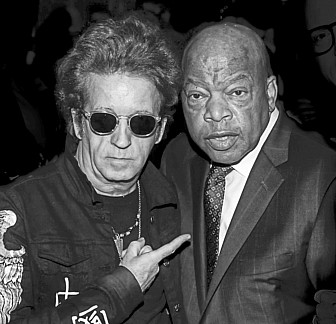 Nile with civil rights leader and US Representative John Lewis, who died in 2020
Nile: Sometimes I'll play old stuff, sometimes I won't. But I had never played the whole album like that. I was knocked out by the quality of the songs. I thought, These are pretty good! I loved playing it, it was fun revisiting it, it brought me back to those days of being on the streets in 1980 New York. Literally a week ago, we played in Red Bank in Vogels, next to the Count Basie Theater, this great new venue, and we did two shows. The first show was the 40th anniversary of my second album, Golden Down, played top to bottom. The second show was my first album played top to bottom. It was just great revisiting them. It was fun, and I was pleasantly surprised they still resonate with me.
Songfacts: Golden Down is a favorite of mine.
Nile: We filmed it. We have a film that's really strong. We'll put something out along with the new album release August 13. Then the next show we'll put out is Golden Down, the 40th Anniversary. It was glorious to play it. It really was. The band killed it. I've got a great band with me. I've always had great bands. I've been very fortunate. None better than this one.
Songfacts: I wanted to ask about your album from 2017, Positively Bob, covering Bob Dylan. That would seem to be a daunting task, first of all, to try to put an imprint on those songs. But did singing those songs help inspire your own songwriting?
Nile: I learned a lot from that. Obviously, Bob is a total hero of mine. Clearly a big influence, as are the Beatles and Stones and the rockabilly guys of the early days. When I first played in New York City on Bleeker Street, around town, I never did cover songs. I just did my own songs, because that's what I was interested in. I didn't have high school bands doing covers. I never did it. So on my records, I've done "Sweet Jane." I've done "Police and Thieves." Lou Reed was a friend of mine. When he died, I wanted to honor him, so we played "Sweet Jane." It was so much fun playing it live, we kept playing it every show. The next thing you know, we're in the studio and I go, "Let's do it." We got a great version of it.
I was invited five years ago in New York City when City Winery was having a Bob Dylan 75th birthday party. It was an acoustic night and I was invited to come in and sing four songs and close the show. I thought, let me look and see what I could play. I don't just do stuff. If I couldn't bring stuff to the table, I wouldn't bother.
I spent one night looking over the songs, and I came to "A Hard Rain's A-Gonna Fall." I thought, What if we played that like "Bolero"? Which we did. I did "Rainy Day Women." The song that really inspired the album was "Love Minus Zero / No Limit." I played it that night. It's on Bringing It All Back Home.
I played it, and I told the audience, "There's a great, great love song that you don't hear on the radio." I just wanted to give it a voice again. It's a beautiful song. Dylan is a true master, he's the Shakespeare of rock and roll. That experience, playing those four songs - I think we did "You Ain't Going Nowhere," too - was so much fun. The audience just lit up, because everybody knows those songs. I thought, Man, this was so much fun, if I had six more we could make a record. We did it in two days, it was so much fun. There are 10 songs on it - every song on there, it's a live vocal. I didn't do any overdubs vocally.
I know the songs well. The drummer on there was Aaron Comess from the Spin Doctors for that record. My guy was out of town. It was James Maddick on guitar, Ben Hogan on guitar, Johnny Pisano on bass. We went in, set up, and we just went through it: boom boom boom. Two days. All the live vocals. And there were some guitar overdubs. Maybe some keyboards afterwards. It was very quick, just a joyful experience. I think my motivating factor for the whole record was, I want to do justice to these songs and get them out there again for another hearing, for however limited that may be. They're all beautiful, brilliant masterpieces, and that was my thinking.
It did get a lot of play and a lot of good reactions. The Dylan Facebook page gave me a real nice plug, actually. It was so much fun to do. As far as my songwriting, I mean, I've been influenced by Bob from years before that. But I'm sure I learned from that experience. It was great fun, it was easy making the selection. I just went: "What would be fun to do?" Like, doing "Blowin' In The Wind" like the Ramones was an absolute blast. Can you imagine? First of all, it's an utter masterpiece - three verses. We roar through it with Harley Davidsons on guitar. It's just so much fun to play, and a masterpiece. It's fun to do that: different spins. "Rainy Day Women," "The Times They Are A-Changin'," there's so many great songs. I just picked songs I liked and went, "That'll make a great collection." It was fairly effortless to be honest.
Songfacts: You toured that one as well, right?
Nile: Yeah, I'm always playing live, year in and year out. I'm not on the road every day, but I toured behind it. It was really, really an honor to sing those songs. To sing "A Hard Rain's A-Gonna Fall." We'll occasionally pull out "Rainy Day Women." But we did tour behind it. It's joyful. The songs were amazing.
And there's one hidden gem on that record, "Abandoned Love," which I understand Bob only played once live at the Bitter End here on Bleeker Street. I remember hearing about it from some friends of the era. One of my buddies, George Gerdes, a great singer, songwriter and actor, died earlier this year in January. God bless George. He would play it in his live shows. That's where I heard it. I went, "Wow, what a great song." When I was looking through his list, I saw the song and looked it up and thought, Yeah, and we do a beautiful version of it. James Maddick plays some beautiful acoustic guitar on it. You know, Bob's a master, and to give those songs another airing in a different fashion I thought would be worth the effort.
Songfacts: How have your live shows been so far on this tour?
Nile: Friends seeing old friends again, people telling me, "I haven't been to a concert in 16 months, this is the first one." And the guys on stage, us, beaming, so happy. It's like a rebirth. It feels so great to get out and play again.
August 23, 2021
Willie Nile's new album, The Day The Earth Stood Still is available on River House Records.
He and his band are on tour in the US through November. Details at willienile.com.
Further reading:
Interview with Steve Earle
Bob Dylan lyric quiz
Steve Earle photo by Dominick Totino; Nile solo shot by Cristina Arrigoni
More Songwriter Interviews