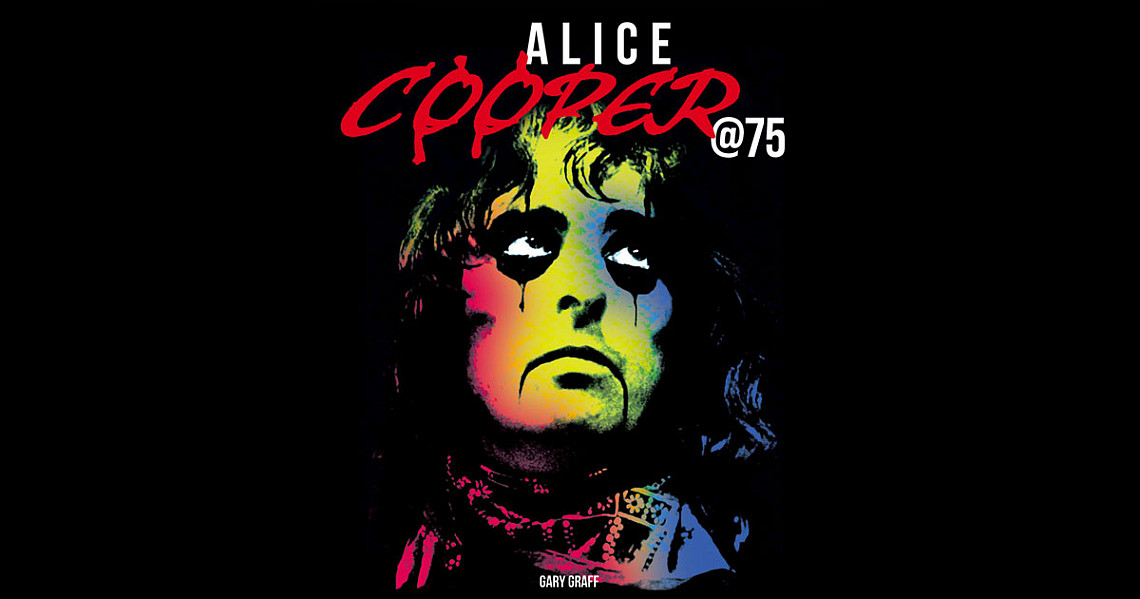
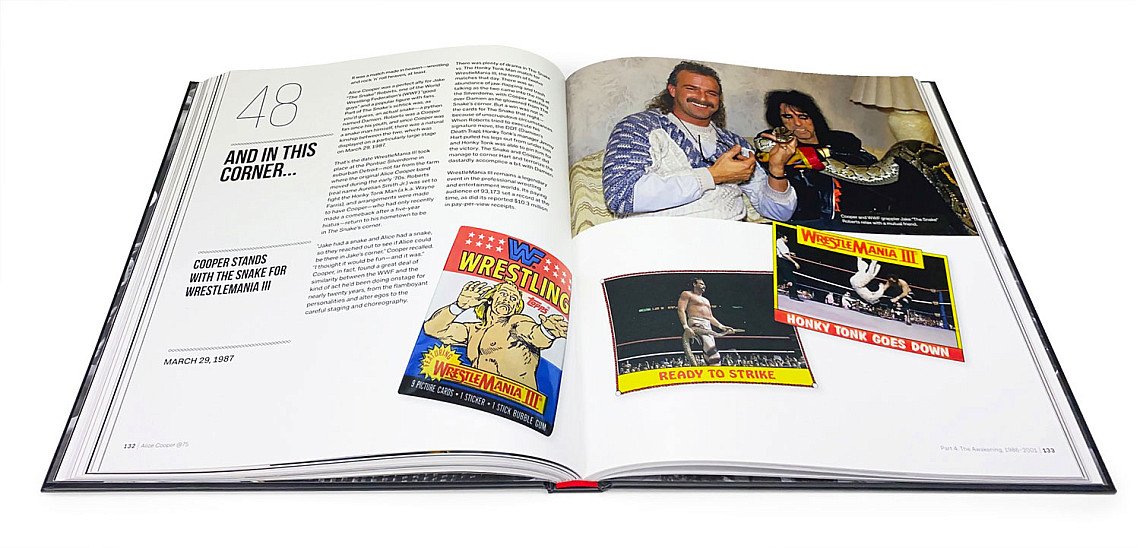
Gary Graff's book Alice Cooper @75 goes in-depth to explore 75 key moments in the history of Alice Cooper - the man and the band. It covers his early beginnings, time spent in LA in the 1960s, skyrocket successes in the early '70s, and the enduring career that followed.
In this discussion, Gary talks about some of these moments and also goes over a few songs, including "I'm Eighteen" and "No More Mr. Nice Guy." The book is a must-read for anyone interested in Alice Cooper. The "Dying To Entertain Us" chapter, where Alice takes a macabre turn, is particularly compelling, although not for the squeamish. Please enjoy this nightmarishly delightful discussion. The transcript is below.
In this discussion, Gary talks about some of these moments and also goes over a few songs, including "I'm Eighteen" and "No More Mr. Nice Guy." The book is a must-read for anyone interested in Alice Cooper. The "Dying To Entertain Us" chapter, where Alice takes a macabre turn, is particularly compelling, although not for the squeamish. Please enjoy this nightmarishly delightful discussion. The transcript is below.
How Gary Got The Gig Writing The Book
I call it a "needle-drop" kind of book, where you can stick your finger into any page, flip it open, and there's a nice, self-contained chapter that you can read and have an experience with. But if you do read it front to back, soup to nuts, it does read like a linear biography.I did the book Bruce Springsteen: A to E to Z - "E" for when he worked with the E Street Band - and that one's more of an encyclopedia-type of book. Then there was a Neil Young book and a Rock 'n' Roll Myths book, both of which I did with my brother-from-another-mother colleague, Dan Durchholz, in Seattle. And there was a Bob Seger book that I did in conjunction with his former tour manager and photographer and album designer - a Detroiter. The Alice Cooper book is the third book I'd done for this publisher, and they were starting this @75 series. They did David Bowie first, then Elton John, and then Alice Cooper. And for Alice Cooper, they called me up and they said, "Hey, we know you're tight with Alice, you've reported on him for a long time. We think you'd be the right guy for this book. Would you like to do it?"
"Hell, yeah."
That's an easy fit. I'm right here in Detroit, which is Alice Cooper ground zero since he was born here and really started the successful portion of his career here. There wasn't a second thought in saying yes to that.
The Alice Cooper Band In Laurel Canyon, Los Angeles
Laurel Canyon, Sunset Strip, which was where they were playing, that's where they gravitated and where they went to from Phoenix. When they moved there, they were The Spiders, then they became The Nazz. Then the Todd Rundgren Nazz had a hit with "Open My Eyes," and all of a sudden they had to change their name and came up with Alice Cooper.But no, they were working the psychedelic-rock scene on the Sunset Strip. They were contemporaries and friends with The Doors and Jimi Hendrix and Janis Joplin and The Chambers Brothers. They were straddling that psychedelic-acid-rock scene - very psychedelic - the Alice Cooper that was playing in those clubs and recorded those first two albums for Frank Zappa,1 there's very little similarity with the Alice Cooper we came to know and love with "I'm Eighteen" and "Love It To Death."
Enter Bob Ezrin
They moved out of LA. And then they hooked up with a producer in Bob Ezrin, who challenged them to write better songs and to record better records. He was charged with making them a sellable act. Making them an act that radio would play, that people would come out and see.Everybody's fascination with the early LA-era Alice Cooper - whether it was Shep Gordon, their manager, or Frank Zappa - was, "We went to see him at this club and five minutes in, everybody walked out. I figured there's gotta be something to this."
It was like, okay, if everybody hates them, there's gotta be something here. Bob Ezrin circa 1970 back in Detroit was saying, "No, we're going to make records that people like and we're gonna make records that radio will play, and we're gonna make you a band that people will like." He really took them to boot camp.
Would They Have Made It If They Stayed In LA?
Probably not. But you can never say never. The right producer could've found them in LA - lord knows there were enough of them in LA. But Frank Zappa didn't care about making them a commercial act, and by the time those two Zappa records happened, Warner Brothers Records was ready to dump 'em, and they were already soiled goods. They were affectionately known as the worst band in LA."I'm Eighteen"
I think it was 18-minutes long when it started. Bob Ezrin had just started working at Nimbus 9 Productions studios in Toronto for Jack Richardson. Alice wanted Richardson to produce the band because he liked what Richardson did with The Guess Who. But Richardson heard him and was like, "There's no way." So he sent Bob Ezrin, who had started work at Nimbus 9 literally that day, and his first assignment was to get rid of these guys... tell 'em we're not interested. Instead, they charmed him into coming to see them at Max's Kansas City in New York a couple of weeks later.So Ezrin, who's looking to make his mark, figures, "What do I have to lose?" He goes to New York and within this long psychedelic jam, he hears the root of "I'm Eighteen." The riff was there, some of the melody was there. He thought it was called "I'm Edgy" - he didn't understand what Alice was singing. So when he comes to Detroit, or more specifically, Pontiac, Michigan, to work with these guys after they moved back there to Alice's hometown, he was like, "OK, we're going to treat this like you'd find a diamond. Here's this great big rock and we're going to chisel at it until we find the diamond in there." And that's the song that became "I'm Eighteen."
An Audience Of Inmates
As Graff explains in the book, when the band moved out of LA they first lived in a dive motel in Detroit, then they moved to an abandoned farm north of the city in Pontiac. Next to it was an insane asylum.The inmates would stand by the fence and listen to them rehearsing, working on the songs in a barn. They had the doors thrown open and the window of the hay loft thrown open.
How appropriate was it that Alice Cooper's test market would be the residents of an asylum next door? That had some influence on "The Ballad Of Dwight Fry." That was part of the story of that song.
Neither of those places are there anymore. The properties are, but the places themselves are gone.
Detroit Vs. Los Angeles
The energy and the scene was completely different. California, in general, there were still a lot of the vestiges of the peace and love, the counterculture, the hippie movement. You come back to Detroit and it was "kick out the jams mother you-know-what" from the MC5. It was Iggy and the Stooges. It was The Frost, The Bob Seger System, Mitch Ryder And The Detroit Wheels. It was hard, blue collar, heavy."Kick Out The Jams" was not just a song title, it was the ethos. It's what the Detroit fans said to any band that came from out of town. You get up there, you kick out the jams. You don't and we're gonna ride you out of town bleeding. That fit Alice Cooper better.
They were at their heart a hard-rock band, and they definitely gravitated to the hard-rock world. They came from The Yardbirds and The Rolling Stones and The Animals, even more than they did from The Beatles, The Kinks, The Who. Those were the rock-and-roll roots of Alice Cooper. The stagecraft came more from the visual art world, from Salvador Dali and the surrealists and Dadaism, but the music was rooted in hard rock, so they were a much better fit at the Grande Ballroom and the Eastown Theatre and all those places in Detroit that liked them.
Through reporting the book, and even in years prior, I've talked to Iggy and guys from the MC5, and they said, "Yeah, these guys came from out of town, we didn't know what to make of 'em, and we went to see them and they kicked ass." So they were embraced by the scene here.
It's instructive that it took the Grateful Dead decades to find an audience in Detroit. That was not Detroit music. They would come to town, they played the Grande and other places, but it really wasn't until the '80s that they were embraced in a meaningful way in this area. And even a lot of that was because of the travelers... Detroit was another stop on the way. So they helped sell out the shows that the Detroiters weren't buying tickets for. Detroit wanted red meat rock and roll, and that was what Alice Cooper was capable of serving. And Detroit likes a little bit of blood, so if you're gonna cut your head off on stage, more power to you.
Books And Music As Physical Experiences
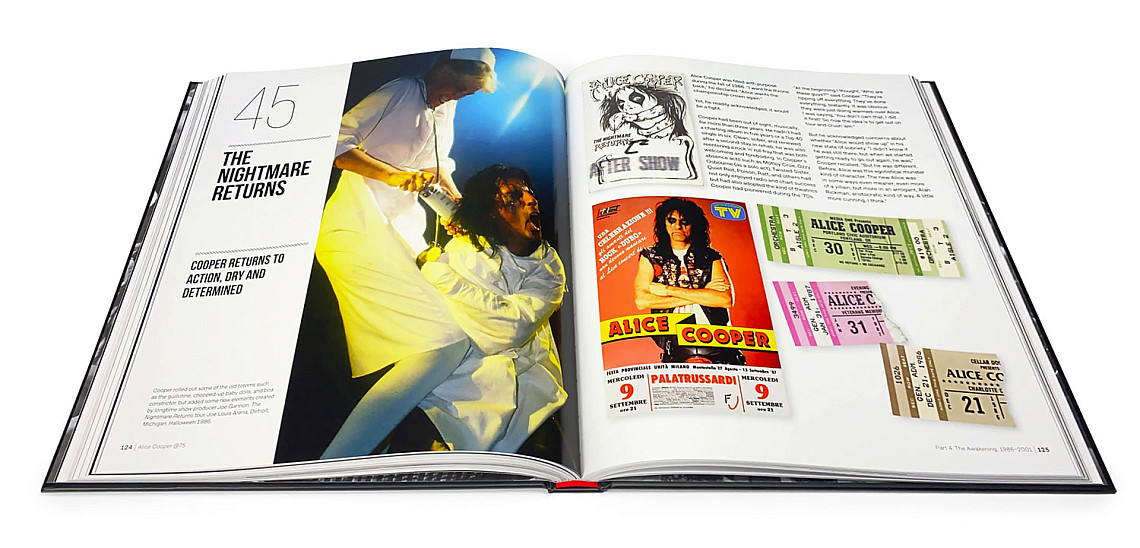
This publisher does wonderful-looking books, and they did ratchet it up a notch for the @75 series. But it's the same issue that's facing the music world now. In a world where people are streaming more and they're not consuming the physical product, you have to create literally a hands-on experience - whether it's books or music - that you can't get from Kindle or you can't get from Spotify or iTunes or anything like that. That's why you're seeing the proliferation of box sets from the music world - these gorgeously produced keepsakes that are really an experience to have in your hands.Same with the books. In the case of the Alice Cooper @75 book, you have a freaking black velvet, black light poster cover. There's a funny story. I was visiting my daughter and granddaughter out of town when my advance copy came in, and I was talking to my partner that night on the phone and it occurred to me it should be coming soon. I said, "Is one of those packages from Motorbooks? Well, open it." There's a pause and I hear, "Ooh," and I can tell she's running her hand over the black velvet cover.
This publisher and many publishers now are trying to create books as experiences - physical experiences - so you'll want to have them in your hands and not just read it on a Kindle.
"No More Mr. Nice Guy"
Michael Bruce, guitarist, is Alice's primary co-songwriter. His Keith Richards, if you will. He came up with a Stonesy riff, Ezrin liked it, and it just developed into a song. It was handed to Alice to put some lyrics on, and Alice decided to write about the experience of being Alice Cooper at that time when he was public enemy number one to the mainstream adult world. Remember, he's hacking up baby dolls, he's hanging himself, he's chopping his head off, he's singing about necrophilia, he's singing about mass murderers, insane people. That didn't go over well with a mainstream audience.He wasn't really punched in the nose by a reverend, but he took a little dramatic license there. That is Alice singing about the experience of being Alice Cooper in 1972-'73, and it's a great song. It was the first record I owned. I bought the 45 and I had to sneak it in the house. I didn't show it to mom and dad.
I would've been 12 when that song came out. You know, Alice Cooper was reviled but also kind of a joke. My brother was a hippie and was really my entré into the music world. He was 11-and-a-half years older than I was, so through him I heard all the good stuff - The Beatles, The Stones, Motown and everything. But he and his generation hated Alice Cooper.
Alice likes to say, "We were the stake in the heart of the love generation." But that was where my generation, kids of my age, could find our identity in music. It was one thing to like your older sibling's band, but what's gonna be mine and mine alone? Alice Cooper comes along and, OK, my parents hate it, my older brother hates it... I'm in!
Alice And The Friars Club
The folks who got Alice besides his fans were these guys in the Friars Club - Jack Benny and Dean Martin and George Burns and Milton Berle and even Frank Sinatra - they understood him. Here they are, these mainstream, straight-laced-ish performers, they understood that what Alice Cooper was doing was the 1970s incarnate of the vaudeville that they came up doing. They knew it was a vaudeville act. They knew where it came from, they understood it.Alice has told me on a number of occasions how George Burns used to say to him, "Me and Gracie were out there in 1923 and there was this guy who had a guillotine and he cut his head off. Yeah, it's great." They made him a member of the Friars Club. They all wore tuxedos, but Alice wore a leather jacket. They loved him and they loved what he did.
It's just so ironic and fascinating that the entertainers my parents loved, loved Alice Cooper, this guy they would never listen to and didn't even like to look at.
Transition From Vincent Furnier To Alice Cooper
He wasn't supposed to be Alice Cooper, that was the band name, but eventually everyone's gonna think the singer's name is Alice. Everybody thinks Ian Anderson is Jethro Tull. Everybody thinks Darius Rucker is named Hootie. That's just what's gonna happen.But I think the first step in Vincent Furnier becoming Alice Cooper was that he became Alice Cooper 24-7. And even if those hours off the stage he was not walking around the world hacking up real babies, he was drinking, heavily, and he was living a lot of rock-star life, and it caught up. It caught up to him by the early '80s and he nearly killed himself. He went through two rehabs and after the second rehab, he got into cocaine. Blame Bernie Taupin, who wrote the From The Inside album with Alice and kind of introduced him to the drug back then.
It really took a lot of things happening: his wife leaving him, Shep Gordon walking away from him essentially saying, "If you're gonna kill yourself, I don't want any part of it." And Alice, to his credit and to the credit of his character, was able to realize all by himself that he was in trouble and didn't want to be that anymore. He took himself home literally to his parents back in Phoenix and got into the rehab that stuck. And what came out of that was learning that Alice Cooper, the character, is alive and well for 80, 90 minutes a day whenever he's playing on stage, and the other 22-and-a-half hours of that day and the 24 hours of every other day, he, Alice Cooper the man, is a significantly different type of person. And I argue that the Alice Cooper that's on stage now is even more ferocious than the Alice Cooper of the '70s. He's unleashed from his cage and ready to go. I think that's why there are more injuries in the Alice Cooper Band now than there were back in the '70s, because the madman is out there and he's slinging his sword around and doing whatever else.
Wayne's World And "Feed My Frankenstein"
You had Alice at the time coming off of one of his greatest career successes, which was Trash and the song "Poison," and he wanted to re-establish the hard rock a little bit more, yet still have some commercial appeal. So you had the song, "Hey Stoopid," which was another kind of a goofy, single-type of song, but much of the rest of the album really was Alice trying to crank up the hard rock again, and "Feed My Frankenstein" came along.It was one of these team-written songs. It was Alice, of course, mostly lyrically, but you had Mark Manning, Ian Richardson, Nick Coler doing the song, and you had Mickey Curry who was Hall and Oates' drummer, Joe Satriani and Steve Vai on guitar, and Nikki Sixx on bass. And those people are all over the album. The album has this great collection of really notable hard-rock players, and they came up with a great groove rock track, but it still had that hook, it still had some commercial tightness to it. It had that '80s-rolling-into-the-early-'90s production where everything was big and upfront, and that was a great selling point.
It was originally done by Zodiac Mindwarp, a British hard-rock band, and its formal title was Zodiac Mindwarp And The Love Reaction - one of the lost bands in rock-and-roll history. I'm not sure if it was an A&R rep who found it, or somebody in Alice's camp who found it, but they changed it around and they made it an Alice Cooper song.
Zodiac Mindwarp was a good band. I remember seeing them with Guns N' Roses when they were on this package with like five or six other bands. Guns N' Roses started as the opening act, and like three weeks into the tour they had to make them the headliner.
"School's Out" Children's Choir
Bob Ezrin, as a record producer, is almost like a movie director. He hears the soundscape. He doesn't just hear the song or the record, he hears an entire experience. He used it with "School's Out" because it fit. It's a song about school, so wouldn't it be fun to have this children's choir do it?Then we hear the thematic similarity in "Another Brick In The Wall (part II)" [produced by Ezrin]. So it worked once, let's do it again. Let's go to the school that's down the street from the studio here in London, and bring these kids into the studio and record.
Interestingly, Alice, in his live performance, he breaks into "Another Brick In The Wall (part II)" in the chorus, "We don't need no education." He inserts that into his own song to hammer the point home.
Pink Floyd came over in 1967 and lived in the same house with the Alice Cooper Band, and Alice talks about sitting at breakfast with Syd Barrett, and Syd thinks his cornflakes are singing and dancing in front of him. Pink Floyd dosed the Alice Cooper Band once before they went on stage, and they played a lot of poker together. There was a really nice history between those two bands.
May 19, 2023
Get Alice Cooper @75 at Amazon
Subscribe to the Songfacts podcast, part of the Pantheon Network
Alice Cooper Songfacts
Alice Cooper: Fact or Fiction
They're Playing My Song: "I'm Eighteen"
Footnotes:
- 1] Zappa signed Alice Cooper to his label, Straight Records, which released their first two albums - Pretties For You in 1969 and Easy Action in 1970. By the time they released their third album - Love It To Death in 1971 - Straight had been sold to Warner Brothers and the band had moved from LA to Detroit. (back)
More Songfacts Podcast