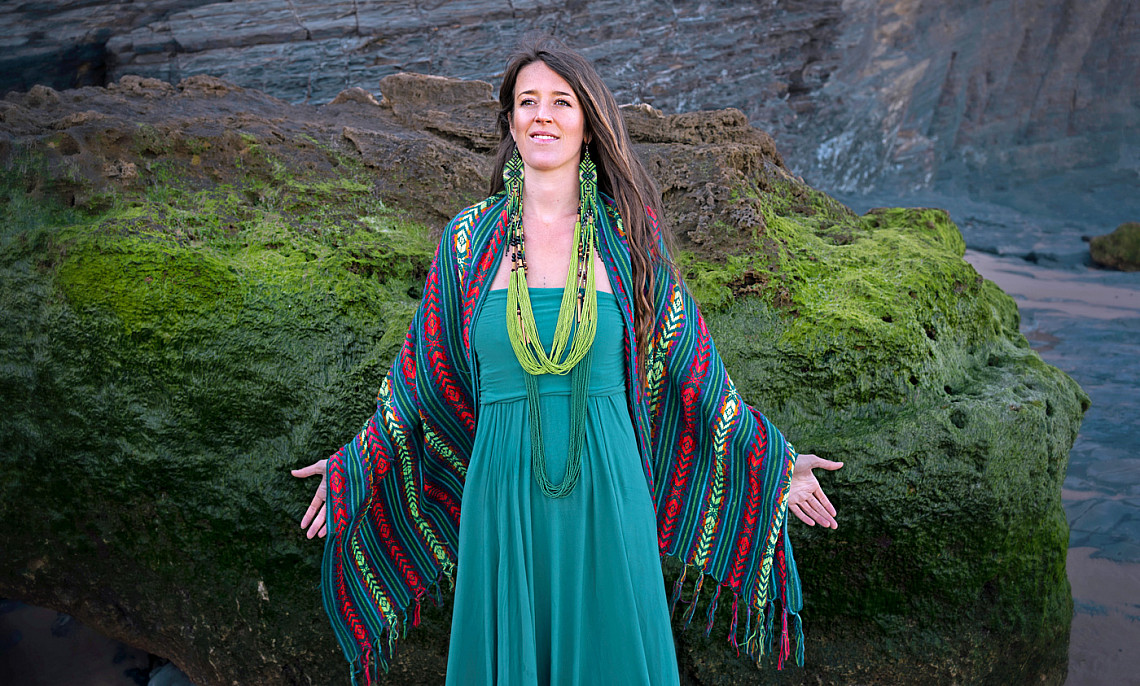
 When Ayla Schafer ran off with a band of horse travelers to South America in her early 20s, the English singer-songwriter had no idea the journey would lead her deep into the spiritual side of music.
Schafer, known for her soothing Spanish-language streamer "Vuela Con El Viento" ("Fly With The Wind"), learned about the healing power of the voice by observing different cultural traditions on her travels. In this episode, she goes in depth about the importance of music and how it affects people on a core level.
As I record this intro, I am camping in the Wyoming highlands and have had a few days to reset, slow down, and clear my head of all the noise that life brings from time to time. I find Ayla's music and story run parallel to this kind of slowed-down mentality. Her beautiful melodies, soft vocal touches and spiritual lyrics remind us that we are all connected to one another and the natural world.
Her Life-Changing Journey To South America
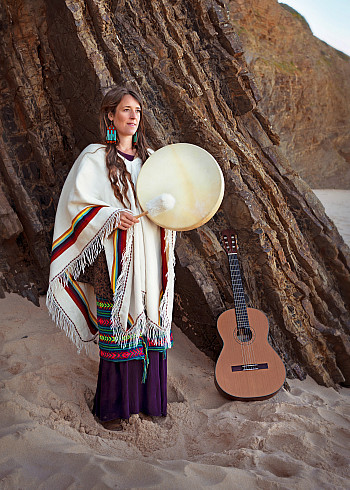 That journey to South America was initiated in my being from a time of intense crisis. These bold decisions sometimes come from having a lot of internal or external pressure that makes something just go like, 'aaaah!' - like either I break or something has to change. So it was many, many things. I still don't fully understand and it would be a lot to talk about, but in that time I actually had kind of given up music. I was just like, I'm not doing this. I was 21 years old and was still really figuring out my way, my life, who I am, all of that. It takes quite a lot of courage and self-assurance to go, "I'm gonna make my life about music." School doesn't really educate us to believe in ourselves in that way. It's like, yeah, you can kind of do that as a hobby - for years, people would say, "So what do you do?" I would say, "I'm a musician." They'd go, "Oh, you mean you're unemployed." I was like, "No." It's just kinda society's assumptions.
 But anyway, I'd been playing music in bars and these kinds of venues where more amateur musicians can actually share their music, and that was the only place I knew how to do it. And it just was heartbreaking, it just was not the space that was appropriate for me to bear my heart and soul in the way that I do with my music. Something in me just went, I'm not here for this. But I didn't know there was anything more than the kind of conventional arena of music, which is like people drinking and half listening to music. Maybe not entirely conventional, but at the level that I was, that was what was possible for me.
So I knew I had to give that up and I didn't know what else I was making space for. I just knew I had to do something really radical, and I heard about a group of people traveling on horseback across Mexico, like a kind of traveling circus. They traveled on horses and they lived with their horses and it was like the wildest thing I could have possibly done. I was like, "I'm gonna do that. That!" I'd say I ran away with the gypsies in some ways - I just went, packed my suitcase, and said to my mom I'll be back in six months, don't worry. And I ended up being away for two years and had this amazing time traveling with the horses, which was really something just phenomenal. I felt like I became like a wild animal or something. We lived, we slept on the ground in tents with the horses and we cooked on the fires and we washed in the rivers and then we rode in the daytime. And it was so beautiful. Horses are amazing, amazing beings.
The people [in the group] change. The horses sometimes change. They've been going for like 18 years from South America up to Mexico. So I traveled to Mexico. Now they're traveling south again. I was with them for maybe 10 months or something altogether spread over a year and a half. But traveling through Mexico, up in the mountains, through the villages in places where they've never seen like white people like us... they don't speak Spanish up there. People were living so simple, just going along the donkey trails.
But during that time in Mexico, the journey really expanded. I then was meeting the native traditions of Mexico there, and also a lot of the traditions like coming down from North America, the native Americans, the rituals, the ceremonies. I discovered yoga. I started meditating. It was just like expansion upon expansion upon expansion. Then I went to Peru and worked with plant medicines and it rocked my world - changed everything. Really, everything changed.
On a musical level, even though it wasn't my intention consciously to transform my relationship with music, of course, it's my path - it's like the language that I speak. It's the way that I work somehow is in music. So it naturally happened that that became a big part of the journey being part of these lovely ceremonies. The songs were just the central part of the way people were gathering, but a different way of music than I'd ever experienced. And they're just very honest, very naked singing songs.
How She Discovered The Spiritual Side Of Music
I didn't know I was looking for that. I didn't know what existed. I didn't know that "it," whatever "it" exactly is, existed. I just knew that I needed to leave behind everything that I knew. I needed to enter really into the unknowing. I remember people saying, what do you want to eat? And I'd be like, I don't know. I just kind of undid everything - I was undoing my being, all these things of learning all these boxes.And also on a musical level, I was doing that with having no idea I was doing that. So I was expanding, just making space. Now looking back in the perspective - of course I was seeking that pain that I felt when I would sing in a bar to people not listening to me. That pain was actually something guiding me saying like, no, keep, keep searching, there's something more, Ayla, there's something deeper. There's something wider than this. I'm a Sagittarius, and it's like the classic horse firing the arrows to the sky - like I'm always seeking something and won't stop and won't rest and will keep going and keep going.
Learning To Speak Spanish On Her Travels
The majority of the time with the horse caravan I was with multinational groups of people. There were people from all around the world - and many of the places they were speaking English. And I was like, "I'm never gonna learn Spanish unless I try." So I would learn with the children and the mommies in the markets. And I was drawn to the language - I like its rhythm, its energy. You can say things in Spanish that just wouldn't sound right in English. Like if I translate some of my songs from Spanish into English, they're like, oh my God, I wouldn't be able to sing it. They have something, they have a feeling. Each language has its own feeling. That's what I was drawn to.The Story Behind "Vuela Con El Viento" ("Fly With The Wind")
I like the human part - for me, my music is very connected to my human. It's me, it's my spirit speaking. But this song - it just came so pure and so easily. I was so relaxed. I was in such an empty, clear, soft, tender space about to go to sleep. It's a bit like playing a lullaby. And I started writing, I think I got it about half-written, and I was like, oh, I'm tired now. Like, I didn't think anything. But I do remember I laid back down and then it was like, no, turn the light back on. Then the rest of the song came.
But the build-up to the song - because there's a whole process in what I'm learning, what I'm healing, my thoughts, what's moving in me, what I'm understanding, what I'm letting go of, like what's moving in my being. And there can be processes that happen for weeks until something crystallizes or it's a bit like a flower, preparing to bloom. There's a whole process before with how much growing has to happen before it's ready.
So that song, it was really just a very deep time for me, with myself and deep prayers of letting go of that which is not serving me and just coming deeper into myself. But really acknowledging my vulnerability and my softness, and at the same time, acknowledging myself as part of something bigger, which is why there's this line in there (speaks in Spanish) - which in English doesn't sound as good, but it's like Mother Earth. "I love giving thanks for my life, Mother Earth. I love you." And just this very simple from the pain, from the learning, from the growing, from the shedding, this essence that we can come to of just like, I'm just here on this earth and I'm grateful. It's very pure.
The Secret Of Success
I honestly can't say how or why ["Vuela Con El Viento"] has flown around the world like it has. Sometimes I go, do you know what the secret is? Just name a song, fly with the wind, you know. Then it flies with the wind, like something magical. I think this song more than any of my songs feels like its own force somehow. Like music has a power, has a force.Some of my teachers refer to music or to sound like it's a spiritual force in itself. And this song kind of teaches me that, 'cause I go like, wow, it's this song doing it, it's not me spreading this song. This song is flying and touching people, moving people very deeply. I guess it's that simple ...staying simple. It's a very simple, pure deep space from where it came from, and my sense is that it touches people in that place.
And we, as a global society, all see it as more and more of a hunger for that feeling for something that feels like it means something - to be touched. More and more people listening, wanting to listen to music that actually really means something and really listen, and to really be moved and receive this spiritual force. This gift that music is - this amazing medicine that music "is" can be.
The Healing Power Of Sound And Music
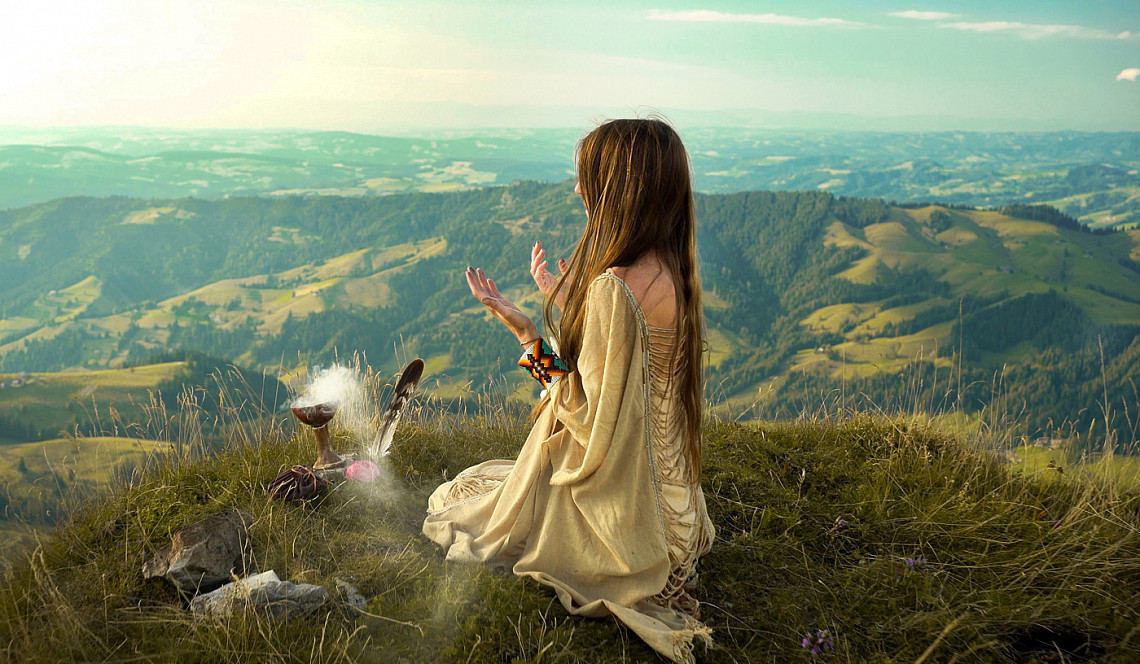
It's such a rich, vast world. Each nation has its different ways. The traditions I've spent the most time or that I feel the most inspired by in my life are the cultures of North America and the different natives of American nations. And then the tribes from the Brazilian Amazon - a few of the different tribes there - they're obviously totally extremely different from one another, and how music is part of their culture also has its similarities.I think in all native traditions, we can find almost like these threads that they're all woven together in an essence. There's an essence to them where they're connected and with music, with songs, sound, rhythm - I so far have not come across a native culture that doesn't have sound in some form at the center of its culture and at the center of its traditions and its rituals. I'm so in love with native cultures and how wildly different they can be. Like the Mongolian shamans, who play this drum, and they cover their face and they just spin and they spin and they drum, drum, drum, drum, drum, drum drum and like, that's one of their main tools of entering another state of consciousness, and from there they work in the spiritual realm.
And then you have Yaminawa, and they're one of the people who speak about music as a spiritual force. In their ceremonies, they often will sing with everyone together really loud, like you can't believe it. At the beginning, I was like, ow, it's kind of hurting my ears, because I just was so not used to it, but then I began to realize, wow, the sound of a nation is also like the landscape from where they come. You begin to see the similarities between the sounds and the natures of the Yaminawas - they live in the Amazon jungle, which is super loud. Everything is loud and big and dangerous, and it's this amazing energy.
But they're also a good example of the different ways of working with music. So, in their healing, they have ceremonies that are more focused on a specific healing for a person. And in those ceremonies, nobody else can sing other than the Paje, who is what you could call the Shaman - but they don't use that word. The Paje is the one who is holding the spiritual world, and he will sing. And the sound is so different, and my experience of being there is - to listen to that as a spiritual force and what it's doing, you literally can feel it moving and working. There's a whole science to it. It's vibration. It literally moves the cells. It vibrates the cells.
Then there's how they work with the spirits, what they are invoking, what words they're calling, and often it's beyond the words. It's the language of the spirit. They bring forces with the voice. And for me, this is so fascinating. Why do we sing as human beings? Why aren't we just all talking? We can do loads of talking. There's something else that happens when they use the voice in that particular way - kind of singing or chanting. It's a different voice and it works differently. And there's many cultures like the Chabebi cultures from the Amazon, and they're amazing how they talk about how the whole of existence is sound basically.
So when we use sound, we are entering a conversation. We are working with that which the universe is made of, and that's why it can be so powerful for healing, for moving things in the body, for praying. It's a tool. It's a spiritual tool in the traditions of North America. It's like they sing as a tool. They sing to invoke, to communicate, to pray, to let go. And it's very, very specific. And the songs are ancient. They have a resonance, they are passed down, these old, old songs.
They're used very carefully. It's something that's taken very seriously, particularly in that tradition. I think in all traditions, it's not something to mess around with. It's not something to sing a song like, oh yeah, I had that song and I can just sing it. It's very, very serious because the way that they believe in it is so powerful that it's not something to use lightly. It's to deeply respect these sounds that we make, especially when we learn so much tradition, especially when we're conscious. Because it's a lot about the intention that is connected - the intention we make, the intention that's within us and what comes out of us, and the effect that that has.
A Conversation With Water Inspired "Fluyendo"
I often think about water as a theme. There are so many incredible metaphors within the many forms of water - in the way that water is, the way that water moves. But in this song, it's more than a metaphor. I really entered the space where I was like, this water is a living being, a living entity, it is a spirit, it is a teacher, it has teachings for me. So I went into this conversation, like, teach me, and this longing in my own being to be more like water - to be pure and transparent and clear, learn to let go, learn to just trust in the direction and the flow. And I don't just mean this casual, go-with-the-flow kind of thing. Like yeah, go-with-the-flow is good, but what is that? That actually is something very profound - to go with the flow. We use it so lightly as a phrase. It's easy to go with the flow when everything's just nice. But when it's like, ouch, and things are really, really challenging, like, can I let go and just surrender? Water is an amazing teacher of trust for me - of trust, surrender and letting go. So that's the song really - it's my conversation.
Remixing "Fluyendo"
I got put in touch with Steffen Ki, who made this remix, by my label manager, Nils. Nils is an amazing guy, and he's very good at connecting and sensing when there's a potential spark between people. Because it's very, very personal. I've had many people along the way ask to do a remix of my music and I'm just basically all the time being like, no, 'cause it's like handing over my child. It's not like my child, but I do regard my songs in some ways like my babies. They're so deeply personal. It means so much to me because it's my inner world. It's not just like, yeah, do what you want with it. So I've been very like, no. And I've also heard people make really bad, big messes out of songs. People have made remixes without asking sometimes. And I'm like, ouch, like it hurts physically.So Nils connected me with this man Steffen and it's very beautiful to hear him speak about his process with the song, like how much care he took. He really took what I handed him and was like, okay, I need to take care of this like a beautiful little baby bird or something like that. And he took his time. He took about a year because he said he just went so deep into the song. He put so much love into it. It's one of the remixes that I've been the most touched by because I really felt his dedication to the song. It comes back to the same thing, like to the song itself, like this kind of entity, this being, this force, and how delicate it is to start interfering. When something's complete, what do you add? What do you do? How do you shape this so that it can actually be a kind of expansion, like lifting the wings up to the sky? I almost like it more than the original. It just opens up with the beats and the rhythms.
Ayla's Song Of The Soul Workshops
So I have two rivers of work there in terms of the workshops and retreats. The first that I started working with was what I call 'The song of the soul' workshops. I always find it very hard to put it into a few words because it's covering so much because that's what I see the voice does. It's the whole depth of our human being when we start working with the voice.But essentially it's holding space for people to be going really deeply into themselves and discovering their voice from within the depths, within the truth, within all that we are as human beings, and finding a way that that can move through, whether it be the emotions or whether it be using our voice more like the ways we've been speaking about that the indigenous people use as a connection to their prayer or invocations. Using this gift that we've been given - our human voice, and this tool, and inspiring people to really bring it into their lives.
I don't think I'd be alive if I didn't sing. It's my guiding force and l really believe it's our birthright to sing. There's no such thing as they're a singer and they're not a singer. So it's kind of like dissolving these non-truths around the voice and undoing all the things we've learned around our expression, and around being safe to be who we are and speaking our truth. Singing the song of our soul in all its colors.
The most common [challenge] is people having some kind of block or deep insecurity. This stuff can go really deep because why do we have such a thing around our voice? What is it connected to deep in our being way, way back from our life? It's a very profound journey to start to surrender to this space. I always say, if you're coming to me to learn how to sing, I'm not the right person, because I'm not teaching anybody to sing. It's more like going on the process that means that we can just drop deeper into our being. It's like the medicine of water - through the trust and surrender, this has been my process. I had one singing lesson and I hated it so much, it was so boring and so technical, I was just like, this is not for me. My process has been learning from this and learning by listening and going inward and letting go. The opposite of trying, just surrendering. The voice becomes! Beautiful. So beautiful.
The Connection Between The Voice And Feminine Energy
The other work that I have more recently started to do is working with women and also working with the voice. So, connecting to the womb space, to the pelvis, and the essence of being woman - of the feminine also - which is beyond being a woman. It's not just about femininity. It's really the energy of 'the feminine' and then the connection with the voice. There's some amazing science around how we are physiologically connected - men also, actually. I just can't facilitate that work. It's not my realm, but the same work that I'm doing actually totally can apply with men.We start in the uterus - there's a whole thing that they can show how we grow in the uterus - that there are two indentations, like one cell has two indentations, and it begins to split - and then the spine grows in between. Then the two indentations form the bowl of the jaw and the bowl of the pelvis and they remain connected. And it's amazing - connected by the vagus nerve, and there's a whole science behind it. Energetically, spiritually. So it's a voice work, but it's very, very deep work. As women - men also - we have a huge amount of deep healing to do with our collective, with our personal stories, and the voice, using the voice as a tool, as a guide, and to support us in going into this physical area of our body, but also the memories and the emotions and connecting beyond to the greater feminine force in the earth. It's a very strong work.
July 14, 2022
Find more information about Ayla Schafer's music and workshops on her website
Subscribe to the Songfacts podcast, part of the Pantheon Network
Photos: Iris Hollow
More Songfacts Podcast