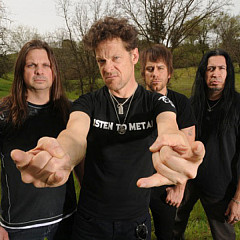
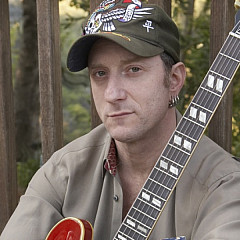
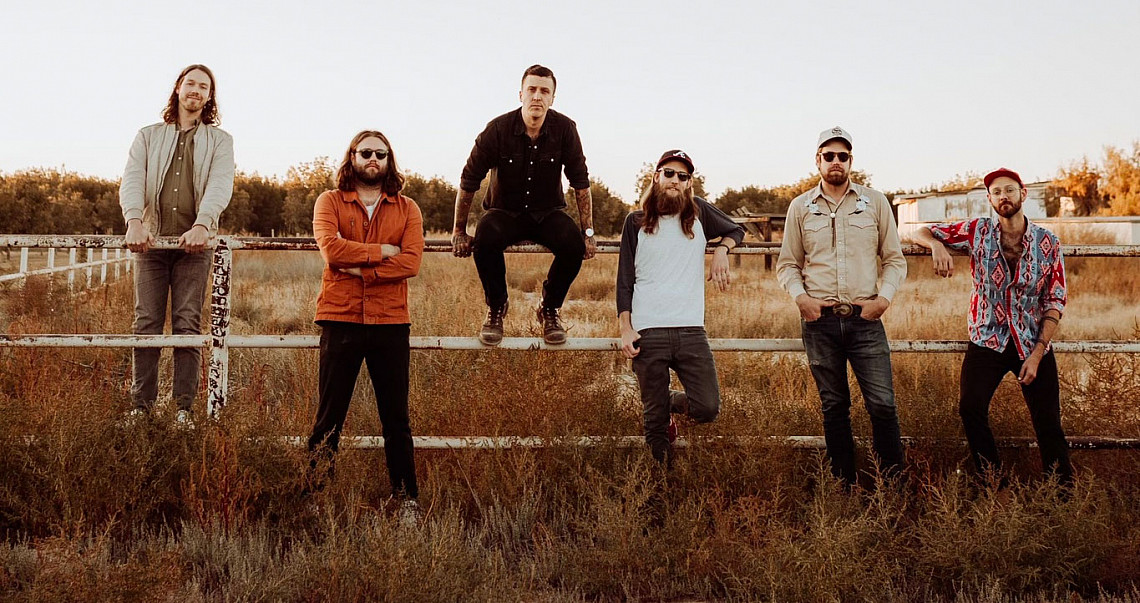
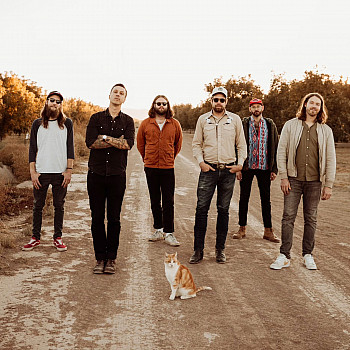
 Ten years ago BJ Barham and his band American Aquarium were about to call it quits. They'd been touring nationally at small clubs and had seemingly plateaued in their growth as a band. They'd written some new tunes and decided to hop into a studio with Jason Isbell to record what they thought would be their swan song album, Burn. Flicker. Die. It was not.
As BJ describes in this Songfacts Podcast episode, things changed after that album. When I press him on what he thinks happened, he points to writing songs for himself rather than trying to create something he thought listeners might want. Ten years later, American Aquarium is going strong and about to release their latest album, Chicamacomico, and start a massive summer tour with a headlining slot at Nashville's Ryman Auditorium.
Writing "Wildfire"
I've had a few of these situations throughout my life, and that's the cool thing about a songwriter is everybody thinks that just because it's a new song, it's a current emotion. The cool thing about songwriters is we get to compartmentalize a lot of this stuff, and we get to go through these experiences, kind of wrap it up in a bow, put it on a shelf, and come back when we need it. I take that back...it's not come back when we need it, it's come back when we're ready to deal with it. I've had a few of these situations where you're in this thing and it's very short-lived, but it's extremely passionate while it's that thing. And both of you know, this can't last - it's too volatile. The reason it works now is the reason it can't work long term.And so, this record is about loss in so many different capacities. That song came about because I wanted to write a relationship song. This record is extremely personal - this song, this record, is about a lot of the stuff that I went through and I kind of wanted to have a couple of songs on this record that were universal. I think anybody that has lived a pretty full life, this song resonates with them. Everybody's had the classic 'one that got away' kind of thing. The one that, 20 years later, you're still thinking about every now and then, or you're still checking up on their Facebook to see how they're doing. You know why it didn't work for you, but still 20 years later you question like, man, why didn't that work? And I've always loved the imagery... I've had the idea written down for quite a while - just the idea of being consumed by this thing, this really big thing.
We've got a really cool claymation music video coming out in a couple of weeks for it that visually explains where I was going with the music. It kind of encapsulates what I was feeling when I wrote this record: You walk into the scenario thinking it's one thing and then all of a sudden you leave and you're just engulfed in it. And you're like, oh, this was not supposed to be this complex or this dangerous, or this time-consuming.
Good Fire Versus Bad Fire
A lot of the time fire is looked at as this destructive device, and this is a song where I wanted to use fire as a cleansing device, and not a destructive thing. It's a cleansing fire, it's not a devastating fire. No one's losing life here. Nobody's losing the farm here. I'm not going to say a good fire, but I'm going to say a good fire.The chorus was the first thing I wrote, and then I wrote the first line and I realized like, okay, I love the imagery of painting this character as this hardened dude...comparing him to a tree. This old tree that is set in his ways, that is not moving, that does not or is not going to be a recipient to new ideas and has come to terms with just being the old single tree in the middle of the woods. And then having this one thing come along that changes his mind and he's willing to completely give it all up for. That's a powerful image for me. So it was really easy once I had what the story was.
The Gift Of Songwriting
We all have our gifts. We all have that thing we're supposed to do while we're here on this earth. And I've been lucky to have the power of putting things into words. There's a lot of things I can't do that most people, I think, should know how to do. It's 'the jar can only hold so much water' kind of scenario where I've got what I've got and I don't know if I'm going to learn a lot of new tasks, but I'm very happy with the fact that I can take these really big life situations and shrink them down into these two-and-a-half minute, digestible things. Like taking big emotions and making them three verses and a chorus - I think that's important. That's an important job to have, and I don't take that job lightly.The Craft Of Songwriting
I always equate it to a craft, and nobody starts a craft being amazing at it unless you're John Prine. Nobody comes out with debut records that are perfect, unless you're John Prine. But it's like cabinet makers - that's always my analogy. I've been doing this for 16 years, so I would love to meet a cabinet maker who's been building cabinets for 16 years - he won't show me his first set of cabinets. He won't show me his second set of cabinets, but guess what? You can buy my first set of cabinets on iTunes, and it's still out there in the rawest form, like all of the dinks and the dings and the cheesy cliches. I'll look back at that kind of stuff as a kid trying to find a voice, that's all. And you're throwing as much of your influence at the wall as you can, and seeing what sticks and occasionally you float two of your influences together and they smash together and it comes off almost as an original idea. And you're like, oh, that's what my voice is turning into - it's like a mixture between this and this. That's the part that keeps me in it, the growth of songwriting.Sixteen years into this game, I'm not at the point where I want to be, but I'm at a point where I'm really proud of myself as a songwriter. I've got a very, very good, bird's-eye view - I'm really good at removing myself from the current situation and looking down on it. And I realized like, okay, you've got a voice, you've already established what your voice is - how do you push that in a different direction? That's the part a lot of people don't do. Like once you find your voice, once you find something that resonates with a large group of people, there's a lot of artists that will never deter from that. They're like, this is successful, I'm going to keep doing this. I'm gonna make the same record for 10 years. It's important that once you find your voice, then you try to push that voice into as many different corners as you can to see if it can go there, to see if it can be a folk voice, if it can be a country voice, if it can be a rock voice, if it can be something that you can't put into a shoe box. That's where I'm at in my career - I found my voice about 10 years ago, like how I write, what I write, where my strengths are, where my weaknesses are, and now it's just about trying to see how adaptive that voice is.
Pronouncing Chicamacomico
It's a doozy because it's a lot of vowels and I think a lot of vowels throw people off sometimes. But if you just go through it, phonetically. It's funny, a lot of our fans have been posting what Google calls it. If you're like, "Hey Alexa, play Chicamacomico" and she'll be like, "Playing chick-a-mac-ameco," and technically, phonetically, it's right. And I'm like.... (BJ shouts to Alexa: oh, Alexa, stop!...Alexa was trying to play just now, I guess she heard me talking. She's trying, she's doing the trick now) But yeah, some people call it 'chica-macco-meeco.' I put out a bunch of pronunciation videos over the last six months since we announced the title, but just Chicamacomico.Headlining At The Ryman Auditorium In Nashville
When you start off, you think it's kind of an unattainable goal - like everybody wants to play the Ryman. It's the mother church. Every artist that has ever mattered has played there or headlined there. So, to finally be at a point in our career where it's an achievable goal, it feels really great. Anytime you put in a lot of work, it's always nice to get those pats on the back. And this is definitely a pat on the back saying, good job kid. And I tell the band, if we don't ever get asked to play it again, we got to play it once. I was like, soak it up, boys. I don't know if we're going to be doing like any Jason Isbell eight-night stands or anything at the Ryman, but soak this one up, because I'd say less than 1% of people that ever pick up a guitar gets to headline the Ryman.Early on when I was young, I was full of like, I want this, I want that. I think I'm now at a point in my life where I appreciate this and I appreciate that and I appreciate this opportunity. I'm at a point now where I'm really soaking in any step forward, any movement up that mountain we get, I'm thankful for. Instead of wishing what the next step is, I'm trying to focus more on enjoying the current step.
We live in a kind of crazy social environment where we're constantly bombarded with other people doing other things that we want to do, or taking those steps before we are ready to take those steps. On a daily basis, we log into devices that make us feel less than. By choice, like we actively go online to be told that we haven't done this yet...and we're not playing this festival, and we're not this high on the Billboard charts... and it's this constant comparative. It's always good to take a step back and appreciate what you have. It's like our band has been together for 16 years, we have 16 records, we're in a tour bus, and we're playing some of the nicest venues in the country. We have fans, people show up and sing our songs. We're not selling out the 'enormo-dome' in town, but we're doing okay for ourselves. And I think a lot of people need to take that step back and realize that their current spot is good enough. No matter what Instagram tells you, it is good enough.
The Importance Of Working With A Variety Of Producers
Everybody has a different approach to how they make records, and I have been very grateful. Again, it goes back to gratitude - I've been extremely fortunate in my 16-year journey to have amassed a group of friends that are wildly talented. We never make records with people we don't know. So, Jason's a friend, Shooter's (Jennings) a friend, John Fullbright's a friend. Brad Cook - he produced Chicamacomico - I've done three records with Brad, and Brad's worked with Bon Iver, Waxahatchee, Nathaniel Rateliff. He's done the big records and his approach is far different than Jason's approach. And Jason's approach is way different than Shooter's approach.But I think the fun thing about what we do is trying to push ourselves. If I wanted to make the same record every time I would have the same band and the same producer, the same studio, and it would be boring for me. But I've never made a record in the same studio twice. We always go to a different studio. We've never made consecutive records with the same producer. We're always trying to mix that up because it brings a different chemistry to the table. It's bound to, and the record we made with Jason, if we'd tried to make that record with Shooter, yes, the lyrics would have been the same, but the songs and the sounds you would get at the very end product are two totally different things. It's kinda like if I sent my wife grocery shopping or I went grocery shopping, yes, we'd get a lot of the same stuff, but it would be very different same stuff. And that's kind of the analogy - it's like, at the end of the day, you're walking out with a buggy of sustenance, but what is in that buggy of sustenance?
Burn.Flicker.Die. Rekindled Their Career
This was supposed to be our last record. This was the swan song. We called it quits about six months before we made this record. At this point, we'd been touring for six years and were making zero headway in music. We kind of had that talk amongst ourselves, like, hey, maybe we're not good enough, maybe we're not supposed to be doing this. We were playing 300 shows a year, so it was like, we tried our best, we could hold our heads high and walk away because we tried and we weren't good enough, like, that's fine.We were touring nationally and playing every mini venue between North Carolina and California. In Denver, our spot would have been Moe's - a little barbecue bowling alley down in Englewood. It was like a little 75-person barbecue joint that had a bowling alley built into it. And we played shows there like every three or four months. And we were constantly on this giant circle around the country, trying to find our place, trying to find a market that would embrace us. And we did, we found a few of them. But we also found a lot of places that we couldn't get any kind of foothold in. After six years we realized it wasn't coming to us, so we decided to not make a record anymore.
At that time, we were on tour with Jason, and he was like, what are you doing with these songs? And I was like, ah, we're not doing anything with them, we're just going to call it quits. And he was like, you're going to regret it if you don't record these songs. So we were very lucky, he invited us down to Muscle Shoals, Alabama. We were down there for eight days, and we cut this record in a little less than a week and a half, and he did it for a very, very small amount of money. Like one day I'll write a book and I'll tell how much he charged us to make the record. I'll always have him to thank for my current career because he got us over that giant bump.
We never got any press before, and when Burn.Flicker.Die came out, it was like Rolling Stone and American Songwriter and all of these kinds of magazines that we appreciated were talking about how great of a record it was. So the first show we booked after we made the record, it was sold out in a place that we never pulled more than like 10 people. And all of a sudden we were like, oh, that's weird. And then the next show was sold out and we're like, oh, I think things are changing. Then from there on, it's been this weird, exponential, uphill growth. After about two weeks after the record came out and we'd played 10 or 11 sold-out shows, we were like, maybe we shouldn't quit. Maybe we're past that hump that most bands quit at, and if they had just went over it a little bit, or if they'd have just held on a little longer, we're that story...
What Made Burn.Flicker.Die. Special?
Well, it was the desperation. It was the honesty. That whole record is about a band who's failing. It's a 'what not to do to find success in the music business manual.' These are the mistakes we made on the road. It was almost like if anybody ever asked whatever happened to American Aquarium, we wanted to leave them a handbook of why there's no band anymore. This is why we quit. This record is why we quit. But I think that honesty resonated with people.I was so open and I always argued that's where I truly found my voice was on that record. Not just my singing voice, but my actual writing voice was all in that record because I showed a side of me that was vulnerable. Like most of the records before that were very much like machismo. We were a band on the road and we were rock and roll - chasing girls and doing drugs and drinking and having fun. And this was a record just admitting fault. This was a record being like, maybe a lot of the bad things that have happened in my life are my own fault and instead of pointing my finger in an ex-girlfriend's direction or my parents' direction or a friend's direction. Maybe I should start looking in the mirror and admitting that I'm the root of a lot of my problems.
I think that kind of honesty is what resonated with people and brought more people to the table and be like, that guy gets it, that guy's being open. That guy's being honest. That was the first record where I was truly transparent with people about who I was for better or for worse.
We always joke that the record about us being failures was the record that made us successful. I wrote a record about failing in the music business and why I was quitting it, and that's why the record is called Burn.Flicker.Die. It's about trying so hard for a short amount of time. It's kind of like "Wildfire" - it's the same kind of premise. It's going as hard as you can until you just can't go that hard anymore. And then, this is why after six years of playing 300 plus shows a year, your favorite band is not playing anymore.
Writing "The Luckier You Get"
It's definitely autobiographical. That was a thing my dad used to always say. He had this saying that was "Work hard. Get lucky." It literally is tattooed across my chest. It's like the mantra of what my dad taught me as a kid. I played sports growing up and every time I'd lose to a kid, I'm like, oh, lucky shot or lucky hit. And my dad had to explain to me that that kid just outworked you when nobody was looking. That's all it was - that kid didn't get lucky. My dad very early on, for better or for worse, taught me that luck is just the intersection of hard work and opportunity - that's all luck is. Luck is the name we give it to blame it.I wrote that song after a publication called us an overnight success. They were like, this band came out of nowhere and I was like, we had 14 records. And it's funny because a lot of people find us and they've never heard of our band. We're not on a major label, we're an independent band - I own the record label that we're on. We don't have a radio single, we're not on MTV. We don't have a viral video. So when people find us, we're a new band to them. Until they check Spotify and click discography, and they're like, holy shit, like this band has 16 records in 16 years.
We're not a new band. So I wrote that almost tongue in cheek, like who the fuck are they calling a new band? Like, why would they call us an overnight success? So it was about people on the outside, looking at us, being like, man, that band got lucky and got to tour with this guy, or that band got lucky and gets to play the Ryman.
And it's like, no, we worked really, really hard and you're seeing it as luck, but we know that the harder you work, the luckier you get. The whole story is me - it's me growing up in a really small rural town and my dad telling me, like, we can't afford to pay for college, so there's a few ways for you to get out of here. It's study hard and get good grades or join the military. That's how you're leaving our town.
Hometown Hatred Fuels Their Biggest Hit
Well, there's a reason "The Luckier You Get" is our most-streamed song on Spotify. We don't have a song bigger than that on Spotify, I think it's been streamed like 10 or 11 million times. It's the biggest song we have, and it's because everybody's been in that situation. Because everybody hates their hometown. I don't care if you're from Brooklyn or if you're from Reidsville, North Carolina, like I am - nobody loves where they're from. Like until later in life.I truly appreciate where I'm from now. I'm pushing 40. I'm a father. I appreciate where I'm from. I see the positives. I can finally hover above that situation and see the positive of where I was from. But from birth to 18, all I could see was the negative - all I could see was a small podunk town, backwards-thinking, holding me back. Everything was about getting out of this town. And now at 40, I find myself going back like every other week to visit my dad and eat at my favorite spot from when I was a kid. And I find these powerful images from when I was a kid that weren't bad. And so I'm not the only kid that experiences that.
That's why this song at its root is about working your ass off to get out of a situation that you're in, or working your way out of bad situations. I think that resonates because that's… another word for that is the American dream. We call that the American dream. There's a reason that kind of ethos resonates with a large chunk of our society, it's because it's what we have to live every day. It's how we all got to where we are is we weren't happy with the current situation, we made the proper changes, worked extremely hard, and got to where we are.
I don't think the song is candy coating it. It's extremely hard work. I think there's a lot in that song about that, like I wrote a couple of hundred bad songs till I had two or three that weren't bad. It's like I had to fail a lot before I even tasted what success was. So don't think that just because you work really hard, it's going to immediately come to you. It takes time - like we talked about that plateau, it can take six years of working really, really hard before any kind of positivity comes. But I'm a true believer that there's no way you can wake up every day and work as hard as humanly possible to get something and then eventually not get it.
Reflecting On The Band's Achievements
It's rewarding. I'd be lying if I said it didn't feel good. It's a self pat on the back. I realize there's still many miles to go to get to where I'm going to go, but taking a moment, pausing, pulling over on the side of the road and realizing like, holy shit, like I said I was going to do something when I was drunk and 20, and I got there. I haven't worked a straight job since 2007. I've been a professional musician for 15 years now where the only income is from music or some derivative of music. That's a really cool feeling as someone who's 38 years old and quickly approaching the point where half my life I'll be playing music.It's a neat feeling to look up and realize that like, yes, I've burned a lot of bridges and threw away a lot of really great relationships and friendships, but it was worth it at the end of the day to get to the point where I'm at now, which is sober, I'm a father, I'm a husband, I'm happy. I can't say I was happy in my twenties. I was driven in my twenties, but I wasn't happy. So to be just as driven as I was in my twenties, still wanting to work as hard as humanly possible and be happy - that's a dangerous combination. That's a dangerous combination because there's a lot of people who are hungry that are unhappy, and there's a lot of people who are happy that aren't hungry anymore, and I always tell the boys, I'm like, as long as we can stay happy and hungry, we've still got some work to do. And there's still a possibility for us to get that work done.
And the Ryman is ...we always call these kinds of things feathers in caps. At the end of the day, it's another show, it's one more show on a list of 70, 75 shows. But it's a feather in the cap. It's one that we're going to take and we're going to put up there and when people ask to see the feathers in our cap, one of them will be bullet point - headlining at the Ryman Auditorium. One of them will be we played Late Night, one of them will be we debuted the Billboard Top 200. They're all feathers in caps. They're meaningless until you need to show off your cap feathers, but it's neat because we're at a point in our career where the feathers are starting to pile up and every now and then when you take your hat off and you look at them, you're like, holy...like that's neat. That's 16 years worth of work deduced to just the greatest hits.
This is the cool stuff that we've done, and anytime I need reminders, I look around and in my office there's my Grand Ole Opry debut parking spot thing. And my hometown gave me the key to the city. And my alma mater had me as a distinguished alumni to speak to students. Little things like that. The feathers in the cap, I kind of keep myself surrounded by them. I'm looking around and seeing some of the coolest things I've done in my life, all on my walls and on my shelf, and it's a daily reminder, I guess, maybe it's subconscious, but looking up and saying, you know what, you did that, you did that, you did that... I'm just realizing that I'm kind of surrounded by my life's work.
June 14, 2022
Subscribe to the Songfacts podcast, part of the Pantheon Network
Photos: Joel Piper (1,2), Andrew Huse (3)
For touring and album info visit americanaquarium.com
More Songfacts Podcast