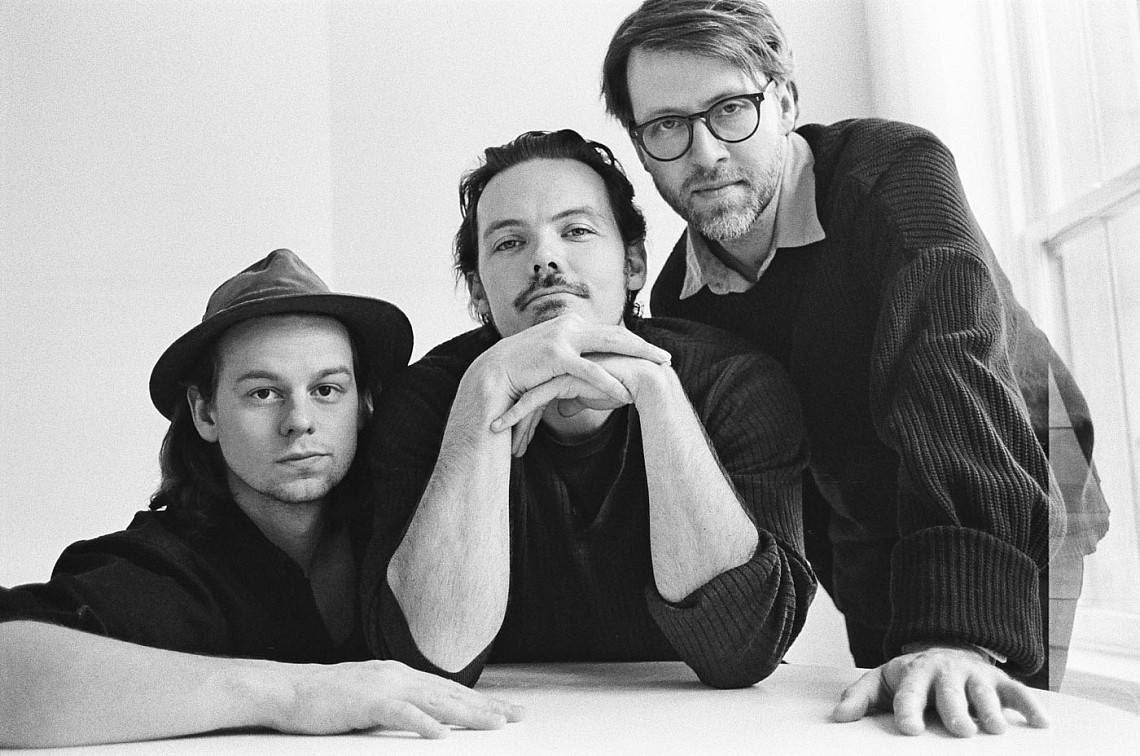
 Half Moon Run (L-R): Conner Molander, Devon Portielje, Dylan Phillips
Maybe you are getting tired of me saying this, but I am so excited to bring you this episode and this amazing new music from the Montreal band Half Moon Run. Our guest is Devon Portielje, one of the three band members, all of whom sing and play multiple instruments.
Half Moon Run came together back in 2009 when Portielje answered a Craigslist ad from a group seeking a bassist and drummer. Portielje played neither, but reached out anyway and met his new bandmates, Conner Molander and Dylan Phillips. The indie-rock trio - who became a foursome when Isaac Symonds joined the lineup - released their debut album, Dark Eyes, to acclaim in 2012 and followed up with Sun Leads Me On (2015) and A Blemish In The Great Light (2019). Symonds left the group in 2020, but the founding trio forged ahead.
Their new album, Salt, caught my ear and engaged me front to back, so I really enjoyed speaking with Portielje to find out how some of these tracks came together. Whether it's strumming a ukulele on the beaches of Thailand or scraping old audio files looking for hidden gems, these stories don't disappoint.
How The Band Has Matured Over The Years
It's funny because we brought a lot of songs from that initial era forward and finally realized them - like, "Alco" and "Salt," even - songs that we couldn't finish back then. Maybe we have more of a craftsman approach where we're able to sit down with something and maybe the initial spark is lost, but you sort through it and chisel away at it and you find something beautiful in it again that's new, and then you're finally able to finish it. So that's one thing. I mean, I like to think we're better at our instruments than we were back then.Resurrecting "Alco" From The Song Graveyard
At some point in 2013 the band was in Australia and we went to a studio, and we tracked it and we brought horn players in. And then it just sucked. Something about it just sucked. Then we went to our own studio and we went through it many, many times - many variations, arrangement changes like you wouldn't believe, just trying..."Oh, what if this is four bars longer? What if this is four bars shorter?" Just pulling our hair out on and off for years until eventually, it was in the graveyard, which is like the bottom corner of our double whiteboard, which is reserved for songs that are basically dead. The only thing that's keeping them alive is the fact that they're still written down somewhere, 'cause as soon as you erase it off that it's like into the ether never to be heard from again, and everyone will forget it. God knows what is there in the ether now. But the graveyard, they're still there.
When we wanted to do this fourth record, we went to our friend, a producer, with like 80 demos, or 50 demos or however many we sent him, and we said, "No preferences, tell us what you like." He came back with around 20 or 25 songs that he liked, and "Alco" was one of them. Adding that guy kind of renewed some energy - okay, someone, a third party, has seen something promising in this song, let's give it another swing.
The riffs always stayed through, the bridge changed a little bit, and the lyrics back then in 2013, it was almost a hundred percent gibberish. That's how I start writing generally, it's just… [Devon scats a bit], and then, accidentally, I'll say a word and then I identify a theme like that. It was almost 100% gibberish, which is also a really hard mountain to climb when you have all of the song done, all of the syllabic phrasings on all of the melodies done, but none of the words done. You're setting yourself up for a very challenging thing to fit words into syllables that you've already decided the length of and the sound of.
Eliminating Distractions
I like to stay dark during the recording process. I think there's a time for planting and there's a time for harvesting, and when you're in the studio, that's like pure harvesting. I don't want any more stimulation input, necessarily. The producer might pull up, you know, Bon Iver, Michael Kiwanuka or God knows what else, like Caribou or something, and be like, "Listen to this, the way they did this," but that's more for tone sculpting or something on the engineering side.By the time we're in the studio, I like to just pull from within and then chisel and put the finishing touches on because sometimes it can be overwhelming. I don't wanna be overstimulated. After a long day in the studio, I don't want to take in more stimulation. I want to go back the next day and feel like I've denied myself the stimulation. So when I hear something in the studio, I'm like, "Oh, this feels good." Not like I've been listening to music and TV all night and I'm kind of tired. My ears are tired. My brain is tired.
His Flawed Songwriting Process
My process is deeply flawed, and it is not consistently, deeply flawed. It's flawed in different ways at different times, and part of the reason why I think I'm still in the game is because I can't figure it out, and it always changes. I'll be at home, and I've been home for too long - my life is kind of the same thing every day - maybe I should go traveling or something. And I go traveling and I think, Oh, this is good, but I can't wait to get home to start working. And then I go home again and I'm like, "Oh, I kind of wanna go traveling again."The muse always wants something more of something different. So at some point, you have to say, "Enough," and you just have to sit down and do the work because the muse wants to feed itself, but it also wants to keep you distracted too. I think a lot of people will find songwriting difficult. Even songwriters will find songwriting very taxing and very difficult. I often don't wanna do it, but I feel so much better when I've done it.
Sneaky Sonic Influences
I don't intentionally go in with any idea to be like, "I want this to be like these guys do it, or these people do it." I go in and do whatever I want to do and whatever I think sounds good.I mean, as a teenager and in my early twenties, I was crazy about Radiohead - that definitely I can't help. It's like in my DNA now, it's gonna come through. I've never been a pure Coldplay or U2 fan per se, but I've definitely heard their music in my life, as most people have. I think that everything, including pop music - when I was a dishwasher, I had to listen to the pop radio station every day and the same hits, Katy Perry or whatever - somewhere inside me it lives and sometimes it comes out. What are you gonna do? That's just how it is - you're a product of your environment to some degree.
The Song That Had To Grow On The Band
We weren't gonna release the song as a single, but now we are as a result of the feedback. So we decided, after getting that feedback, that we should film a music video for the single release. The music video is simple. There's this intersection that it occupies somewhere between beauty, sadness, and yearning. It's kind of that feeling of someone you love going away, or maybe you're going away and you're leaving someone behind, or you want to go with someone but you can't. What if you're just driving away - and it's each of us individually in the same car, which is kind of counterintuitive, I know. It's a very simple concept, and surely something similar has been done before, but I think it pairs well and it elevates that feeling.
The Story Behind The Song "9Beat"
Eventually, we had piled up 104, 2-track recordings of this song that I had archived, and one day I went through every single one, the whole thing. I didn't fast forward, and I listened to any arrangements that felt like they were elevated, or any lyrics that I happened to shout out from the ether, from the gibberish I'd been singing to just, "Oh, that's nice."
One beacon of good hope came up, and I was like, "What the hell is that? That's cool. What do I even mean there?" Maybe that's a theme. When we showed our big batch of demos to Connor Seidel, our producer, he flagged that one, and we thought, "Oh God, he's picked that one. What have we done? We shouldn't have shown it to him." But we managed to find an arrangement with his guidance that really did it for us, finally. It's so good to have that out after struggling with it for that many years. It's one of those songs that's a bit manic, but it's sad and it's yearning and it's a mix of a lot of different things. It's a bit of a juxtaposition happening.
Touring As A Three-Piece Band
Occasionally we will bring a string quartet for added texture and they're wonderful players, but no, it's all three-piece, and we don't use tracks, because it sucks to play with. That's when you're playing along with music from the computer. A lot of people do that. No judgment against them, we just don't like it. Basically, we sample the sounds onto keyboards, and then we play the keyboard parts, and that allows for a lot more sounds than you would normally have. But everything you see is live and we make it work and we skip some stuff, which you may or may not notice - we skip some parts that we just can't play. I mean, Dylan's playing snare with his foot some of the time, which is normally played with your hand, and everybody's singing all the time. Everyone's very, very busy - I mean, if you've got one hand free, maybe you're not working hard enough.At some point, I have to hit my guitar on a cymbal. There's all kinds of shenanigans we have to get through, but that's why a lot of people like our show because it's a bit of a circus act to get through for us.
June 9, 2023
Find album details and tour dates at halfmoon.run
Subscribe to the Songfacts podcast, part of the Pantheon Network
Photos: Gaëlle Leroyer (1), Jennifer McCord (2)
More Songfacts Podcast