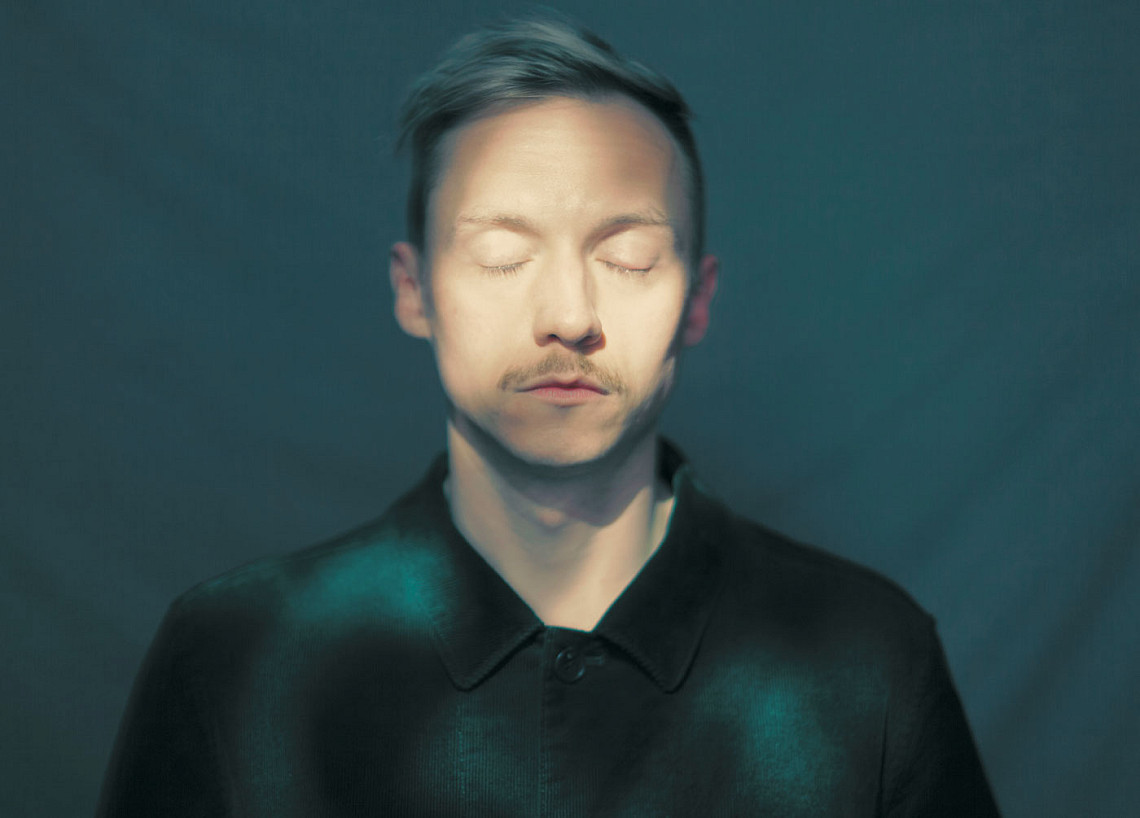
 Hamish Hawk, based in Edinburgh, is a rare artist that evokes multiple eras and styles of music. When I put on his new album, Angel Numbers, I was taken back to the new-age era of the late '70s and early '80s. Then my wife called out from the other room saying, "This sounds like David Bowie!" Quite the first impression!
Many of Hawk's fans were first introduced to his eclectic sonic palette via his breakthrough 2021 album, Heavy Elevator, which was commended for capturing the quarantine zeitgeist, even though it was written long before the world turned upside down. It was Angel Numbers, Hawk tells us, that was created in the thick of the COVID-19 pandemic, which found him abandoning his perfectionist songwriting approach in favor of a rapid-fire strategy of churning out a song a day.
Here, I chat with Hamish about the album (released on February 3), including the songs "Think Of Us Kissing" and "Money," and we dive into some of the details of his Dylan-influenced songwriting.
Breaking Into The Scottish Music Scene At St. Andrews University
I started taking music more seriously when I was at university. I was surrounded by like-minded people who were not only looking to release their own music but were also completely enthralled by the wider Scottish music scene and the lots of mini scenes within that wider scene. So I had a lot of musical friends and we got together a lot because St. Andrews is a quiet place and it's a smaller university, and there's not much of a club scene, so you have to make your own fun. We would put on gigs a lot, sort of speakeasy-style things and open mics where people would play covers, or little collaboration nights. So there was always lots of music going on when I was at uni.I started writing songs when I was a teenager but continued in earnest once I was at uni, and I prefer not to think about the low quality of the songs I wrote when I was a teenager. I've definitely improved since then, but they're an essential part of the journey.
How Scotland Fosters Creativity
I grew up with an older brother and an older sister and my parents, and I wouldn't say that my close family were particularly musical. We were all music fans, and my brother dabbled a bit on the guitar and things, but mostly we weren't an overly musical family. But growing up in Scotland, you are surrounded by a really rich history of arts and culture - it's valued in Scotland very highly. So even though Scotland is a very small country and only one of the countries within the UK, it has a very rich and diverse musical history, and you've always got bands to draw from and be inspired by, all down the decades.But when I was just becoming a teenager, it was this explosion of British indie music and American indie music. I was hugely into bands like The Strokes and the White Stripes, but also this Glasgow scene as well, which was exploding with things like Franz Ferdinand, and then you would start digging deeper and go further back into the post punk of bands like Aztec Camera or Orange Juice, or Camera Obscura, Belle and Sebastian - these are all Scottish bands - and The Vaccines. Scotland would come up a lot in little interesting corners of musical lore. So it was like Kurt Cobain famously said that his favorite bands in the world were the Vaselines and the Pastels and Teenage Fan Club, and they're all Scottish indie bands. Despite him being this king of grunge, he was really into pretty jangly music, which is really interesting.
So growing up in Scotland and being very aware of this rich musical history breeds very passionate and quite single-minded young artists or creatively minded people. In pursuing songwriting as a craft and as a passion of mine, I had a lot of things to draw on and a rich palette to paint with. I was never short of role models or ideas of what I could eventually do. I feel very grateful being brought up in Scotland for that reason - for its insistence of drilling in an artistic sensibility into its young people. I think that's a good thing.
Ditching Perfectionism With Angel Numbers
I have a really overactive perfectionist streak when I write. I'll pore over lyrics for a long, long time, shave bits off them, chop bits off them, add extra fragments that I got from some back of the cupboard somewhere. And over a long period of time, it will start to look like a presentable piece of work. But writing Angel Numbers was a different experience.It's odd, but when my last record, Heavy Elevator, was reviewed the few times that it was, one of the things that was said about it was that it captured a kind of lockdown or pandemic zeitgeist. It was odd because it was written and recorded long before the world went upside down. And Angel Numbers actually is the product of that period of time.
When the pandemic hit, I thought not only was the live music industry gonna struggle and might have been dealt a fatal blow, but I was also thinking, How am I gonna write? I don't feel I'll be inspired in this context at all. Then after a few weeks, things quieted down and a lot of the panic blew over. And what set in was this environment in which I could really focus and really didn't have much excuse to not write. I thought, Every hour of the day is up for grabs here, I'll just give it a go. So Andrew Pearson, my guitarist and collaborator, would send me music demos and I would try to come up with something and sing over the top of it, and by that evening would send something back to him. We did that every day. It wasn't like we said, "We'll do this every day and we can't stop." We just did it naturally. And for about three solid weeks, it was just a song a day. And I have never experienced that sort of creative flow state.
You're like the antenna and the signal comes in. The information flows through you. It was a completely new landscape for me, and it was very exciting because where I had previously beaten myself up about lyrics - and to be fair, I still do - that period taught me to be slightly less critical, or at least to delay my critiques of my own work and just allow the work to form, and then later I could do something about it. But I was trying not to be an obstacle in my own path, and Angel Numbers is a product of that little moment.
Repurposing Defunct Songs
There are a few songs that will never see the light of day. But what I've often done when a song has got bits in it that are good but maybe not sitting right in that song is hack that bit off and place it somewhere else and repurpose it. There are a lot of verses and choruses in Angel Numbers that were taken from defunct songs, so I can only bid farewell to them but thank them for their service.How Writing A Song Is Like Building A Puzzle
Sometimes you'll write a song and you'll just have a feeling that it is of value, but you can't see it - you're like, "I don't know what the song's trying to say, I don't know what character the song is trying to be, and whatever is there is not shining through. What can I do to move pieces around or take parts out and replace them or glue different bits on, or break them in two and see if I can get the jigsaw looking right?"It really is a puzzle sometimes, and then you can put things together and they can feel awkward and then a few months later, you have this epiphany moment where you go, "That's what that was." That's why I did that, and that's why that made sense. Especially when you're putting an album together, songs can start making sense of themselves, but as individual songs, they felt like the odd ones out. Sometimes on an album, the story makes sense.
Collecting Phrases And Other Song Ideas
"Angel with the incredible piercing" from "Think Of Us Kissing" came from my real life. But usually the phrases I end up using and the images I go back to and build up as the backbone of a song are the things that are autobiographical and real to me, but to other people, it suggests something greater. Those images become symbolic in the song. I'm always drawn to those images but I couldn't tell you how I find them or what it is about them that makes me think they're valuable when I see them. But I'll write them down and when I read them in a song, it becomes quite clear to me that they have a specific function. It's communicating something beyond itself. If you could find a technique that I use, that's something I do a lot - the phrases mean something to me on an ordinary level, but I think they might be able to evoke something grander and more significant and more meaningful within a song.

Taking A Cue From Bob Dylan
One of the things that I've always held above other qualities in my songwriting is originality. Really what I mean is not necessarily originality, but it needs to be very personal to me and I need to be able to feel it and recognize it when I sing it and be taken back to where I was when I wrote it, or at the very least taken back to the image it came from.One of the reasons that I might be critical of commercial pop music is that often I find their lyrics to be generic in the sense that they're designed to appeal to as wide an audience as possible, and designed to not alienate people from identifying with the song. They don't want to present an experience to someone that they go, Well, I don't know what that's like. I don't know what that means and I don't identify with that.
Whereas when I engage with songs, it's things like, the heat pipes just coughed... I didn't live in a Greenwich Village apartment in the '60s, but the thing that brings me closer to Bob Dylan as a songwriter, as a person, and to the central emotion in the song, is by hearing his summing up of his situation that is personal to him. That's what makes me feel close to him, as opposed to him trying to write songs so that I'll get it. A lot of the time commercial music can patronize its audience by thinking we need to simplify this so everyone can get on board. But I think your casual pop listener is far more astute than a lot of the people making the music might think, or a lot of the people paying for the music might think.
One of the essential draws of Dylan's music, and one of the things that makes it so colorful and exciting and long lasting, and the kind of thing that will forge this incredible relationship that you'll have with Bob Dylan over your entire life, is that it's all of these moments - and there's thousands of them - and that's why Bob Dylan's repertoire is so powerful and so unique. It's that he was never worried about you not getting it. He was singing from his own experience and putting it through this incredible poetic machine that renders these incredible images.
So you listen to something like "Think Of Us Kissing" and you can sort of see the angel with the incredible piercing, and that means a lot to me because I know what that means, and you are across the ocean and you're getting your own thing out of it. The best thing about writing songs is that communication.
What Are Angel Numbers?
The idea is that certain numbers convey certain information about how you relate to your own destiny and whether you are moving in the right direction, or whether you're going against the grain and doing yourself a disservice. And if you took the other fork in the road, then that is the more successful path. People talk about that in relation to their astrological signs. The idea of Saturn returning in your late 20s and you'll have a time where you make a decision that'll take you forward another 29 years, and it might be in the right direction or the wrong direction. So that became the overarching concept for the whole record.
The central image of my last album, Heavy Elevator, was the image of a heavy elevator, which was you standing in an elevator wanting desperately to move up and the elevator is trying to move upwards, but it's so heavy laden with baggage from your past that it's fighting against itself and you get that sinking feeling. So, the sinking feeling was what I was looking at in the last record. Angel Numbers is sort of the remedy to that, which is, okay, the world went into a standstill, and we were all spending a lot of time indoors. But you had a lot more time to look forward into the future and ask yourself, "Am I moving in the right direction? Am I making the right choices? Am I serving myself? Am I doing what I ought to be doing?" Angel Numbers is an exploration of that idea, which is looking into the future, dealing with ideas of ambition, potential, success and failure, and those great leaps of faith.
And the idea of Angel Numbers was not only that it was these guiding numbers, but it was also about these people that came to be these angels in the album - the people that can come into your life and can teach you a lot. Either in an instant or you spend weeks or days or years of your life with these people, and they can tell you a lot about yourself and teach you a lot about how to live your life. The album itself is a collection of angel numbers - songs about angels.
Was The Concept Of Angel Numbers Preconceived?
It was something I discovered along the way, and that happens to me most of the time when I'm writing an album. I won't know until a few songs in what it's called, and then when the title hits me, it sticks like glue. I'll be writing songs, and three or four songs in, they'll all have a common thread, but I can't think of what that is. And then the title comes along, and I go, That's what it is. And then I can complete the album in that same vein. That also happened with Heavy Elevator - it was suddenly like that.Hamish Performs "Money" And Tells The Story Behind The Song
I went for a walk in Edinburgh, as I often do to process the day's events or start the day with a walk and hopefully come out the other end of it with a song. I went for a walk and the song wrote itself in its entirety - three verses. And I was excited to write it and to finish it because it introduced a lot of new imagery that I hadn't worked with before. It felt like a fresh batch of inspiration in a way because I wasn't treading over old ground.
January 31, 2023
For more information about Hamish Hawk and how to purchase the album, visit hamishhawk.com.
Subscribe to the Songfacts podcast, part of the Pantheon Network
Photos: Emanuele Centi (1), Gabriela Silveira (2)
More Songfacts Podcast