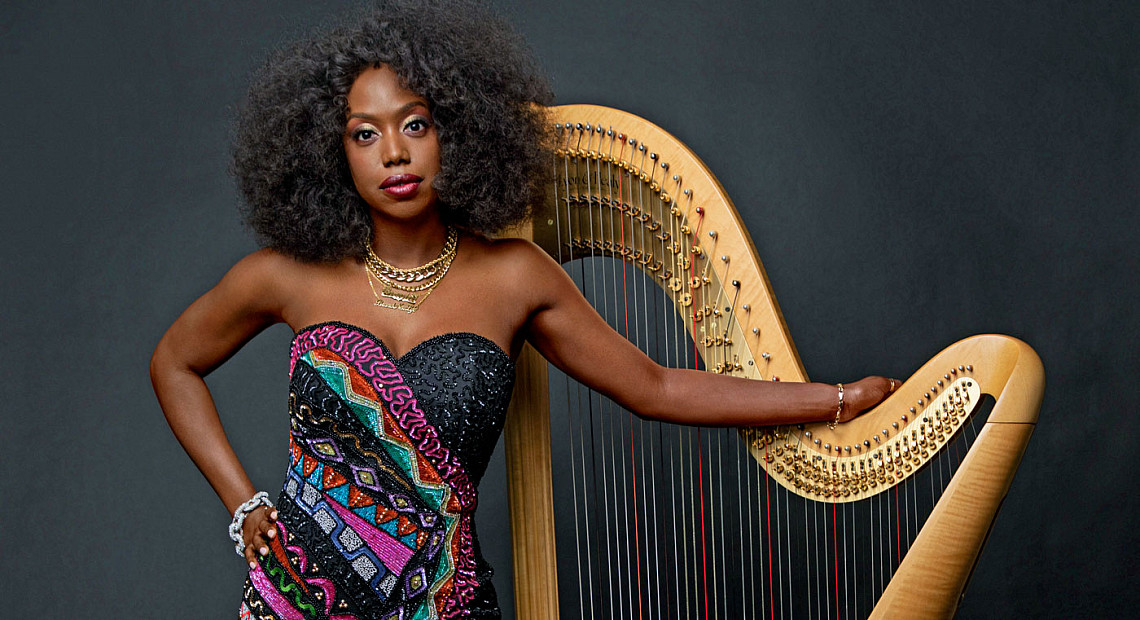
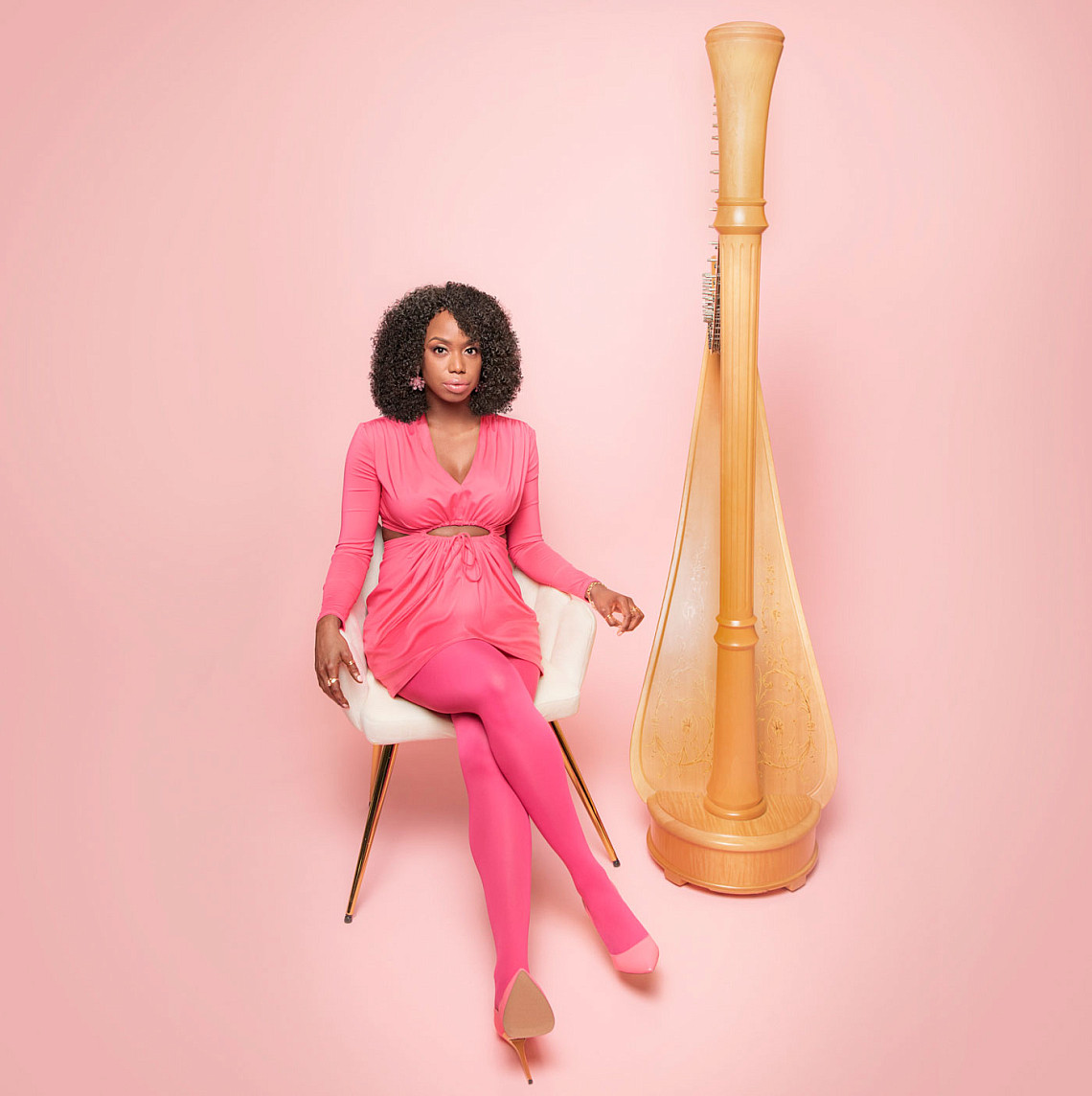
You probably don't think about the harp very often, but Brandee Younger is here to change that. She's part of a new generation of harpists, bringing the instrument to contemporary music while also honoring the heritage of harpists of the past, particularly Dorothy Ashby, who elevated the form from the '50s through the '80s.
Younger's harp can be heard on tracks by Alessia Cara, Pete Rock, Jane Monheit, Ravi Coltrane, and a mix of other artists across the musical spectrum. She's also an artist in her own right with several solo albums, most recently Brand New Life, where she reworks some of Ashby's songs and takes on a Stevie Wonder song called "If It's Magic."
On this episode of the Songfacts Podcast, Younger talks about her musical journey (including how she discovered the harp and who lugged it around) and breaks down some songs on the album. The transcript is below.
Younger's harp can be heard on tracks by Alessia Cara, Pete Rock, Jane Monheit, Ravi Coltrane, and a mix of other artists across the musical spectrum. She's also an artist in her own right with several solo albums, most recently Brand New Life, where she reworks some of Ashby's songs and takes on a Stevie Wonder song called "If It's Magic."
On this episode of the Songfacts Podcast, Younger talks about her musical journey (including how she discovered the harp and who lugged it around) and breaks down some songs on the album. The transcript is below.
How Brandee Discovered The Harp
There was a woman at my dad's job who played harp as a hobby, and my parents were like, "Our daughter is musical, can we bring her over to your house?" I played flute and we did a couple of duets and stuff, and she told my parents that if I took lessons, I could probably get a scholarship. That's all parents need to hear - that's their favorite word.So, that's really how it happened. And my parents are to thank for lugging around the instrument. No one thinks about how much of a job it is until you get to a larger harp. Then it becomes a job.
Brandee's Style
I have no problem bleeding over into a different style, so I just try to avoid the labels altogether in terms of classification. The cool part is that some of it is music that has not previously been recorded by Dorothy Ashby, so we got to use our imagination. Some of it read down like it was clear, "This should just read like a pretty typical standard." Others, like the one with Pete Rock for example ["Livin' And Lovin' In My Own Way"], it wasn't that cut and dry, so it was just a matter of sitting down and playing through it a bunch to try to hear where it could go, which I did at home, and then went to Chicago by Makaya McCraven's house and we just played through it - drums and harp - a few times... okay, more than a few times.I'm here trying to force ideas and Makaya's like, "No, you don't force the idea." You let the ideas happen. So then the next day, Rashaan Carter came in to lay the basslines down and work through it. So once the three of us got together, the ideas became more clear and concrete, but maybe most importantly, more organic.
The Song "Dust," Featuring Meshell Ndegeocello
"Dust" is a cover. Dorothy Ashby did the original. But what inspired me to cover it was that I heard a recording of her rehearsing it, and it wasn't her singing it. I assume it was maybe Maxcine Dixon singing, I'm not sure. But I just heard a rehearsal recording of her singing it, and I was like, this! I love the rehearsal more than the final product on the record. The final product on the record was so refined, and the rehearsal recording was down and dirty.I said, "Makaya, check this out, listen to this." We didn't want to regurgitate what exists, but hearing it like that was really cool, so we played through it and played through it, and played through it...
You know, when you're playing things, they start to turn into something else. Someone might play something and it just morphs. So I left Chicago with a reggae track and thought, whose vocals can we put over that? And I was just so excited that Meshell said yes.
Brandee's Grammy Nomination
Younger's 2021 song "Beautiful Is Black" earned a Grammy nomination for Best Instrumental Composition.I was at school in class, so I kept seeing texts come through, but I was teaching, so I didn't know. I had no idea. And then I must have in between students looked down at my phone and I was like, "Huh? What?"
I couldn't really process it until after I got out of school, and I was like, "Oh, shoot! What song? What category? How does this work?" So it wasn't until after school that I started to process it, and I had no idea - honestly, no clue - that I was the first Black woman nominated in that category. I mean, I'm busy. I don't have time to do this research! But also, who would've thunk it?
I didn't know it was coming. I had no idea. It surprised me as much as it surprised others.
Working With Other Artists
I learned so much working with different people. You've got artists that are completely hands-on and you have artists that are completely hands-off and leave everything in the hands of their producers. I've always been a hands-on person, but then there is beauty in trusting the people you're working with, trusting them to know you and to know your style and to create something without you micromanaging the whole situation.So, I learned a lot by watching and by being a part of larger-scale recordings. Just watching how folks function in the studio.
In terms of my own stuff and bringing in collaborators, nine out of 10 times it's a friend, it's a dear friend, so it's less about, "Oh, I need a trumpet, I need a horn." It's more that I want a specific sound. And then just having the camaraderie in the studio with said people, it makes all the difference. If it's a stranger, I'm not going to feel as comfortable as if it's someone I've known for years.
You want the folks you're working with to be able to be themselves, so you don't want to micromanage how someone's playing, yet you want the music to represent you and to be in your style. That's when knowing folks really helps. Both Rashaan and Makaya I've known for years. I met Makaya when I was in college - undergrad. I've been playing with Rashaan for years. So, when you know someone, you've played with them so many times, you just learn what they're thinking in a way. There's less that needs to be said. It's like going out and having a good night.
May 25, 2023
Subscribe to the Songfacts podcast, part of the Pantheon Network
Here's our interview with Meshell Ndegeocello
Photos: Erin O'Brien
More Songfacts Podcast