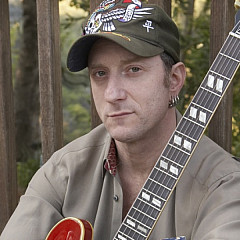
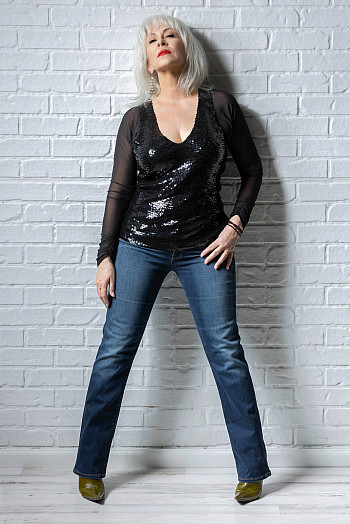
Over the last three decades, Janiva Magness has become one of the preeminent voices in contemporary American roots music. She's garnered nearly 30 Blues Music Award nominations, and in 2009 became only the second woman to receive the highly coveted B.B. King Entertainer of the Year Award. Here, we learn all about her new album, Hard To Kill, and because we caught up with her and her band as they were rehearsing, we get to hear a live version of one of their tunes.
Janiva And Her Band Perform "Closer"
The band is Matt Tecu on drums, Gary Davenport on bass, and Zach Zunis on guitar. These guys are on the record and a regular part of my touring ensemble and I'm really grateful to work with them. We're gonna do this song called "Closer," written by my dear friend, Miss Annie Mack, who is a brilliant artist that needs so much more recognition. She's a young woman and she's a brilliant songwriter and singer herself and deeply, deeply embedded in gospel and soul and blues music. I first heard her perform it in Memphis and I'd like to have died. I just fell over and died when I heard her do this. Beautiful, beautiful song.The Los Angeles Blues Scene In The '80s
I'm originally from Detroit, but I've been in LA since 1986. At the time there was a super, super strong blues scene here. Eight nights a week, man, eight nights a week, you could go hear some unbelievable live blues. James Harmon, who sadly passed last year. James Harmon band, great players, just a ton of really great Southern California, West Coast swing blues.How The Pandemic Shaped Hard To Kill
That time was interesting as it was for all of us. I did not have the experience that a lot of my friends had - a lot of artists were going like, "Oh, this is great, we're just gonna dial up the gear and we're gonna hang around and we don't have to tour, we don't have to go out. We can't go out. We can't go on road. So we're gonna write a bunch of songs and record a bunch of stuff, dial up the home studio." Not my experience, man. I cleaned some stuff out, I threw some crap out, I shredded a bunch of stuff. And then I went straight into deer in the headlights. I kind of froze on the inside.It turns out that it was the longest period of time in the history of my life that I had gone without performing music, without being in what I consider to be the holy water of my life, which is music. And to be not in that, to not be on tour, to not be with fans... the longest period of time since I was 19 years old. I'm not 19, okay, so it was really hard for me. I struggled. It was difficult, and how that fed the album was I think in one way, it really gave me a sense of commitment. Not that I've not been committed to the process always, but it gave me a real sense of commitment in taking the gloves off for this album. The whole album is gloves off. And it's out on my own label, which makes me fully indie - yahoo for the fully indies - and it's my 16th album and I recorded.
I also recorded an audio version of my memoir [Weeds Like Us]. So I published the memoir in 2019, recorded the audio book in 10 days, and then took about four days off to rest my voice and then went into the studio to track these songs that I had been working on. My producer and I had been working on these songs for six, seven months. Whatever anxiety I was having during the pandemic - the real serious shutdown part - rereading my memoir out loud to myself sort of took me back and I thought, what are you worried about? What are you scared of? What do you think's gonna happen? Whoever they are - what do you think they're gonna do to you? It ain't gonna be anything that you can't get through, survive, come out the other side a champion, quite frankly. And that is based on my memoir and the experiences of all of that.
But the point is going into the studio with that headspace made for gloves all the way off. And we're just gonna record this and track this, and I think in that way, the pandemic served to really help me feel like I've got nothing to lose.
The Story Behind "Strong As Steel"
Songs are snapshots, right? They are little vignettes, they're little mini movies. And if you're listening, you're listening to the story. "Strong As Steel," track number one, I was talking with a couple of my co-writer friends in Australia, Andrew Lowden and Lauren Bliss. They're really sneaky because they were like, "Tell us about your grandma." So I'd start talking about my maternal grandmother, Pearl, and then I'd start talking about how strong she was. She was very, very strong and she married and "divorced." I'm using the term divorce with quotes around it because I don't think she actually legally divorced him six times - swear to God. My maternal grandfather was a bit of a piece of work. And so she'd kick him out or he would just abandon my grandma and my mother during the Depression, very difficult times.But the bottom line is my grandma was strong as steel and that was what I said to them. And they were like, "Yeah, yeah, tell us a little bit more about that, and then tell us this other story." So the story that's painted in "Strong As Steel" is a true story. I actually fell off a cliff - I went right off the side of a cliff. I was probably 18 or 19 years old. I was really inebriated. I was super, super drunk. I was walking around the top of this cliff in Duluth, Minnesota, with some friends and it was like two in the morning, and we were like, yeah man, and boom I went off the cliff. My first thought was, okay, this is it, fine, it's over, thank God, we're done. And I landed in a tree, broke my wrist, and my friends were at the top of the cliff going, "What are you doing down there!?" It was just an absolute cartoon episode. Anyway, that's all a true story in there.
It turns out I find out later in my life that I have generations and generations and generations and generations of these incredibly strong women. These incredibly bold women that were like, I'm sorry, but in the '20s and the '30s and the '40s, you didn't kick your husband out, and be a single mom, you know? And so she would literally marry Charlie Kirby five times and divorce him six. That was the tale. She probably didn't divorce him all, but one time, but she booted him out, which was tantamount to a divorce in those days.
And it turns out that I come from a long line of super-strong women, and that's probably why I landed in the damn tree.
Music Without The Business
It was all happening at the same time. It was all popping. It was happening everywhere. It would've been '70s into just about '80 or '81 - I lived in Phoenix before I was in LA. There was so much great music. There was great blues. There was great funk. There was great soul music. There was great music that was happening everywhere. There was even great country music that was happening in the clubs and around the scene there.It was during a period of time, which I consider to be a huge blessing, where the business of music had not infiltrated deeply enough as it is now. You could listen to anything on the radio. You could listen to a radio show and they would play James Brown, and they would play Aretha Franklin - so there's funk and soul. Then they would play early Linda Ronstadt, which was definitely country music of the time, and then they would play Van Morrison. There was a lot less Big Brother determining what was being listened to, and it was much more creative on the parts of the DJs. The DJs were making those decisions for themselves, not corporations, not someone that has some other deep-line agenda that nobody can see because they own half the damn publishing or something like that. Whatever it might be.
There was a lot of advertising-free radio in those days. FM was where it was at, man. AM was like, blah, blah, blah, blah, blah, and loud pop music. And then FM was all the cool stuff.
That was true of the local live scene in Minneapolis as well.
Riding The Bus With Prince
I was a young girl riding the bus in south Minneapolis and Prince used to take the same bus down Hennepin that I took. People were kind of talking about him at the time, but he was still a pretty young dude and he was doing cutting-edge things. He wasn't afraid to be doing what he was doing, just to authentically be himself. And people were put off by that a bit. Some of the local scene were kind of like, Who's this guy think he is? But is that his real name? Come on, man. Who names their kid 'Prince'? There was like this back-biting undercurrent thing that was going on. And he just, like, he made never-you-mind, he was just busy being Prince and he just stayed on his path and he pressed forward. He was the powerful, powerful word called persistent, and he stayed on it.Then pretty soon all of that sort of back-biting stuff kind of fell away because it was very obvious that the guy in fact was a genius. And who gives a rat what he calls himself. In fact, his parents did name him Prince - and it's none of your business. And if you're lucky, you're gonna get a ticket to get into the show, but maybe you're not so damn lucky, are you?
Early in his career when things were really starting to pop for him, he was also reaching back to help other artists from his neighborhood and other people that I guess were probably in his fold get put in the forefront. I saw a show with an all-female group that he put together. The band, the female group was called Six, and I remember being in this tight little club that was probably the size a little bit bigger than this rehearsal room that I'm sitting in and there was a stage at one end and there was a five-piece band, and then these three women up front, and everybody was rammed into the room. I'm sure it was way past fire code. It was crazy. And it was the funkiest thing you've ever heard in your life. And Prince was there... I mean, it was all happening. What a beautiful, rich time to be in the Twin Cities.
"Right Here"
"Right Here" is a song about really, truly standing with someone. If you have the great fortune - whether it's a friend or a family member or a spouse, whatever it is, in life, to find yourself with someone that really will stay with you through thick and thin. If you need to tell me something - here's the lyric: you know, I would never make you wrong. So say what you need to say and mean what you need to mean, 'cause I'm just gonna stand right here. I'm not going anywhere. It's far too unusual in life to find that, and when we find it, if we find it, it is priceless, it is precious. It's a delicate thing. If you need to tell me something, you know, I would never make you wrong. You said you know the melody, but you don't know the words to the song. If we take it back to where we started, maybe we can make things right. Don't give up.I didn't really have that in my life until quite a bit later, but to be able to look somebody in the eye, and go, you know what? This isn't working. When you say this, or when you do this, I feel awful. Or you hurt me. And to have that other person not go, "Well, you did this and you did that... well, what about you?" Or run from the room, slam the door, all kinds of other crap. That's not what happens. I look you in the eye. I stand there and I listen and I hear you and I want to hear you. I want you to tell me what's on your mind to be able to move through that with another human being.
Janiva's Advice To Women Starting Music Careers
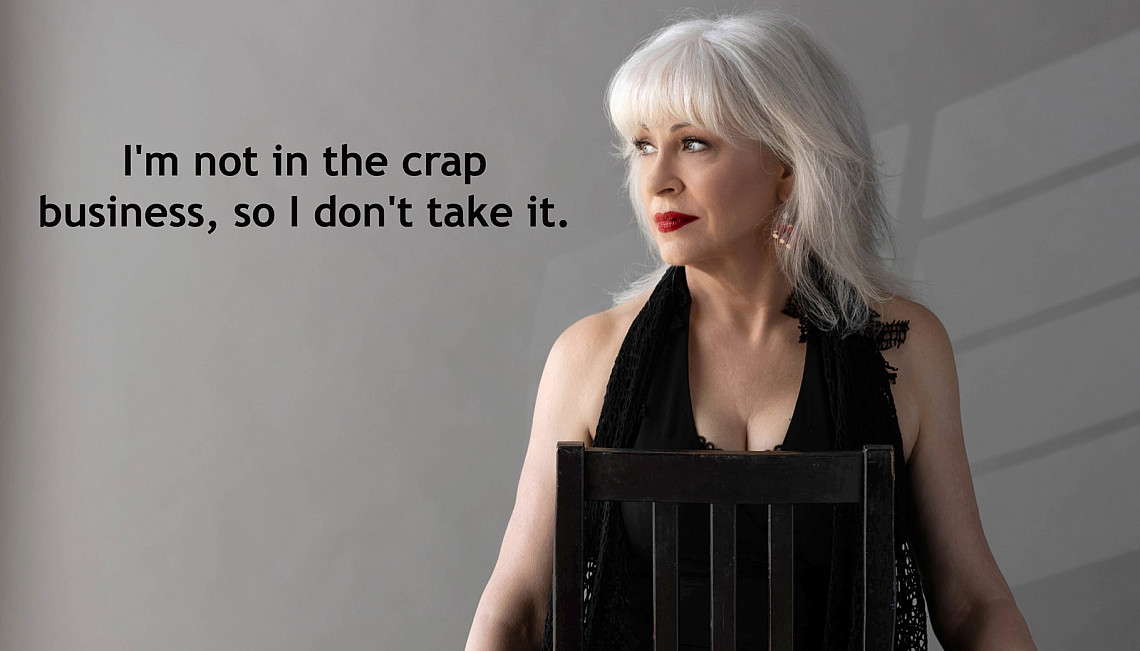
Well, there's a lot to unpack there. For starters, the first phrase that comes to mind is something a girlfriend said to me around 30 years ago: "Controle su destinado" - "Control your destiny." So I take that to heart. It's probably why I'm at this point in my career - album number 16, fully independent as an artist on my own label, own my own publishing. Do I work my assets off? Yeah. Am I gonna work my assets off anyway? Yeah. Nobody's gonna work harder for me than me.So, what do I have to say to other women starting out or in the early parts of their careers? We're not in the business to take crap. I'm not in the crap business, so I don't take it. Now I'm privileged because I'm where I am in my career that it's simpler for me to say no to someone. Or that doesn't work for me. Or spell it out. Or here's what I need you to do. Whether that's don't play that riff, please play this other thing. Or hiring a team to help me launch a record, to work with Fathead Records, my label.
I wish I would've understood earlier that I wasn't in the business to take crap and I wish I would've trusted my instinct more. It isn't to say that other people didn't have feedback of value for me, because they often did and often do. But, it would've been easier on me if I would've trusted myself a bit more and if I would've trusted my vision sooner. There's always something to learn. I mean, the Buddhists have it right as far as I'm concerned, which is to try to hold onto the idea of keeping the student mind - be teachable. Remain teachable. Because when I'm not teachable, that means I can't bend, and if I can't bend, I'm gonna break. It's all of that, as well as learning to tune into my own instinct and trust it, staying true to my vision, and not putting up with crap from industry people, or other musicians.
As a singer, I was learning a lot, but for example, I sang songs for years in keys that I should not have been singing songs in, but I sang it in those keys because it was better for the guitar player or better for this other musician or something but not better for me. But no, they needed it in that key, so I would make my adjustments. Well over time, that wears on my instrument. My instrument is the one instrument you can't take to the shop.
Or we'd record it in this key and then we'd play it live in this key. Sometimes I do that still to this day because there's a certain feeling or a sense of a vocal timbre that my producer is looking for in the studio. But to do that a hundred nights a week, live, that ain't happening. I'm not singing it in E 100 nights a year. I got news for you, baby. So, there's that kind of thing.
"Anyone Who's Ever Said No To Me Did Me A Huge Favor"
Another quick story for the ladies. I talk about this in my book - I was working with a band in Phoenix and I had a bandmate that was doing most of the booking. It was like local bar stuff, and I wasn't doing any booking at that time. I was just glad to be there and glad to be learning. Then he booked a few shows without me. He didn't talk to me about it. He did it underhanded. In other words, he went around to all the other people in the band and said, "Hey, do you wanna do this show opening for this famous blues guy?" And they were all like, "yeah, yeah, yeah." Well, the thing is, we don't need the singer, we have the famous blues guy, so we're just gonna go ahead and do this, and we're just gonna leave her out.Now, what's accurate is if he had come to me and said, "You know, we have this chance to do this thing, but they don't want a singer, they just want the band to back up so and so." I would've gone, "Of course. Are you kidding me? Aren't they? Can I get a ticket? I'm thrilled." But that's not how it was handled. It was really crappy underhanded office politics. So he went around and then came to me and then told me that they were doing these shows and that I wasn't on it. Very different. Very, very different tactic. And I was so taken aback by that, but it turned out to be a gift.
Here's why - I got upset. I got really pissed off. I was crying. I was really upset - 20-something - and I'm talking to my girlfriend and she goes, "You know what to do, right?" I go, "No, I don't know what to do!" She goes, "Well, you can either let him keep treating you like that, or you can just go out and book like two or three months' worth of work yourself, and then you bring it to the band and you let them know that the band is now gonna be called Janiva Magness and the band name - not just the band name." And I go, "Really?" She goes, "Absolutely, that's how you do it. Trust me. You gotta hit him right where it hurts and you hit him in the pocketbook. And if he doesn't wanna take the billing that way, if he is not willing to be in the band, that's okay. You'll find another player. But that's the name of the band on those shows. You did the booking, that's the end of the story." And I was like, wow.
So I did exactly what she suggested I do. I went out and I booked three months' worth of work, and I had a ton of work, and I went back to him. I did what he did. I went to all the guys and said, "Hey, do you want this work?" And they were like, "Yeah, that's great, wonderful, wonderful." And I said, here's what it is. I wasn't asking permission. I told them it's gonna be Janiva Magness. And they were like, "Sure, no problem, no sweat, whatever - we wanna work." And then I went to the one guy who had been so underhanded with me and I said, "Well, this is what it is, and I want you on the gigs if you wanna do it." And he was like, "Well, you can't do that." And I went, "Well, actually I can. And I did. Are you telling me you don't want the work?" And he was like, "Well, that's not right, that's not fair." And I said, "Well, it's where it's at, so just tell me if you don't wanna be on the gig." So I just completely turned the situation that was potentially gonna be a real ugly push-pull, and I just went boom, and I drop-kicked the guy.
But he did me a solid. Because it upset me and it pissed me off and it hurt my feelings enough and then I took that and I went, "Okay, here's what we're gonna do." It was motivation for me. Ladies listen closely: Anyone who's ever said no to me - you can't have that, you can't do that 'cause you're a woman, you can't do that 'cause you're white, you can't do that because there are no chicks in the band, any of that kind of crap - did me a huge favor. Because it put fire in the engine. It just motivated me after I decided to raise my head again. I licked my wounds, I'm like, "Oh God, oh God," and then I get up and I use it. I use it as motivation. I use it as fuel. I use it for the drive. Anybody who's ever kicked me when I was down, I've been able to use it for fuel and I think that's pretty valuable.
June 30, 2022
Keep up with Janiva Magness on Instagram
Subscribe to the Songfacts podcast, part of the Pantheon Network
Photos: Jay Gilbert
More Songfacts Podcast