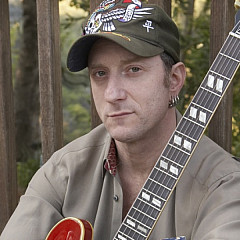
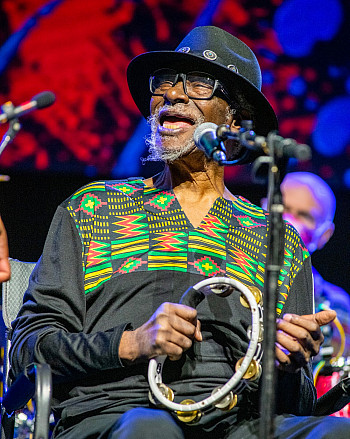
 Even by the lofty standards of the late '60s, The Chambers Brothers were visionaries, blending rock, gospel and psychedelia into a musical bouillabaisse seasoned with social awareness. Lester is the third of the four Brothers, who were joined by a white drummer named Brian Keenan.
The Chambers family is from Mississippi, but they formed their band in Los Angeles after the oldest brother, George, was discharged from the Army and settled there. "He went to California because he no longer wanted his brothers and sisters to grow up in a place like Mississippi," Lester says. "We got in the car one night and drove up. And, after two-and-a-half to three days we wound up in California, but it was a struggle getting out of Mississippi on the road."
They started performing in 1961 and added Keenan in 1965, the year they earned great acclaim with a performance at the Newport Folk Festival, where they went electric hours before Bob Dylan. Their first album, The Time Has Come, was released in 1967 and includes their masterpiece "Time Has Come Today," a song that still rings true five decades later. That album also includes "Uptown," a song you can see the band perform in the documentary Summer Of Soul.
We touch on all these topics in this conversation with Lester, who also talks about his latest venture, the band Moonalice.
Chambers Brothers' Move From Mississippi To California
The intention was to just move to California and get out of Mississippi and be somewhere else. Yes, a better place. This was in '53. All of 14 years old.We were a gospel group and sang only in churches during our earlier days in Mississippi, out of Mississippi and into California, but we had problems with that, so we went to the coffee houses for something to do because we had it in our minds that we were going to be singers.
Going Electric At Newport Before Dylan
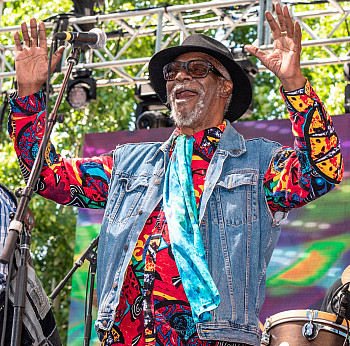
To go from the coffee houses to Newport, that was great. When we got there, we had already been playing with one electric guitar and one acoustic guitar and a gutbucket bass. So when we got to Newport, people kept coming and coming and coming, and we're going, "Oh my God, look at all these people." [Festival founder] George Wein was saying, "We don't want no electric," but we had no choice. We decided that with all those people, there was no way they were gonna hear an acoustic guitar in the back, so we went electric before Bob Dylan, but he got credit for it.1Nobody talked about the four Black dudes that went on stage and rocked the place out, because our music was quite different. We're doing Jimmy Reed, great rock-and-roll, get-up-and-dance music, but we didn't get any credit for it.
They screamed at Bob when he came out, "Go get your real guitar!"
We didn't give them a choice. We wanted to be heard, and we got heard.
"Time Has Come Today"
It was developed by the four of us from traveling cross-country so many times from everywhere in the world. We were going to play coffee houses, and it was the beginning of the hippie uprising. People were walking all over the place, just lost-looking as if they had nowhere to go and nowhere to be. The words "time has come today" got my brother Joe's attention, and then from there we all hitched on and came up with "Time Has Come Today."The 1971 Chambers Brothers Song "Funky," Written by Lester
We were before Sly and the Family Stone. Yeah, we were a couple of years out front of Sly and the Family Stone. "Let's Get Funky" was written by me. I was hoping to create and start a new dance because everybody was doing dancing. You know, the Boogaloo, the Mashed Potato, the Watusi, the Funky Chicken. So I said, "Let's make it a funky tune and talk about what happened in your home." That's how that came up.It was natural. We're African, we got rhythm, man.
Moonalice
Moonalice is a musical collective based in San Francisco that has been recording and performing since the late '00s. Led by Roger McNamee, they brought Lester in a few years ago and covered "Time Has Come Today," "Funky," and The Impressions' classic "People Get Ready," famously recorded by The Chambers Brothers in 1966. Lester's son Dylan is also part of the group along with the vocal trio the T Sisters.It's just one big ball of happiness. I couldn't ask for a better thing than to be on stage with my son and the T Sisters. All the guys in the band, they're just a happy group of people that come together as a family, and we are like family because the T Sisters now have children, and my son and I and Roger, we're just all great, happy people, and we all really love music.
The Mid-To-Late 1960s
It was total fulfillment of being a musician, a singer, because you got to tell people in quality and quantity: Lots of people at the same time were hearing your message. And it was a great way to get the message out because when people pick up a newspaper, they read it and they put it down. They pick up a flyer, they read it, they use the back of it to take notes and then it becomes torn apart. Music is played over and over and over and nationwide and worldwide. And people know what you're saying and what you're thinking. It was so great to be a part of helping to deliver great songs to the public's ear.As you know, things weren't good then. We had been warned by the media and by booking agents that if we participated in any of the protests or marches, or we sang at any of them, we would no longer be booked by any of the agents. So we figured, "Hey, we don't have to be there. Let's get on the radio with it."
Several people at that particular time started to write music for those purposes because they had been told the same thing: If you go to any of these benefits that are raising money for this protest of people against people, you won't be playing anymore. And several people you don't hear on the radio still.
We wrote the greatest song that's ever been written for it: "Time Has Come Today." Time has come today for hearts - young hearts - to go their way. Can't put it off another day, we gotta do this.
So the need for that now keeps being bigger and more, and really needs to be heard. People really need to know that time has come for us to act like people, not animals, and stop killing, shooting and stealing from one another.
"We Never Got Paid"
Musicians like us had so many great stories to tell, but we were being robbed, and we are still being robbed. We're like sharecroppers - we get a small percentage of the music we make, just a small percentage. The record company gets the rest. What do they do with it? They don't share it, they float around on yachts and drive around in Teslas, and here we are still walking, still renting homes, we made all this music. We never got paid.Lester's son Dylan joins the discussion:
Just to chime in here real quick. Lester didn't receive a royalty check for anything that he and The Chambers Brothers had recorded until the mid-'90s, so there were times in my life growing up where we were going to food banks and church handouts because we didn't have money for food. You'd tell people who know who The Chambers Brothers are and they're like, "What did you do? Did you spend it all on drugs, or did you gamble it all? How come you don't have any money?" They don't realize that was very predatory in that time.
The mafia was involved in a lot of record labels,2 and most artists just got the worst deals you could possibly imagine, but from their perspective, they're like, "Hey, this is the only way I'm going to get heard, so I've got to sign this contract so that I can record my music." And there's a handful of cats who have made it out successfully from the '60s owning the majority of their rights or becoming financially stable from their music, like Bob Dylan or The Stones.
Musicians of color throughout the world, throughout the time of our lifetime, we have not yet been treated right. Out of all the years of "Time Has Come Today," there's never been a day gone by since we recorded that song and it was released that it hasn't been played on the radio in every state in the United States, and we've only gotten one tiny little Gold record for it. That record must be 10 times Platinum. So if you don't get acknowledged, how are you going to get paid?Just to chime in here real quick. Lester didn't receive a royalty check for anything that he and The Chambers Brothers had recorded until the mid-'90s, so there were times in my life growing up where we were going to food banks and church handouts because we didn't have money for food. You'd tell people who know who The Chambers Brothers are and they're like, "What did you do? Did you spend it all on drugs, or did you gamble it all? How come you don't have any money?" They don't realize that was very predatory in that time.
The mafia was involved in a lot of record labels,2 and most artists just got the worst deals you could possibly imagine, but from their perspective, they're like, "Hey, this is the only way I'm going to get heard, so I've got to sign this contract so that I can record my music." And there's a handful of cats who have made it out successfully from the '60s owning the majority of their rights or becoming financially stable from their music, like Bob Dylan or The Stones.
Most musicians that recorded way back when we did, especially if you're a white musician, your contract was upgraded, your pay scale was upgraded. If you're people of color, you don't get upgraded, you just keep making that same little three points.
That's why I consider a musician's job as a sharecropper. The record company gets all the money and they take five dollars and give you three pennies of that dollar. You do all the traveling, you risk your life. The real sad and sick thing about it is the country we live in doesn't recognize musicians as workers. We do not get insurance. They will not allow musicians insurance because we are assigned risk. They will not insure your equipment because it's at high risk of being stolen.
"People Get Ready"
It has a message. It has one of the greatest messages you could ever have: We all have to get up and get ready to go anywhere, to be anywhere, to do anything. You have to get ready and be ready.And that's one of the main things that people don't understand: You need time, and if you don't take time to get ready, then you're angry about being where you have to be. You're not happy. Make yourself happy. Take time to get ready to do what you have to do and be at peace with yourself and the world.
"Uptown" And Summer Of Soul
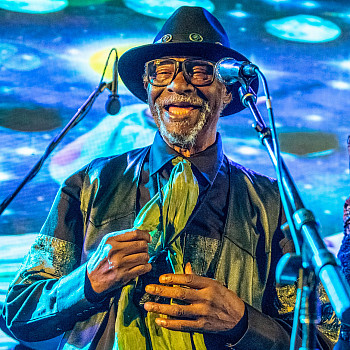
For 60 years I've been singing that song "People Get Ready." Sixty more years I've been singing "Time Has Come Today." And there are so many other great songs.When we originally did the song "Going Uptown To Harlem" [official title: "Uptown"], there was a whole movement going on to where if you were Black and lived in New York, don't think you're going to get a taxi. You could not get a taxi. The only way you could get a taxi was to have a white person stop it for you and act like they were going to get in it and you got in it. So Betty Mabry wrote the song because she was a victim - a female victim - of racism by transportation. It doesn't make sense to own a car in New York unless you lived in the suburbs. So, she lived in Manhattan and could never get a taxi, and there was nowhere for Blacks to hang out in New York, hardly, so she wrote the song "I'm Going Uptown To Harlem."
It became the favorite song for Questlove in his movie - it was perfect for Summer Of Soul. And did you see that huge audience? Central Park has never had that many people in it before our sets. But the weird thing is, Summer Of Soul - The Harlem Cultural Festival - was before Woodstock. So, that's why Harlem Cultural Festival got dumped in the basement, because they wanted Woodstock to shine. Why? Our cultural festival was Black, Woodstock was white.
If you look at the stage and the equipment that was provided for us, it was very minimum. There was no wall of sound back there. No sound company would come, would even talk to us about equipment for the festival, because they thought we were going to flop and not be able to pay the bill. So we had to bring our equipment, our personal equipment with us for that gig.
Great music, great people, a great cast of musicians and bands. Oh my God, what an enjoyment it was.
Best Part Of Playing Live Now
Well, the ones that haven't heard it, the best thing is knowing that they got to hear it, and that I got to sing it to them like I did in the '60s. And then a lot of them are like, Wow! In awe, you know. And the greatest thing about it is having that audience come to see you and still loving what I can bring to the table, or to the show, or to the audience. I just love it.April 27, 2022
Also check out our interview with Willie Chambers
Subscribe to the Songfacts podcast, part of the Pantheon Network
More on Moonalice, including tour dates, at moonalice.com
Photos: Bob Minkin
Footnotes:
- 1] Chambers Brothers played the 1965 Newport Folk Festival during the afternoon concert on July 25. Hours later, Dylan, the headliner, took the stage during the evening concert, famously plugging in and horrifying folk purists. (back)
- 2] Trying to reclaim royalties from avaricious record companies is hard enough, but getting anything back from the slice of the industry that had mob ties is nearly impossible. Tommy James wrote a book about his experience called Me, The Mob, And The Music. (back)
More Songfacts Podcast