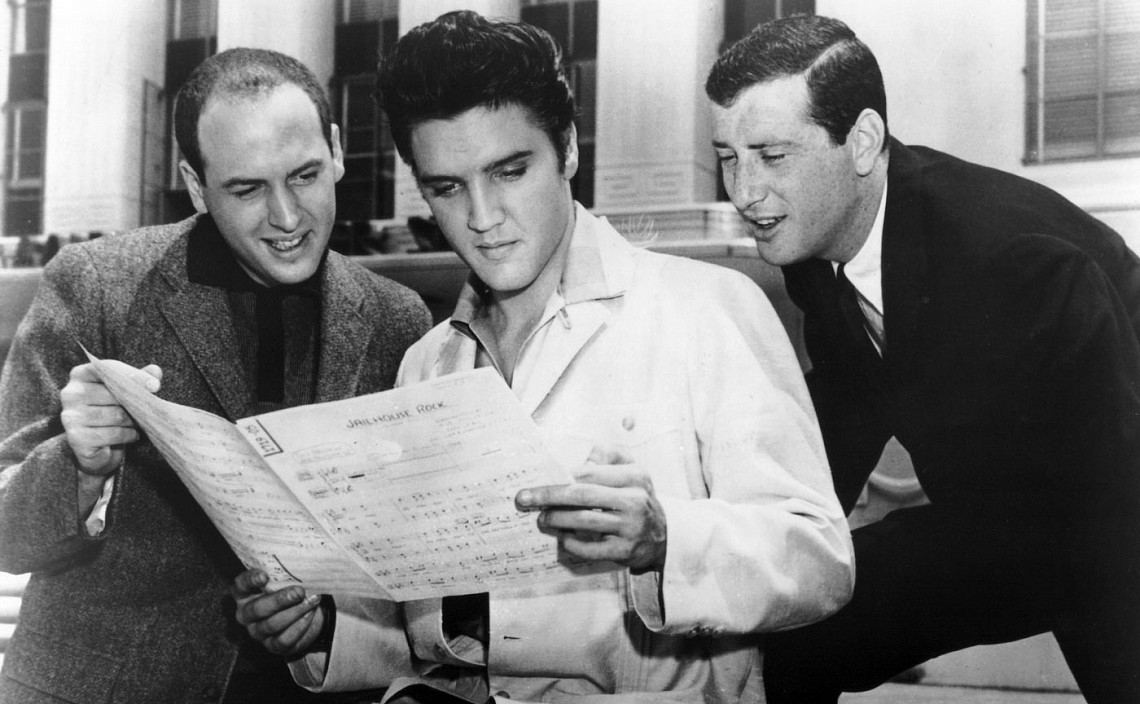
 Mike Stoller (left) and Jerry Leiber with Elvis Presley in 1957. Courtesy of the Leiber & Stoller Archives.
Together with Jerry Leiber, Mike Stoller wrote a breathtaking number of classics for Elvis Presley, The Coasters, The Drifters, Peggy Lee, LaVern Baker, Ben E. King, and more, including "Jailhouse Rock," "Hound Dog," "Santa Claus Is Back In Town," "Stand By Me," "Love Potion #9," "Yakety Yak," "Kansas City," "Poison Ivy," "Along Came Jones," "Bossa Nova Baby," and so many more.
Although Jerry passed in 2011, Mike continues the duo's legacy and is still actively working. Songfacts Podcast host Stephanie R. Myers spoke with Mike, now 90 years old, to discuss his work on the recently released album Brendan McCreary Sings The Love Songs Of Mike Stoller, tell the story behind the fascinating Peggy Lee song "Is That All There Is?" and talk about his new project, working on the musical Beaches.
Although Jerry passed in 2011, Mike continues the duo's legacy and is still actively working. Songfacts Podcast host Stephanie R. Myers spoke with Mike, now 90 years old, to discuss his work on the recently released album Brendan McCreary Sings The Love Songs Of Mike Stoller, tell the story behind the fascinating Peggy Lee song "Is That All There Is?" and talk about his new project, working on the musical Beaches.
"That Old Tune Called Romance"
Speaking with Ward Roberts of The Cole Porter Project, Stoller said that he and Jerry Leiber wrote a song in Porter's style called "That Old Tune Called Romance." Roberts arranged for the song to be recorded, leading to a full album.I just had a marvelous time. At first I thought they wanted to do maybe an album of five songs by Cole Porter and five by Leiber & Stoller. But no, they wanted to do my songs, and, of course, the bulk of them are songs that I wrote with Jerry, and some of them had never been done.
One of the songs I wrote, "Words And Music," was one of the songs I wrote with Marilyn and Alan Bergman. And one was a song that Jerry and I wrote with two other people that we recorded back in God-knows-when: John Sembello and Ralph Dino. I was thrilled looking down the whole list of songs, and I decided that every song on the album is my favorite.
Leiber & Stoller Songs Mike Hoped Elvis Would Record
There were songs that we always hoped he would do, particularly "Kansas City." I would have loved for him to have done that, and I did hear years ago, through the grapevine, that one of the people who was at that time producing him had done a track but he never got to put his voice on it.I was very happy with "Stand By Me" as sung by Ben E. King, who was the co-writer of the song with Jerry and me. There have been so many covers of it, but never an Elvis cover.
Recording Songs Like "Yakety Yak" with The Coasters
Oh, just the fun of it. We would do these amusing songs and then The Coasters would go out on the road and they would choreograph themselves and work out how they're going to perform it before an audience. Then they'd come back and do it for us, and we'd fall down on the floor laughing. Then we'd play them our new song and they'd fall down on the floor laughing. So it was always great fun.Most of the recordings I played piano on. We rehearsed for usually for a week before we went into the studio to get the voices all on the right harmonies. We started recording The Coasters in Los Angeles, where there had been a group called The Robins. We had our own little label, Spark Records, and we recorded things like "Riot In Cell Block Number 9" and "Smokey Joe's Café." We wanted to take them with us to Atlantic when Atlantic offered us the opportunity to be the first independent record producers in the business, but only two of them came, so we added two other people to the group and we recorded the first big double-sided hit in L.A. That was "Searchin'" and "Young Blood." Then we all moved to New York and we started using King Curtis on saxophone. He became almost like a member of the group, at least for recording. We used to have a great time listening to his solos. He would do a kind of bluegrass fiddle on a tenor saxophone. It's wonderful.
"Is That All There Is?" by Peggy Lee
It was inspired by a novel that Jerry had read, Disillusionment by Thomas Mann. He recited these little stories, vignettes, and I set it to music. There was a singer who had been on Broadway, an English singer named Georgia Brown - not "Sweet Georgia Brown," but Georgia Brown. She had been on Broadway in a musical and she was going back to London to do a special called Georgia's Back, which opened on a picture of her bag. Her manager, who was a guy we knew, brought her up to Jerry's house one day where we were working. She wanted to hear some new songs, and we played that. She said, "It's wonderful. I love the stories, but I gotta have something to sing."Jerry said, "I'll work on it," and I said, "I'll go home and play with the music." And I did.
I came back the next day, I said, "Jerry, I got the music and I'd like to come over and play it for you." He said, "Well, I'm not sure I want to hear it because I wrote the lyrics to a thing that shouldn't be sung, and I don't want to have to change it because I know I got it right."
We had this back and forth and I came over and finally he said, "Alright, play it." Then he said, "Play it again." He sang his lyric and we didn't have to change a syllable. So that's how the song came to be.
However, when it was played for Peggy - we had a demo that Jerry and I had made and he played it for her - she said, "That's my life story. How did you know all that?" She said, "If you give this song to anybody else, I'll break all your pencils."
At any rate, the first performance was in England on Georgia Brown's television special. It was arranged over there by a wonderful arranger whose name I can't think of at the moment. And unfortunately, although they recorded it, it was never available because they were reusing tape in England - it was costly.
There was a recording done prior to Peggy's, but Peggy's is really the essential version of that song. Randy Newman did the arrangement and the orchestration, and he added a great deal because the first two verses he changed the music to the spoken voices and it was marvelous. The last two verses were with the music I had originally written, but again, arranged by Randy Newman. It's a wonderful recording.
What Music Does Stoller Listen To?
I tend to listen more to jazz, and I love Brazilian music. That's mostly what I listen to at this point, because most of the time I'm trying to create for a show that I'm working on.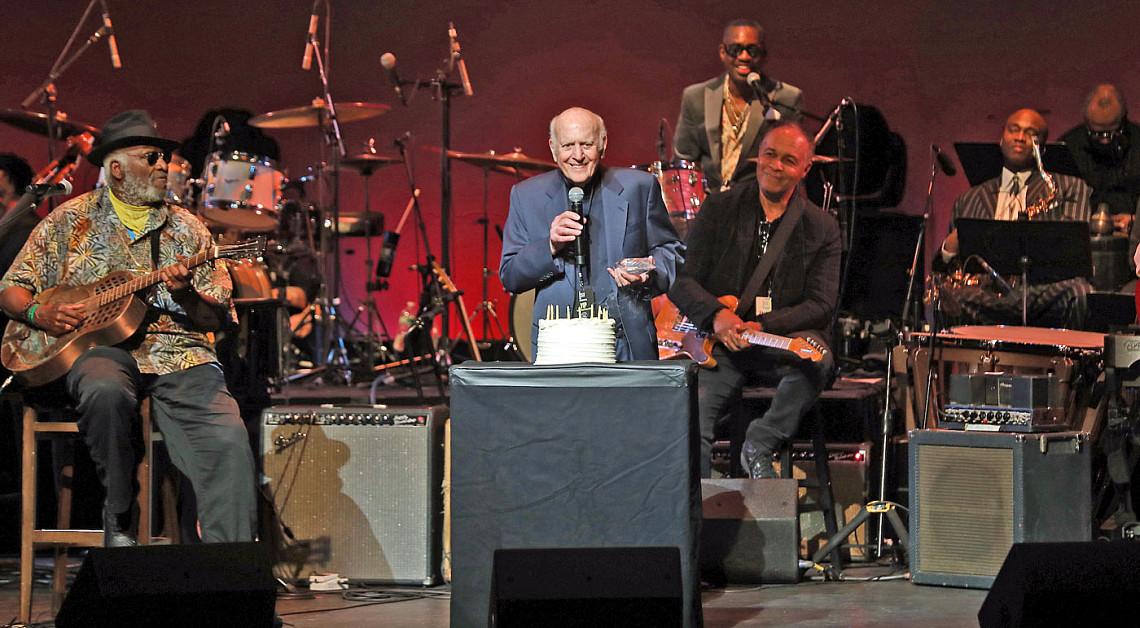 Celebrating Stoller's 90th birthday at JFA's "A Great Night In Harlem" event at the Apollo Theater. Photo: Udo Salters.
Beaches Musical
The woman I'm writing the show with wrote the original novel, and now she is writing the book for a musical and the lyrics. Her name is Iris Rainer Dart, and she wrote the novel, Beaches, which was made a number of years ago into a movie with Bette Midler. Although she had given the rights for a film, she maintained the theatrical rights. She called me and asked if I would write the music to her lyrics, and I said, "You bet." I think we're close to finishing. We're having a wonderful time.We did a reading in New York for an invited audience, and we had standing ovations for that. We are going to open, of all places, in Calgary in a couple of months. The artistic director of the Calgary Theatre has worked with Iris before, and has actually worked with me before, on a project that we did a number of years ago called The People In The Picture. He was eager to have us there, and I guess our producers were eager to be there. We're looking forward to doing that.
Stoller's Favorite Genre
I started out with a love of boogie-woogie and blues when I was an early teenager. Then I loved jazz - Charlie Parker, Thelonious Monk, Miles Davis. And I love the bossa nova, all the Brazilian genres.The bossa nova sound was big in 1963 when Leiber & Stoller wrote "Bossa Nova Baby" for Elvis, but Mike tells us, "That's not really bossa nova."
Stoller's Proudest Accomplishments
Musically, I'm proud of the fact that a number of the songs I wrote with Jerry way back have lasted so long. That makes me very proud. And that people tell me that this song or that song has been meaningful to them - it makes me feel very good.And other than that, you know, my wife is a great jazz musician - Corky Hale - a great jazz pianist and harpist, jazz harp. She and I have donated a lot of time and funds to various projects, and there's a theater at the Southern Poverty Law Center in Montgomery, Alabama, that is named after us: The Mike and Corky Hale Stoller Civil Rights Memorial Theater. I'm very proud of that. That's one of the many things that I'm very proud of.
January 30, 2024
Subscribe to the Songfacts podcast, part of the Pantheon Network
Here's our list of Songs written by Leiber & Stoller
More Songfacts Podcast