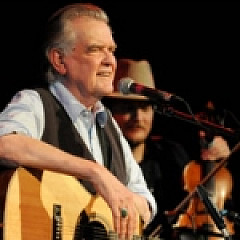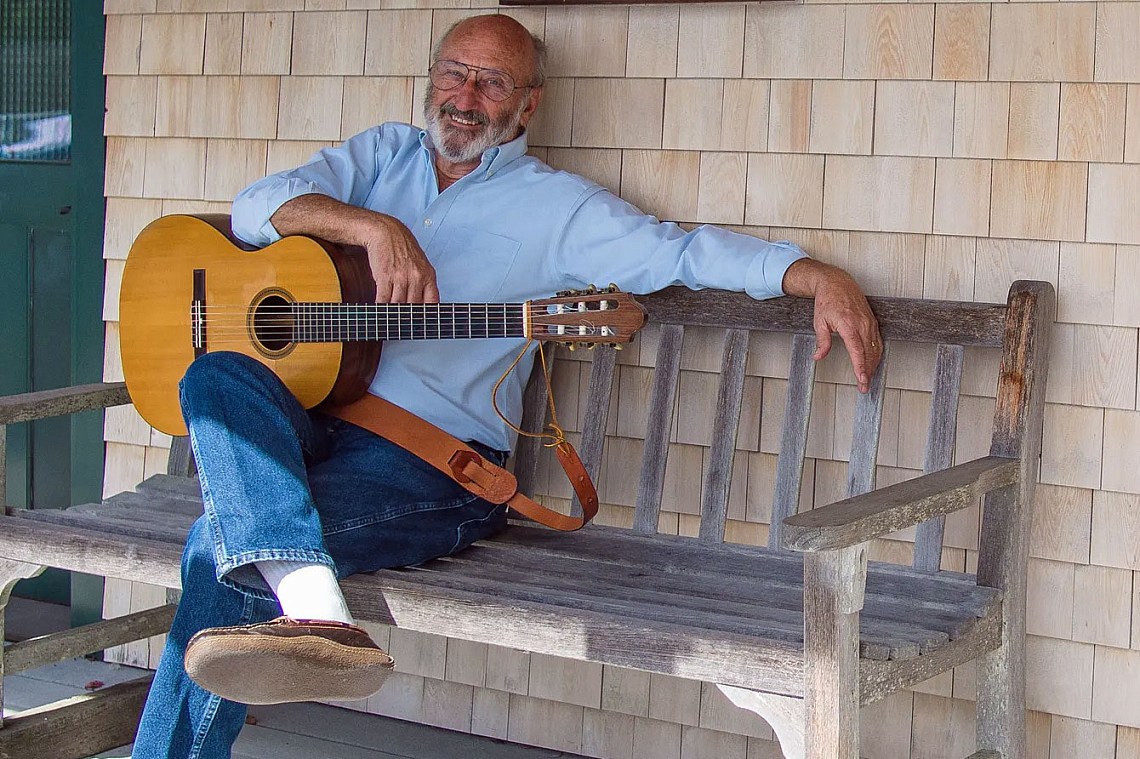
As a member of the trio Peter, Paul, and Mary, Noel Paul Stookey was one of the leading voices for social change in the American folk movement of the 1960s through timeless songs like "Puff, The Magic Dragon," "If I Had A Hammer," and "Leaving On A Jet Plane. With a little help from above, Stookey penned the intimate number "Wedding Song (There Is Love)" for his bandmate Peter Yarrow's wedding in 1969. Two years later, he introduced the song to the public on his debut solo album, Paul And, and it became a popular choice at wedding ceremonies for years to come.
A self-described "slave to melodies," Stookey can't help but find inspiration wherever he goes, whether it's the beep of an ATM or the trill of an iPhone's ringtone. Nearing 87 years old, he's still making innovative music with activism in his heart. His latest projects include Neworld Sampler, a collaboration with fellow artists, and Fazz: Now & Then, an album blending folk and jazz elements - a style he's been cultivating for decades.
In this episode, Stookey also discusses the process of working on his memoir, which offers an intimate look into his life, music, and the social justice commitments that have defined his career.
A self-described "slave to melodies," Stookey can't help but find inspiration wherever he goes, whether it's the beep of an ATM or the trill of an iPhone's ringtone. Nearing 87 years old, he's still making innovative music with activism in his heart. His latest projects include Neworld Sampler, a collaboration with fellow artists, and Fazz: Now & Then, an album blending folk and jazz elements - a style he's been cultivating for decades.
In this episode, Stookey also discusses the process of working on his memoir, which offers an intimate look into his life, music, and the social justice commitments that have defined his career.
How The Neworld Sampler Came Together
I don't think it would have happened if I hadn't received the "I'd Like To Buy Jesus A Beer" song from the writer J.T. Thompson down in Nashville. I was so struck by the honesty and simplicity and straightforwardness of the message. Particularly in a contentious era where everybody feels like they've got a claim on religion and not always using it for love's purpose. I just found it a refreshing tune. So, I gave it to the guy who does most of my recording near Portland, Maine, and he did a beautiful rendering of it. Then that caused me to think, Well, okay, I've only got two or three tunes that I could put on a sampler, but who else have I got here? And to be able to go to a dulcimerist like Kevin Roth, and people that I've had a long relationship with like Peter Campbell, who's Australian, it was fun putting the sampler together. It was probably a cheap out for me, only just contributing the three songs, but I had fun overseeing the beautiful artwork by Sally Farr.There's A Time And A Place For Jazz
I would say right now Fazz is my most complete work to date. Particularly because I'm very jazz-oriented - always have been - and used to bring it into the trio Peter, Paul and Mary's work quite often, sometimes inappropriately. I can remember standing backstage with Peter warming up, and he reached over and touched the neck of my guitar and said, "No, you don't play major sevenths on 'This Land Is Your Land.'"That started a chain of self-consciousness that was pretty good and probably a good message for a lot of singers-songwriters that you can play any chord you want, but it should be appropriate to the tenor of the lyric. That became a rule of thumb for the way the trio even worked out our harmony parts - if it suited the nature of the lyric, if it helped to make the point that the lyric was trying to make, then by all means, let's do it. Let's do the counterpoint there, or let's back off and let one voice say it, or let's make it a duet because there's more than one person saying it.
How Peter, Paul And Mary Became Voices For Social Change During The '60s Folk Movement
An interesting transition happened. There was no doubt that we had inherited a legacy from Woody Guthrie, from Pete Seeger, the Weavers, Cisco Houston, and Josh White. And Greenwich Village in the early '60s was such a bubbling pot of claims for equity, recognitions of inequality, and particularly, as history has shown, the Civil Rights Movement. So, by 1963, it became pretty obvious that songs like "Blowin' In The Wind" and "If I Had A Hammer," performed for a quarter of a million people at the Lincoln Memorial, was a fitting testimony. That's when the interesting transition began to happen because we realized that it was really a pilot for human rights. Civil rights was a lot bigger than just issues of culture or race. There were inequities - payroll inequities, there were inequities on the climate, there were inequities in our war in Vietnam. There were commitments that were made on a governmental level that hopefully could be addressed by a public level and withdrawn. So, the width of the musical expression looking towards social concerns and causes broadened considerably.Did God Provide "The Wedding Song" As A Wedding Gift To Peter Yarrow?
It was like an answer [to a prayer]. I mean, I didn't say, "Help me write a song," or, "Give me a song." I asked specifically, "How would You manifest yourself at Peter's wedding?" Uh, duh:I am now to be among you at the calling of your hearts,
rest assured…
I think the confusion comes from my self-consciousness, as my wife said to me, "They're not going to understand when you say, 'I am now to be among you.'" She didn't say this, but the implication was I would be revealing myself as the Second Coming, and that was not the point at all. So I changed the lyric to "He."
But isn't it interesting over these past 50 some-odd years, the realization that the holy, love incarnate is genderless or gender-full! It embraces and encompasses all of life. That has become, in a sense, more commonly accepted now. There was a bumper sticker I had: "In Christ, there is no East or West, but it's wise that we remember in God there is no gender." I can't remember how it went on, but it rhymed.
The more you live out a belief in your life and it comes true and pays back with an honest benefit of a relationship between you and all peoples and the world around you, the more it sinks into your very being. I can't help but be thankful that what I discovered in the early '70s has really turned into a way of life and an outlook about other people, and an outlook about my music.
I keep thinking, Noel, just write something light and airy. So every once in a while, "The Dimpled White Orb" will emerge, or "The Virtual Party." But still, as I look back to the lyrics of many of the songs that I've written, I find it kind of perplexing that I would take the time to be self-effacing in the hopes that it would teach a lesson to somebody from what I've learned. I mean, the character in "The Virtual Party" climbs back into his bed after hanging out on a talk on the internet to discover that his wife has actually gone to the same site on the internet and used an alias, and that was the woman that he was trying to escape from on the internet. Those kinds of wonderful paradox-coincidences that happen in our life, I truly have come to embrace, and I look back at a kind of cosmic truth that exists in all of them.
"Wedding Song" Inadvertently Helped Launch The Music To Life Organization
My daughter Liz has created an organization called Music to Life, which had its early beginnings just inviting singers-songwriters to submit songs of social concern, and we'd review them with a panel that had some great folks on it, like Judy Collins. We had performances of these songs at Kerrville Folk Festival for about eight years running, and even put out three, maybe four CDs. But my daughter began to notice that the singers-songwriters had an activist heart as well as an activist talent, and they wanted to bring their concerns to their respective communities, much less make a national expression. So, homelessness, drug addiction, incarceration, climate - the concern for that became sponsored by neighborhood organizations that faced it directly. Instead of just performing at a benefit dinner, these songs, sometimes even the art of song-making in many cases, became the therapeutic method by which many people in the neighborhood could express their concerns.Interestingly, Music to Life received its first funding from the Public Domain Foundation, which was the organization I self-consciously created because I knew I couldn't claim credit for the writing of "The Wedding Song," or felt that I shouldn't. I wasn't concerned that a bolt of lightning would come down from the real author, but nonetheless, I felt it was a really good way to make use of the proceeds for a song that I just had to give away. Public Domain initially funded Music to Life and then Music to Life now stands on its own with national sponsorship, and over 400 artists signed up for all various kinds of programs that are offered by the organization. We also received a half-million-dollar grant from the Mellon Foundation last year. So, it's well on its way to establish a kind of haven for musicians who are saying, "Hey, I write all this music, I'm concerned about the world around me. Where can I take it in an age when everything seems to be maybe not disco, but it seems to be very 'Taylor Swift-y.'"
That's part of the folk process. Songs about self-realization and relationship to other human beings is an important part of the musical heritage, but at some point in your musical productive life, you begin to want to address a larger picture.
The Protest Songs "El Salvador" And "In These Times"
"El Salvador"1 really came out of Sojourners magazine in an article by Jim Wallis. I was so moved by it. It's practically word for word...If the rebels take a bus on the Grand Highway,
the government destroys a village miles away
The man on the radio says, "Now we'll play South of the Border."
And in the morning the natives say,
"We're happy to have lived another day."
Last night a thousand more passed away in El Salvador
And then the trio visited El Salvador and saw the fruits of that description. It was probably the most contributive song because El Salvador was a pretty narrow focus.
But a most recent song of mine called "In These Times" addresses everything from politics to climate, and it says that we've been given a gift and that we have to honor that gift by being respectful of each other and passing it on. And yet it addresses in subtext the ship of state is drifting and it's getting hard to steer. It's a complicated issue, but the meaning is pretty clear - each of us is who we need to get to there from here. Those kinds of coalescing thoughts show up in a lot of my songs. But I think that's probably the best one that I've written that brings climate, political, and caring issues together.
Noel's Views On Contemporary Folk Music
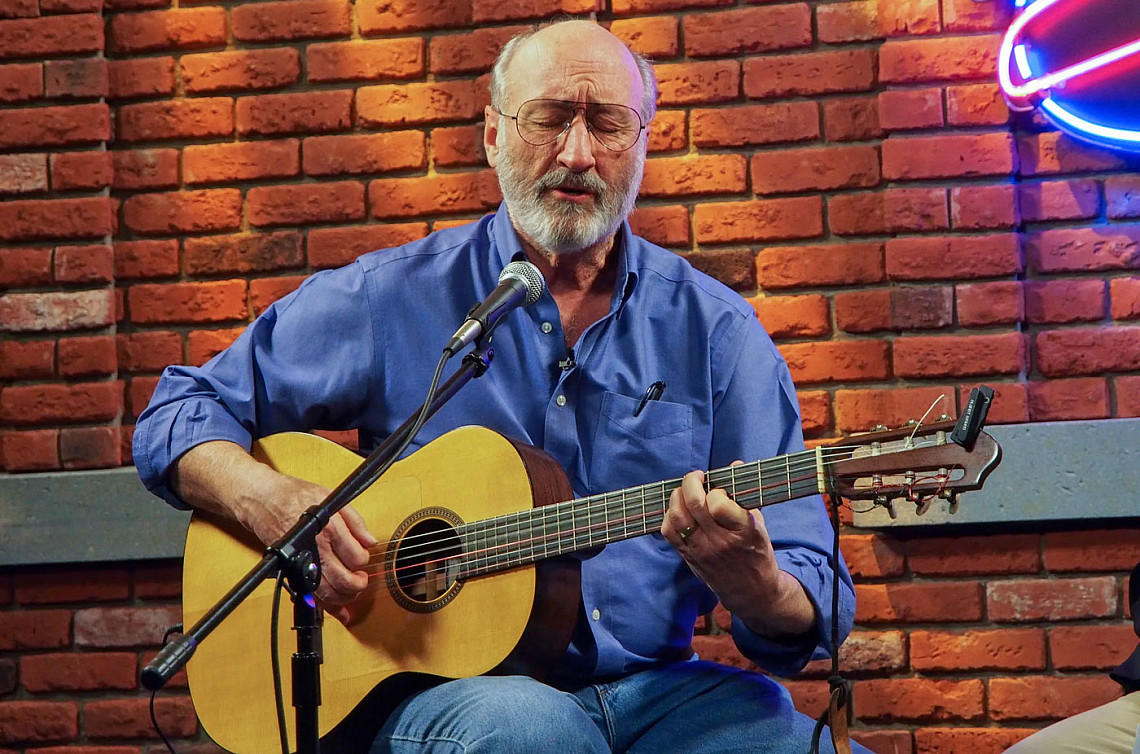
I think that the more complex the world has become, there is a real hunger for intimacy. It may very well turn out that we return to coffeehouses, or maybe to podcasts like yours, where there's some actual performance that is very low-key - one instrument, two instruments, a trio of voices maybe - singing songs with which there's a shared concern. But folk music on the popular stage - I mean, what is the popular stage anymore? You know, CDs are a dead issue, radio is scrambling, except maybe for community broadcasting stations. So, it's the internet and programs like yours that offer that kind of intimacy that has been missing since the days of the coffeehouse.Connection Is Complicated
There's a wide chasm between singing for a quarter of a million people and singing with your arms around somebody who's experienced great loss. And those are the gaps, those are the moments. I really don't sing "The Wedding Song" at other people's weddings all that often. I sing it for family, I sing it for close friends. And, of course, those are emotionally loaded moments for the occasion. But there's a kind of a detachment that I think maybe I'm unusual in that regard, because you can't really get consumed by the emotion while you're performing the song. I am just happy for the moments that I do touch folks with something. I've heard, "How could you possibly know that that's how I was feeling?" I think other singers-songwriters probably have those shared experiences. That's very reassuring that you're on the right track, that you're following your heart and your heart is coming through your lyrics.
He's A Melody Man
I am an absolute slave to melodies - whether they're inferred or what… and I take almost each suggestion as a challenge. Where does this go? My mind is constantly evolving and following melodic lines.I think maybe if I do another album, I may do one called Instrumentality, where I actually take all the ringtones from your iPhone and create longer pieces based on that melodic structure. Because there's some very clever music in there, but it's never long enough. It hasn't been explored fully. So music is a constant in my life, whether it becomes guitar chords, or whether it's on the Manulenjo.
I wrote a song called "Dance To The Manulenjo," which is an effort to remind us of the complexity of United States citizenship, and how we come from such varied places. This instrument comes from an inspiration of a banjo, a ukulele, and a mandolin, but it's tuned like a 12-string in so far as they're doubled strings and the bottoms are an octave, so that's what provides that kind of ringy sound to it. And that's been fun. So Instrumentality is quite possibly the next album that I'll do which may not have any vocals.
I do occasionally drop instrumentals into the albums that I have done, so I might collect some of them. I learned on the ukulele, which was a great way because it takes three notes to make a chord, to distinguish a chord. So the fourth one is available to augment, to double, to play as a leading tone, to play slightly dissonant. I always recommend to people that are just starting out to pick up a ukulele. It's a great teaching tool.
Noel's Autobiography
I'm working on an autobiography and being helped by a woman named Jeanne Finley. It's very interesting writing a biography as we move into this pre-Trump, post-Trump era, not knowing which way it's going to go. We have two or three chapters to go and yet so much of my music begs to differ with his particular perspective. With the Substack that we've created called Strings, which speaks to the resonance and the connection of folk music to a readership, I can't help but kind of lean left as I write the Substacks and try to reveal as much of the book's direction as possible. But it's very interesting when one reviews one's own life. It's far easier to talk about years that happened when you were growing up, and memories that you have from that period of time, than it is to talk, with any kind of depth or meaningfulness, about something that happened a half hour ago, or a week ago, or a month ago. So, it's harder and harder to write these last chapters.One of the most compelling things that I find in reading is the evolution of thought - following the authors growing up, because I'm inevitably drawn along with the author. I just started reading Judy Collins' latest book, Singing Lessons. It has a very powerfully written first chapter about the death of her son. It is a good lesson to be writing about one's life, whether you keep a journal or whether you're writing an autobiography.
December 11, 2024
Subscribe to the Songfacts podcast, part of the Pantheon Network
For more on Noel Paul Stookey, visit noelpaulstookey.com
Footnotes:
- 1] Stookey wrote the 1982 song as a critique of the United States' involvement in the Salvadoran Civil War, and Peter, Paul and Mary recorded it for their 1986 album, No Easy Walk To Freedom. Its message was controversial and drew boos at the trio's concerts. (back)
More Songfacts Podcast