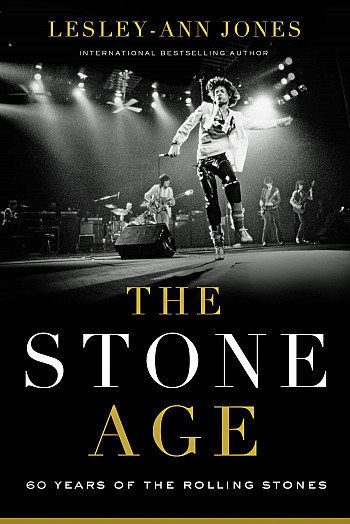
Lesley-Ann Jones, a British journalist and presenter, has a unique perspective on The Rolling Stones forged from her time covering the band and interviewing many of their members and associates. In her latest book, The Stone Age: Sixty Years of The Rolling Stones, she goes beyond the well-worn tales to explain what was really going on in their lives and music.
We used our time with Jones to get her insights on some Rolling Stones songs that aren't often discussed, like "Midnight Rambler" and "Ventilator Blues," and to get her take on a few other topics, including what led to the demise of their founder, Brian Jones, and if Keith Richards really did get blood transfusions to purge his system.
Jones also had a role in the story of Bill Wyman's relationship with Mandy Smith. The couple started dating when Wyman was in his late 40s and Smith was just 13. They got married when she turned 18, but divorced soon after. If you're wondering how he got away with it, Jones has the answer.
You can listen to the episode in the player below (or on most streaming services) or read the excepts from the transcript.
We used our time with Jones to get her insights on some Rolling Stones songs that aren't often discussed, like "Midnight Rambler" and "Ventilator Blues," and to get her take on a few other topics, including what led to the demise of their founder, Brian Jones, and if Keith Richards really did get blood transfusions to purge his system.
Jones also had a role in the story of Bill Wyman's relationship with Mandy Smith. The couple started dating when Wyman was in his late 40s and Smith was just 13. They got married when she turned 18, but divorced soon after. If you're wondering how he got away with it, Jones has the answer.
You can listen to the episode in the player below (or on most streaming services) or read the excepts from the transcript.
Working on The Stone Age: 60 years of The Rolling Stones
I had such ambivalent feelings about them. I've always loved the music, but I have not always loved the behavior - the way they've treated people, the fallout of their lives, the victims. I've known some of them and I've known women and children of theirs as well, and also other people who've been used and abused by them. There doesn't seem to have been an exemplary human rights record among this band.I thought for the longest time that it was too big a subject for me, but then of course we grow older and more experienced and grow into ourselves as writers and become more courageous about tackling the big "untackle-able" subjects. I just reached a stage that happened to coincide with the forthcoming 60th anniversary, which was the 12th of July, 1962 when they played their first-ever gig as almost the classic lineup. They didn't yet have Charlie Watts on drums, they didn't yet have Bill Wyman on bass, but it was that core lineup of Mick, Keith, and Brian Jones that played together with another drummer that night and another bassist. They were called "The Rollin' Stones" without the G on the end. That was the start of it all really.
Brian Jones
He died at the age of 27, so all of his life was his early life, and it was extinguished at a very early stage. And the more I discovered about him by talking to people who had known him, and reading, and then digging in and trying to find people who'd been around, the more I found out, the less I was surprised by what happened. He was obviously a very fragile individual with a dysfunctional home life, which is the case with so many rock stars I have found over the years when I'm writing about these people. There's always a major reason why they head for rock and roll, and it's usually dysfunction, it's usually abuse, it's usually a void - some massive void within them, which they are desperate to fill. And we know about voids: The more you try and fill a void, the less you're going to fill it. It's impossible to do.But Brian was damaged, incredibly damaged. And the main reason why was that his younger sister died when she was two years old and nobody ever discussed it with him. The parents contained it, they kept it to themselves. They didn't share with him what had happened and why. She was there one day and the next day she went away and she wasn't there anymore, and he carried the burden of this. He believed that it was his fault in some way. They were the dead spit of each other as well. So, this little angelic, blonde, round-eyed child disappeared, and he carried the guilt of that for the longest time.
So, he went into himself and he wasn't loved. Nowadays, we would nurture a bereaved child - we would acknowledge, first of all, the bereavement of a child rather than say, "Oh my goodness, those parents, those poor people, they've lost their child." We would also embrace the rest of the family and say, "They're not the only ones who lost that person. These little kids lost their sibling as well." There has never been very much research into bereaved children. Even now, there isn't an awful lot, but Brian needed that and he wasn't offered that.
He went into himself and became a very introspective child, so music was the obvious release for him, and it turned out that he was gifted musically. He was one of those people who could pick up more or less any instrument and get a tune out of it, teach himself how to play it. He did have lessons at school and he did play in orchestras and that kind of thing, but he was better left to his own devices. Nobody was teaching guitar at school back then. That was something you learned by yourself, and he did learn it by himself.
He lived in a place called Cheltenham in Gloucestershire, which is on the circuit, on the jazz map. So musicians coming in from America, for example, they would do some gigs in London and then they would go outside of London and they would go on the tour and visit all the obvious places where there were aficionados, where there were people who were jazz fans. And Cheltenham, where Brian lived, was one of the places on the map where visiting jazz musicians came and there was quite a bit of a jazz scene. So he got himself involved with like-minded people and he would go to see musicians who came to town, and that really fueled his interest. He was able to park his void and park his negative feelings and pour all his emotions and needs, desires, into music. He was also, how can I put this nicely? He was prolifically into women.
Corey: I read that Brian Jones had five known children, the first couple of them by the age of 17.
And all by different girls. Yes. All born while he was still a teenager. And he didn't stay with any of the mothers and he didn't support them financially. He wasn't able to - he wasn't yet in a position to do that, so he became a pariah in a small, well-heeled town. He was kind of "lock up your daughters" material, you know. He was not somebody that good families wanted around even though he came from a good family himself.
So there were reasons to run this boy out of town and reasons for him to escape to London, which he did pretty soon, and started turning up at the Ealing Jazz Club, which is a club in west London, which is still there actually. He would start to get involved with musicians and put feelers out because he wanted to form his own band, and eventually collided with these two boys from Dartford - which is Southeast London, a bit of a low-heeled place, really - Mick and Keith, who'd known each other since they were 5, they'd gone to the same infant school. They separated for a while, went to different schools after that and then bumped into each other again on a railway station platform. And they were carrying the same kinds of blues records. In those days, everybody went around with their albums in a plastic carrier bag or under their arm, and you could see what people had. So it was kind of a badge of honor to carry your albums. Even when I was a teenager, further down the line, when we started having parties at friends' houses from the age of about 15, you'd all go along with your albums and whoever had the latest Cat Stevens or Elton John or whatever it was, this was a prize to be shared.
But it was the same thing for them with American blues records. So they found each other again.
You had these two factions, the Brian Jones faction and the Mick and Keith faction, and they came together. They converged, and eventually they formed a band together. But Brian was the essence of the early band. Brian was the official founder and he named the band. Their second manager, Andrew Loog Oldham, decided they had to stop doing covers of other people's music and start writing their own songs. The myth goes that he locked Mick and Keith in the kitchen and said, "You're not coming out until you've written a song." Whether it's true or not, we don't care, because it's quite a good story. But at that point, Brian started to lose his power because Brian could not write. Brian could play anything, but he could not write a song to save his life. Neither could he sing, so he then is relegated to the back seat and it becomes Mick and Keith's band.
It was a great big turning point because he could see his control slipping away, and yeah, he hit drugs, he hit booze, he started abusing girlfriends and losing control to the point that he became a liability. But on the other hand, as Bill Wyman, their bassist at the time, said, "Well, Keith's taking more drugs than Brian. Keith's outta control, way more than Brian." So there wasn't really justification to kick him out of the band, except when it came to returning to America to tour and Brian had a drugs case hanging over his head - a pending case. He wouldn't have been allowed in. Immigration would've turned him away. And at that point, the others turned around and said, "Well, we have to get rid of him."
He died in '69, and was going off the rails by '67. But their career was burgeoning at that stage and they were pouring through the albums, pouring through the singles and the tours. It was a relentless schedule, so there wasn't really an opportunity to take a step back, go on holiday, sit around, discuss the way this was evolving.
There was a rumor that Brian was planning to leave The Rolling Stones but to take the name with him and launch a supergroup featuring Jimi Hendrix, Eric Clapton, and other musicians. He would have a Rolling Stones Mark II.1 Mick and Keith were terrified that this was going to happen because it would wipe out everything they'd achieved as The Rolling Stones. They would've had to start from scratch again and the momentum they had built up would've been lost. So they were desperate not to lose the name to Brian, who had come up with the name in the first place, which I think led to some of the rumors that they had Brian "done in" as it were.
Brian Jones Getting Booted From The Band
It was ruthless the way it was handled. He needed help and instead of just kicking him out, somebody - not them because they also were young and inexperienced - but somebody should have taken control and got Brian the professional help that he needed. And he wasn't the only one. Keith was out of his brains most of the time. The thing about Keith was that he was able to step up in the studio. Even being out of his brains he could go into a studio and be able to perform. Brian couldn't do that. He'd be slumped in a corner. And he was quite far gone at that stage. He needed medical attention and he didn't get it."No Expectations"
It's one of those interesting songs. This was the original B-side of "Street Fighting Man" and it's on the album Beggars Banquet, 1968. It's a very blues-driven song, it's got a sadness to it. There's an inevitability about this song. You've got Mick with this very controlled vocal, sort of accepting. There's a resigned note to Mick's voice in this song. Keith is on acoustic guitar, and even that is very mournful. You know, you can make an acoustic very mournful, and he really does. He gets inside the guitar here. And the guitar, it reminded me of "Still My Guitar Gently Weeps." A guitar is crying in this track and that is audible to me, the sadness.You've got Nicky Hopkins on this track, the incredible pianist with the magical tinkering keys. He worked with The Rolling Stones so much and he was a prodigy, but he had an illness - he had Crohn's disease from a very young age, which meant that he wasn't able to go on the road. So even though he played on many, many Stones recordings, right up until I think Tattoo You in 1981, he wasn't able to tour. He went out a couple of times but he needed hospitalization quite often. For about a year and a half he was bedridden.
And they also had Ian Stewart, who was one of the original lineup. "Stu" as they called him. Andrew Loog Oldham kicked him out of the band because, he said, he's one too many, and also his face doesn't fit. It literally didn't fit. He was a great big roughly hewn Scot, and he just didn't match the others visually, which seems very harsh, but that's what happens.
This is Brian's song really. It's kind of Brian's last lament. He comes through loudly and clearly with this beautiful slide guitar, which once it's pointed out to you, it's all you can hear. The ghostly remnants of Brian come back to life every time you hear this. And it is strange because of that.
"Midnight Rambler"
This is from the album Let It Bleed, 1969. This is the song about the Boston Strangler, which kids today would go, "Who the hell is the Boston Strangler?" But it was a big story in the 1960s. There was a series of murders in Boston, Massachusetts, and it was said to be this prowler who came out at night and got into women's apartments, and the notion was that they were letting him in and he would then rape and strangle them. So this song is about this character - Albert DeSalvo was his real name.The lyrics of "Midnight Rambler," they're fairly harmless, really. A verse:
Did you hear about the midnight rambler?
Well, honey, it's no rock and roll show
Well I'm talking about the midnight rambler
Yeah, the one you never seen before
There's nothing offensive there. It's the theme. So you sing that today and it's just a great song about the midnight rambler, just some random guy. Nobody remembers the Boston Strangler. But it's interesting how the controversy follows them around.
Jagger on harmonica on this is absolutely mind-blowing, just ridiculously brilliant. Brian plays congas on this, obviously you've got Charlie on drums. They have often featured "Midnight Rambler" in their live sets, and yes, it has been criticized down the years for celebrating violence and acting out a rape/murder and so on. I think the wider implication is that women's sexuality is under the control of men, which wasn't being challenged in the 1970s, but it's certainly being challenged today. So maybe this song has lost its relevance to some extent, but it's still a great rock track. It's still a wonderful piece of performance in which they lose themselves, and it's a sight to behold The Stones playing this.
There's a flow, there's an electricity to this track and there's dirt to it. There's sex to it. Everything about being rock and rollers is fizzing out. It's like shaking a bottle of champagne and then opening it. It all comes out - all of their influences, all of their energy, all of their inspiration, and all of their talent as well.
Beggars Banquet
It doesn't speak to me. Apart from a handful of singles, The Stones albums don't speak to me until Exile On Main St., which is where I came in. I got so deeply immersed in that album, but a bit later down the line, because I was just too young to get it in real-time. So when I got to it, I was dismissive of everything that came before, apart from their hit singles, which kind of pervaded the charts and excited everybody. I'm the person who discovered The Beatles backwards because I was too young when they were out there doing it. I came in at Wings and worked my way back.I often wondered what it would've been like to be that bit older and to have been immersed in the explosion of these two bands and the rivalry that was built up to such a degree in their music press, even though they were friends, and even though The Beatles were giving them songs in the first place.2 That rivalry to this day is magnified and exploited, let's say. Mick is encouraged to say stuff like, "Where are The Beatles? They haven't been out there since 1970. We're still out there doing it." But that's overlooking the fact that McCartney tours the world every two years and will until he drops down dead. So effectively, it's The Beatles. If you think about it, we have only two-fifths of The Rolling Stones, so that's not technically The Rolling Stones. We have half The Beatles. We have Paul and Ringo. They don't go out as The Beatles because it wouldn't be The Beatles without John Lennon. But you have to say, are The Rolling Stones The Rolling Stones without Brian Jones? On the 3rd of July in London, they performed on the 53rd anniversary of his death. There was not a mention. They did not say anything. They include a lot of tributes to Charlie Watts in their current show, but there wasn't even a nod to Brian Jones, and I was very disappointed by that.
I think there's guilt. When they were only young men in their 20s and they were drugged up to their eyeballs the entire time, they weren't capable of thinking too deeply about what was going on around them. But as they've grown older and they've had more and more children and they've had grandchildren, they've had great-grandchildren, and they've become elder statesmen now, and they've got a long, long life - collective and personal lives to look back on and to think, OK, that happened. Maybe that was our fault in some way. Maybe we should have done something to help Brian. And maybe we are responsible. But they don't want to think about that because if you take on board that kind of guilt, that means you've got to do something about it. They're never going to come out and say, "Actually, Brian died because of us." They're not gonna say that. So it's easier for them to ignore it and pretend that they had nothing to do with it. You know, Mick and Keith didn't even go to Brian's funeral.

Keith Richards' Blood Transfusions?
He does always say, and I love this phrase: "I will drop down dead live on stage," which is a great paradox, isn't it? I so want to be there when that happens. Not in a macabre way, not because I'm a ghoul or anything. I just want to be there. It's a part of history. Keith Richards has to die with his boots on. He has to die live on stage.You know, there was a rumor kicked around for years that was greatly disputed and he denied it. It was that he used to go to Switzerland to a clinic to have his blood changed because he would be so immersed in heroin and whatever else that he was going to die if he kept this stuff in his system, so he had to clean up. So he'd go to this clinic and they would drain his blood and replace it. Now, a blood transfusion is not that unusual a thing. This happens routinely in surgery. And it turned out to be true!
I interviewed a guy called David Ambrose, he used to be head of A&R at EMI, and we were chatting about this. I said, "Do you reckon there was any truth in that?" He said, "I know that there is." He says, "It wasn't Switzerland, it was London."
There was a clinic in Seymour Place, which is near Baker Street, where Madame Tussauds is - the Wax Works - and he says, "I used to go to this clinic on a regular basis to have the same treatment. I would sit in the waiting room and Keith Richards would be sitting next to me, seeing the same doctor." And he said, "I know that he was doing this for a fact."
So Keith can deny it as much as he likes, but there were witnesses. The other great one was the story about after his dad Bert died. It was all over the papers at the time that he smoked his father's ashes. Keith sort of explains it in Life, his autobiography. First he denied it massively and said, "No, how disgusting, what a terrible story, of course I didn't do that, it's a joke." But then in the book he explains how he had arranged to bury the ashes, and there was a planting of an oak tree. He wanted to breathe new life into his father by planting a tree as a monument. So he's doing this, the ashes are on the table, and when he's taking the top off, there's suddenly a huge gust of wind and some of the ashes come out of the urn and they go onto the table. So he said, "I did what anybody else would've done, I licked my finger and wiped them up and consumed them."
And this becomes "Keith Richards smoked his father," the idea being that he would've put the ashes into his spliff and smoked him away.
"Ventilator Blues" from Exile On Main St.
It's so infused with Muddy Waters and Howlin' Wolf. It's got the majesty of Mick Taylor who contributed to this song - he created the riff and, quite rarely, he's credited as co-writer of the song, though he never got the money, mind you, and this is a beef of his all these years later, because he lost his marbles a bit at the time and he was never remunerated as he should have been.There's all kinds of stuff going on here. You've got Keith on slide guitar because Brian's no longer with them. Mick's vocal is double-tracked, which is quite rare for a Rolling Stones recording. They got Nicky Hopkins again on the lightning chills. Bobby Keys came up with this weird rhythm, which Charlie Watts had to learn by having Bobby clap it for him. That was a rare thing for Charlie because he was such a natural drummer. It was quite rare for him to not get the rhythm and have to have somebody else pace him through it.
The thing about this song, it's very heavy, it's got a seductive drama to it, it's quite draining to listen to. But it's very Moorish, and it's quite different in flavor from the rest of the album. If you compare it, for example, to "Tumbling Dice," which is a very light, bouncy, laid back, resigned kind of a song. "Ventilator Blues" gets under your skin, into your blood, and you don't want to listen to it all the time because it will bring you down. This is an enervating track, but it's an important track because it shows The Stones in a light that does link them directly back to their original influences and inspirations.
I have a theory about the title. Take this little bit:
When your spine is cracking and your hands, they shake
Heart is bursting and your butt's gonna break
Woman's cussing, you can hear her scream
Feel like murder in the first degree
Ain't nobody's slowing down, no way
Everybody's stepping on their accelerator
Don't matter where you are
Everybody's gonna need a ventilator
I think the inspiration of this came from the dungeons in Villa Nellcote in Villefranche where they were at the time. Keith had rented this house. There were all kinds of rumors about it, that it was a Nazi headquarters during the Second World War. It wasn't. But in the dungeon, it had air vents, like what we call "air bricks" in the walls as an early ventilation facility to allow air to escape, because the heat was brutal in that under-floor space and the walls are very thick. And it was airless - the air wasn't circulating. So everybody's down there in next to no clothing, sweating their way through these recording sessions, and it was a den of iniquity - everything was going on down there. And I think the word ventilator might have been inspired by these holes in the walls.
I would've loved to go there. It's privately owned now, you can't get close. It's behind very high fences and gates and you can't even see in anymore. But Villefranche, which is the little seaside place that it sits above, is still very much as it was during those days. It started out a little fishing village. It's developed a bit, it's a bit of a resort now, but Keith kept a speed boat down in the harbor called Mandrax, which tells you everything you need to know, doesn't it? And he had fast cars down there. They used to tear around town and terrorize all the little black-clad widows in the town screeching around in sports cars. Imagine being those local people and suddenly these rock and roll terrorists move in and take over.
But going back to the house, I've read that the basement was divided into lots of little spaces. There are lots of little cubby holes, which lent itself quite well to the recording process because you could put your keyboard player in here, you could put your drummer there, you could put your sax player in there, guitars over here, and separate everybody out. And of course they were recording on what they called the mobile, which was their mobile recording truck, which was a rarity at that time. People didn't have these kind of things. A few bands did also borrow it from them over the years and used it too, but they had it parked outside on the driveway and the album was being recorded into this truck.
All hell broke loose in that place. I mean, the stories! I knew a chef, a guy called Gerard Monsiniak, who came in as one of the chefs at Villa Nellcote, and he said that on any given day, there'd be Yoko Ono wandering up and down staircases, completely nude. There'd be kids wandering around who weren't potty trained, who were just dropping their doings all over the place and somebody was running along behind them, scooping it up. But most of the time, people were completely out of it - there were more than 20 people there at any given time and they all needed feeding at ridiculous hours of day and night, because their preferred recording routine is to record through the night. Recording through the night, you're gonna need feeding, so you've got these twilight chefs who are having to produce banquets at no notice.
So it sounds like it was complete debauchery, but there's something fascinating about that. They were literally living in exile. They had to leave the UK because the rate of taxation had gone through the roof and they found that because of management crises and so on, they had been working their asses off for the past however many years but they didn't actually have any money. And if they stayed, her Majesty's government was gonna take the rest of their money off them, so they had to leave.
Mick Jagger was just recently married to Bianca, his wife, who was living in Paris because she refused to live down in the south of France with all this going on. She was a very swanky and sophisticated person who was not gonna put up with all this. So Mick was having to commute from Paris, which is a distance, and that puts him out of the frame. And then Bill Wyman's rented a villa somewhere else along the coast. And this den of iniquity is the sort of party central... well, debauchery central. And then with Bianca back in Paris, Mick has free rein and he's taking advantage of anything and anything that's coming through town.
Bill Wyman
A big unanswered thing is the reason why Bill Wyman left the band in 1991 but The Stones didn't announce it to the world until two years later. They tried to make it seem that Bill had had enough of touring and that he wanted to concentrate on family life and he was walking away. Wind back to 1984 when I was with him at the Daily Mirror Rock and Pop Awards at Lyceum, the Strand, London. He was there handing over an award to Alexis Korner's widow Bobbie. There was a ceremony, there was dinner, and then there was dancing, and these two girls get up and start whirling around the floor like dervishes, and Bill is entranced. He's watching these two girls, and sitting on the other side of me is Midge Ure, the singer in Ultravox. He lounged across to me and he said, "I think we've just lost him."And one of these girls is Mandy Smith, the other one is her sister Nicola, and Bill took up with Mandy. He constructed a mixed-age friendship group, one of whom was me, to conceal the fact that he was having an affair with a child. And people have said to me over the years, "You knew about that, how come you never told anybody?" Well, I knew that they were in a relationship, what I didn't know was how young she was.
I think we all assumed Mandy was about 18 or 19. She was very sophisticated. She was tall. She was made up. She dressed in very adult clothes. But as it turned out, he moved her out of her state school in North London and enrolled her at a fee-paying school in Chelsea, just down the road from his flat on the King's Road. She was going to school and coming home in her school uniform. The headmistress of that school knew how old she was, the bursar in control of the finances of the school would've known how old she was because her date of birth would've been all over everything. Her mother certainly knew how old she was, and nobody did anything. We only discovered Mandy's age when Bill threw a birthday party for her. It was in the restaurant underneath his flat, and there was a huge circular birthday cake with one candle in the middle. One of our friends said, "Tell us how old are you today?" And she said 15.
We all did the math. Bill had been seeing her for the past few years.
When I was researching the book I interviewed a High Court judge and I said to him, "How come Bill Wyman's not inside? How come he never went to prison?" And the reason is that nobody made a formal complaint against Bill - not her mother, not Mandy herself. And then somebody else said, "Well, yeah, but when she was 18, he married her." Well, that doesn't absolve him of a crime. That doesn't negate what's happened.
August 24, 2022
Get The Stone Age: Sixty Years of The Rolling Stones at lesleyannjones.com
Subscribe to the Songfacts podcast, part of the Pantheon Network
Further reading:
Rolling Stones Songfacts
The Life And Death Of Brian Jones
On The Road To Exile With The Rolling Stones
Footnotes:
- 1] Deep Purple imprinted the idea of different lineups labeled as "Marks." Mark III, for instance, is when David Coverdale became their frontman. (back)
- 2] "I Wanna Be Your Man." (back)
More Songfacts Podcast