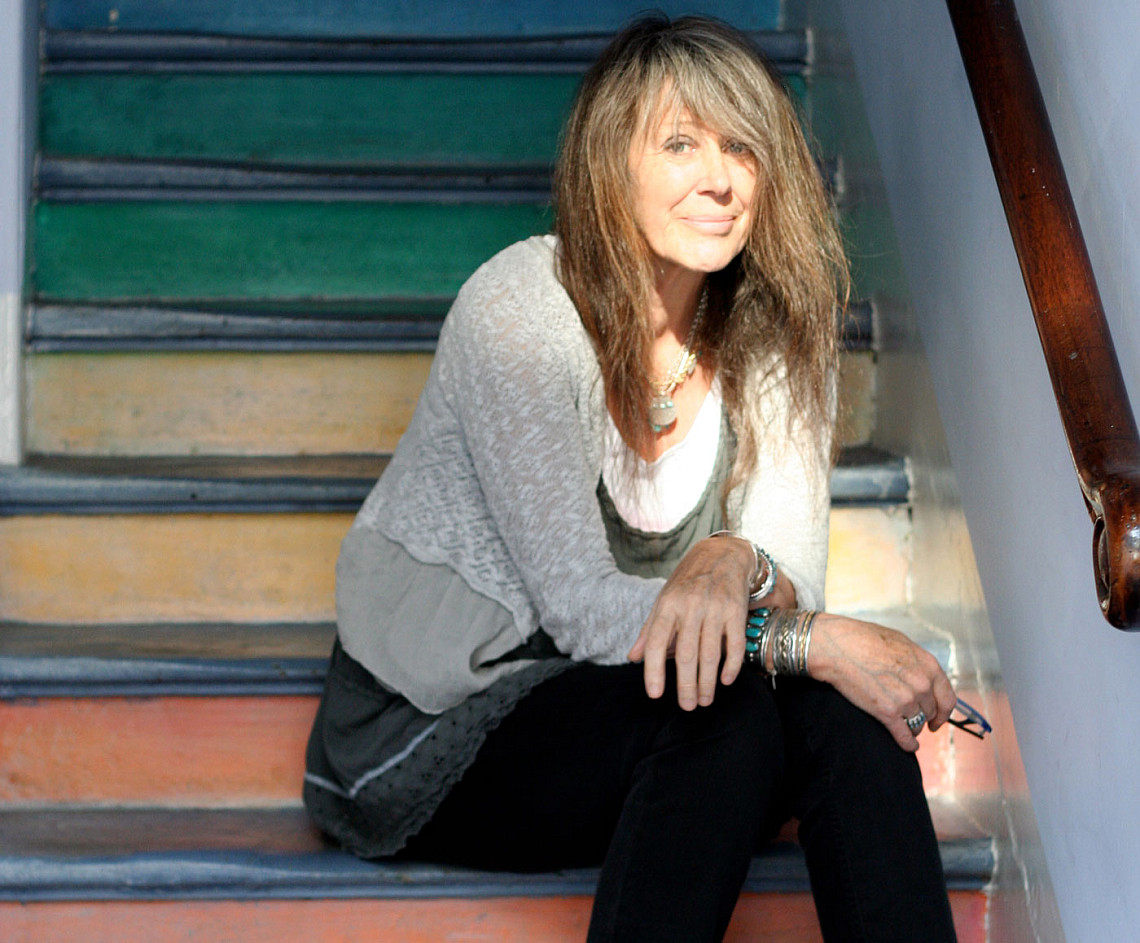
Vashti Bunyan didn't know her 1970 debut album, Just Another Diamond Day, had reached cult status until the '90s, when she first typed her name into a search engine. In those 20+ years, many listeners had not only discovered the album, but found it quite profound. In 2000, it was reissued on CD and revived Bunyan's long-abandoned career.
The album is a signpost on the road to "alternative folk" - think Joanna Newsom, Animal Collective, and Devendra Banhart, all of whom have cited her as an influence and collaborated with her since Diamond Day's resurgence. The newfound attention inspired Bunyan to grab her guitar and start making music again. She released her album Lookaftering in 2005, followed by Heartleap in 2014. When the COVID-19 pandemic hit, she spent the lockdown finishing her autobiography, Wayward, Just Another Life To Live, which was issued in 2023.
In this episode, Bunyan talks about her remarkable resurgence and discusses some key songs from her catalog, including her Jagger/Richards-penned debut single, "Some Things Just Stick In Your Mind," and "Train Song," a little-known B-side that exploded on Spotify.
The album is a signpost on the road to "alternative folk" - think Joanna Newsom, Animal Collective, and Devendra Banhart, all of whom have cited her as an influence and collaborated with her since Diamond Day's resurgence. The newfound attention inspired Bunyan to grab her guitar and start making music again. She released her album Lookaftering in 2005, followed by Heartleap in 2014. When the COVID-19 pandemic hit, she spent the lockdown finishing her autobiography, Wayward, Just Another Life To Live, which was issued in 2023.
In this episode, Bunyan talks about her remarkable resurgence and discusses some key songs from her catalog, including her Jagger/Richards-penned debut single, "Some Things Just Stick In Your Mind," and "Train Song," a little-known B-side that exploded on Spotify.
What Instruments Does She Play?
I mostly just play guitar and, when I was recording, I could pretend to play the piano with one finger at a time and then track it. So in that way, I have used the piano, or at least a fake piano. I would love to be able to play it properly, but I don't - I can only play the guitar. I did have violin lessons when I was very young but my teacher made me play "Twinkle, Twinkle, Little Star" for a whole school term, and that was that. No more violin.Getting Kicked Out Of Art School
It was in a museum in Oxford - it wasn't part of the university, but it was in Oxford in an old, old building and a very traditional art school. I was thrown out after two years because I really preferred to be playing my guitar and writing songs and all kinds of other things that weren't to do with drawing and painting. And when I said to the principal of the art school, "I thought that art was art in any medium," and he said, "Well, you go and do your art somewhere else. Here, you paint and draw," I had to leave. But I'm really glad that I was able to leave. I wasn't interested in painting and drawing, although I could do it. I had always loved it when I was a child, but it wasn't my ambition. I found much more joy in playing guitar and writing songs. And that was in 1963/64.Finding The Freewheelin' Bob Dylan
I went to New York to visit my sister, who lives there, and I found The Freewheelin' Bob Dylan in a record store, and that set me on the thought that I really wanted to be a musician. I really wanted to be a traveling musician. I mean, those songs on that album really opened my mind to the world that I hadn't seen yet because I was too young. I was too sheltered. But that album really educated me in a way. Just incredible.I came back to London and went round, knocking on doors, trying to find myself a manager or an agent, or anybody who would listen to me and my songs and try to help me to record - I wanted to make records. I wasn't very successful because I wasn't dressed in ballgowns and sequins with my hair up. I was in an old, holey jumper with an old guitar slung over my back. I didn't make any impression at all on the old guard.
Her First Single Was A Rolling Stones Composition
Andrew Loog Oldham [The Stones' manager/producer] gave me this song, "Some Things Just Stick In Your Mind," for my first single. And I was outraged. I didn't want to sing somebody else's songs, even if it was Mick Jagger and Keith Richards. But I did it anyway and it was the most extraordinary experience. One of my own songs was on the B-side. It was incredible to be amongst young people taking over because all the people that I'd been knocking on the doors of were the old guard, the old impresarios, and to be amongst people like Andrew Oldham and The Stones and the young musicians who were playing the arrangements was just a wonderful feeling that things were changing.But a year later I left Andrew, his wonderful orchestrations and his incredible life force, because that single didn't work. It didn't sell.
The Story Behind "Train Song"
That was when I was still at art school, and a friend that I shared a bed-sit with had a guitar and we started writing songs together. We wrote a song together called "17 Pink Sugar Elephants," and later on, I met a poet called Alasdair Clayre in Oxford, who had this lovely song called "Train Song," but he didn't have any music for it. I put the "17 Pink Sugar Elephants" tune to his words for "Train Song." So my friend Jenny and I share the royalties for "Train Song." Alasdair is no longer with us, but his nephew gets the royalties for the words, and I just love that. I love that it has been something that has grown despite none of us doing anything for it.
It's not just the royalties, but it's the recognition of that song that has been so extraordinary for all of us. And it's been used in adverts, it's been used in film scores. It's grown without me having to do anything for it at all. I remember the session and how incredible it was to just be recording a song simply, and that it has worked all these years later, it's lovely.
Explaining The Lyrics To "I'd Like To Walk Around In Your Mind"
It was frustration with somebody who just wasn't going to take any risks. "You see the end before the beginning has ever begun." This is about a real person who would not take any risks with commitment - I suppose in today's language, it would be that he was a commitment-phobe. But then it was just frustrating that he wouldn't take life on, wouldn't take any risks and, yeah, "I'd like to run and jump on your solitude." He just wanted to be left alone.Generally he didn't want to be part of a couple. He wasn't ready for that, and I was. I really liked him, and I really wanted to be with him, but he was not in that place. For me, it was frustrating 'cause I thought we could be so great and he just wasn't having it at all. He wanted to be solitary, poor guy. Why? Why couldn't I just leave him alone?
An Inspiring Journey To The Isle Of Skye
My first single with Andrew Oldham didn't work. My second single, "Train Song," didn't work - nobody heard it. And then I made more. I made "I'd Like To Walk Around In Your Mind," and I thought that was going to be it because I loved the recording, but it was never released. Then a couple of other things like "Winter Is Blue" and "Coldest Night Of The Year" were not released properly, and I became just totally disillusioned with the whole thing. I thought, "Oh, well, I must be no good."I met this art student who was living in a wood behind his art college under a rhododendron bush, and I went to join him under a rhododendron bush. And we got thrown out of that wood, and on the way out we decided what we really needed was a house on wheels that we couldn't get thrown out of. We could go wherever we wanted. And then, ah! But we'd need a horse because horses don't need petrol, and we didn't have any money for petrol, so we thought, "Ah, mm-hmm a horse and a cart - that would do it." And by some incredible miracle, that time that we were thrown out of the wood with all our possessions, and a friend came to pick us up, we found a little wagon and a horse on the way back. That! Being thrown out of the wood, we found a horse and a wagon.
At that time, we met a friend called Donovan Leitch [better known by the mononym Donovan], who was a singer, and he had just bought some land on the Isle of Skye that he rented to people - sympathetic people, artists and painters and writers and everything - not as a commune but just to have those people on his land. That sounded like a very good idea to us. He went up in his Land Rover, and we went up with a horse and cart. It took us a year and a half. It hadn't occurred to us that it would take that long, but it was an incredible journey. To just leave everything behind. I didn't want to be a singer anymore. I didn't want to be anything anymore. I just wanted to get to where we were going. I actually can't remember what was in my head at the time. I think probably not very much.
It was partly just out of necessity 'cause neither of us had any money. Neither of us had family who were supporting us, and it just seemed like the only thing that we could do, really. It wasn't like it was a conscious decision or any kind of statement or any rebellion. It was the most incredible education for me. It was a fantastic journey and I wrote songs along the way without thinking of recording them. I never wanted to set my foot in a studio again, ever. But I did write songs, and it was to keep us going mostly, not with the thought of making an album or anything like that. I just wanted to keep our spirits up, really, because it was quite hard. I'm sure that that led to them being very different. But also my partner at the time said, "Why don't you stop writing these miserable little love songs and write about the wonderful world around you?" And that's kind of what I did.
The Creation And Resurrection Of Just Another Diamond Day
Halfway through the journey, I met the producer Joe Boyd, and he wanted to make an album of the songs. He persuaded me back into the studio and we made an album called Just Another Diamond Day, which was never really properly released. It sort of came out in 1970, but it was totally ignored. Nobody spoke about it. Nobody I knew spoke about it. I didn't like it myself. I thought it was too folky, too fay, too gentle, and I abandoned it completely for 30 years. I just lived my life. I had my kids and we lived an extraordinary life, but with no music in it whatsoever. I didn't even sing to my kids. Music was something that I'd thrown out of my life.But in the year 2000, the album was reissued to a completely different response - a totally different generation who understood it in a way that my contemporaries never had. This time I could read lovely things said about it, and it was an extraordinary experience for me to have people say good things about my music because nothing had ever been said about it. Getting onto the internet and finding out that this stuff still exists, you know? I thought it was completely forgotten. And then with the reissue, it just unlocked something. I was able to pick up my guitar without it sounding sad to me. I started writing songs again, and I made two more albums. Yes, there was that huge gap of 30 years without any music in it, and then suddenly, a lot of music, a lot of people, a lot of new musical friends that I had never had before. I never played with anybody before in my old music life. I never played with other musicians really or had anything much to do with other musicians - I didn't know them. To come to this totally different time where I met lots of wonderful musicians and collaborated with people that I would never have dreamed of doing, yeah, wow. How different.
I didn't do any live performances when I was young, and then suddenly I was being asked to do stuff on the stage. Oh my God! But it was great. I'm so lucky to have that second go at it.
Writing Her Autobiography, Wayward: Just Another Life To Live
I started it years and years and years ago as a way of trying to explain to my children what their parents had been like and what their lives had been like and the reasons for it - or trying to figure it out for myself, really. But it wasn't until lockdown that a friend called me, and he said, "So what are you doing?" And I said, "What am I doing? Oh my goodness. Oh, I'm writing." And it was a complete lie. I wasn't. He said, "Oh, I know somebody who would be very interested to read what you're writing." And that was Lee Blackstone of White Rabbit. I did send him some of what I'd written and he signed me up to White Rabbit and I wrote the rest over the rest of lockdown, in fact. Thank goodness I had the time for not the best of reasons, but I did have to actually make myself finish what I'd started all those years.I did enjoy writing it. But also, I did still have in mind wanting to tell my kids what it had all been about, and to try to describe to them the kind of life that I had before they came along. I mean, I did carry on with that kind of life - the Diamond Day kind of life out in the country with all kinds of animals and people and kids. I did carry on with it and that's how they grew up, but I wanted to explain to them how it had started and I think that has worked. They now know all the stuff about the early days that I never mentioned to them.
What Advice Would She Give To Her Younger Self?
I think one of my big problems when I was very young and starting out with music, was that I would compare myself to other people and find myself wanting. Looking back now and seeing what has happened, I would say that everybody is so different and that you have to celebrate that difference and keep going with it and not feel that you're not as good as another person, or that you can't do this or you can't do that. That you could do what you do and you go with it. I just wish that I had had a little bit more faith in myself and in my own music. I could have done with the internet back then [laughs]. Well, there was no feedback. There was nowhere I could go to find out if it was any good or not. I would love to be able to tell that young woman, "It's okay. You've done something that's okay, and you don't need to feel bad about it."April 4, 2023
Wayward, Just Another Life To Live is available on Amazon.
Further Reading:
Interview with Donovan
Interview with Victoria Williams
Subscribe to the Songfacts podcast, part of the Pantheon Network
photo: Whyn Lewis
More Songfacts Podcast