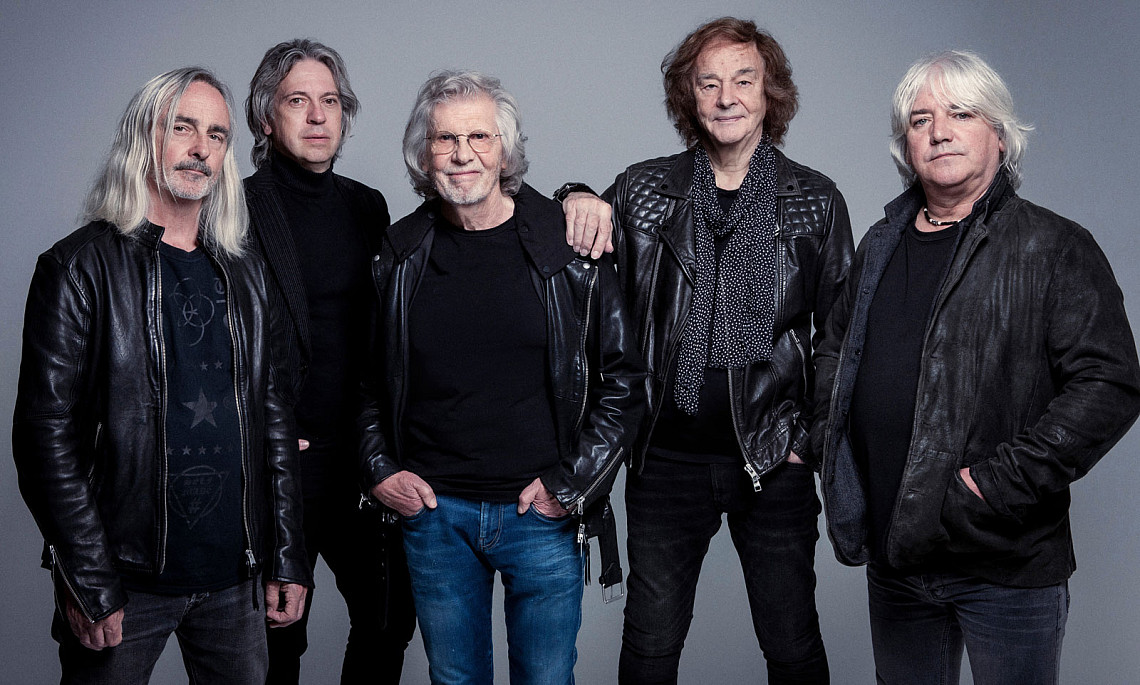
 The Zombies, 2023: (L-R) Tom Toomey (guitar), Soren Koch (bass), Rod Argent (keyboards/vocals), Colin Blunstone (lead vocals), Steve Rodford (drums)
Tom Petty played a lot of Zombies on his radio show, Buried Treasure. He was a huge fan, as are many musicians of his generation who drew influence from the group. As lead singer Colin Blunstone explains, their unorthodox sound - powered by Rod Argent's dazzling keyboard riffs and Colin's dynamic, intimate vocals - caused some problems with radio stations and record stores that needed to classify them, but it's all they knew. "We're not trying to sound like anybody else," he says. "That was true in 1964 and it's true with us now."
That's right, The Zombies are still at it, with an album called Different Game set for release March 31. The first two singles, "Dropped Reeling & Stupid" and "Love You While I Can," are out now.
Here on his Songfacts Podcast appearance, Blunstone talks about those two tracks and shares his thoughts about being inducted with The Zombies into the Rock And Roll Hall Of Fame in 2019. He also tells the fascinating story behind their first single, "She's Not There," which might not have happened if the recording engineer didn't pass out drunk. The transcript is below.
That's right, The Zombies are still at it, with an album called Different Game set for release March 31. The first two singles, "Dropped Reeling & Stupid" and "Love You While I Can," are out now.
Here on his Songfacts Podcast appearance, Blunstone talks about those two tracks and shares his thoughts about being inducted with The Zombies into the Rock And Roll Hall Of Fame in 2019. He also tells the fascinating story behind their first single, "She's Not There," which might not have happened if the recording engineer didn't pass out drunk. The transcript is below.
Recording In-Person
This album was obviously interrupted by the pandemic. There were two songs that were recorded before the lockdown came.But we learned from our last album. It was in 2015 called Still Got That Hunger, and almost by accident we recorded all of that album with us all in the studio playing live together. In some respects, it's almost like a live album, but it's in a studio environment, and we really enjoyed it because there's an energy in the studio when you're all there playing live that isn't there if you record your parts separately, which is how a lot of recording's done now.
We really enjoyed that experience in 2015, and we were determined to do it this time around. But of course, with the pandemic, it was very hard to get everyone together. In this country [England] there were two separate lockdowns where you were encouraged not to leave your house. And our bass player, Soren Koch, lives in Denmark, so that made it even more difficult. So what could have been a couple of months in the studio actually turned into a bit of a marathon getting on for three years now, because we stuck true to the ideal that we would all be in the studio together recording at the same time. So, it's been a little bit of a drawn-out affair, but it was out of our hands. I don't think there was a problem in that two-year gap. It's the same players, playing with the same spirit, and I don't think you can tell any difference.
Another question is, Can you tell the difference between an album that's recorded with all the players in the room playing live at the same time and an album that's recorded where people will record their parts separately? I'd like to think you can tell a difference, but maybe it's just in our minds. It's certainly more enjoyable to perform in the studio with all the other guys there because I will sing a song differently if a bass player and drummer are in the room with me, and they have all told me that they will perform differently if they can hear the lead vocal and the other instruments as well.
After A Tour
When you finish a tour, you always think, yeah, this is great. We've just floated through these performances where the energy levels are incredible, everybody's feeling really confident, and that would be a great time to start recording, but usually, we're so exhausted that that's when we sort of go and visit the asylum to try and get our brains sorted out at the end of a tour."Love You While I Can"
It does have quite an interesting story. We are managed by The Rocks Management, who are Chris and Cindy, and they got married when we were beginning this album, so before the pandemic. Rod thought I'd like to write a song for the wedding, and so it was written for them. Unfortunately, I found most of these songs quite easy to get into, but the one song that I found really challenging, and I'm embarrassed to say this, but I struggled on "Love You While I Can" and I didn't feel confident enough to sing it at their wedding, which was the plan.So we sang "This Will Be Our Year" because we felt quite secure about that as an old classic track from Odessey And Oracle. So they still got a performance, but they got a different song.
So it was very interesting for me. This song was originally written on piano, and Tom, our guitarist, took the exact notes that Rod was playing and played them on guitar, and it sounded so effective. The whole idea of the song was transferred to acoustic guitar, and now you hear it like that and you can't imagine it any other way. But when I first heard it, I heard it on piano.
Rod is very much the dominant songwriter in The Zombies. He lives quite near to me, and when he writes a song, he will always call me and then we'll go and rehearse that song, just the two of us, before we move on to the band. We go into it in quite some depth, especially the phrasing of the song. And when I record the song, it's absolutely what he wrote. The melody will be exactly what he wrote. Not close, exactly. And the phrasing will be exactly the same. And we're forever talking about, "Is this note pushed," or, "Should this note be on the beat?" It's one of the things I dread when we're recording. Rod will say, "Now look, can you get that phrase on the beat?" And I thought I was singing it on the beat.
These were the kind of things that were happening when we were first trying to go through this single "Love You While I Can." I just struggled with it. But now I hear it, and of course, it's absolutely worthwhile, and hopefully, it sounds effortless.
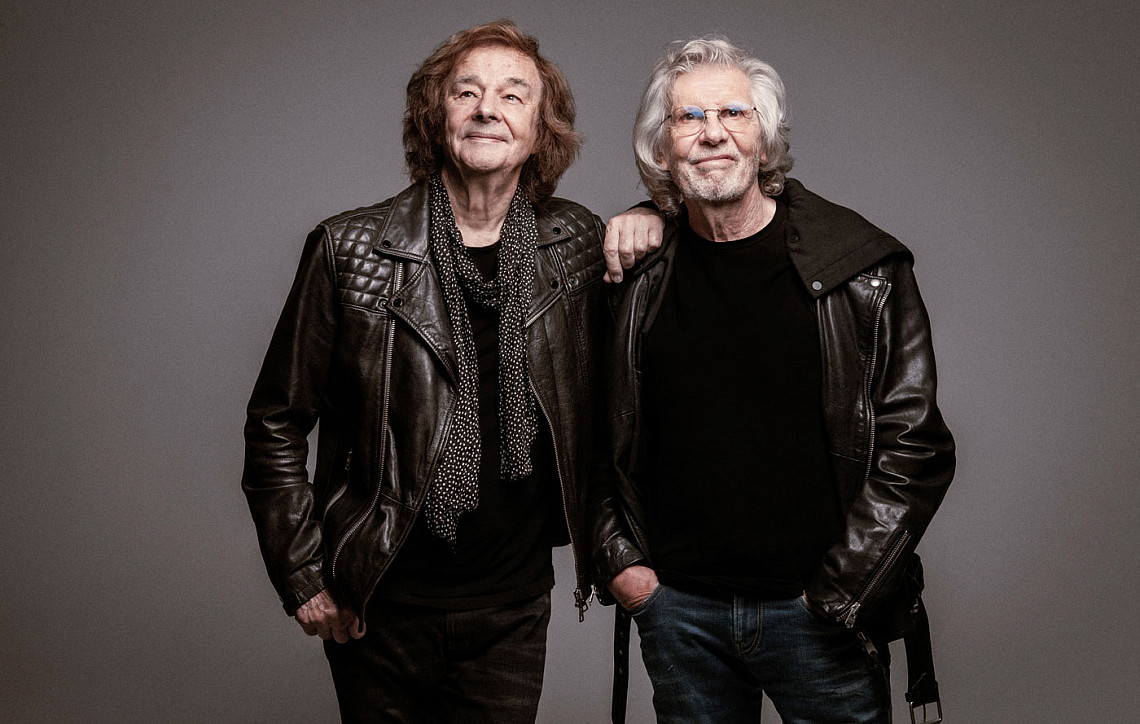 Colin with Rod Argent
Crafting A Zombies Song
I don't want to be too presumptuous and say "secret to success," but it's the way we do things, especially on Rod's songs. He usually has a very full picture of how he wants the song to sound. For instance, he certainly will know what the chords are and what the melody is, and he'll probably have a pretty good idea where he wants the bass to play and sometimes the drums as well. Those parts are written as part of the song. And he's very patient and very supportive when you're coming to terms with a song, but I always say to him, "I want this to be how you want it to be. I want it to be exactly how you hear it." And that's what we try and get.Rock Hall Induction
To start with, I think we were nominated four times before we were inducted. And I've got to be honest, I'd started to think that maybe it would never happen.So, because we'd been nominated and not inducted so many times before, I wasn't paying as much attention as I was when we were first nominated. And there's a trick to this also in that there's the fan vote, which is public and everyone knows, and we were incredibly well-supported. We had over 300,000 votes. It's just mind-boggling. But then the vote by the members of the Rock Hall is private, so no one knows how that vote's going. It's a surprise for everyone.
Yeah, we got the magic phone call and I was very happy. I had to sit down for a little while and just absorb it all, because any sort of acknowledgment from your peer group is exciting. It's fulfilling, it's so meaningful. It's what artists long for: to get acknowledgment from their peers, and that's what this is to be inducted into the Rock and Roll Hall of Fame. The main vote is from fellow inductees.
It was a wonderful experience. The induction ceremony was at the Barclays Center in Brooklyn in front of 17,000 people, and right in the front few rows you've got these icons of the music industry.
We played with the original lineup. Our lead guitarist passed away some time ago, so he wasn't with us, but our original bass player, Chris White, and our original drummer, Hugh Grundy, played with us, and that was fantastic because they don't play regularly anymore and I just thought they did incredibly well. We've done some tours recently of playing Odessey And Oracle in its entirety, and they've played on those tours. But other than those tours, they haven't played since 1967.1 So to get up in front of an audience like that, I thought they did incredibly well.
When we first decided to play Odessey And Oracle in its entirety, it was 2008 and we were celebrating the 40th anniversary. It was at the Shepherd's Bush Empire. Rod and I were on tour when we were putting the idea of the show together, and we said, "You know, we should get together with Chris White and Hugh Grundy, the other original members. We have to see if they can play." We got together and it was a very humiliating experience because Hugh and Chris, who haven't played since 1967, had obviously rehearsed and rehearsed and rehearsed. They were absolutely perfect. And Rod and I, who hadn't rehearsed at all because we were in the middle of a tour, we were all over the place. It was a little bit embarrassing but it was a very good thing for us to realize that just because we're currently touring doesn't mean that we know Odessey And Oracle as well as we need to know it. So we had to do a bit of homework.
"She's Not There"
From the time when you recorded a song to when it was released, it was a very short period of time in those days to turn over singles. It was the spring of '64 that we recorded it, and it was released on July the 24th in this country, 1964, so there was only a few weeks' gap.But how it came about, we won a big rock-and-roll competition. We can never agree if part of the prize for winning the competition was actually a recording contract. I don't think it was. I think it was a little bit of a coincidence that we won this competition, and that led to being introduced to some people and we ended up with a record contract. We were introduced to a producer called Ken Jones, who helped us get a deal with Decca Studios. And about 10 days before the session, Ken was giving us a bit of a pep talk. I think Rod and I were 18 at this time, and Paul Atkinson [original guitarist] was a year younger, 17. We thought of ourselves as a rhythm and blues band at the time - that was when the band was called The Zombies R&B because we played rhythm and blues. We were going to do some rhythm and blues tracks in the studio, but Ken said, "You know, you could always write something for this session." Then he went on and talked about other things. That was it.
I didn't pay any attention to it, but Rod and Chris White did, and they both went away and wrote one song each - two really good songs. A few days later, Rod came back and played us "She's Not There," and Chris played us the song that became the B-side, "You Make Me Feel Good" - two really good songs.
But the session nearly didn't happen because we'd been booked into the studio at 7 o'clock at night because it was thought then that to record in the evening going through the night was more artistically stimulating than during the day. I don't think as you get older that's the case, because we would've been asleep if we were doing it now.
So we went in at about seven o'clock and we were introduced to this recording engineer we'd never met before, who was a really good engineer and had engineered a lot of big hits. But because we got there at 7 o'clock in the evening, unfortunately, he'd been at a wedding all day and he was horrifically drunk. Not only horrifically drunk, but he was very aggressively drunk as well.
So this is our first time in a commercial studio and we are just going through some songs and I put some headphones on, and this engineer is screaming down in these headphones with the worst language you can possibly think of - very, very aggressive. It makes me laugh because having been in the business for over 60 years, in that first half an hour with this guy screaming at me, I was thinking, I don't think this music business is for me. Then we had a bit of luck and he passed out. He passed out cold on the floor. We had to carry him out of the studio, one on each arm and one on each leg. We took him up two flights of stairs and we put him in a London black taxi and waved him goodbye. We never saw him again, ever.
The assistant engineer took over, and the assistant engineer was Gus Dudgeon. I don't know if you're familiar with Gus's name, but he went on to be one of the most successful producers of all time. He's no longer with us, but he recorded all of Elton's early albums. He recorded Bowie, Kiki Dee... he's responsible for producing so much wonderful music. He was the assistant engineer that night, and that was his first session ever where he was a recording engineer, and it was our first session ever.
It wouldn't have happened if this guy hadn't gone to a wedding and got horrendously drunk. I'm not sure if he'd have gone on like that, I don't know if it would've happened at all. But it did happen and "She's Not There" was released a few weeks later and it was on a live television show over here called Juke Box Jury, where they have four panelists who judge whether seven or eight songs are gonna be a hit or a miss. One of the panelists was George Harrison, and of course, we were thinking it's wonderful he's going to listen to our record, and the whole country was watching because it was George Harrison. And he said, "Well done Zombies. I think this will be a hit."
You couldn't fail after that. George Harrison says it's gonna be a hit, it is a hit. And that's the story of "She's Not There."
I do think there was a bit of a reluctance in America because it was quite unusual. A lot of our songs, they're not what other people are recording. We've never tried to follow trends, ever. There was resistance in America to even releasing it. It came out on a subsidiary of London Records called Parrot Records - they released a lot of English artists. I don't think the label was over-enthusiastic, but it was released in the fall, and by Christmas it was #1 in Cashbox2 and #2 on Billboard. So we arrived in America at Christmas 1964 with that record at #1 in Cashbox. It was a great way to be introduced to the American public, having such a huge hit.
The Zombies' Unique Sound
It does have its drawbacks in that the media like to put you in a box. When there were actual physical records, like singles and things like that, they had these people called rackers. There would be thousands of records coming into a wholesale place that then went off to retail, and they got confused if they didn't know what genre to rack your records in. Something like that can make things really difficult.So, although I think it was a great advantage for us to have a unique sound, it did have its downsides as well. And you know, radio stations tend to play a particular genre of music, and if they're not sure where you fit, you can lose radio play over that. But, we've never gotten too involved in that side of things. It's been very simple with us: We record the best songs we've got to the best of our ability. We're not trying to sound like anybody else. That was true in 1964 and it's true with us now.
We had the added complication in 1964 that Rod and Chris were finding their feet as songwriters. Later on, Rod told me he had written one song before that first session, but I don't think I've ever heard it, and I'm not sure if Chris had ever written before, so they didn't have a back catalog of songs - they had just started writing. And one of the problems that we came up against was that Decca immediately wanted a follow-up. Within six weeks they wanted a follow-up.
We were touring and we just had one song written ["Leave Me Be"], and we were pressured into putting that song out. None of us thought it was a hit or commercial at all, and we were right. It's the devil or the deep blue sea, because either we put a record out that we are not confident will be successful, or we probably get dropped by the label. So it's a difficult situation.
So the follow-up in the UK didn't go anywhere, but in the States, because the records were released a little later, they skipped that and they released "Tell Her No," which was a big hit. And it was a hit in the UK as well.
But it just seemed so shortsighted to me. I think all labels did it at the time, but my only experience was with Decca, and they would put such pressure on you to keep recording singles. It's a self-fulfilling prophecy in a way because they're expecting you to tour and promote it at the same time. I guess they thought that artists only had short careers anyway, and no wonder. They were pressured to keep releasing records. They thought artists only had short careers, so they should get the most out of them while they're still relevant.
Why not try and nourish careers? Why not try and help people develop as musicians until they can have a lifetime career? You could have a lifetime's music out of this band rather than six months. All record companies were like that then, all managers were like that and all agents. That's how they thought - very short term.
We were surrounded by people who were like that. Absolutely charming. Lovely people to talk to, they just had it in their minds that you would have a very, very short career. It's laughable looking back at it, but that's just the way it was then.
Dropped Reeling & Stupid
It was written by Rod, and I think it's a really great title. He was thinking of calling it "Dropped, Reeling & Naked," but I think "stupid" is much better. So this is what it developed to.I was talking to him about the lyric and he just quite simply explained it as when you are in what you think of as a secure relationship, and then the carpet's pulled from under you, it's a great shock and it's quite hard to take. And how do you feel? Dropped, reeling and stupid. That's the trigger for the song.
Rod wrote most of the songs and I don't know the story behind some of the songs because Rod, he usually plays the cards very close to his chest, and he would always say that the song means what it means to you, so he tries to make the lyrics not too personal to him. But he did tell me that that was the trigger for this particular song.
Another thing with Rod, when he writes a song, it's very important to him how a word sings. So sometimes you'll get someone who's perhaps explaining a really complicated story in a song, and there's a jarring line in there, or a jarring phrase, and you think, Wow, I think you could have found a better way to explain that in a song, but Rod is always very conscious of how a word sings. He's a great songwriter and I've tried to learn from him. When I write, I try and do the same thing.
Song By Another Artist That Made The Biggest Impact On Colin
I was a huge fan of anything by The Beatles, but I'm gonna choose something else. We were also huge fans - and still are - of The Beach Boys, and we recently toured with Brian Wilson. I was asked to sing "God Only Knows" on stage with Brian Wilson and his wonderful band, and I can't tell you how exciting, thrilling, and intimidating that was. It's certainly a very special song, and to have sung it with Brian, that's a story I'll be telling to my grandchildren.I sang the melody and I stuck to it very resonantly, and then the band did all the complicated, wonderful stuff around me. Yeah, I played it very safe. Believe me.
March 3, 2022
Different Game comes out March 31, 2023. Here's where you can preorder.
Subscribe to the Songfacts podcast, part of the Pantheon Network
More Interviews:
Colin Blunstone's 2015 Songfacts interview
Rod Argent
Alan Parsons
David Crosby
Photos: Alex Lake
Footnotes:
- 1] The Zombies broke up after releasing their 1968 album, Odessey And Oracle, because it stiffed. But then it got released in America and DJs started playing "Time Of The Season," which became a huge hit. The group didn't get back together because they were all knee-deep in other projects, particularly Rod Argent with his band Argent. Colin and Rod brought The Zombies back from the dead with a new lineup in 2004. (back)
- 2] Cashbox was a competitor to Billboard with their own charts and methodology. (back)
More Songfacts Podcast