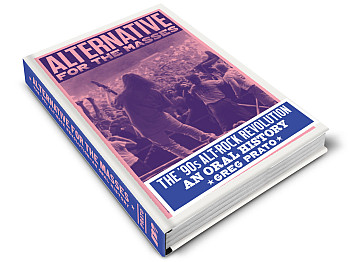
 In Greg Prato's book Alternative for the Masses: The '90s Alt-Rock Revolution - An Oral History, we hear from the people who were on the scene to get a refreshingly candid perspective that goes well beyond Nirvana. Frank Black (Pixies), Johnette Napolitano (Concrete Blonde), Butch Vig (Nirvana, Smashing Pumpkins producer), Moby, Corey Glover (Living Colour) and at least 50 others tell their tales from this time. Some of the best insights come from those covering the scene, including MTV VJs Kennedy and Matt Pinfield.
 The book is available now on Amazon and in bookstores. Here's an excerpt from Chapter 12, "Singers."
"The soulfulness was the way they put the feeling across"
Alt-rock in the '90s gave us an impressive number of original and instantly identifiable singers - perhaps more so than any other rock era past or present. Who were the top vocalists, and what made them so special?Matt Johnson (Jeff Buckley's drummer): You couldn't fake it back in those days [as a singer]. There were no in-ear monitors. There really was no Melodyne; there was no Auto-Tune. On the live side, you had monitors that, if you turned them up really hot, they're going to feedback. So, you had to sing out more. And I think singers had to go through a very difficult phase of development where they had to learn how to open up their voice sufficiently to where they could sing with limited and lower-tech monitor gear. And also, the bands were louder.
You had less of the studio conditions that you would associate with being in a recording studio on a stage. Now when you go see a band with in-ears, there may not be any speakers onstage, and everybody has their own independent monitor mixes. And you can possibly get away with having a singer get up and almost whisper into the microphone-and sound great, even.
The barrier to entry for a singer 30 years ago was, "Well, for starters, you're going to have to be able to be heard over a loud band," and bad technology by today's standards. That's a huge part of it to me. And I think that eliminated a lot of people who, these days, would no longer be eliminated from the possible cast of characters that are going to be branded as singers. It's not that I think singers have necessarily gotten worse, but I think more and more unlikely singers are making it into the professional domain of "singer."
Chris Haskett (Rollins Band Guitarist): Most rock singers are not great "singers" in a classic sense. That doesn't mean they're not great. I just mean that, more often than not, they're working with a small palette of tonal color and timbral/dynamic options and making the most of it. That's part of what makes them great and unique. Conversely, it's really uncommon for people that have really rich singing voices to be convincing rock singers.
Kevin Martin (Candlebox singer): They were looking for real, raw talent. Chris Cornell was incredibly good looking, but [other singers of the era were] not the best-looking guys. Weird, androgynous - the "David Bowie element" of things that were allowed in the late '60s/early '70s were being allowed again. There were so many guys hiding in the shadows that had these great voices that never would have had an opportunity in the '80s to be successful.
It was when that Nirvana train peaked over that hill and started to come down, it opened the world up to great talent - not just great singers. There are so many great bands that came out of the '90s. One of my favorites is the Smashing Pumpkins, and Billy Corgan is one of the most original "nasally" singers ever - that has written some of the greatest songs of all time.
Corey Glover: This is all about expression and how people chose to express themselves. I think Eddie Vedder is in that pantheon - they're really compelling storytellers. All of them. Chris Cornell was a very compelling storyteller. It wasn't their ability to sing but what they said and how it resonated with people. "Jeremy" was a story-with a beginning, middle, and end. As nutty as "Spoonman" is as a song, you got it because Chris gave you the story-and you understood the story.
Gerald Casale (Devo): Chris Cornell almost hearkened back... he was like a guy who was time traveling. He could have almost been a blues guy if he wanted to. I would have loved to hear him do hardcore rural blues - but in his style. He had an amazing voice. Powerful. And controlled. He could croon if he wanted to croon.
Johnny Temple (Girls Against Boys bassist): Perry Farrell's singing style is so unhinged and artful.
Lori Barbero (Babes In Toyland drummer): There's great frontpeople, but Mike Patton apparently has the widest range of singing - pitch perfect.
Tracy Bonham: Björk could really go for these notes in such a way that was edgy but not harsh. I really loved that. She could also sing beautifully and quietly and expressive - even veer into this almost jazz... I don't even know what to call it. I know a lot of singers right after her tried to emulate her sound. It was jazzy; it was punk in its energy. I didn't care about whether it was proper technique at all. It was more the expressiveness of it. It was compelling.
Matt Pinfield: Tori Amos was unique as a singer and had a beautiful delivery. It was so passionate and so honest. She addressed a lot of things that weren't always as pretty as other singers - she had a deeper soul and looked into things that maybe weren't as comfortable. There was a lot of pain involved in a lot of those songs. But also beauty.
Vinnie Dombroski (Sponge singer): Nothing sounded like Layne Staley back in the "rock days" - Peter Wolf, Brian Johnson. Who sounded like Eddie Vedder back in the '80s? Really nobody. I think what was a great singer was redefined. Would Kurt Cobain have been chosen as the singer of a band in 1980? You were looking for the "castrati dudes." And that was what people thought of as a "great singer."
Any one of us can sit down and sing an Alice in Chains song. But not like that. That's coming from a whole different planet, man. It's like Mark Lanegan - Lanegan wouldn't have been that guy in the '80s that was "I need you for a band." But there's something so special about that voice. You can't imitate it. I'm happy that we consider these people and these voices great singers today, because they deserve it.
John Agnello (Dinosaur Jr., The Breeders producer): Mark Lanegan was a special singer. In my career for 40 years, he is one of my favorite singers I've had the pleasure to record. He had many sides and styles to his delivery. He could sing soft songs of the soul or torch-song style. He could belt a rocker like few others. And sometimes, he could do both in the same song-as he did in the Screaming Trees classic "Dollar Bill." He could give you chills while delivering his solo classic "House a Home." His choice of melodies and wonderful lyrics added to the emotive quality. He was literally one in a million. Mark sang like his personality - really strong at times, really delicate and vulnerable at times. Because Mark as a person, that's how he was-he'd either be in your face and beat the shit out of you or he could be vulnerable.
J Mascis is himself - he's very wistful. If you talk to him, he's like [talks in soft-spoken voice], "Well... I don't know. " And his vocalizations are an extension of that. He's not really pushing more, as he's questioning. It is his character, though. If you go through technical singers, yes, he's not the greatest singer ever. But he's got a real style. When you hear Dinosaur Jr., you know he's singing. But he also has real character. Even the beginning of "Start Choppin'" - he's putting it out there. He is fun in a way because of the way he sings.
When a Dinosaur Jr. song comes on, you know it's J Mascis. Not many other people sound like that. If you're listening to a Dinosaur Jr. song, imagine the singer having a question mark over his head! That's J's style - he's not pushy; he's not in your face. He gets that shit out in his guitar playing-he doesn't get that shit out in his vocals. And that's the difference between him and Mark. Mark didn't play much guitar, so he had to really express himself with the vocal. J does it with the Jazzmaster.
Chris Haskett: Corey Glover is one of the exceedingly rare frontmen that has an enormous tonal, dynamic, and timbral range, and still totally brings it home as a rock singer. People with that much power and control often sound like their technique is driving their aesthetic - whereas with Corey fronting Living Colour, there's not even a nanosecond that he's not coming from the heart. Always. Listen to the range he covers between the Middle Eastern opening and closing of "This Is the Life" - one of my fave songs, by the way-and the soaring, roaring soul cry of the end chorus. Or contrast the commanding force of "Never Satisfied" with the bittersweet gentleness of "Nothingness."
Kevin Martin: Shannon Hoon had an incredible voice. Again, so original. I can't think of anybody that sounds like him - even to this day. I remember I was working in Christopher Thorn's studio when he first moved to Seattle, and I helped him build his studio in his basement. And Shannon used to call and leave him voicemails on his answering machine with songs-and one ended up on the Nico record ["Letters from a Porcupine"]. Just hearing him sing through the phone, I was like, "Man, what is it like being in a band with him?" And Christopher's like, "He's fuckin' out of his mind... but every night is amazing." And what a brilliant lyricist Shannon was. "Vernie" and "Galaxie" and all of those songs on Soup are ten times what the first album is-it's a brilliant album.
Matt Pinfield: The thing that made Scott Weiland so special as a singer and frontman was his vocal range, his undeniable swagger, and this chameleon-like personality onstage. Even when he was struggling with his personal demons and not 100 percent, he was still a better performer than most people who fronted bands in that era.
Mike Johnson: From the first time I heard Kurt's voice, I thought, "This is a voice that should be on radio."
Fat Mike (NOFX): Kurt Cobain not only sang in pitch, but his emotion was incredible. You felt it. Kurt sang his heart.
Eddie "King" Roeser (Urge Overkill): I do have to say I was fortunate enough to see Nirvana play, and I think Kurt Cobain probably had the most engaging vocal thing. I mean, that guy really had something that he worked on - to make it really consistent. And he really knew what he was doing - without really trying too hard. That was one of the things where you didn't see a lot of people who had any sort of compelling vocal style. Anybody could play guitar or do a drumbeat. But to really have that voice that pierces you to the core... I mean, Chris Cornell, same thing. You didn't see guys like that. And they really deserved to have that stage.
Corey Glover: I knew Jeff Buckley personally, and he was hauntingly beautiful the way he sang. And I think Jeff had the potential to become so... I would have hoped that he would have gone beyond where he was at the time before he passed [on May 29, 1997, at the age of 30].
Craig Wedren: The minute Andy Wallace played us [Jeff Buckley's] "Mojo Pin," it was like, "Oh. This is generational." We were fiercely competitive and into our own thing, but it didn't change the fact that when you hear beauty at that level, that combination of gifted technical, transcendent... I've known a lot of really great singers and great composers and musicians, and he was the best of all those things.
Like, I went to college with Anohni - an extraordinary singer and artist. Just beautiful-even when she was eighteen. She'd open up her mouth, and out would pour Nina Simone–level gorgeousness. I toured with Chris Cornell, and we were friends, and that "instrument" is... there are only a couple of those. But Jeff somehow transcended all of it-the era, the genre, the instrument, the humor, the intelligence, the sensuality, the musicality. It was a gift.
Matt Johnson: [Jeff Buckley's] use of vibrato to me - and his use of falsetto - I didn't know how to place it when I first heard it. It really took me by surprise. I think the time when his voice most strongly affected me was, we were playing a gig at [New York City club] the Fez, and I remember some part of a song we were in and some part of his voice - the way he used his voice - caused an effect in my body that I can only describe as your whole internal environment of your mind and your body and the way your whole being feels, it's almost like it got a shock of electricity through it. It moved like a wave throughout my whole body. And it was associated with the music that we were making at that time. I associate it with me having a very kinetic, physical, psychological, and emotional connection to music. A truly incredible feeling.
Corey Glover: The soulfulness was the way they put the feeling across. The way that they put the emotional aspect of the song into their performances. And that sort of resonated with people.
Robert Deleo (Stone Temple Pilots bassist): I think people had a lot to say. And it was timing. Things were going a certain way, and there was a reaction. And sometimes when there's a reaction, something that is really explosive comes out of that; and I think it was the time for that to happen. There were a lot of very talented... and I hate to use the word "was." A lot of those people are gone, and it's a shame, but it was a great time for music. It really was.
All of a sudden, there were, like, a thousand girls; and they were all freaking out. It was quite a test for your restraints. But you do that for a while and you go, "Well, that's not the answer. It doesn't really work. A different girl every night, it's no fun." I mean, it's fun for a little while. We went over the top in this bullshit of me being handsome or whatever. It worked... and I got stung exactly in the cliché way - I'm a total poster boy asshole. I went along with it. I guess it was my "jujitsu move," like, "Okay. I use their power against me and go that way instead and roll over." I ended up in a trailer as a junkie for five years, but that was all part of the recovery, I guess. Because luckily, this girl Antonia came up to the Vineyard and saved my life - and brought me to Brazil.
But I cut my hair off just to piss people off. I did it after Kurt Cobain first tried to kill himself, on March 4 [1994, in Rome] - thanks, Kurt, on my birthday! I cut my hair because my friend used to say it's the best thing to do if you're in shiva - or potentially - you cut your hair off when someone dies. So, I did. And I was high. I was testing the loyalty of the fanbase. But I tried not to be precious - my whole career I tried not to be fussy. I totally understand with people seeing me as, "Oh, fuck . . . that guy." At that same time when something like Die Evan Dando Die [the title of a zine from 1994] comes out, my friends were all like, "You're doing something right."
October 29, 2025
Alternative for the Masses: The '90s Alt-Rock Revolution - An Oral History is available at Amazon
Further Reading:
The Stories Behind 10 Classic Mark Lanegan Songs
Interview with Tracy Bonham
Matt Pinfield On 10 Of The Greatest Alt-Rock Videos of the '90s
Shannon Hoon Remembered
More Song Writing