Right below the Billboard Hot 100 is a ranking of up-and-coming songs that are "bubbling under," expected to boil into the main chart in the weeks to come. Often they do, but many never make it to The Show. Most of the songs that get stuck in this chart purgatory are abundantly forgettable singles promoted with brio but unable to pass muster with listeners. But there are some gold nuggets in this sluice, some fantastic songs that for whatever reason couldn't get out of the minor league. Here, we pick the best of the songs that bubbled under but never made the Hot 100.
[While not technically an extension of the Hot 100, the Bubbling Under chart is often regarded that way for chart position listings, so if a song got to #3 (but no higher) on Bubbling Under, we say it reached #103 on the Hot 100. The year listed for each song is when it peaked on the chart, not necessarily when it was released.]
[While not technically an extension of the Hot 100, the Bubbling Under chart is often regarded that way for chart position listings, so if a song got to #3 (but no higher) on Bubbling Under, we say it reached #103 on the Hot 100. The year listed for each song is when it peaked on the chart, not necessarily when it was released.]
"Crazy Train" by Ozzy Osbourne
#106 in 1981
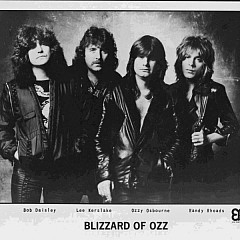
How did one of the most famous songs in history get no higher than #106? Well, unless you were a Black Sabbath fan, you probably didn't know who this Ozzy guy was.Osbourne was Sabbath's original lead singer but left the band in 1978 after a dispute with guitarist Tony Iommi. The jury was out on Ozzy, who seemed too drug-addled to make any worthy music, but he proved the naysayers wrong with "Crazy Train," his first single.
The song is undeniable. Ozzy is well suited to sing about insanity, and that Randy Rhoads guitar riff is as good as it gets. But before it could chart in America, it had to cross an ocean. Released in Ozzy's native UK in the fall of 1980, it came to America in the spring of 1981 and gradually built its legend. The song popped into the chart for a few weeks that summer, peaking at #106.
Improbably, Ozzy became a household name, adding "reality star" to his CV when The Osbournes debuted on MTV in 2002. "Crazy Train" held up as his signature song, always a showstopper at his concerts. This story, though, is tinged with tragedy. Randy Rhoads died in a plane crash in 1982 when he was just 25.
"Crazy Train" Songfacts
"Atomic Dog" by George Clinton
#101 in 1983
This dog has bite! One of the biggest songs in the P-Funk universe, "Atomic Dog" is credited to George Clinton solo but has contributions from his Parliament-Funkadelic crew.Clinton's brand of funk never really crossed over into the mainstream, at least until the early '90s when his sound was fully and unabashedly purloined to make G-Funk, the specialty of Snoop Dogg and Dr. Dre. Snoop's first single, "Who Am I? (What's My Name?)" from 1993, is a reworking of "Atomic Dog" complete with the "Bow, wow, wow, yippy-yo, yippy-yay" cowboy barking. That one made #8.
"Atomic Dog" did have its day on the R&B chart, where it spent four weeks at #1, displacing Michael Jackson's "Billie Jean" while that song was still on top of the Hot 100.
"Atomic Dog" Songfacts
"White Lines" by Grandmaster Flash
#101 in 1983
A hip-hop landmark, "White Lines" was the first rap hit with a moral to the story: Don't do cocaine. A cultural touchstone, it was covered by Duran Duran in 1995 and reworked by Pusha T for the 2023 movie Cocaine Bear.It's also an early example of musical thievery that became so prevalent in hip-hop. The vocal melody and backing track were lifted from a dance song released earlier in 1983 called "Cavern" by an outfit called Liquid Liquid.
And there's some fishy attribution. The song is credited to Grandmaster Flash, but he had nothing to do with it. Melle Mel, a rapper in Grandmaster Flash And The Furious Five, wrote the lyrics, did the vocals and put the song together with Sugar Hill Records label boss Sylvia Robinson.
"White Lines" Songfacts
"Dancing With Myself" by Billy Idol
#102 in 1983
Like Ozzy and The Who, it took a while for Billy Idol to catch on in America. He was known in his native UK as leader of the band Generation X, which released the first version of "Dancing With Myself" in 1980 only in the UK. When the band broke up a year later, Idol went solo and released a new version of the song as a single. It went nowhere, but he broke through in 1982 with "Hot In The City" and re-released "Dancing With Myself" in 1983 along with a music video, which is when it reached its not-so-lofty peak of #102.The song, though, is vital Idol, one of his classics. Because it was never a big hit, it never got much airplay, which meant we never got sick of it. Rock radio sprinkled it into their playlists as a recurrent, and as Idol's star rose, the song did too.
Idol says the song really is about dancing, inspired by a visit to a Japanese nightclub where mirrors were installed so the kids could watch themselves dance.
"Dancing With Myself" Songfacts
"More Than This" by Roxy Music
#102 in 1983
"More Than This" has aged very well but couldn't get any higher than #102 when it was released in 1982. It's an intriguing song with lots of room to breathe amid the wash of synthesizers. The last minute or so is a fade-out, so it's not exactly radio-friendly, but it is evocative in a way that can really set a scene, and movie makers took notice.The song shows up most famously in Lost In Translation from 2003, where Bill Murray sings it in a karaoke bar in Tokyo. It's also part of a memorable scene in the 2019 film Knives Out.
Roxy Music is a British band that's far more popular in their home country but still made the Rock And Roll Hall Of Fame in America, where they played "More Than This" at their induction.
"More Than This" Songfacts
"Bellyache" by Billie Eilish
#103 in 2017
"Bellyache" came along before most of us knew about Billie Eilish, but it's gone on to become one of her most popular songs, a little gem that still shines. It's an early look at her unique dark humor; she murders her friends, stashes their bodies and gets a little agita in the aftermath.Eilish was just 15 when she wrote it and 16 when it was released in 2017. She had a small following at this point thanks to her previous single, "Ocean Eyes," which made the big chart at #84. "Bellyache" couldn't get any higher than #103, but just two years later she went to #1 with another delightfully macabre single, "Bad Guy."
"Bellyache" Songfacts
"Freak On A Leash" by Korn
#106 in 1999
Not surprisingly, nu-metal didn't do very well on the Hot 100. Limp Bizkit, the kings of the genre, topped out at #65 with "Rollin' (Air Raid Vehicle)" (in the UK it was #1!). That explains why Korn's most famous song, "Freak On A Leash," stayed tethered to the Bubbling Under chart, peaking at #106.Don't let that number fool you: Korn was a very big deal. The song was part of their third album, Follow The Leader, which went to #1 and sold over 5 million copies in America. They didn't push their singles very hard because no Korn fan wanted to think of them as a pop band, and album sales were far more profitable. Also, the radio edit is a shorter sanitized version... no one wants that.
"Freak On A Leash" Songfacts
"The Kids Are Alright" by The Who
#106 in 1966
The Who rival The Beatles, The Stones and Queen for musical legacy, but you wouldn't know it by looking at the Hot 100. Their highest-charting song is "I Can See For Miles" at #9.The Who came late to the British Invasion and didn't put much focus on America - they didn't tour there until 1967. That explains how "The Kids Are Alright," despite being one of the most enduring Who songs, got no higher than #106.
Even if you don't know the song, you know the title. It quickly entered the vernacular and has since been used as the name of both a movie and a TV series. Both The Offspring and Fall Out Boy released answer songs of sorts called "The Kids Aren't Alright."
"The Kids Are Alright" Songfacts
"Alive" by Pearl Jam
#107 in 1998
"Alive" holds the record for most weeks bubbling under without breaking through: 61. Part of their 1991 debut album, Ten, it's one of the most popular Pearl Jam songs, but they didn't put it out as a single in America until 1995. It popped in and out of the Bubbling Under chart until 1999 and never got higher than #107.Pearl Jam's singles often simmered in this area. "Even Flow," another PJ favorite from Ten, spent 52 weeks bubbling under, peaking at #108 in 1997.
When you went to Tower Records (or Strawberries, Sam Goody, Coconuts...) to get some Pearl Jam music, you probably grabbed an album and didn't even look at the 45s. Pearl Jam is not a singles band, but they did sometimes issue them for that very narrow audience that wanted just one song but not the full album.
"Alive" Songfacts
"Renegades Of Funk" by Rage Against the Machine
#109 in 2001
Anyone boiling over from the sounds of Matchbox Twenty, Christina Aguilera and N' Sync in 2001 could release their fury with a loud listen to Rage Against The Machine. Most of their songs are too controversial or intense to ever graze a pop chart, but "Renegades Of Funk" goes a little lighter than, say, "Bulls On Parade." It bubbled under at #109.The song is a cover of a hip-hop tune from 1983 by Afrika Bambaataa & the Soulsonic Force. It's about various revolutionaries who changed the course of American history.
"Renegades Of Funk" Songfacts
"Steal My Kisses" by Ben Harper
#111 in 2000
You know this song. It's famous, right? This seems like one of those tunes that toddlers grow up humming along to and is wired into their brains by adulthood. Yet it topped out at #111.Ben Harper was part of a mellow surf-pop movement that crested in the early '00s when his pal Jack Johnson had some hits. Harper is one of those artists who developed a sizable global fan base without the need for a hit.
If you're filling up theaters and selling a few hundred thousand copies of each new album, a hit song can do more harm than good. Indeed, Harper's record company wanted more songs like "Steal My Kisses," hoping he'd expand his audience and make even more money for the label. Harper balked, continuing on the adventurous musical path that appealed to his loyal fans.
The song, by the way, is not what it seems. The main character has to steal his kisses from the girl because she won't give them willingly.
"Steal My Kisses" Songfacts
"Fell In Love With A Girl" by The White Stripes
#121 in 2002
The White Stripes were well under the radar when they released "Fell In Love With A Girl" on their 2001 album, White Blood Cells. It didn't bubble under until over a year later as word got out about this dynamic duo (Jack and Meg White, who had just been outed as a divorced couple after presenting as brother and sister to the press). The biggest bump came thanks to the video, created entirely out of Legos. Directed by Michel Gondry before he made Eternal Sunshine Of The Spotless Mind, it won three MTV Video Music Awards, including Best Special Effects.The White Stripes' break to the mainstream (in America at least - they had three UK hits from White Blood Cells) came with their 2003 song "Seven Nation Army" from their Elephant album. That year, Joss Stone did a sultry cover of "Fell In Love With A Girl," turning it into "Fell In Love With A Boy."
"Fell In Love With A Girl" Songfacts
"Savior" by Rise Against
#102 in 2010
Hardcore punk doesn't do very well on a pop chart, so "Savior" never got higher than #102 despite being a very popular song. If you tally up the streams on this one, they're well over a billion.The song rocks out hard and tells a compelling story from the perspective of a guy trying to make sense of a breakup. Rise Against lead singer Tim McIlrath told us it's "a story of love and loss... a push and pull of a relationship."
"Savior" rolled out slowly and hung around the Bubbling Under chart for 36 weeks. Rise Against did manage to make the main chart with their next single, "Help Is On The Way," which went to #89.
"Savior" Songfacts
"Last Night A D.J. Saved My Life" by Indeep
#101 in 1983
Had this song been released in either 1978 or 2013, it would have been a smash, but America was in no mood for disco when it came out in 1982. Now considered a club classic, it got a bump during the disco revival of the 2010s when Nile Rodgers revived Chic and gave groove to Daft Punk's "Get Lucky." Last we checked, it had 66 million views on YouTube."Last Night A D.J. Saved My Life" sounds very Nile, but it's the creation of a New York DJ named Michael Cleveland, who founded Indeep. Little is known is about him.
Like the best dance music, the song tells a story, with Indeep singer Réjane Magloire finding solace in the music after a nasty breakup. At the end of the song, Cleveland does a rap, which is really more of a spoken-word presentation like Debbie Harry in "Rapture" by Blondie from 1980. These songs showed how dance music and hip-hop could intermingle.
"Last Night A D.J. Saved My Life" Songfacts
Here are some other notable songs that bubbled under but got no higher:
"King Of Rock" by Run-DMC#108 in 1985
"I Bet You Look Good On The Dancefloor" by Arctic Monkeys
#118 in 2006
"Satellite Of Love" by Lou Reed
#119 in 1973
"Hold On Hold Out" by Jackson Browne
#103 in 1981
"Six Months In A Leaky Boat" by Split Enz
#104 in 1982
"Cover Me In Sunshine" by Pink
#104 in 2021
"Chlorine" by Twenty One Pilots
#105 in 2018
"A Pirate Looks At Forty" by Jimmy Buffett
#101 in 1975
"Talk To Ya Later" by The Tubes
#101 in 1981
Note: Lots of really famous rock songs didn't chart, often because they weren't released as singles, making them ineligible - "Stairway To Heaven" is a good example.
May 16, 2024
Here's our list of one-hit wonders
More Song Writing