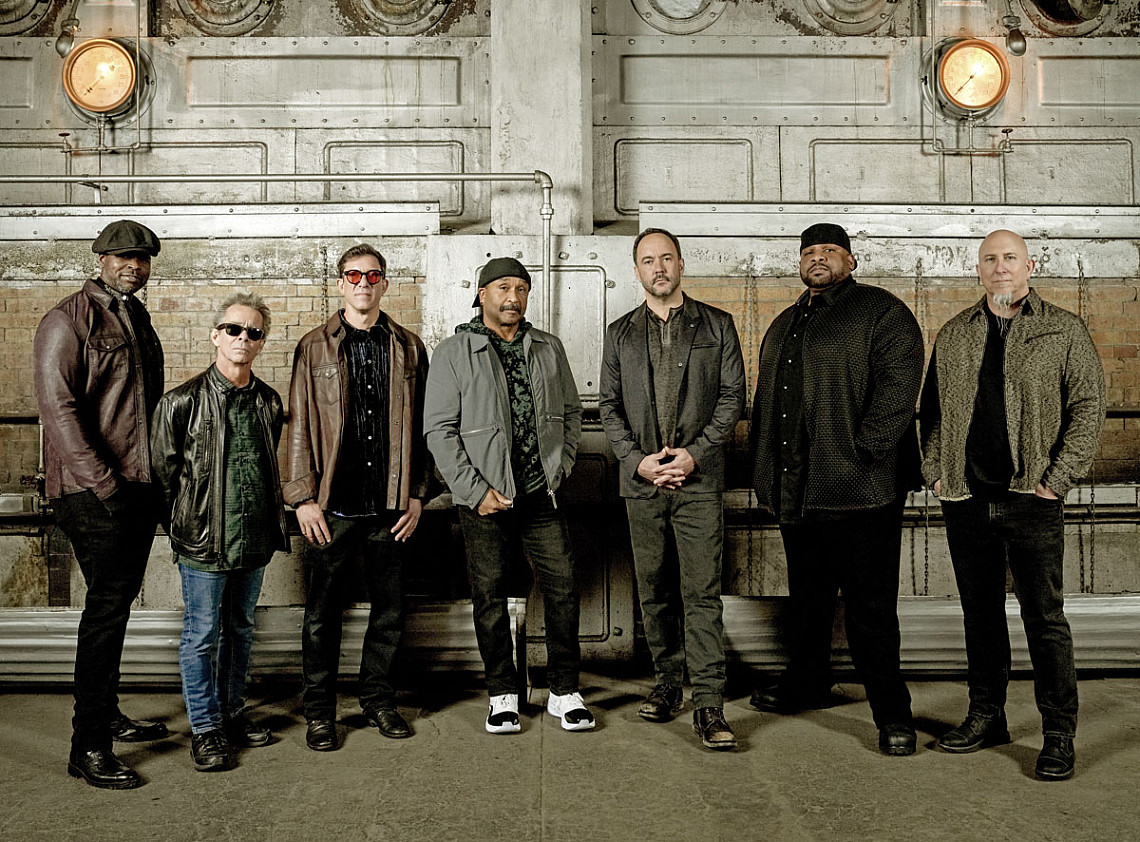
Dave Matthews writes some intriguing songs, some deeply personal, others more character-driven. Here, we tell the stories behind their most enduring songs, including "Crash Into Me," a very romantic sounding number that's anything but.
Crush - 1998
A very romantic song, Dave Matthews calls "Crush" a "worship-of-women-type of song." He elaborated to Vogelism:
"I feel that I have worked my whole life to get to the point where I should have a good understanding of women. But I'm still trying, and although I think I'm a little closer, as any guy knows, we still have a long way to go."
The first word in the lyric is "Crazy," a nod to the Patsy Cline classic country song "Crazy," written by Willie Nelson.
Ants Marching - 1993
This song is about people who lead a monotonous life, doing the same things the same way, day after day. They never take risks and are content living this way until they die. Matthews compares these people to ants who perform the same daily tasks over and over.
One of the most venerable DMB songs, the band started performing an early version of "Ants Marching" soon after they formed in 1991. Originally, it was known as "No New Directions."
The song quickly became a crowd favorite, and when the band issued their first album, the 1993 independent release Remember Two Things, they included a live version as the first track. A studio version was released on their major-label debut, Under The Table And Dreaming, in 1994.
Satellite - 1993
One of the most popular and enduring songs in the Dave Matthews Band catalog, "Satellite" is also one of their most intriguing. A satellite looks down from orbit, constantly observing what we can't see at ground level. It can also bring us TV channels.
So, is the song about shifting perspectives? The media? Human connection?
Probably all of the above. Dave Matthews isn't sure himself.
The song is often assumed to be about his father, who died in 1977 when Dave was 10 years old. When he sat down for an interview with GQ and asked if this was the case, Matthews replied, "Maybe."
He then offered this explanation:
"Lyrics are not easy. Some people are really good at it, but the songs that I'm unapologetic about are the ones that come quickly. Then they don't have time to get dragged through the gravel or through the dirt. I don't think too clinically about them, but I imagine that a therapist might look at 'Satellite' and say, 'That's about death or about loss or about accepting that it is loss." Then if you look at my life, you'd say, 'Well, his dad died.' But my dog died too, so it could be about my dog."
Too Much - 1996
The lead single from DMB's Crash album, this funky number examines greed and wastefulness, when too much is never enough. Matthews explained to The Boston Globe: "It's where excess has taken over, where your appetite has taken control of the narrator. As opposed to enjoying life, it's devouring life, which seems to be a common theme in the world - certainly in America, where we do just that - eat too much, drink too much, consume too much, and preach too much."
"Too Much" is a good description for how some listeners felt in the summer of 1996 when the song was getting lots of airplay. Soon after the band formed in 1991 they amassed a bunch of original songs that they honed at their many concerts. They released an independent album in 1993 and put out their first major-label album, Under the Table and Dreaming, in 1994 on RCA Records. The label deployed the songs "What Would You Say" and "Ants Marching" to radio stations in 1995. Pop radio stations were soft targets - in an effort to please as many listeners as possible ("pop" is short for "popular," after all), many of them avoided hip-hop and rock, which left them with the likes of Sheryl Crow, Hootie & the Blowfish and... Dave Matthews Band. Program directors loved the DMB songs because they were upbeat and catchy, not likely to turn anyone off. "Satellite," also from the album, was still getting played in 1996 when "Too Much" was introduced, followed by "So Much To Say." You can't blame the band for having a bunch of songs people like, but most weren't aware of the years they spent working them up before they were released.
So Much To Say - 1996
Dave Matthews says this rock song, the second single from their 1996 album Crash, is about discovering who you are as an individual: "It's something that we learn when we're children and trusting and naïve. Everything seems so simple, until we find out, well, not necessarily find out, we just become actors and actresses, trying to portray ourselves the best possible way we can. Sometimes it's natural, and sometimes we can just be ourselves and it's enough. But other times it seems we have to do ourselves better."
Two Step - 1996
In a 1996 interview with Billboard magazine, Dave Matthews said "Two Step," the fourth single from Crash in 1996, is his favorite track on the album. "It's about a love affair that takes place in the middle of great world upheaval. It's romantic and mysterious at the same time," he explained.
"Two Step" isn't well known among casual Dave Matthews Band listeners but their big fans know it well. It's one of their most-played live songs, often filled with ecstatic improvisation and a drum solo from Carter Beauford.
The band started playing it live in 1992 but didn't record it until 1996 when they included it on Crash.
The Space Between - 2001
Matthews, who writes a lot of songs based on the emotions that come with love, told MTV this is about "that connection we can never make. It's accepting that we're basically alone. That's kind of what life is about, trying to bridge the gap that's between us."
In a Songfacts interview with Glen Ballard, he talked about producing this song. "It's probably an apology - that's the way I see it," said Ballard. "It's telling the person who is most vivid in your life, whenever we've been apart, I want to make sure that we're back together."
"What I love most about songwriting is a kind of specific ambiguity," he added. "You can provide people with a lot of imagery, a very strong point of view, but everybody might take their own view of it."
Crash Into Me - 1996
"Crash Into Me" comes off as a very romantic song, but a close listen reveals that this is not the guy you want to crash into. He's crazy for the girl, but in an obsessive, voyeuristic way. There are lots of red flags in the lyrics:
I watch you there through the window
And I stare at you
You wear nothing but you wear it so well
...
Hike up your skirt a little more
And show the world to me
Dave Matthews pulled back the veil when he appeared on the VH1 show Storytellers, where he explained: "This song is about the worship of women, but this is a little bit of a crazy man. He's the kind of man you'd call the police on, some guy kind of peering in on his neighbors, a young girl who moved in or something, staring... [heavy breathing]. She's calling the police: 'You've got to get down here, he's looking at me!' So I wrote the song about it rather than actually peering in the window for fear of being arrested."
Don't Drink The Water - 1998
"Don't Drink The Water" is about the European slaughter of Native Americans, as the colonization of North America caused the near-extinction of the Native American populace. Dave Matthews is South African, which gave him an outsider's perspective on American history when he moved to Virginia in 1985 when he was 18. Had he stayed in South Africa, he would have been conscripted into the military in a country that was still under Apartheid.
Matthews told this story from his travels to illustrate the song: "I remember one time standing at the edge of Lake Superior, up there, we were camping up on the northern side of it and looking out and imagining these little rocks that jut out, families of people going past in canoes and hunting on the side of the lake there, and also like if you sit and look at the Grand Canyon and get a little distance between you and that McDonald's that's peering down over the canyon with you, and just imagine the quiet that must have been there and the people that enjoyed it before we came, and I just get awed because it's sort of an overwhelming feeling looking at those things just going, 'Man does that suck, does it suck.' That you could erase somebody, ya know? Take somebody's whole universe away. It's just unbelievable for those people... just the fact that a little bit of our history has a lot of poison in it and that maybe we can't reverse things but maybe pay a little tribute to it every once in a while."
Tripping Billies - 1993
Matthews has offered varied explanations of the lyrics over the years. When he talked about it in a 1996 interview with the Pittsburgh Post-Gazette, he said: "Well, see, you've got billy goats. A herd of billy goats. Tripping goats. Hillbillies on acid, maybe that's another possibility. Maybe there's a party and maybe everybody's venturing into the shadowy corners of their mind, and maybe someone at the party is upset about what they find in the recesses of their mind. And other people say, 'Look, we're at a party, you should enjoy things, forget about those dark, little corners in your head.'"
The line, "dragons were smoked," is a nod to the 1963 song "Puff The Magic Dragon," which was rumored to be about smoking pot but is actually a very innocent children's song.
May 13, 2025
Further Reading:
Interview with G. Love
Talk with Donna Jean Godchaux of the Grateful Dead
Photo: Sanjay Suchak
More Song Writing